Comment of the Day: “Ethics Quiz: Holder’s ‘Brainwash’ Comment”

"You want 'consensus'? I'll give you consensus, Pilgrim..."

Penn, who has been on a roll lately, has another Comment of the Day regarding the prospects of a cultural shift in public attitudes toward guns in America. I’ll have some thoughts afterwards, but right now, here is Penn COTD on the post, Ethics Quiz: Holder’s “Brainwash” Comment:

“I’m seeing a problem here that’s as insoluble as “what to do with the homeless.”  It comes up again and again: defending the right to bear arms against teaching non-violence — okay, that’s simplistic, but I think you know what I mean. Since arguments on both sides have been validated, their proponents feel duty-bound to reiterate them.

“Granted, consensus is a no-go in our culture. You win or you lose: compromise is a dirty word, and a win/win situation, while given lip service as a goal (e.g. good sportsmanship), is not an acceptable outcome.  Thus neither argument, in theory or in practice, takes a step further in solving in the short-term the problem of what to do with an increasingly violent society (schools, families, criminals, celebrities, etc.), a society embedded in an ever-shrinking, increasingly threatening world. Thinking that these guns/no guns arguments have some pragmatic use keeps us, so to speak, backward. Continue reading

Introducing “The Hollinger Awards”…and the First Recipient, Susan Cole

The Original Hollinger

Every year, the Darwin Awards amuse us, in a blackly humorous way, with tales of people who improve the gene pool by getting themselves killed through acts of stunning stupidity, often seasoned by exquisite irony. To take a random example from 2011, Phil Contos was participating in a helmet-less high-speed motorcycle ride when he crashed and suffered fatal brain injuries. His brother was quoted as saying that Phil would do it again, too—and I’m sure he would.

A story out of Denver made me realize that faulty or entirely absent ethics alarms work in a similar way to ensure that the most shamelessly unethical among us get their just desserts. Such individuals are so lacking in comprehension of what is wrong with their conduct that they can’t resist publicizing it, thereby revealing themselves as blights on their communities and workplaces, and attracting appropriate treatment in response. Searching for an appropriate name for the ethics version of the Darwin Awards, I was irresistably drawn to Jeremy Hollinger, the Mobile, Alabama special ed teacher who last year mocked his challenged fourth graders on Facebook, and, for good measure, posted a photo of himself wearing one of his student’s protective helmets and making a moronic face. (Or, come to think of it, maybe that’s Jeremy’s normal face.) Thus I am dubbing the new distinction The Hollinger, and give the very first one to Susan Cole. Continue reading

Ethics Quiz: Holder’s “Brainwash” Comment

"You WILL feel differently about guns!"

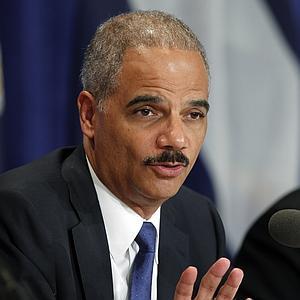
The death of founder Andrew Breitbart hasn’t slowed down his website’s ability to dig up provocative and embarrassing videos one bit. Its latest is a bit of off-putting rhetoric from Eric Holder, when he was the Clinton Administration U.S. attorney for Washington, D.C., telling a D.C. audience that the long-term solution to gun control is to “brainwash” the  public into opposing firearms. Holder said…

“What we need to do is change the way in which people think about guns, especially young people, and make it something that’s not cool, that it’s not acceptable, it’s not hip to carry a gun anymore, in the way in which we’ve changed our attitudes about cigarettes.”

He went on to outline steps that could be taken to “really brainwash people into thinking about guns in a vastly different way.”

Seeing this as a major “gotcha” for the embattled Attorney General, who is already facing growing criticism both for his oversight (or lack of it) of the Fast and Furious gun-smuggling fiasco and his evasive testimony about it before Congress, conservative critics are jumping on the 1995 statement to bolster calls for Holder’s resignation.

Your Ethics Quiz today: Is it fair to criticize a U.S. Attorney General’s statement that he wants to “brainwash” the  public into rejecting a core Constitutional right, when the statement is more than 15 years old, and was made while he was in a different job? Continue reading

No, Center For Public Integrity, New Jersey Obviously Is NOT the “Least Corruptible State, ” and Stop Confusing Compliance and Ethics

Sorry, Tony! Overnight, New Jersey became uncorruptible. Time to move to Washington, D.C.

The Center for Public Integrity got what it wanted yesterday, which was headlines about its extensive new study of public ethics laws in the U.S. In order to get its cherished publicity, the Center added to the public’s confusion about what corruption is, what ethics is, and how one discourages one while iencouraging the other in our various governments. They released results that graded the 50 states according to “corruptibility”, and found that New Jersey was the least corruptible of all.  I hope the Center’s officials and scholars are happy with their PR, but if they have a shred of integrity and common sense, they should be ashamed of themselves. Continue reading

Ethics Dunces: 29 Wisconsin Judges

Yes the gavel's fuzzy, but then so is the judgment of the person on the other end of it.

There is something seriously wrong with the ethical culture of the judiciary in Wisconsin. I suppose this was already obvious, as it is definitely a bad sign when two members of the state Supreme Court accused each other of physical attacks. Nonetheless, the news that 29 of Wisconsin’s sitting judges placed their names on the recall petition for Gov. Scott Walker would seem to settle any remaining doubts.

Is doing this a strict, slam-dunk, violation of the Wisconsin Code of Judicial conduct? No, probably not. It is in a gray area of the Code. Judicial ethics codes prohibit judges from becoming involved in political contests, but a recall petition a judge signs as a private individual (Personally and professionally, I don’t think it is possible for a judge to sign a petition as “a private individual”) don’t fit neatly into the definition of political activity. Other states, such as New York and New Mexico, have allowed judges to sign nominating petitions for candidates on the theory that it is the equivalent of voting, the right to which judges do not give up by ascending the bench.

Still, the judicial codes don’t exactly give a ringing endorsement to this kind of activity, and I would say the better interpretation is that the ethical rules preclude it. The ABA’s Model Judicial Code, for example, says… Continue reading

Revisiting the Tragedy of the Dead Child in the Locked Car

Almost two years ago, I wrote about Washington Post feature writer Gene Weingarten’s provocative and sensitive 2009 exploration of the tragic cases in which a distracted parent leaves a small child in an over-heated car. The issue, now as then, is how society should treat such parents, who are without exception crushed with remorse and guilt, their lives and psyches permanently scarred. Weingarten’s original piece, which won him a 2010 Pulitzer, did not take a position on how such parents should be treated by the criminal justice system. In today’s Washington Post, he does.

Weingarten writes:

“The parents are a continuing danger to no one, nor could anybody sanely argue that fear of prison is even a minuscule factor in preventing this. So we are left with the nebulous notion of punishing, for punishment’s sake alone, an act of accidental negligence that by its nature subjects the doer to a lifetime of agony so profound that it is unfathomable to anyone who has not lived it. Prosecution is not, in my view, warranted.”

Weingarten is thoughtful, analytical, reasonable, compassionate and fair. He is also, in this case, dead wrong. Continue reading

Ethics Lessons of the Great Lotto Betrayal

Let's see how many friends you can buy now, Amerigo...

After more than a year and a contentious trial, a New Jersey jury has unanimously determined that hard-hat worker Americo Lopes cheated five co-workers out their fair shares of $38.5 million in lottery winnings. Each was awarded a $4 million share. The evidence presented in the trial was mostly circumstantial, and the case came down to what the jury believed, whom they trusted. Go figure: they chose not to believe the man who organized a lottery pool with his co-workers, collected their money and bought New Jersey lottery tickets with it routinely, and then, when he found himself with a winning ticket in the Mega-Millions game…

  • Didn’t tell any of the group.
  • Claimed he was going on leave to have surgery,
  • Quietly quit without returning,
  • Claimed that the winning ticket was bought with his personal funds, not the pool’s,
  • Argued that none of the men were friends of his and
  • Reportedly said at one point, “With all that money, I can buy new friends.”

Gee, who wouldn’t believe such a terrific guy? Continue reading

Unethical Quote of the Week: “Brad”

“How much did all these hacks get paid to do this? What a waste of money. Are they bothering somebody? Leave them alone. They obviously want to be together, and who are we to say that they shouldn’t? How much did this judge and all the hacks get paid to issue this decision? Somewhere, somehow this waste has to stop.”

“Brad,” a commenter on NECN.com’s story about Lisa Lavole, a former teacher who was out of jail on parole after three years for the offense of having sex with her 15-year old student and running away with him. She was taken back into custody when the same student, now 18, was discovered hiding in her closet. One of the conditions of her parole was that she had to stay away from her former victim.

Lisa Lavole, doing her Norman Bates imitation

While perusing the comments to news stories often gives me more insight into the state of our culture’s ethics than reading the stories themselves, there is always the downside that many comments make me want to chuck ethics as a futile and pointless career choice and begin honest work as a bookie or a pimp. “Brad’s” comment is a case in point.

It would be difficult to pack more flawed ethical reasoning and rationalizations into a mere 60 words. The woman was hired to teach, and instead used her authority, age and power to entice a child into a sexual relationship, and then take him away from his parents and his home. By the most charitable interpretation she is a sexual predator and a rapist, as well as the betrayer of the community’s trust. Of course part of her punishment involves keeping her away from her victim, whose mind and emotions she had damaged and warped. To Brad, however, it is a “waste of money” to enforce legitimate laws, protect children from predatory adults, and make certain that at very least adults who prey on the children in their charge don’t benefit from it. She turned a child into a sex object and lover, and Brad thinks it’s a waste of time and money for society to make certain that she can’t keep reaping the benefits of her crime after her prison sentence. Continue reading

“The Good Wife” Ethics Addendum: Why Misrepresenting the Legal Profession’s Standards Does Real Harm

Sure, it was a comedy, but how many people believe that Jim Carrey's compulsively lying lawyer was not that far from the truth?

A comment from reader Penn on my post about “The Good Wife’s” recent misrepresentation of legal ethics standards got me thinking, and what it got me thinking was that I was too easy on the show.

Penn asked why I waste my time watching programs that raise my blood pressure, and there are two answers. The first is what I wrote back: it’s not a bad show; in the past it has been a very good one, even from the legal ethics perspective. I have used several scenarios from episodes in seminars.

The second answer, which I didn’t mention in my response to Penn, is the more important one, however. Good show or not, millions of Americans get their information about the legal profession from the portrayal of lawyers and law on TV and in movies. From these fictional sources, they think they know that most lawyers are liars, that they allow their clients to lie, that they put witnesses on the stand who they know will lie under oath. The public thinks that lawyers abuse the law, don’t earn their fees, don’t give a damn about their clients (unless they are sleeping with them), switch sides routinely and confuse juries to release serial killers on more victims. Continue reading

“The Good Wife,” Flunking Legal Ethics 101

CBS’s “The Good Wife” remains ensconced in my Hall of Fame for TV lawyer dramas, but last night the series committed the kind of “what the hell?” blatant legal ethics gaffe that causes many lawyers to avoid such shows.

The situation is one that may be dramatic but hardly unusual: the client who lies on the witness stand. Unlike a lot of the ethical conundrums that are concocted in the fevered brains of TV scriptwriters (“Your client leaves a human head in your office—what do you do?”—“The Practice”), this is one that is thoroughly explored in law school and one which every competent litigator has to be prepared to face, because 1) it happens and 2) the legal ethics rules about how a lawyer is supposed to handle it have bounced all over the place, like William Shatner. Continue reading