Dear Sincerely Shallow: “It’s True, You’re Horrible. Show Your Fiancé Your Letter, And Go Pimp Yourself Out Like Anna Nicole.”

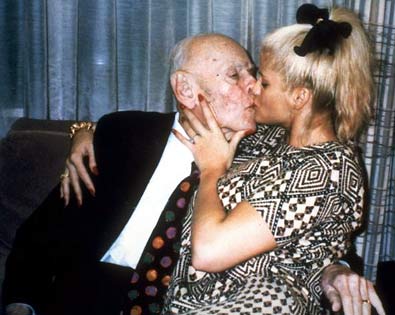
This could be you, SS!

This could be you, “Sincerely Shallow” ! Go for it!

Emily Yoffe is Slate’s stunt advice columnist, who in her “Dear Prudence” column answers questions reminiscent of the freak-show howlers they used to concoct for the “Penthouse Forum” (or so I’ve heard.) Sometimes Emily’s advice has me convinced she is the consort of Pazuzu, and other times her advice is measured and wise. This time, she sided with the demon, and I’m about finished with her.

Here is the query sent by “Sincerely Shallow” in its entirety. I’m sure it’s viral by now:

Dear Prudence,
I’m recently engaged to the most honest, thoughtful, and loving man I’ve ever met. He has supported me through many hard times, including losing my job and being assaulted. Here’s the but about him: He makes no money. He has ambitions, and he’s smart, but will likely only bring a middle-class income at best. I have an OK job and I’m self-sufficient. Now here’s the but about me: I’m really, really pretty. My whole life people have told me I could get any man I want, meaning a rich man, and are shocked that I’m engaged to my fiancé, nice though he is. I’ve never dated a rich man, but it does make me curious. So part of me thinks I’m squandering my good looks on this poor man, and the other part of me thinks that I’m so shallow that I don’t even deserve him or anyone else. Am I a fool for thinking that a poor man can make me happy, or an idiot for believing a sexist fantasy?

You can read “Prudence’s” annoying answer here, which concludes with this: Continue reading

Comment of the Day: “Ethics Hero: David Blankenhorn, Former Same-Sex Marriage Opponent”

eeyore1

In many ways, I love this post. I love it because it is passionate and serious, and from the heart, and because I am certain that it reflects what many Americans, especially those of a certain age, feel with frustration and a little fear and anger.  I also agree with much of what it concerns, the lack of respect for accumulated wisdom in many aspects of the culture, and the rush to discard old standards not because they have failed us, but just because they are old. The comment comes from a regular commentator, Eeyoure (not his real name, you’ll be relieved to learn, and yes, we both know how to spell the A.A. Milne character he honors) who is educated, decent, smart and articulate.

But regarding his lament’s  applicability to the controversy at issue, gay marriage, he is absolutely, utterly, tragically wrong. The conventional wisdom is that we should just try to ignore Americans who feel similarly to Eeyoure, because demographics are relentlessly removing them from the scene. As the politically active public becomes younger, the support for equal rights for gays, trangendered and bi-sexual citizens will grow into an overwhelming majority.  I think that’s a lazy and obnoxious way to win an argument, even when you are right. Smart but misguided people, like Eeyoure in this matter, should be able to evolve, learn, and realize when what they once thought was right, isn’t.  Realizing that one aspect of entrenched belief was, upon knowledge and reflection, wrong does not mean the whole foundation of civilized society has to crumble—this is the classic, irrational, self-defeating fallacy of conservatism. Change in the presence of enlightenment and experience is the essence of ethics, which constantly evolves. We should be able to explain what is wrong with this post so that even the poster agrees.

Here is Eeyoure’s Comment of the Day, on the post (and comment thread t0) Ethics Hero: David Blankenhorn, Former Same-Sex Marriage Opponent: Continue reading

Ethics Quiz: The Harley Tragedy

I’m sure PETA thinks this is fair; I’m not sure that I do.

No goldfish for you!

No goldfish for you!

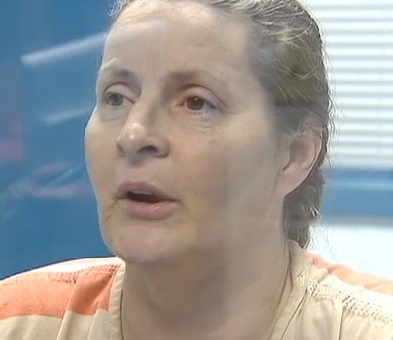
Tammy Brown,47, a disabled Moon Lake, Florida woman trying to make ends meet on her $508-a-month government check, argued that she was not able to afford veterinary care for Harley, her 14-year-old dog who had a painful ear infection as well as skin problems, periodic tumors, heartworms and ear mites. Because she did not get treatment for Harley, however—the fact that she tried to treat the dog’s problems with over the counter ointments wasn’t enough to mollify the judge— Brown was convicted of felony animal cruelty. She spent more than a month in jail awaiting sentencing, and then received six months of house arrest, 300 hours of community service, three years of probation, and $1,000 in court costs. Circuit Judge William Webb also commanded, “I don’t want you to own any animals. Not even a goldfish!” (Hartley had been euthanized.)

Apparently Harley’s physical condition was shockingly poor, so much so that jurors found photos hard to look at. An Animal Services officer testified that Harley couldn’t stand up without support. The prosecutor wanted Brown imprisoned.

Has society become so animal-sensitive that it has lost its priorities? Your Ethics Alarms Ethics Quiz is this: Assuming that Harley’s lack of treatment was due to lack of resources and neglect rather than malice…

Was Tammy Brown’s sentence fair, or was it excessive and cruel? Continue reading

Ethics Hero: Dick Hoyt

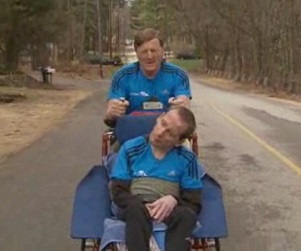
hoytsI don’t think I’ll have to explain why Dick Hoyt is an Ethics Hero.

Rick Hoyt has cerebral palsy and has been a quadriplegic since childhood. When he was in middle school, he told his father, Dick, that he wanted to compete in a charity marathon for a basketball player who had been paralyzed in an accident. Dick Hoyt agreed to push his son’s wheel chair in the race. When it was over, Rick told him, “Dad, when I’m ‘running,’ it feels like I’m not handicapped!” Touched and inspired, Dick Hoyt, 72, went on to push his son, now  51, in 1,091 events, including 252 triathlons, 70 marathons, 94 half marathons, and 155 five-kilometer races. They have never finished last. The father-son team is preparing to compete in their 31st Boston Marathon next week.

When they compete in the triathlons, Dick pulls his son in a boat tied to a cord as he swims, and pedals for him on a tandem bicycle for the cycle round. In 1989, the family set up the Hoyt Foundation which has the goal of helping disabled youths participate in activities that their disabilities would normally preclude.

Rick says his only wish is that he could make his dad sit in the chair and push him for once.

Every now and then, I learn about people whose kindness, selflessness and ethical instincts place me in awe.

Dick Hoyt is such an individual.

__________________________________

Facts and Graphic: Opposing Views

Ethics Dunce: Susan A. Patton

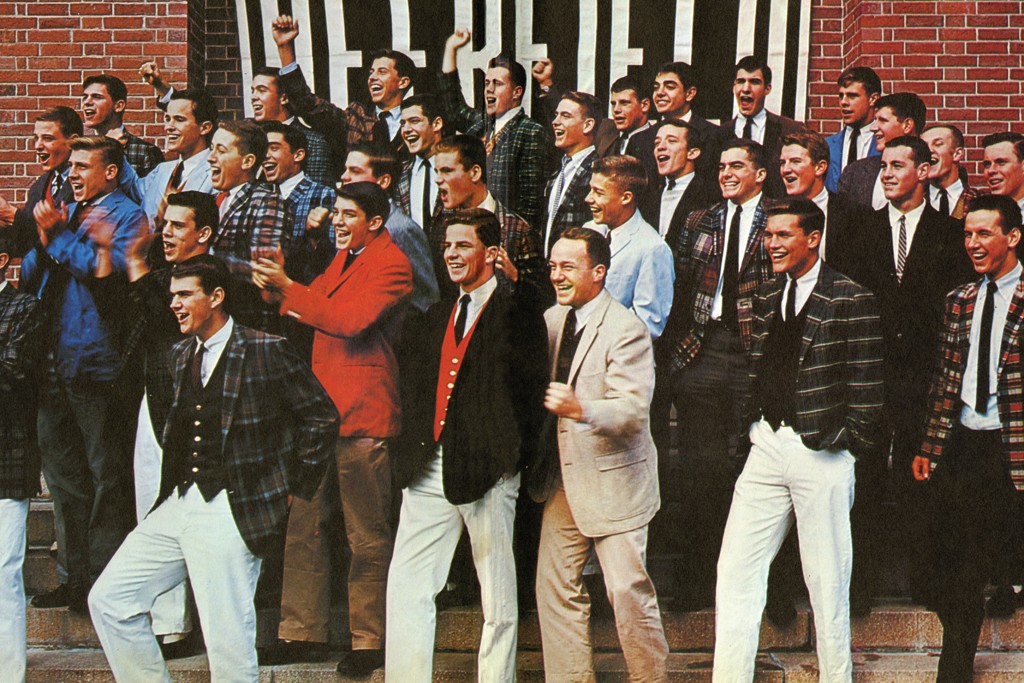
Oh, yeah, ladies, if you can't hook one of these gems, you should just kill yourself...

Oh, yeah, ladies, if you can’t hook one of these gems, you should just kill yourself…

Ethics are built by values, and those whose values are warped and flawed are very likely to engage in unethical conduct consistent with their rickety ethical foundation. Thus it is that I have serious doubts about Princeton grad Susan A. Patton, who in a letter to the Daily Princetonian not only proclaimed her own lousy values but did so as “advice” to co-eds. (I hope the link starts working; it was not earlier today.) In her letter, she wrote…

“Forget about having it all, or not having it all, leaning in or leaning out … Here’s what nobody is telling you: Find a husband on campus before you graduate. Yes, I went there…. Men regularly marry women who are younger, less intelligent, less educated. It’s amazing how forgiving men can be about a woman’s lack of erudition, if she is exceptionally pretty. Smart women can’t (shouldn’t) marry men who aren’t at least their intellectual equal. As Princeton women, we have almost priced ourselves out of the market. Simply put, there is a very limited population of men who are as smart or smarter than we are. And I say again — you will never again be surrounded by this concentration of men who are worthy of you.”

How misguided, jaded and warped is this advice?

Allow me to take inventory. Continue reading

In Connecticut, A Surrogate Mother Triggers An Epic Ethics Train Wreck

Crystal Kelley and...somebody's baby

Crystal Kelley and…somebody’s baby

There is no field of ethics more murky or subject to conflicting interpretations than bioethics, and few issues in bioethics are as confusing as those involving surrogate mothers who decide that they should have some say regarding the fate of the child that grows in their bodies. CNN has reported on the most perplexing such scenario I’ve every encountered, so perplexing that I can’t unravel the ethical rights and wrongs of it.  I wonder if anyone can with confidence. I’ll just summarize the main features and some of the issues raised; you will need to read the whole, stunning story to fully appreciate this train wreck’s sweep and carnage.

I. Crystal Kelley, a single mother who had endured two miscarriages, wanted to help another couple conceive, but mostly wanted the $22,000 fee since she was out of a job. She contracted with a couple seeking their fourth child, and was implanted with two previously frozen embryos. One survived. Ethics issue: Did Kelley tell the parents about her miscarriages?

2. Five months into her pregnancy, tests showed the baby Kelley was carrying had serious medical problems, though the child had a chance at survival. The couple said that they wanted Kelley’s pregnancy terminated because they didn’t want the baby to suffer. Ethics issues: Is that a valid reason to take an unborn child’s life? Was it the real reason? Was the real reason that they were unwilling to pay for and endure all the necessary medical treatmenst, or that they wanted nothing less than a “perfect” baby? Does it matter what the real reason was? Continue reading

Tales From The “Ick!” Files: If Luke Married Leia…

Luke and Leia

Emily Yoffe, who is not Ethics Alarms’ favorite advice columnist, gets one right at Slate—a weird one, but then, that’s the only kind of question she usually chooses to answer. If I had to bet, I’d place my money on this question being a fake. Emily acknowledges that possibility, but couldn’t pass this one up, and neither can I.

A loving husband who already knew that both he and his wife (it was virtually love at first sight when they met in college) were raised by lesbian parent couples who conceived via sperm donors found out that they both have the same donor to thank for their conception. Now he thinks “sister” every time he sees his spouse, and ask 1) what should he do? and 2) should he tell his wife that he has learned that they are half-siblings? Yoffe tells this poor guy to stop feeling guilty, and that he hasn’t done anything wrong. She also advises him to get some counseling, and to suck it up and tell sis about their dilemma….but not to reveal the secret to their kids, Anteater Boy and Tilly the Boneless. Continue reading

The Lovers’ Complimentary Meal: An Ethics Tale

The couple

The couple

On his blog, Virgin Airlines tycoon Richard Branson told a story, reputedly true, that show vividly how kindness and ethical conduct can have far-reaching consequences.

Three years ago, a young couple was dining  in a Boston restaurant about . Their affection for each other was obvious, and it attracted the attention of a friend of Branson’s named Pankaj Shah. He was eating at a nearby table, and is apparently a lovable eccentric who likes to anonymously pay for the meals of strangers when he is dining out. He had asked the restaurant staff that night to let him pay the bill for “the couple who looked most in love.”

It was done. The couple learned that a mysterious benefactor had paid for their romantic rendezvous, and Shah received his usual pleasure from the random act of kindness.

Three years later, Pankaj Shah returned to have dinner at the same establishment.  The manager recognized and approached him, and said that he night be interested to learn that the same couple he had treated  three years before were also in the restaurant. Not only that: the manager revealed that
the “dude just got down on one knee and proposed.” He asked the aspiring groom why they he had chosen his restaurant for this life-changing ritual, and was told  that three years ago, at the same table, some stranger had paid for their meal right out of the blue. The gesture made the couple ponder on the importance of kindness, selflessness and love, and had talked about the incident many times since. He said both he and his girlfriend had been inspired to be better, more caring, ethical people as a result, and he felt that the place where this epiphanal event occurred would be the perfect place to propose.

The manager introduced them to Shah, who attended their wedding.

It seems that the couple has preferred to stay anonymous, and hell, I don’t know if the story is really true. That couple in the photo on Branson’s blog may be friends of Manti Te’o, if you get my meaning.

But I hope it is true. It should be.

It could be.

And its lesson is true, regardless.

________________________________

Pointer and Source: Cafe Mom

Facts and Graphic: Richard Branson

Facts: Richard Branson

An Ethics Hero Potpourri!

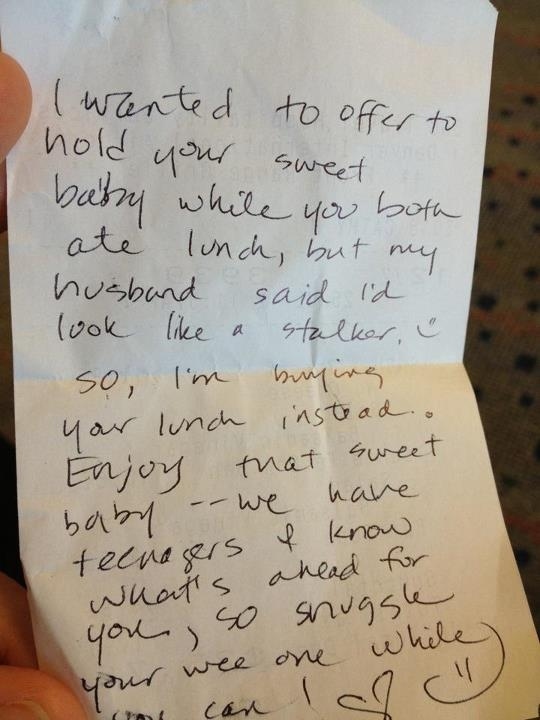
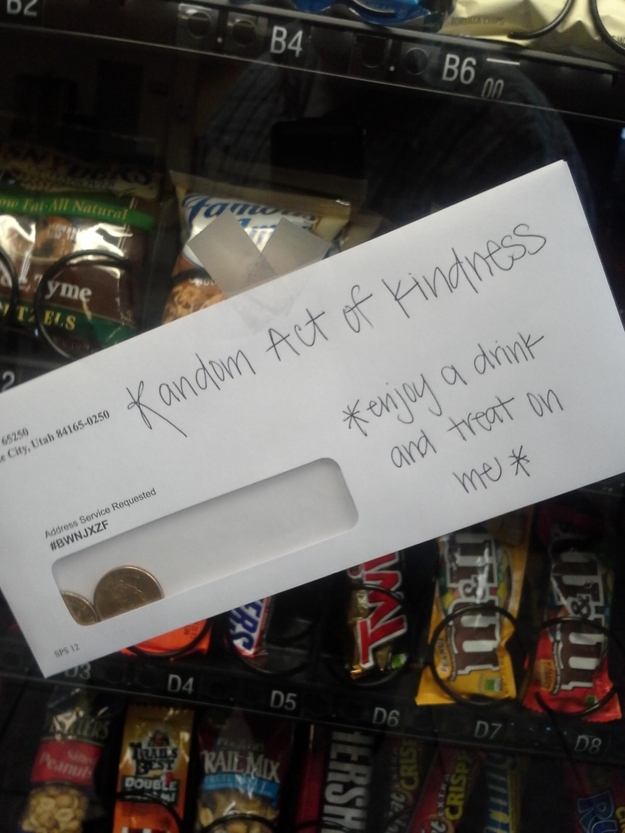
Earlier this year, Buzzfeed gathered and posted these sixteen photographic records of people being kind just because that’s how we should be. Yes, I guess one or more of them may be fake; it doesn’t matter much. It is still helpful to remember, especially in my business, that there are a lot of good people out there.

Thanks, Buzzfeed.

1.

Kindness 1

2.

Kindness2

3.

Kindness3

Continue reading

The Last Birthday Gift

blown out candles on a birthday cakeThis is my birthday. It’s also the third anniversary of my father’s death, as the two dates collided for all time when I found him dead, as if asleep, in his favorite chair when I went to my parents condo to meet him for a late birthday dinner, December 1, 2009.

I feel no more in the mood to celebrate my birth this day than I did that one, and seriously doubt if I ever will again. I miss my father terribly, every day really, and yet I recall that moment when I realized he was gone with mixed emotions. I knew that the old soldier, 89, fighting cancer, a heart condition and old war wounds, was facing a sharp down-turn in his quality of life; I knew that this was the way he always said he wanted to go out—quickly, without drama, humiliation or excessive expense—and I knew that among the members of his immediate family, I was the one whom he would have wanted to find his abandoned body. I never felt closer to my father, who, like so many of his gender and generation, had trouble expressing affection and intimacy directly, than I did in those last moments before the EMT’s arrived, as I stroked his thin, gray hair and said good-bye.

I have also come to believe that he gave me a great gift three years ago, probably unconsciously, but with my father, you never know.  He detested and rejected all forms of score-keeping, including regrets, accolades, praise and bucket lists. He was proud of many things in his life, especially his military service and his family, but he never felt superior to another human being based on what had happened in the past. My father believed that what mattered in life was going forward—doing one’s duty, helping others, setting a good example, and making every minute of your life count by trying to leave the world, even if it is only your small corner of it, better than it was before you got there. And when you’re done, you’re done. There is nothing to be sad about, or to be afraid of, or to regret; no recriminations for what didn’t happen, what couldn’t be completed, or mistakes made along the way. Just do your best, as you have learned to do it, for as long as you can. It’s not a competition, and you shouldn’t judge yourself by anyone’s standard but your own.

My father’s death reminded me that there is nothing special about being born. Everybody is born. It is how we use whatever time we have, when we use it well, that is truly worth celebrating, and even then, past achievements never justify resting on our laurels as long as we are still capable of doing some good, and have time left to do it.

On the day he died, my father spent loving hours with my mother in her hospital room, gave some needed advice and encouragement to my sister, wished his son a happy birthday, and made him laugh one last time. Good work, right to the end. If the timing of his finale changed for all time the meaning of my birthday for me, it also made vivid the life lessons that were the essence of Jack A. Marshall, Sr. Care about others. Be responsible.  Be fair. Do the best you can for as long as you can. Keep trying to be better. Never give up. Don’t be afraid. If you do all of that, you don’t need celebrations to prove your life has meaning. It just does.

It is true that “Happy Birthday” will never sound right to me again. Still, my father’s life and his way of leaving it gave me ideals good and true to celebrate on every December 1,  the wisdom to cherish whatever birthdays I have remaining, and the sense to never waste precious time regretting what is past and beyond changing. In many ways, his last birthday gift to me was the best one of all.