In Connecticut, A Surrogate Mother Triggers An Epic Ethics Train Wreck

Crystal Kelley and...somebody's baby

Crystal Kelley and…somebody’s baby

There is no field of ethics more murky or subject to conflicting interpretations than bioethics, and few issues in bioethics are as confusing as those involving surrogate mothers who decide that they should have some say regarding the fate of the child that grows in their bodies. CNN has reported on the most perplexing such scenario I’ve every encountered, so perplexing that I can’t unravel the ethical rights and wrongs of it.  I wonder if anyone can with confidence. I’ll just summarize the main features and some of the issues raised; you will need to read the whole, stunning story to fully appreciate this train wreck’s sweep and carnage.

I. Crystal Kelley, a single mother who had endured two miscarriages, wanted to help another couple conceive, but mostly wanted the $22,000 fee since she was out of a job. She contracted with a couple seeking their fourth child, and was implanted with two previously frozen embryos. One survived. Ethics issue: Did Kelley tell the parents about her miscarriages?

2. Five months into her pregnancy, tests showed the baby Kelley was carrying had serious medical problems, though the child had a chance at survival. The couple said that they wanted Kelley’s pregnancy terminated because they didn’t want the baby to suffer. Ethics issues: Is that a valid reason to take an unborn child’s life? Was it the real reason? Was the real reason that they were unwilling to pay for and endure all the necessary medical treatmenst, or that they wanted nothing less than a “perfect” baby? Does it matter what the real reason was? Continue reading →

Tales From The “Ick!” Files: If Luke Married Leia…

Luke and Leia

Emily Yoffe, who is not Ethics Alarms’ favorite advice columnist, gets one right at Slate—a weird one, but then, that’s the only kind of question she usually chooses to answer. If I had to bet, I’d place my money on this question being a fake. Emily acknowledges that possibility, but couldn’t pass this one up, and neither can I.

A loving husband who already knew that both he and his wife (it was virtually love at first sight when they met in college) were raised by lesbian parent couples who conceived via sperm donors found out that they both have the same donor to thank for their conception. Now he thinks “sister” every time he sees his spouse, and ask 1) what should he do? and 2) should he tell his wife that he has learned that they are half-siblings? Yoffe tells this poor guy to stop feeling guilty, and that he hasn’t done anything wrong. She also advises him to get some counseling, and to suck it up and tell sis about their dilemma….but not to reveal the secret to their kids, Anteater Boy and Tilly the Boneless. Continue reading →

The Lovers’ Complimentary Meal: An Ethics Tale

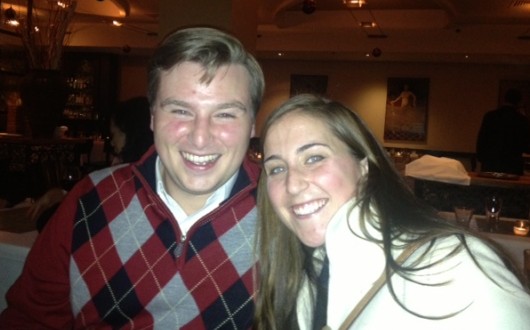
The couple

The couple

On his blog, Virgin Airlines tycoon Richard Branson told a story, reputedly true, that show vividly how kindness and ethical conduct can have far-reaching consequences.

Three years ago, a young couple was dining  in a Boston restaurant about . Their affection for each other was obvious, and it attracted the attention of a friend of Branson’s named Pankaj Shah. He was eating at a nearby table, and is apparently a lovable eccentric who likes to anonymously pay for the meals of strangers when he is dining out. He had asked the restaurant staff that night to let him pay the bill for “the couple who looked most in love.”

It was done. The couple learned that a mysterious benefactor had paid for their romantic rendezvous, and Shah received his usual pleasure from the random act of kindness.

Three years later, Pankaj Shah returned to have dinner at the same establishment.  The manager recognized and approached him, and said that he night be interested to learn that the same couple he had treated  three years before were also in the restaurant. Not only that: the manager revealed that
the “dude just got down on one knee and proposed.” He asked the aspiring groom why they he had chosen his restaurant for this life-changing ritual, and was told  that three years ago, at the same table, some stranger had paid for their meal right out of the blue. The gesture made the couple ponder on the importance of kindness, selflessness and love, and had talked about the incident many times since. He said both he and his girlfriend had been inspired to be better, more caring, ethical people as a result, and he felt that the place where this epiphanal event occurred would be the perfect place to propose.

The manager introduced them to Shah, who attended their wedding.

It seems that the couple has preferred to stay anonymous, and hell, I don’t know if the story is really true. That couple in the photo on Branson’s blog may be friends of Manti Te’o, if you get my meaning.

But I hope it is true. It should be.

It could be.

And its lesson is true, regardless.

________________________________

Pointer and Source: Cafe Mom

Facts and Graphic: Richard Branson

Facts: Richard Branson

An Ethics Hero Potpourri!

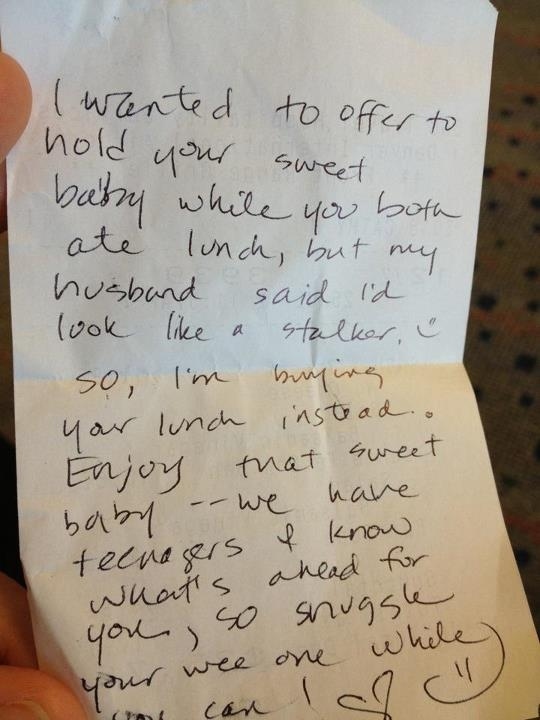
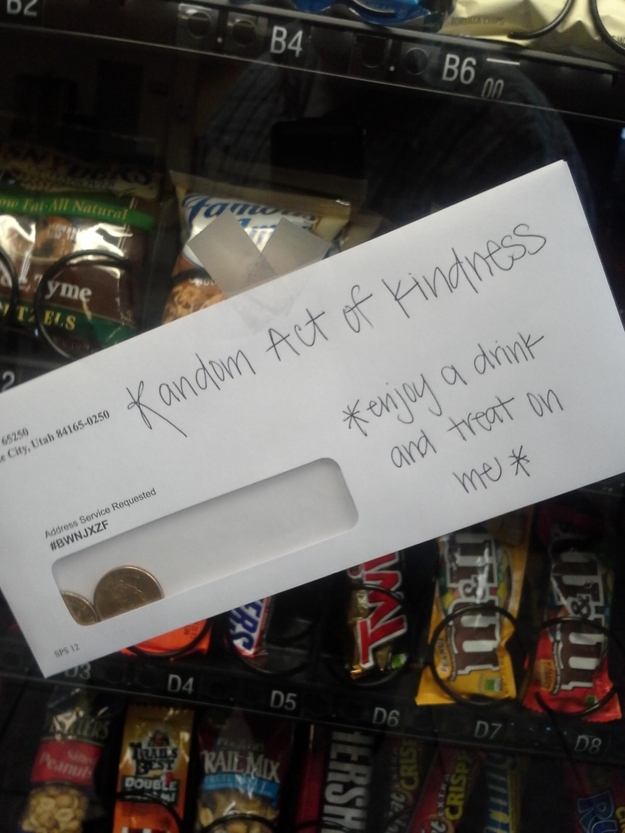
Earlier this year, Buzzfeed gathered and posted these sixteen photographic records of people being kind just because that’s how we should be. Yes, I guess one or more of them may be fake; it doesn’t matter much. It is still helpful to remember, especially in my business, that there are a lot of good people out there.

Thanks, Buzzfeed.

1.

Kindness 1

2.

Kindness2

3.

Kindness3

Continue reading →

The Last Birthday Gift

blown out candles on a birthday cakeThis is my birthday. It’s also the third anniversary of my father’s death, as the two dates collided for all time when I found him dead, as if asleep, in his favorite chair when I went to my parents condo to meet him for a late birthday dinner, December 1, 2009.

I feel no more in the mood to celebrate my birth this day than I did that one, and seriously doubt if I ever will again. I miss my father terribly, every day really, and yet I recall that moment when I realized he was gone with mixed emotions. I knew that the old soldier, 89, fighting cancer, a heart condition and old war wounds, was facing a sharp down-turn in his quality of life; I knew that this was the way he always said he wanted to go out—quickly, without drama, humiliation or excessive expense—and I knew that among the members of his immediate family, I was the one whom he would have wanted to find his abandoned body. I never felt closer to my father, who, like so many of his gender and generation, had trouble expressing affection and intimacy directly, than I did in those last moments before the EMT’s arrived, as I stroked his thin, gray hair and said good-bye.

I have also come to believe that he gave me a great gift three years ago, probably unconsciously, but with my father, you never know.  He detested and rejected all forms of score-keeping, including regrets, accolades, praise and bucket lists. He was proud of many things in his life, especially his military service and his family, but he never felt superior to another human being based on what had happened in the past. My father believed that what mattered in life was going forward—doing one’s duty, helping others, setting a good example, and making every minute of your life count by trying to leave the world, even if it is only your small corner of it, better than it was before you got there. And when you’re done, you’re done. There is nothing to be sad about, or to be afraid of, or to regret; no recriminations for what didn’t happen, what couldn’t be completed, or mistakes made along the way. Just do your best, as you have learned to do it, for as long as you can. It’s not a competition, and you shouldn’t judge yourself by anyone’s standard but your own.

My father’s death reminded me that there is nothing special about being born. Everybody is born. It is how we use whatever time we have, when we use it well, that is truly worth celebrating, and even then, past achievements never justify resting on our laurels as long as we are still capable of doing some good, and have time left to do it.

On the day he died, my father spent loving hours with my mother in her hospital room, gave some needed advice and encouragement to my sister, wished his son a happy birthday, and made him laugh one last time. Good work, right to the end. If the timing of his finale changed for all time the meaning of my birthday for me, it also made vivid the life lessons that were the essence of Jack A. Marshall, Sr. Care about others. Be responsible.  Be fair. Do the best you can for as long as you can. Keep trying to be better. Never give up. Don’t be afraid. If you do all of that, you don’t need celebrations to prove your life has meaning. It just does.

It is true that “Happy Birthday” will never sound right to me again. Still, my father’s life and his way of leaving it gave me ideals good and true to celebrate on every December 1,  the wisdom to cherish whatever birthdays I have remaining, and the sense to never waste precious time regretting what is past and beyond changing. In many ways, his last birthday gift to me was the best one of all.


What’s Wrong With The “Crews Missile”

Nick Crews, trying tough-love without that tricky “love” part.

I was happily unaware of the e-mail that retired Royal Navy officer Nick Crews sent to his son and two daughters in February, expressing his and his wife’s disappointment in them, until an attorney brought it to my attention during my legal ethics seminar yesterday. Apparently the screed made Crews something of a folk hero in Great Britain. In other news, the Brits elevate jerks to folk heroes just like we do.

Crews decided that he and his wife had reached the end of their ropes with their three adult children’s career and domestic misadventures, so he felt what the kiddies needed was a swift kick in the pants, old school. He wrote all of them a withering e-mail denouncing them as failures and fools. Some samples:

  • “Which of you, with or without a spouse, can support your families, finance your home and provide a pension for your old age? Each of you is well able to earn a comfortable living and provide for your children, yet each of you has contrived to avoid even moderate achievement. Far from your children being able to rely on your provision, they are faced with needing to survive their introduction to life with you as parents.” Continue reading →

The Golden Rule Sets Off An Ethics Alarm At Popehat

I posted earlier here about the efforts by lawyers (and bloggers) Marc Randazza and Ken at Popehat to foil the despicable operators of “IsAnybodyDown?” That vile website solicits and uses nude photos of women who have not given permission for them to be posted. It often posts contact information for the women as well, and, as a final touch, promotes an alleged legal service that guarantees that it will get the photos taken down. This is a good bet, since the legal service is operated by the same two men who run the site, though it is very unlikely that the “lawyer” really exists. After Marc and Ken challenged the site, its purveyors launched another one accusing them of secretly working for pornography interests and being funded by the Mob.

These are not, in other words, nice people.

In his most recent post about their ongoing battle, Ken recounted an e-mail exchange with Chance Trahan, who founded and operates  “IsAnybodyDown?”with Craig Brittain. It is an exchange that confirms what one would assume about someone who engages in a business like his. A typical tweet from Chance to Craig reads in part, “You aren’t shit to the world you immoral fuck.” Yet Ken was moved to reflect upon even this individual’s humanity, applying the Golden Rule to and musing about how even the likes of Trahan and Brittain can have redeeming qualities. In doing so he provided as profound and lovely reflection on the ethical process of reciprocity, as well as kindness, fairness, forgiveness and empathy. With Ken’s permission, I present it here. Continue reading →

The Spectacularly Unethical Angela Buchanan, Making Life A Little Meaner For Us All

According to court documents, Angela Buchanan, 30, of Lufkin, Texas, desperately wanted to be in a romantic relationship with a long-time female friend. She contacted the friend on Yahoo Messenger in March, explaining that she was diagnosed with breast cancer in 2008 and was now suffering from a pre-cancerous mass. She told her concerned friend that she was being treated by a local gynecologist. Then the gynecologist contacted the friend too, also on Yahoo Messenger.  The doctor confided to the friend that the pre-cancerous mass in Buchanan’s breast could possibly be delayed or even reduced and cured by an increase in hormone production, which, the doctor helpfully suggested, could be stimulated by sexual intercourse. The doctor recommended that the friend agree to participate in sexual activity with Buchanan in order to bolster this vital hormone production—if she really wanted to save her friend’s life, that is. Continue reading →

Ethics Dunce: Ryan Thompson

You may have heard about this guy: he took his girlfriend up in his private plane, and pretended that the plane was about to crash as part of his set-up to propose to her. As he supposedly tried to get the plane under control to save their lives, Thompson told Carlie Kennedy to read from an emergency protocol explaining how to pull the plane out of a dive. “I genuinely did believe that we were going to die,” Kennedy told ABC News. “I felt like our lives depended on me making it through that checklist.” Then, as she read through the list, it slowly dawned that it was actually an marriage  proposal leading up to the final bullet point: “Will you marry me?” She turned to the smiling pilot, who was holding a ring. She said yes.

And then they crashed.

No, not really. And I suppose this sadistic narcissist has found a perfect mate, a naive victim who will doubtless enjoy all the hell he puts her through for his own amusement. It was a pretty good test, when you think about it. What better way to let your intended know exactly what she’s getting into, and to find out whether she’ll tolerate despicable treatment and outrageous conduct with a smile and a kiss?

Good luck, Carlie, and I mean that sincerely. Your husband to be is an Ethics Dunce, an especially cruel one, and you’re an idiot.

You’ll need all the luck you can get.

Is a Transgendered Woman Ethically Obligated To Tell Her Boyfriend That She Used To be Male?

“Is this a bad time to tell you that I used to be a man?”

Sometimes I wonder if Emily Yoffe’s Slate advice column (“Dear Prudence”) is like the old Penthouse Forum, where it was clear to any reader who hadn’t purchased the Brooklyn Bridge twice that a team of giggling writers was coming up with the feature’s bizarre letters about orgies with amputees and people having sex in piles of fresh fish. But never mind: her most recent column makes an interesting ethical assertion is response to a woman who is troubled that her transgendered cousin refuses to tell her serious boyfriend about the jockstrap in her past:

“I think you should tell your cousin she’s living in a dream world and that she’s being unfair to John, even if he has a lack of desire for children. Of course, it could be that John flees, or it could be that he says, “She’s more than woman enough for me.” But it’s his right to know the crucial piece of history.”

I agree with Yoffe that the cousin is deluded if she thinks she can keep her past gender hidden forever if the relationship continues, and that the revelation of a secret of such magnitude is bound to be more disruptive the longer it is hidden. But is she correct that he has a right to know about it? Elsewhere Yoffe suggests that not telling him is dishonest. Why?

I understand the theory that couples shouldn’t withhold personal information from one another in the interest of mutual trust. Surely each member of a committed couple has an obligation to reveal any personal information that has the potential to affect the other. Is there an obligation to reveal personal information that one knows a boyfriend or girlfriend will be shocked to learn, or that will tap into visceral fears or biases? Author William Saroyan left his wife on their honeymoon when she revealed to him that she was Jewish, which highlights the irony of the problem: if a woman knows that a secret may cause a lover to reject her, however irrational that reaction would be, then is she ethically obligated to tell him but not obligated if she is sure he wouldn’t care? In other words, is one only ethically obligated to reveal the secrets that will destroy a relationship?

That seems strange. Continue reading →