The “White Christmas” Ethics Guide 2020

2020 Introduction

I have some very dear friends who are still angry with me for writing this admittedly harsh analysis of their favorite Christmas movie. Maybe that’s why I didn’t post it last Christmas season; I don’t know. It really is an ethics mess, however, and as I’ve stated elsewhere this week on Ethics Alarms, if you are going to make an ethics movie, someone involved ought to have functioning ethics alarms. The heartwarming ending—I still get misty when the old general played by Dean Jagger, gets saluted and serenaded by his reunited army unit—doesn’t make up for all the gratuitous lying and betraying going on in the rest of the film.

I have never mentioned this here before, but the movie was the result of an ethical act by one of the most unlikely people imaginable, Danny Kaye. If you search for Danny here, you will find that I have more connections to him than to any other entertainer, primarily through my co-writing and direction of an original musical about him, written by his long-time publicist and my friend. I credited Kaye with my interest in performing, musicals, and comedy, but my research into the real man was disheartening: in stark contrast to his persona and his public image, Danny was a miserable, paranoid, selfish, mean and insecure sociopath when he wasn’t playing “Danny Kaye,” which could be on stage or off it. “White Christmas” had been conceived as a re-make of “Holiday Inn” with the same cast, Bing Crosby and Fred Astaire. Fred couldn’t do the project, so his part was re-written for Donald O’Connor, who became ill so close shooting that there was no time to retool the script and have the film ready for its target holiday release. In desperation, the producers asked Kaye if he would play Bing’s side-kick even though it meant 1) playing a support, which he had never done in a movie since becoming a star 2) playing a role that couldn’t highlight his special talents 3) subordinate himself to Bing Crosby, who was indeed the bigger star and box office draw, and most daring of all, expose his own limitations by doing dance numbers created for Donald O’Connor. Kaye was not a trained dancer, just a gifted mimic and athlete who could do almost anything well. Danny (actually Sylvia, his wife, agent and and career Svengali) had his price for the rescue: he demanded $200,000 and 10% of the gross.

Everyone around Danny Kaye was shocked that he agreed to all of this. Not only did he agree, he also amazed everyone by not playing the under-appreciated star on set, by doing O’Connor’s choreography as well as he did, and by knowing how not to steal focus from the star, something he infamously refused to do when he was in “Lady in the Dark” with Gertrude Lawrence. The movie was the top grossing film of 1954, and the most successful movie musical up to that time.

Danny’s good deed was punished, because today it is by far the most seen of his films, and is likely to be the source of his public image as time goes on. Yet it is not his best movie, or a fair representation of what made him a unique and popular supporter. Like Darren McGavin, a fine and versatile dramatic actor cursed to be remembered only as the father in “A Christmas Story,” Danny’s slice of immortality also minimizes his legacy and talent. Watch “The Court Jester.” With your kids or grandchildren.

1. The First Scene

Continue reading

“My Cousin Vinny” Meets Zoom

vinny

Once again I have to say “I don’t understand this story at all.

If you recall “My Cousin Vinny,” as almost all lawyers do (and fondly), Joe Pesci’s fish-out-of-water defense lawyer annoyed imposing Southern judge Fred Gwynn by first appearing in court wearing a leather jacket, and then showing up in the suit above because it was the only one he could acquire at short notice.

At least he tried.

While Ethics Alarms has taken the unalterable position that when children are forced to attend school via Zoom, what may appear in their homes are not, in fact, “in school,” a lawyer who appears before a judge via Zoom is still, in fact, “in court” and before a judge. Why? Because the judge says so, that’s why. And as Vinnie soon learned, when a judge says “Jump!” the only responsible response is “How high, Your Honor?”

Perhaps a Delaware lawyer named Weisbrot has never seen the movie. He complained to Delaware Vice Chancellor Joseph R. Slights III i ex parte “that [the court] would not consider an application from him because he “was not wearing a tie.” The Vice Chancellor responded, “That is true, as the record reflects.” BUT…

What the record also reflects is that Mr. Weisbrot appeared in court for trial (via Zoom) on Tuesday in either a printed tee-shirt or pajamas (it was difficult to discern).

In other words, “It’s true you weren’t wearing a tie, but a greater problem is THAT YOU WERE WEARING FREAKING PAJAMAS!”

Mr. Wiesbrot responded by channeling his inner (and outer) Vinnie by, in his next appearance via Zoom before the same judge, in something less than the kind of attire he had to know the judge expected:

Continue reading

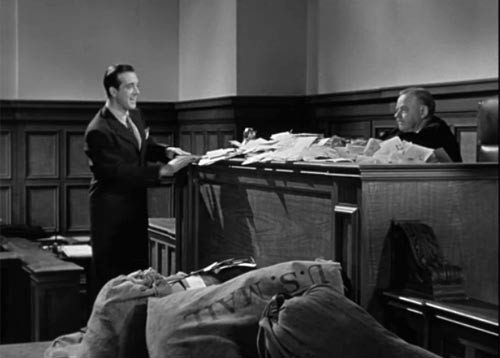
“Miracle On 34th Street,”An Ethics Companion,Chapter 5: Boy, This Guy Sure Doesn’t ACT Like He’s Santa!

Bellevue ride

(The Introduction is here.; Chapter I is here.;Chapter 2 is here; Chapter 3 is here; Chapter 4 is here.)

Everything so far has been laying the foundation for the climactic and justly famous courtroom scene. But before that can happen, there needs to be a pretext for getting the story into court. Of course, the fact that Kris committed assault and battery on Mr. Sawyer would normally be enough to get him there on a criminal charge, but that wouldn’t have anything to do with Santa Claus, so we have a lot of dubious plot machinations that make no sense at all. in rapid succession—got to get to that courtroom scene!—we get…

Sawyer’s Perfidy

First, Sawyer acts like he’s been grievously wounded so he can credibly insist that Kris be committed. He’s a liar as well as a weasel. He’s also not very bright. He knows Macy’s has been using Kris a public relations cornucopia. He has to know that in any feud with a store Santa Claus who has made money for Macy’s, he’ll lose. Sawyer’s antipathy towards Kris to his own likely detriment makes no sense at all.

Doris’s Failure

Doris refuses to have anything to do with sending Kris to Bellevue, the NYC mental hospital, to be examined. She is, however, unlike Sawyer, responsible for Kris, and has said as much. Her duty is to Macy’s, and her employee attacked someone. This is where conflicts of interest get you in the workplace, and she should have seen this coming. Her job is to fix the problem, and instead she acts helpless. I find this to be nascent sexism in the film: “just like a woman,” Doris is being sentimental when she needs to be practical and decisive.

Actress Maureen O’Hara, a notorious tough proto-feminist, must have been seething.

Continue reading

Saturday Ethics Nightcap,12/12/2020: Bad Journalism, Bad Governors, Bad Santas

nightcap

That’s just ginger ale, in case you’re wondering…

1. “Nah, there’s no outrageous, flagrant, shameless mainstream media bias!” April Ryan, arguably the worst, most unethical, most biased and most unprofessional of CNN’s reporters (but it’s such a lively competition), attacked the confidential sources responsible for leaking a recording of Joe Biden making weaselly comments about his stance toward the “defund the police” movement. Ryan demanded to know who was responsible for allowing the embarrassing comments to be made public, because, as we all should know by now, the job of the media isn’t to report the facts, but to empower and protect Democrats. (She didn’t come out and say the last part, but after her performance over the last four years, she doesn’t have to.) Jonathan Turley appropriately nailed this one:

The fact is that Ryan was just stating what has become the approach of many in the media. As we recently discussed, we are moving dangerously close to a de facto state media with the cooperation of Big Tech companies.  Ryan believes that it is outrageous to rely on unapproved material if it is critical of Joe Biden (despite her use of such material for the last four years against Trump)…CNN has not expressed any disagreement with Ryan’s view of the new journalism.

2. Santa Claus Ethics: If you can’t do any better than these Santas, you shouldn’t even try. But they do provide one reason to be grateful for social distancing. I think my favorite is this one…

Continue reading

Ethics Quiz: The Marilyn Monroe Statue

MM statue

Alternate title: “At Last A Statue Everyone Can Get Behind!”

At least this statue ethics controversy has nothing to do with the Civil War.

Palm Springs, California’s City Council voted last month to place a giant sculpture of Marilyn Monroe, her white skirt blown up above her waist and her mouth poised in the semi-erotic smile everyone remembers from the classic movie moment, in the middle of the city. For three years, 2012 to 2014, the sculpture by Seward Johnson enlivened downtown Palm Springs, and now it will be coming back with financing from a local hotel consortium. The 26-foot high “Forever Marilyn,” turned up as a short-term tourist attraction in other cities in the intervening years (many visitors enjoyed posing for photographs between MM’s feet, looking up) but now Palm Springs is offering it—her?— a permanent home.

Ah, but all statues are controversial now. Marilyn will stand across from the entrance to the Palm Springs Art Museum, and its executive director Louis Grachos objects. “You come out of the museum and the first thing you’re going to see is a 26-foot-tall Marilyn Monroe with her entire backside and underwear exposed,” Grachos pointed out to the council. “We serve over 100,000 school-age children that come to our museum every single year. What message does that send to our young people, our visitors and community to present a statue that objectifies women, is sexually charged and disrespectful?” The museum’s previous three directors, Elizabeth Armstrong, Steve Nash and Janice Lyle, designer Trina Turk and others issued a joint op-ed in The Desert Sun condemning the statue as “blatantly sexist.”

Your Ethics Alarms Ethics Quiz of the Day is...

Is Johnson’s statue of Norma Jean unethical public art?

Continue reading

List Ethics Case Study: “The 25 Greatest Actors Of The 21st Century (So Far)”

Lists are fun (that’s why “The Book of Lists” was a runaway best seller); they also drive me crazy. Unless the lists are based on incontrovertible statistics and identifiable features (American League batting champions since 1900; states that begin with the letter “N”) they are essentially a stranger’s arbitrary opinions misrepresenting themselves as facts. I’ve posted about this a couple of times, first in 2011. That one concluded (in part), “I know these lists are all intended in good fun. When one is dealing with history, however, fun doesn’t excuse advancing misinformation at the cost of enlightenment.”

The list in question today involves subjective aesthetic judgments, not history, but it still has ethical problems. It was compiled by the New Your Times film critics—you know: experts!”—and purports to show us the “25 greatest actors of the 21st Century (so far).” That’s a lie. I guarantee that the authors themselves do not believe these are the 25 greatest actors by any standards.

Let’s look at the list:

Continue reading

2020 Election Ethics Train Wreck Update: Well THIS Doesn’t Bode Well…

spelling problem

That’s the embarrassing first sheet of the more than 100 page lawsuit filed by lawyer Sidney Powell asking that 96,000 ballots (“at minimum”) in Georgia be disqualified. This is apparently the attack on the Georgia election that Powell referred to as releasing “the Kraken.”

Nobody seems to feel it’s necessary to explain that “Release the Kraken” is a reference to the semi-cheesy Ray Harryhousen stop-action film “Clash of the Titans,” which starred “LA Law’s” Harry Hamlin as Perseus, the Greek mythological hero. In the movie (though not in mythology), Perseus defeats the monstrous Kraken, which is released by the bad guys to kill him and Andromeda (it’s complicated). For some reason Perseus, in addition to carrying around Medusa’s head (which turns the Kraken to stone), rides the winged horse Pegasus. Pegasus was the transportation of a different Greek myth hero, Bellerophon. Neither Bellerophon nor Perseus had anything to do with the Kraken, which is not even a Greek myth monster. It’s Scandinavian, and is basically a giant squid.

Observations:

Continue reading

No, Pete Davidson Is NOT Starring As George Bailey In A Remake Of “It’s A Wonderful Life”

toy train derailment

Here we have a fine example of that annoying American pop culture phenomenon, the teensie-weensie ethics train wreck. From beginning to end, everything about this episode evinces some lack of ethical values, but in the final analysis, the consequences are negligible.

Let’s examine the trivial Pete Davidson Casting Ethics Train Wreck:

1. Clickbait. Numerous friends and Ethics Alarms readers emailed me with the horrifying news that Pete Davidson, the slimy, possibly mentally-ill Saturday Night Live  cast member and stand-up comic, would be playing George Bailey in a “remake” of the beloved Frank Capra classic, “It’s a Wonderful Life.” The reason for their alarm were headlines like this one, from Tucker Carlson’s Daily Caller: “Pete Davidson To Take On Role Of George Bailey In ‘It’s A Wonderful Life.’” The conclusion reached by those who contacted me was completely reasonable, but the headline was deliberately misleading.

2. Casting a creep like Davidson as George Bailey in any version of that movie including a Cub Scouts skit  is a slur on the film, the beloved character, James Stewart, the holidays, Capra, what the film stands for to many Americans, oh, pretty much everything. Davidson infamously mocked Rep. Dan Crenshaw’s eye-patch when he was running for Congress in 2018, and has generally proven himself to be a smug, shallow jerk of the sort that has flourished during the Trump years. Crenshaw lost his eye in combat, and Davidson has made it clear, despite various insincere mea culpas, that this warrants no respect in his world view.  For Davidson to stand in the shoes of James Stewart, a World War II veteran and hero, is nauseating, and an insult to all veterans. Continue reading

Ethics Quote Of The Day (And For All Time): Abraham Lincoln [Missing Post Section Recovered!]

On this date in 1863, President Abraham Lincoln added a vital coda to the United States mission statement articulated in the Declaration of Independence nearly a hundred years earlier. Gary Wills, among other historians and commentators, has argued that with this single speech Lincoln reframed the purpose of the American experiment as well as clarifying its core values. Those values, it is fair to say, are today under the greatest threat since the Civil War today. Lincoln’s address lasted just two or three minutes (it was not even announced beforehand as a speech, but rather “remarks”), but also reframed the purpose of the war itself, as not only to preserve the union, but a struggle for freedom and equality for all.

There has been so much written about the Gettysburg Address that it would be irresponsible for me to attempt to analyze it here. It probably isn’t necessary to analyze the speech. Few statements speak more clearly for themselves: if ever a speech embodied the principle of res ipsa loquitur, this is it:

Continue reading

Sunday Ethics Infusion, 17/15/2020: “Run Away!”

1. To channel Scarlet O’Hara…If one more Trump-Deranged individual accuses me of  adopting right-wing media conspiracy theories, I will get angry, and they won’t like me when I’m angry. I accept analysis from no one, especially from the likes of (the former version of) Fox News, Breitbart, Mark Levin and others of note. If I like a legitimate authority’s analysis (like, say, Andrew McCarthy, Ann Althouse or Jonathan Turley), I will credit them for it. “It sure is suspicious that your points agree with theirs” I was told today. It’s no more suspicious than the fact that their stated analysis agrees with mine. I’m not tolerating this insult. I’m at least as informed, educated and intelligent as those I am accused of “parroting,” and I’m considerably more informed, educated and intelligent than the typical knee-jerk progressive water-carrier who tries to win arguments they have neither the wit nor the facts to support by calling me incapable of forming my own opinions.

2. An update! The original collection of movie clips that Ethics Alarms uses repeatedly to illustrate certain points has been expanded considerably.

3. “Run away!” I see that conservatives are “fleeing” Facebook and Twitter for the allegedly more accommodating and less censorious environs of Parler and MeWe. EVERYONE should bolt from Facebook and Twitter if they have any concern about the social media platforms manipulating public opinion and possible tilting the election by partisan censorship, not to mention the mendacity of both platforms’ CEOs and their basic lack of trustworthiness.

Continue reading