The position here has always been that nobody has any business telling you how to spend your money. This topic usually comes up in the context of charity, as in, “How dare that individual spend money on what they think is important when they should be spending money on what I think is important!” A couple of recent developments have raised the issue in a different context, however: incompetent and irresponsible expenditures of large amounts of money.
Take “Cats,” for example. The already immortal flop film cost a reported $100,000,000 to make, and marketing costs are on top of that. It is sure to lose many, many millions of dollars, and the question becomes, “How could movie professionals make a blunder like that?”
I always assumed that “Cats” could not be a successful movie because of its purely theatrical nature. Surely the lesson of the film version of “A Chorus Line,” another Broadway musical that never should have move to the screen, was guide enough. Yet it happened. The fiasco put me in mind of other infamous and avoidable screen disasters, like 1978’s “Sgt. Pepper’s Lonely Hearts Club Band” starring Peter Frampton and the Beegees. Before the film’s release, Robin Gibb of the Bee Gees announced: “There is no such thing as the Beatles now. They don’t exist as a band and never performed Sgt Pepper live in any case. When ours comes out, it will be, in effect, as if theirs never existed.”
Good prediction. The huge MGM film with dozens of celebrity cameos was instantly and universally reviled. Even worse, a few years later, was “The Pirate Movie,” another misbegotten big budget musical. The idea here was to do a new version of “The Pirates of Penzance” but without the dialogue, plot and music that has made the Gilbert and Sullivan show popular for more than a century….and to star Kristy MacNichol, the androgynous, non-singing teen star, as the heroine. How could such a brilliant concept fail? Continue reading →
Is it still clickbait when a link virtually screams “CLICKBAIT!”? Maybe, but if someone is going to claim that they have made a “perfect list,” he had better do a better job than this. My earlier comments today about Pauline Kael apply: some of this guy’s assessments of what is “definitive” disqualify him as a useful or credible authority. For example, Field, who reveals himself as an Ella Fitzgerald fan boy, chooses Ella’s rendition of “Have Yourself A Merry Little Christmas” as ‘the best, saying, “If you think Garland’s rendition is better than Ella’s, you’re probably also a Liza Minnelli fan.” Well, I’m not a Liza fan; she sounded nothing like her mother, and Garland’s rendition is better, indeed the “definitive” version. Old Blue Eyes’ rendition finishes second for sure, but Judy’s tumbling scales were never more affecting or emotionally eloquent, and this is her song. Similarly, Field picks Andy Williams’ version of “Do You Hear What I Hear?” as “the best.” That’s ridiculous. I know this song especially well: I watched “The Hollywood Palace” as a kid the night Bing Crosby introduced it. I’ve written about it on Ethics Alarms, researched it, put it into a Christmas revue and staged it. Crosby’s version is the only one that manages to give the song sufficient heft and gravity: he shifts deep into his chest baritone in the final verse, and decades after hearing the song for the first time, Bing still gives me chills. Lots of male singers, including Williams, have done respectable covers, but they are all chasing Bing.
Look, anyone can have a preference for any professional version of any of the Christmas standards and carols, and there is no point arguing about it. However, if one is going to use the descriptor “definitive,” it has to involve more than personal taste. What is the singer’s connection to the song? Why is it identified with him or her, or is it? Do other singers obviously evoke that singers’ performance? Generational familiarity aside, is the version generally recognized as being definitive? Has the singer’s version become iconic? If one were describing the singer, would the song immediately come to mind?
Here’s my definitive list of the definitive versions of Christmas standards:Continue reading →
Once again, I am re-posting the first Ethics Alarms Christmas post from way back in 2010, its first full year. (The last time I revived this post was in 2016.) I’m not inclined to change it, though I did fix some typos.
In the 2016 introduction, I wrote, “The ascendant attitude toward Christmas is both anti-religious and non-ethical.” That is still true. In my extended neighborhood, there are giant penguins, snowmen, Santas, dragons, unicorns, the Grinch and Christmas Storm Troopers on lawns, and exactly one manger or reference to Jesus. There is no mention of peace, good will or love. My wishes of “Merry Christmas!” are returned, I’d estimate, about 20% of the time. Often I get glares, because saying “Merry Christmas!” must mean that I have a MAGA cap in my closet.
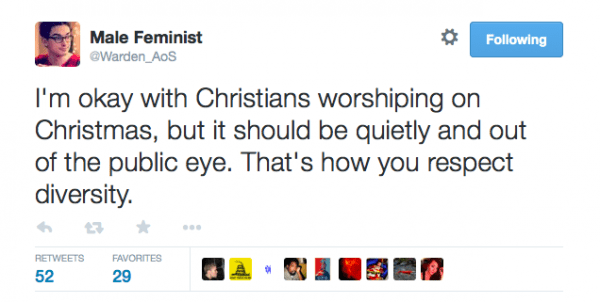
Those who might be otherwise tempted to show some signs of faith may be intimidated by the Diversity Fascists, like this guy:
Yes, many people–they call themselves “progressives”— believe that a healthy national culture embracing love, charity, generosity and kindness is disrespectful. The culture seems to be capitulating to the bullying without a fight. The two most prominent Christmas movies on cable this year are the mildly cynical “A Christmas Story” and the wretched “Christmas Vacation,” which isn’t even a good Griswald movie, much less a decent Christmas movie. I have been searching for the original “Miracle on 34th Street”—yes, I know I haven’t finished the ethics review–and keep finding arguably the worst version, the one with Richard Attenborough playing Kris Kringle. “Four Christmases,” another bitter comedy, has appeared many times. “A Christmas Carol” is now rare fare, but we get many showings of “Scrooged,” with Tiny Tim played by MaryLou Retton.
Some of the Hallmark Christmas stations have been playing a Whitney Houston version of “A Christmas Song” that interjects “Happy Kwanza” in the lyrics. Thanks to John Legend, we now have a Christmastime ditty that endorses abortion.
Think about that a minute.
I don’t know how to reverse the damage already inflicted on our society, but I do know that we have to try.
1. Lesson: Don’t underestimate the Duke! It looks like John Wayne is stronger than the cancel culture after all. Earlier this year the Woke Avengers tracked down an old Playboy interview where the actor made some inflammatory remarks about blacks and Native Americans (I thought then and I think now that the Duke was deliberately trolling his liberal critics, but it was still a bad interview.) Predictions were rife that the most enduring, influential and popular screen icon of all time had reached the end of his run. It doesn’t appear so: at least two cable channels are running John Wayne film marathons on or around Christmas.
2. The ethical response: feel compassion for Hillary. There are people who get run over and squashed by life, their own failings, and bad luck. We don’t have to like all of them, but the Golden Rule argues that we should feel some pity and compassion for them, even though many have brought some of their misery on themselves.
I think about this when I see, for example, Marcia Clark, the losing prosecutor in the O.J. Simpson case, and her desperately tucked and altered face as she transitioned into a B-media personality. The earliest example of this syndrome that I can remember noticing was perennial Republican Presidential candidate Harold Stassen, with his dazed expression and bad toupee, who once thought he was going to be President. Dubbed the “Boy Wonder,” Stassen was only 41 when he seemed to be on his way to winning the Republican nomination for President for the 1948 election in which President Harry Truman was widely regarded as both a lame and dead duck. Stassen lost the convention battle, however, to Thomas Dewey, of subsequent “Dewey Defeats Truman!” fame. After that, Stassen ran for President in 1952, 1964, 1968, 1980, 1984, 1988, and 1992 , gradually becoming a laughing stock. (He also ran unsucessfully for Governor of Minnesota, the United States Senate twice, Governor of Pennsylvania twice, Mayor of Philadelphia once; and U.S. Representative). I just thought he was a buffoon until my father told me about his many accomplishments before his dreams were crushed. He was one of the founders of the United Nations, for example.
As I made pretty clear in 2016, when I wrote almost as many critical posts about her and her generally awful ethics as I did about our current President when he was a candidate, I am not a fan of Hillary Clinton. I’ve continued to write critical commentary about her, because she continues to operate with wildly malfunctioning ethics alarms. She is stuck now, in Kübler-Ross terms, in the first three stages of grief: denial, pain and guilt, and anger and bargaining because she lost the election she was certain she was going to win. (So is the entire Democratic Party.)
Now look at her:
3. Marvin Miller makes it into the Hall of Fame. Yecchh. Marvin Miller was described in his obituary as “an economist and labor leader who became one of the most important figures in baseball history by building the major league players union into a force that revolutionized the game and ultimately transformed all of professional sports.” I have no quarrel with any of that. Miller was a labor activist who did his job extremely well. I would put him into a labor leader’s Hall of Fame—-I’m sure one would get at least a hundred or so visitors a year—without blinking. He no more belongs in the the Baseball Hall of Fame in Cooperstown, NY than I do, but he was posthumously elected to that Hall of Fame last week. Continue reading →
In Part I, I said I was glad that Clint Eastwood’s latest film “Richard Jewell” was bombing, because the film impugns the integrity of a now-deceased reporter simply to spice up its story. After I read some of Clint’s comments yesterday in response to the controversy, I’m even more glad. Clint said that nobody knows how reporter Kathy Scruggs got a crucial leak from the FBI, but that it could have occurred because she traded sex for information. That’s despicable.
Nevertheless, the other dud among the Hollywood releases over the weekend, “Black Christmas,” deserved to flop even more than Eastwood’s epic.
The original “Black Christmas” (1974) was released under the name “Silent Night, Evil Night.” I saw it with my sister a few days after its opening (I was amused at the ad’s catchline, “If this movie doesn’t make your skin crawl, IT’S ON TOO TIGHT!!!”) and it scared the bejesus out of both of us, but especially her: she slept with the light on for weeks, and to this day my uncanny imitations of the maniac’s phone calls upset her (so I keep doing them, of course.)
Arriving before John Carpenter’s “Halloween” and its later, cheesier rip-off “Friday the 13th,” what was soon re-titled “Black Christmas” anticipated many of the themes and techniques of the slasher genre, perhaps too well. Blessed with a much better cast than any subsequent movie of the type (Olivia Hussey, Keir Dullea, Andrea Martin, John Saxon, and Margot Kidder) and clever and gutsy director Bob Clark (“A Christmas Story,” “Porky’s”), the film was declared too disturbing by many critics. I thought it was easily the best horror movie I had ever seen, and recommended it to many friends, some of whom were not grateful after spending the following night jumping at every sound. It was very gratifying to see “Black Christmas” finally emerge as a cult film and the acknowledged inspiration for the slasher film genre (along with “Psycho,” of course.)
I saw the 2006 “sequel,” which was terrible, and had a sense of dread when I learned that Hollywood would try again. It was clear that the new film was already off to an unethical start when I saw the trailer: this was another example of producers hijacking a familiar title while making a movie barely connected to the older film it was evoking. That trick, essentially a bait and switch, always ticks me off. In the trailer for the new film, we could see that the killer wears a black robe and uses a longbow. Clark’s original famously never shows the maniac murderer at all: much of the movie is shot from his perspective (I assume it’s a he), though we see his shadow, one mad eye, and his arm at various times. We also hear him, and a more crazy-sounding killer has never been recorded.
The new “Black Christmas” takes place in a sorority house around Christmas, and there’s someone knocking off the girls. That’s about the extent of the similarity. To be fair, the advent of cell phones ruined the original film’s most iconic scare: it was the first movie in which we heard the chilling words, “The phone calls are coming from inside the house!”
The promotion of more female film directors is a feminist cause right now. There’s even a Christmas commercial where a little girl tells her parents who have just bought Disney princess toys to put under the tree for her, “I don’t want to be a princess any more. I want to be a film director!” I have always championed female directors for the stage; there is no question that there are multiple biases against them in theater, and I assume the same bias afflicts them in Hollywood. However, I do not want to see more female directors because they bring a special, feminine perspective to their work, and I really don’t want to see more female directors so they can use their plays and films as feminist propaganda vehicles. Just make a good movie, kid: if your work only stands for the proposition that women can’t just make entertaining and effective films, but have to clobber the audience with feminist tropes, you will have created a legitimate reason for the industry to be wary of female directors. Continue reading →
1. And speaking of Martin Scorcese movies, since Jerry Vale is alluded to in several of them…”The Irishman” has been viewed on Netflix by many of my showbiz friends, and most, while complaining about the film’s length, have declared the performances “brilliant.” This reaction, is, I think, bias at work, the so-called “halo effect.” It’s the same phenomenon I witnessed in the D.C. theater community, where certain actors, directors and big theater companies were routinely called “brilliant” in their efforts, when in truth, the exact same product presented by artists with lesser reputations would be shrugged off or ignored.
The three veteran stars of “The Irishman” are being praised by critics across the board, but in truth, with the exception of Al Pacino, they seem weary and channeling earlier, better performances. This is especially true of Joe Pesci, who shows none of the energy we associate with his best performances, and the script requires him to run the gamut of emotions, as the old joke goes, from A to C. He’s as old as Joe Biden, and looks and acts every inch of it, though his character is supposed to be younger. Scorcese has used tech wizardry to give De Niro a younger face when necessary, but it still sits on top of his 80-year-old body. and there is nothing in De Niro’s act that we haven’t seen over and over again (though not so much lately, as Bob has been collecting checks for bad movies in which he appeared to be “phoning it in”).
Pacino, as Jimmy Hoffa, is lots of fun as usual, but he doesn’t appear to be trying to be convincing as the mysteriously disappeared labor boss, who was 62 with he vanished. Pacino is 79. How could anyone call Pacino “brilliant” as Hoffa? Jack Nicholson was far more convincing in the film “Hoffa,” and Pacino isn’t significantly different than he was playing a Hollywood agent in “Once Upon A Time In America.”
It must be nice to reach that stage as an actor when you get paid big checks just to show up, like Marlon Brando in “Superman.” Especially if everyone is going to say you were brilliant.
2. And now for something completely stupid. This is remarkable in the dual category of incompetence in one’s chosen pursuit (theft) and unforgivable ignorance regarding social media. Arlando Henderson, 29, who worked for a bank in Charlotte, North Carolina, stole money from his employer’s vault at least 18 times, for a grand total of $88,000. He was apprehended and arrested after posting about his robbery hobby on Facebook, including posts showing his new Mercedes-Benz, and this one…
You know, if someone is this stupid, ethics alarms hardly matter…
3. Surely we are missing some crucial information here...The New York Giants, in the midst of a horrible season, fired veteran cornerback Janoris Jenkins last week. Why? He was engaged in an argument with a fan on social media who objected to Jenkins posting his personal stats after a game that his team lost, and wrote,
“Once Upon A Time..” also features a glorious pit bull.
I watch too much TV, and have all my life. Or maybe not too much. Sometimes I think everybody else watchs too little, reality shows excepted. Three shows I watched this week made me a little bit wiser…
“The Clinton Affair”
What this new, and generally excellent review of the Monica Lewinsky mess teaches us is that the Republicans were looking for ways to justify getting rid of Clinton, though less intensely and openly as today’s Democrats have hunted Donald Trump. The main differences: the news media, which was mostly supportive of Clinton throughout, with a few notable exception, like Chris Matthews; and, as Jonathan Turley correctly stated in his testimony, Clinton unequivocally committed crimes, not just by lying in court in the Paula Jones hearing, but by lying under oath in a deposition in which he swore under oath, that he could not recall ever being “alone” with Monica.
Monica is prominent in the documentary (boy, she is beautiful) and is allowed to appeal to the sympathies of the viewer. Indeed, she was vilified excessively: clips of a younger but no less smug and revolting Bill Maher arguing, with many guests in agreement, that she, not Bill, was the real villain. This was nauseating then, and nauseating still. At the same time, there are limits to how much sympathy one can direct toward Lewinsky, who made a choice that was both unethical and stupid. How could she imagine such a situation would ever turn out anything but disastrously? She keeps telling us how humiliated she was, as if she didn’t deserve to be humiliated. Continue reading →
For some reason, just like the Hallmark cable channels, the satellite radio monopoly Sirius-XM has gone nuts this pre-Christmas season. I count six channels devoted to Christmas music, and I’m sure there are some other buried in there. There are two traditional Christmas music stations that appear to be playing the same songs and recordings; a Country Christmas channel, which means really bad compositions like “Santa Looked A Lot Like Daddy,” a poor rip-off of the slightly less revolting, “I Saw Mommy Kissing Santa Claus” and better songs and carols sung with a twang; a Gospel Christmas channel, and “Nativity,” which includes only carols and songs referencing Jesus, and “Holly,” which avoid religious references completely and is required listening if you want to know how few modern Christmas ballads deserve annual airing. I could two: “Last Christmas,” and Mariah Carey’s “All I Want for Christmas is You,” neither of which can be sung around a piano anywhere but backstage at the Grammys.
I been forcing myself to listen to all of it for days, and have reached some rueful conclusions:
In their rush to avoid referring to Jesus, the programmers over-play the established Winter Solstice canon to the point of madness. We’re talking “Snowfall,” “Winter Wonderland,” “I’ve Got Your Love To Keep Me Warm,” “Sleighride,” “It’s a Marshmallow World,” “Let It Snow,” “Frosty the Snowman,’ and of course, “Baby It’s Cold Outside” by every possible artist, over and over. None of these songs are about Christmas, but if you’re a Druid, I suppose they are appropriate and festive.
At least some versions have lyric changes made to refer to Christmas. Sometimes Frosty says, instead of “I’ll be back again some day!” that he’ll be back on Christmas day. (Is Frosty some kind of a weird Christ figure?). In Winter Wonderland, Farmer Brown’s birthday party is sometimes turned into a Christmas party.
Boy, the ex-Beatles’ attempts at Christmas songs are awful, especially John Lennon’s, with its depressive message, and the lame and gloomy couplet,
And so Merry Christmas, and a happy new year
Let’s make it a good one, without any fear.
There hasn’t been a decent Christmas standard entering the canon since 1963’s “Do You Hear What I Hear?”, which I wrote about last year.
It is also the last popular Christmas song to be written with a religious theme. Think about that, and what it says about the status of religion in U.S. culture.
I know this is a personal preference, but when Bing Crosby’s recordings come on, his warm, smooth, impeccably-crafted delivery just blows everyone else out of the metaphorical water. Yes, even Old Blue Eyes.
Christmas keeps Bing’s legacy alive, though in an unfairly narrow context. We will never hear a voice like that again, I fear.
Having been forced to listen to “Rudolph the Red-Nosed Reindeer” until it kept me awake at night, I have concluded that the suddenly au courant criticism of the song—bullying, you know—is baloney. It teaches the valuable lesson that being a target and a victim need not be permanent, and that if one has character and develops skills, there will be opportunities to prove one’s critics wrong.
I think of Rudolph as a reindeer version of Desmond Doss.
At the risk of being repetitive (I’ve know I mentioned many of these before), here are some Christmas song lyrics that could be, and in some cases, should be, fixed.
What’s a drummer doing by the manger, with a baby sleeping? This has bothered me since the first time I heard “The Little Drummer Boy.”
Speaking of “Do You Hear What I Hear?”: I get the wind talking to the lamb, and I’ll even accept the lamb talking to the shepherd boy, but I’ve never understood how the boy had a chance to meet the mighty king, much less tell him to bring the child “silver and gold.”
Listen to Bobby Helms sing his 1957 hit “Jingle Bell Rock,” and then tell me he doesn’t keep singing “feet” when the lyrics obviously are “beat.” Amazingly, some covers of this song also seem to be singing “feet.”
Dumbest Christmas lyric of all time: The Beach Boys’ repeated (In “Little Saint Nick”) “Christmas comes this time each year.”
I’m tempted to nominate “see the kids bunch” from “Silver Bells” for the second worst. That requires assuming that “then we got upsot” in Jingle Bells is an intentional howler.
The lovely and wistful World War II Christmas ballad “I’ll Be Home For Christmas” refers to “presents on the tree.” Who hangs presents on a Christmas tree? How would you do that? Many recent versions substitute “”round” for on. Good.
The late Andy Williams’ Christmas standard, “It’s The Most Wonderful Time of the Year,” he lists ‘scary ghost stories” as a feature of Christmas. I know the song is referring to “A Christmas Carol,” but that’s a single ghost story. Andy makes Christmas sound like Halloween…
Finally, here’s an example of how attention to tone and craft improved a Christmas song and allowed it to become, deservedly, a classic.
“Have Yourself A Merry Little Christmas” is certainly somber, but having been through some sad Christmases, it’s an essential part of the canon, and a wonderful song. It almost was too sad, however. Hugh Martin and Ralph Blaine, who wrote the song ” for Judy Garland’s 1944 movie, “Meet Me in St. Louis”, originally had the lyrics…
Have yourself a merry little Christmas It may be your last… Next year we may all be living in the past…
Yikes! Judy Garland and others insisted on a revision, and the songwriters ultimately settled on …
Have yourself a merry little Christmas Let your heart be light… Next year all our troubles will be out of sight..
Another gloomy lyric that was vetoed:
No good times like the olden days Happy golden days of yore Faithful friends who were dear to us Will be near to us no more..
Nice. That one became,
Once again as in olden days Happy golden days of yore Faithful friends who are dear to us Will be near to us once more.
“O Come All Ye Faithful” is so stirring that it almost makes up for all other Christmas music botches.
This isn’t so much an ethics analysis as an expression of frustration. For a cultural holiday that relies so much on music, Christmas is wounded today by accumulated incompetence on that front, as well as a lack of diligence. Just a little more attention and industry could make the traditional repertoire so much better. You know those AT&T wireless commercials about how “good enough” isn’t good enough? That’s the issue in a nutshell. We have to hear these songs year after year. Can’t they be cleaned up?
Let’s begin with the traditional songs and carols that weren’t written to avoid the origins of Christmas. These are the strongest and most evocative of all the season’s songs, in contrast to the”popular” Christmas music that came down to us from Tin Pan Alley. I have to ask, though: What the hell is “I Saw Three Ships” about?
I saw three ships come sailing in, On Christmas day, on Christmas day, I saw three ships come sailing in, On Christmas day in the morning.
And what was in those ships all three? On Christmas day, on Christmas day, And what was in those ships all three? On Christmas day in the morning.
The Virgin Mary and Christ were there On Christmas day, on Christmas day, The Virgin Mary and Christ were there On Christmas day in the morning.
Pray whither sailed those ships all three? On Christmas day, on Christmas day, Pray whither sailed those ships all three? On Christmas day in the morning.
Oh, they sailed into Bethlehem, On Christmas day, on Christmas day, Oh, they sailed into Bethlehem, On Christmas day in the morning.
I assumed that there was an acknowledged and well-researched metaphor buried here, but no, there really isn’t. The nearest body of water to Bethlehem is the Dead Sea, and it’s 20 miles away: Bethlehem is land-locked. Where were those ships coming from? How did Jesus and Mary end up on a ship, and why were three necessary? This is the fake news of Christmas Carols. The song makes no sense, so scholars and critics have been positing justifications for this nonsense, without any evidence at all other than, “It must mean something!” One batty theory is that the the three ships are references to the Nina, the Pinta, and the Santa Maria. Wikipedia concludes that the reference to three ships “is thought to originate in the three ships that bore the purported relics of the Biblical magi to Cologne Cathedral in the 12th century.” Then the song has nothing to do with Christmas at all? The entry continues, “Another possible reference is to Wenceslaus II, King of Bohemia, who bore a coat of arms “Azure three galleys argent”. Ah! It’s a song about a coat of arms! Sure! THAT makes sense. Then it goes on to a theory that I considered years ago along with everyone else, that the ships represent the camels used by the Magi, as camels are frequently referred to as “ships of the desert.” Continue reading →
[Yesterday I was just about to post the following when I felt a recurrence of the dizziness that sent me to the floor on Thanksgiving, This sent me to the emergency room, where I spent the second worst birthday of my life. I just got home, now just about 24 hours later, after three blood tests, about ten stroke tests, lots of other tests and quizzes, four doctors and a miserable night, culminating in the conclusion that whatever this was, it wasn’t related to my heart or circulation. 54% of fainting incidents, I learned remain mysteries. Swell.]
Ten years ago today, I went over to my parent’s condo to check on my dad, since my mother, then recovering from knee surgery, was concerned that she hadn’t heard from him. Jack A. Marshall Sr. was also going to take me out for dinner, since it was my birthday, but that pleasure was not to be. He had died, quietly during a nap, a few months short of his 90th year. I miss my father’s inspiration, guidance and unflagging support constantly, and December first has been a matter of serious dissonance for me ever since. I did take comfort, while everyone was telling me that I was a fool not to go to the emergency room after my fainting episode on Thanksgiving, that the odds of anyone dropping dead not only on the anniversary of his father’s death, but also on his own birthday, seems extremely remote. Kind of cool, though.
I took my birthday off of my Facebook page because those reflex happy birthday messages—I send them myself—are meaningless and faintly obligatory. Two years ago I received almost 200 of them, then last year I got the message when the number fell by about two-thirds. I had made it clear by then that I was rebelling against the Facebook Borg aka “the resistance,” and so I had been told that I did NOT deserve a happy birthday. Fine. Bite me.
1 “The Crown” Ethics.A. The Pretend Sister-in-Law Of The King’s Pass! While waiting to see if I was going to pass out again, I began watching Season 3 of Netflix’s “The Crown.” Like the first two seasons, the series is uniformly excellent and largely accurate, but I am annoyed at Helena Bonham Carter’s turn as the middle-aged Princess Margaret. Carter is an excellent actress as well as one of the biggest stars the series has featured, but to be blunt, she’s too fat to play Margaret, who at that point in her life was still vain winning the battle against middle-aged spread (at 5’1, it could not have been easy.) For a production that mostly aims for near perfect look-alike casting (young Charles, Princess Anne and Prince Phillip are especially uncanny), why would the producers allow Carter to appear on screen like this? Mostly, I’m annoyed at her: actors gain and lose weight all the time for roles, and a mere 10-15 pounds would have made Carter a credible and flattering Margaret. She could have hit the gym and laid off the kidney pie; obviously the actress didn’t care, and the producer and director let her get away with it, because she’s a star. Yet all the lines about how glamorous Margaret is make no sense as a result. Carter’s a beautiful woman, but she’s a mighty frumpy Princess Margaret.
B. A perfect future episode for Season 4, or maybe 5, is going on right now. Prince Andrew, the younger brother of Prince Charles, has long been mentioned a party pal of billionaire sex-slaver Jeffrey Epstein, and thanks to a car crash of a BBC interview in which he couldn’t have seemed more guilty and less remorseful, the Duke of York is reportedly being removed from all royal duties and may have his allowance cut off, meaning that his two princess daughters will no longer be supported by taxpayers, among other nasty consequences. Charleshas ordered a crisis meeting with his scandal-scarred brother before Monday night’s dreaded BBC special with key accuser Virginia Roberts Giuffre, who accuses Andrew of raping her while she was under Epstein’s control.
The news media has been ostentatiously uninterested in Prince Andrew’s travails, in marked contrast to its coverage of the various Charles-Diana scandals in days of yore. One reason, I think, is that Epstein’s OTHER celebrity playmate was Bill Clinton, and it will be hard to expose one without drawing attention to the other. After all, the objective now is to get Trump, not remind the public about Bill (or Harvey.) Media bias is exhibited as much by what isn’t reported as by what is. Continue reading →




 Ethics Alarms