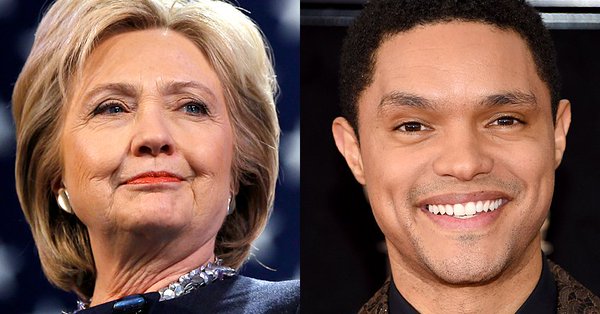
Trevor Noah’s Critics

Trevor Noah, the current Daily Show host who is more thoughtful than funny, made the same points Ethics Alarms did regarding Hillary Clinton’s weasel-like response to the New York Times exposé revealing that she protected a top adviser of hers, Burns Strider, Clinton’s faith adviser and founder of the American Values Network, when he was accused of repeatedly sexually harassing one of Clinton’s young subordinates during her 2008 campaign.

“Hillary’s Grammy cameo came at a weird moment for her,” Noah said, referring to the “Fire and Fury” skit at the Grammys Sunday that featured  Clinton reading excerpts from the book. “Because last night’s theme was #MeToo, Time’s Up, which is a message Hillary found herself on the wrong side of over the weekend. Look, there’s a few areas where I don’t necessarily expect Hillary Clinton to nail it,” Noah continued, “managing emails, visiting Wisconsin, you know, weaknesses. But I won’t lie, I expected standing up for a woman on her staff to be one of her strengths. So the story is disturbing.”

“It’s possible that Hillary Clinton had a good explanation for why she kept this guy on over the objections of her top campaign advisers but instead of an explanation, all we got was this,” Noah said, regurgitating Hillary’s nauseating tweet,

“A story appeared today about something that happened in 2008. I was dismayed when it occurred, but was heartened the young woman came forward, was heard, and had her concerns taken seriously and addressed…I called her today to tell her how proud I am of her and to make sure she knows what all women should: we deserve to be heard,”

“Yeah, ‘women deserve to be heard,’ and then quietly reassigned,” Noah said in reaction to this. “‘Thank you for speaking up — now into the closet…It feels like Hillary’s not only trying to dodge all the blame, she wants to present herself as having always been on this woman’s side, which doesn’t fly, because not only did the woman get reassigned, but this guy, Burns Strider, he went on to get another job in Democratic politics, where he got fired for doing the same thing to other women,” Noah said, correctly. “So you could argue that if Hillary had fired him, she would have been protecting many women, instead of just herself.”

I almost gave Noah an Ethics Hero for this, but thought better of it. The fact that none of his All-Trump-Bashing-All-The-Time comic colleagues, like Colbert, Kimmel, Samantha Bee, Bill Maher and Saturday Night Live lack the integrity to criticize Clinton doesn’t make him a hero. It’s a little like giving a medal to the only soldier who doesn’t run away as soon as the shooting starts. We should respect consistent standards and integrity instead of hypocrisy, not treat them like they are qualifications for sainthood.

However, the criticism Noah received on Twitter for stating the truth was an education in how people delude themselves and pollute their values with rationalizations to avoid facing uncomfortable facts: Continue reading →

Morning Ethics Warm-Up, 1/31/18: The State Of The Union Speech Didn’t Stink Edition

Good Morning.

1 About the President’s speech. In yesterday’s Warm-up, I yearned for the honesty of Gerald Ford, who had the courage to by-pass the usual State of the Union happy talk and admit that the nation was not in a good place. Now that President Trump has delivered his first State of the Union message, I have to admit that being positive, or as my late father would have said, quoting his favorite poem, keeping your head when all about you are losing theirs and blaming it on you, is a good approach too.

The President has managed to find an excellent speechwriter. That is an admirable and responsible thing. These were not, unlike his Inaugural speech was, Trump’s own words, but he gets credit for them, or should, just as much as Ronald Reagan got credit for Peggy Noonan’s soaring rhetoric and  Jack Kennedy deserved the accolades he received for Ted Sorenson’s justly famous scripting. [The full text of last night’s speech is here.] The SOTU was also well-delivered. I know a lot of people would say that any speech this President delivers was horrible and he looked like an ass even if it was the equivalent of Lincoln’s Second Inaugural Address and delivered with the skill of Tom Hanks, but that’s their problem. Not to be repetitive, but  such people need to understand the effects of confirmation bias and cognitive dissonance if they are going to venture outside their little bubbles and echo chambers.

In fact, this is a good test of your Trump-hating friends’, or your own, integrity. If you can’t concede that the speech was at least pretty good, then you are no longer able to perceive reality where this President is concerned. In no way can that be a good thing. Fix it. Continue reading →

Afternoon Ethics Warm-Up, 1/29/2018: Alexa, Hillary, The Grammys, And The LED Rocket Copters

Good afternoon.

(Where did the morning go?)

1 Regarding Alexa the Feminist: I had said that I would wait for 20 comment before revealing my own answer to the recent Ethics Quiz, which asked readers whether it was ethical for Amazon to  program its Artificial Intelligence-wielding personal assistant Alexa with the rhetoric and the sensibilities of a feminist. As usual, Ethics Alarms readers covered a full range of considerations, from the fact that consumers weren’t being forced to take a feminist robot into their homes, and could choose a non-woke personal assistant if they pleased, to the pithy,

“My screwdriver should not tell me it is a communist. My toothbrush should not tell me it is a Republican. My lamp should not tell me it is Hindu. My car should not tell me it likes polka music. My sunglasses should not ask me if I’ve heard the good news. My refrigerator should not tell me I should have more meat in my diet, and by no means should it be vegan.”.

I don’t trust the big tech companies, and the more I see them becoming involved in politics and culture, the less I trust them. It is unethical for Amazon to try to indoctrinate its customers into its values and political views, and if that isn’t what the feminist Alexa portends, it certainly opens the door. If there is a market for communist screwdrivers, however, there is nothing unethical about filling it.

As long as consumers have the power to reject AI-imbued tools with a tendency to proselytize, there seems to be no ethics foul in making them available.  It’s creepy, and since these aren’t women but pieces of plastic and metal, it’s absurd, but in the end, so far at least, Alexa’s feminist grandstanding is “ick,” not unethical.

2. If you think that there was nothing wrong with Hillary’s surprise cameo at the Grammys, you’re hopeless. Continue reading →

Morning Ethics Warm-Up, 1/24/2018: Demands, Denial, And Ethics Distortions

Good morning, crew!

1. Say please..…. A group of “Dreamers” blocked an entrance to Disneyland yesterday, as part of a protest demanding a Congressional OK for DACA.  I am willing to accept the will of Congress and the President if somehow the illegal immigrants who were brought here as children and never took the initiative to become compliant with the law get a break via DACA.  However, they are supplicants. The US has no obligation to accommodate their predicament. I don’t want any demands from them, and the more they demand, the less I am inclined to be sympathetic to their plight.

Ask nicely. Say please. Their sense of entitlement is redolent of the attitudes of the advocates of the usual, everyday, garden variety illegal immigrants. How dare the country we entered illegally enforce the law? If the “Dreamers” want to ask for a compassionate exception, I’ll listen, just as I’ll consider the pleas of panhandlers and homeless veterans. But don’t you dare tell me I have to give you a handout.  And as non-citizens, “the “Dreamers” have no basis to protest anything.

2. Is it news yet? If you had no inkling that the FBI somehow “lost” thousands of text messages sent between those lovebirds, FBI counterintelligence expert Peter Strzok and FBI lawyer Lisa Page,  at the exact point where their conversations and expressed desire to “stop” President Trump may have been especially interesting, you are not alone. There is an internal Justice Department investigation about the communications that went on during the extramarital affair, in part because both were involved in the Mueller investigation into whether there is some way that Democrats can find a legitimate reason to impeach President Trump. Strzok also helped lead the FBI’s probe of Hillary Clinton’s private email server—also now under renewed scrutiny, since more evidence suggests that it might have been rigged; did you know that?— and was initially involved in Special Counsel Mueller’s inquiry into Russia’s 2016 election meddling. Strzok was kicked off the task force after Mueller learned that there was smoking text message evidence that he detested the President, and Strzok and Page had texted about the need for an “insurance policy” against Trump being elected, creating a prima facie case that the investigation included supposed objective seekers of truth who had a political agenda. Page, Strzok’s secret squeeze, was also on Mueller’s team before returning to the FBI. That makes two potential anti-Trump moles. Continue reading →

Ethics Quiz: “NCIS” Ethics

One of the longest running 15 years!), most popular, and never honored TV procedurals is CBS’s “NCIS,” starring Mark Harmon. The show frequently has ethics themes, and tonight’s was especially provocative.

Jethro Gibbs'(that’s Harmon) boss, NCIS chief Leon Vance, found that his daughter Kayla, a top student who had already been accepted at Georgetown, had been arrested for shoplifting. Vance was troubled by his daughter’s dismissive treatment of the arrest and her crime, as she shrugged it off as a first offense that would likely result in community service because of her age, 17. Her father, played by Rocky Carroll, felt that his daughter’s values has been corrupted because he was a single father with a demanding job.

Then he discovered that daughter Kayla had not really committed the crime. She had taken the rap for her troubled 18-year old friend, who had multiple previous shoplifting arrests, but who wanted to go to college. Rocky realizes that his daughter had accepted blame to help her friend, so she might realize her dream of a college education. “I figure I’ll have to do about 30 hours of public service,” Kayla tells her beaming father between hugs. “I think I’ll help teach some poor kids to read, or maybe help some needy seniors.”

Vance beams. He is so proud. Kayla did the right thing.

Your Ethics Alarms Ethics Quiz of the Day is..

Is this the right ethics message for “NCIS” to promote?

I know my answer to this one, and maybe you know me well enough to guess it. But I’ll let readers weigh in first.


The Slippery Slope: From Cyber-Zombie Peter Cushing To Hologram Zombie Maria Callas

“We don’t have to pay her, and she can do a hundred shows a week!”

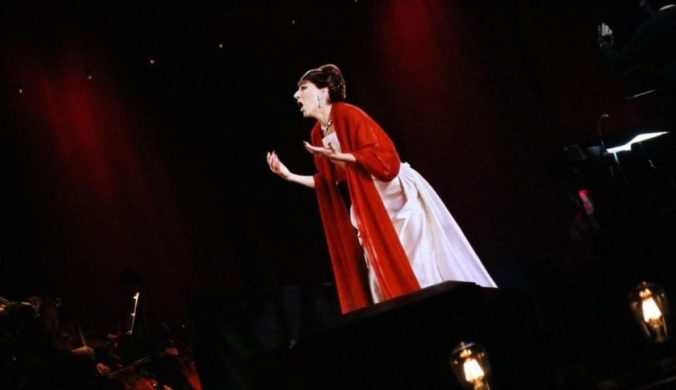
Thanks to the creation of a hologram clone, opera legend Maria Callas,  dead since 1977, appeared onstage at Lincoln Center last week. This is the continuation of a project that previously resurrected such departed stars as Tupac Shakur and Michael Jackson. Roy Orbison, who died in 1988, appeared after Callas. I wonder if he sang, “Pretty Hologram”?

I see where this is going, don’t you? We’re heading straight to “Looker,” the science fiction film directed and written by the late Michael Crichton (“Jurassic Park,”“Westworld,” Disclosure,” “ER,”—How I miss him!).  In that prescient 1981 movie, an evil  corporation transferred the images of living models to a computer program that could use then make the new CGI versions to do and say anything, and do so more effectively and attractively than the living models themselves, in television ads and even in live appearances via hologram. Then the company had the models killed.

In the New York Times review of singing Zombie Callas, the little matter of ethics never was mentioned.  Times critic Anthony Tomassini was not very critical, writing in part,

…[T]here is an amazing video of [Callas]  in Act II of Puccini’s “Tosca” in 1964. But no full operas by one of the greatest singing actresses in history; this hologram performance can seem to fill in a bit of that gap. The operatic voice, and the art form itself, can feel so fragile. What better way to represent that fragility — while also reviving it, in a kind of séance — than a hologram?…In introductory comments, [the director] said that the project has tried to present Callas with “restraint, subtlety and delicacy.” The notion of a singing hologram might seem incompatible with such a goal. Yet moments during Sunday’s preview were surprisingly affecting…The problem, as it always has been in opera fandom, will be if this specter from the past prevents a full appreciation of the vitality of opera and singing today. 

That’s the problem, is it? No, the problem is the same ethical problem I had with regenerating the deceased actor Peter Cushing in “Rogue One”: Continue reading →

I Worry About Cary Grant [Updated]

…and James Cagney. And Kirk Douglas. And Bette Davis. And Rita Hayworth.

Seeing Kirk Douglas at the Golden Globes revived the concern that every Christmas season intensifies for me, when I realize that it is only Christmas that keeps such giants of entertainment past as Gene Autry, Bing Crosby and Dean Martin from fading into permanent obscurity.  The cultural figures who we remember are mostly the beneficiaries of moral luck, not a fair merit-based calculation. It is a random process, and culture, which is significantly defined by who and what we remember and who and what we forget, should not be shaped by coincidence, chance, and random amnesia.

It should not be, but it is. A classic example outside the realm of entertainment is the strange case of  Col. Joshua Lawrence Chamberlain, the hero of Little Round Top in the Battle of Gettysburg, and by some assessments the savior of the Union itself. When the story of Gettysburg was assembled by the battlefield commission, plaques erected and statues placed. Chamberlain’s desperate stand protecting the Union army’s flanks on Day Two of the battle didn’t make the cut. Despite as remarkable a career as anyone from Maine could have, and more than one shining moment of distinction during the Civil War, he was forgotten for more than a century. Then a brilliant, best-selling historical novel, “The Killer Angels,” recounted his heroics leading the 20th Maine so vividly that Chamberlain memory was re-animated, and began receiving the attention from historians that it deserved from the start.

In popular culture, whether a performer’s unique talents and contributions are remembered after more than a generation is now almost entirely dependent on whether there is a film featuring them that is regularly presented on television. Only a handful of performers who have permanently entered iconic status avoid that standard: I’d include Charlie Chaplin, Marilyn Monroe, Fred Astaire, Judy Garland, Shirley Temple and John Wayne in this category, with a few debatable others. (And even the Little Tramp, MM, Fred, Judy and The Duke aren’t necessarily  safe: once Rudolf Valentino, Laurel and Hardy, Lon Cheney, Greta Garbo, Boris Karloff and James Dean could be safely called icons. I doubt one Millennial in a hundred could identify any of them. Marlene Dietrich has a thumb-hold on her iconic status only because of  Madeline Kahn’s film-long send-up of her in “Blazing Saddles.”) Continue reading →

As Expected, The Golden Globes Were Ethically Incoherent

It is not surprising that last night’s Golden Globes award, pre-hyped as some kind of virtuous purging of the old, bad Hollywood culture where men used their power to sexually abuse women, and women submitted–and stayed silent—to achieve power and wealth of their own, was self-contradictory, hypocritical and incoherent.

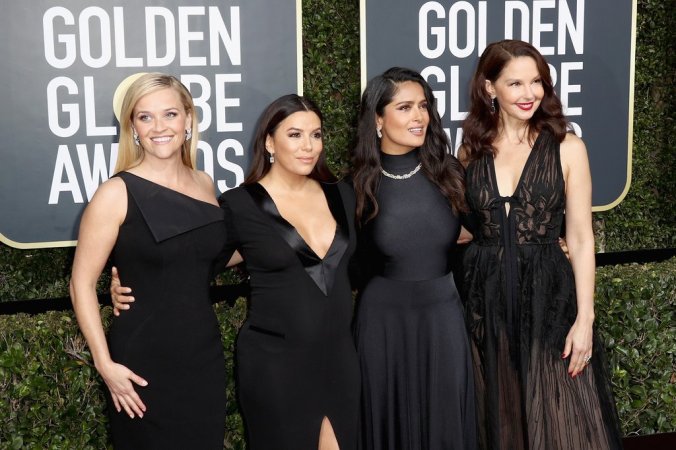
What, for example, did the all-black outfits mean? Here is B-list actress Amber Tamblyn trying to explain in the New York Times:

“We actresses are not just modeling clothing when we walk a red carpet on award show night. We are modeling a kind of behavior. We are speaking in a coded language to other women — even young girls — that says: The way I look and what I wear and how I wear it is the standard for women. What is being worn is not an exception. It is the rule. You must dress a certain way and look a certain way if you want to be valued as a woman, no matter what you do for a living or who you are. We never intend for this to be the message we are sending with what we wear, but often it is the perceived one, whether we like it or not…Tonight, you will see just such an experiment as myself and hundreds of women from the Time’s Up movement will reject colorful gowns for black ones on the Golden Globes’ red carpet and at related events across the country. Wearing black is not all we will be doing. We will be doing away with the old spoken codes in favor of communicating boldly and directly: What we are wearing is not a statement of fashion. It is a statement of action. It is a direct message of resistance. Black because we are powerful when we stand together with all women across industry lines. Black because we’re starting over, resetting the standard. Black because we’re done being silenced and we’re done with the silencers. Tonight is not a mourning. Tonight is an awakening.”

Oh. What? This is Authentic Frontier Gibberish. I sincerely doubt that what actresses wear on the red carpet has as much influence, or even close to it, on young women as what the actresses wear in films and TV. The black is a statement of action? What action? Resistance to what? Anyone who thinks that now, suddenly, a hundred years of a corrupt culture has been erased, and that if a message is sent by a male director, producer or star that an ambitious young actress can prevail over her competition by acceding to a date, a grope, or a night of sex, that won’t get essentially the same results it always has is naive. Tamblyn doesn’t think that, and I guarantee that  Meryl Streep doesn’t think that. This means that the all-black stunt was just grandstanding, and a mass deception upon the public.

If this was genuinely turning the page, why didn’t any of the actors—not one–mention Harvey Weinstein? They didn’t because they are afraid that he might come back, that’s why. Mel Gibson came back. David Begelman came back. Hollywood has a cruel, venal, ethics free,culture, and all of these women and actors know it. They won’t burn bridges, not completely. This is why Rose McGowan, who was the most vocal and audacious of the abused actresses, one who took grave personal risks to accuse Weinstein of raping her and then paying her off, as well as Ashley Judd and Salma Hayek, who both went public with the abuse before other stars felt secure enough to come forward–Hayek wrote that Weinstein threatened to have her killed —were completely ignored during the ceremony. Nobody saluted them. Nobody thanked them. Harvey might take it personally.

When host Seth Meyers, in his opening monologue, mentioned Weinstein, it was with this  jibe “Harvey Weinstein can’t be here tonight because, well, I’ve heard rumors that he’s crazy and difficult to work with.”  (That was an anti-Trump shot, of course) “But don’t worry — he’ll be back in 20 years when he becomes the first person ever booed during the ‘In Memoriam’ segment.”

The crowd, supposedly there explicitly rejecting the Weinstein culture,  moaned and booed. What bad taste for Myers! Imagine, being mean to a rapist! (“See Harvey? I didn’t laugh! Can I read for that part?”) Continue reading →

Morning Ethics Warm-Up, 1/6/2018: The “Too Sick To Come Up With A Good Headline” Edition

He’s lucky: he has hair...

Good Morning!

1 A solution to a perpetual problem. I do the mandatory introduction to legal ethics for two jurisdictions. Both are early in the morning,and both have courts monitoring them, insisting that to get credit, attendees must be present for every second of the course. The problem: late arrivals. One of my jurisdictions had a tendency to let late-comers in if it’s just a few minutes, but sometimes it gets ridiculous. Once the line is blurred, when does it get hard again? I have sen the administrators tell a lawyer that she is absolutely the last one who will get a break, only to see another late comer burst through the door panicked, upset, and with a doozy of an excuse…and then another, and another. This is especially ironic because lawyers are ethically required to be on time to court, or else.

In my other jurisdiction, they deal with the problem by absolute enforcement. 30 seconds late, and you have to come back next month. It doesn’t matter why, it doesn’t matter where the lawyer came from (one had flown in from Seoul and was two minutes late). If you arrive after the doors are closed at 9 am sharp, you can’t get credit. This, as you might imagine, often sparks tantrums, tears, threats, and “Do you know who I am?” One furious attendee actually cast a curse on every bar employee in sight. I’m talking about a real curse, right out of the movies, pointing and chanting. Some months we have had more than ten latecomers in the lobby, acting like an angry mob, and threatening a riot.

This jurisdiction has solved the problem by recently telling all who need the course on the bar website and  in email messages that the program begins at 8:30 am, when it really doesn’t. In other words, the solution is a lie: if someone arrives at 8:59, there’s no problem.

Is this ethical?

2. Oh, this was obviously going to be an ethics rain wreck long ago. AG Sessions announced that the Justice Department would not be following the Obama Administration’s policy regarding federal anti-pot laws—which is to say, it would not signal that it wouldn’t enforce the law. As a result,  Corey Gardner, Republican Senator from happily stoned Colorado, announced that he would block any appointments to Justice until the Department charged with enforcing laws agrees to stop enforcing laws. What Sessions did is not the draconian reversal it has been represented as by the Angry Trump Hate Mob, Stoner Chapter. Read the order from Sessions here.

Never mind. Following the lead of California, which has officially announced that it will encourage breaches of the immigration laws, now Colorado wants to impede the functioning of national law enforcement to force the federal government to let another state veto drug laws. This is what we call “a dangerous and irresponsible trend.”

3.  The Tragedy of Joanie Cunnningham. The New York Times Magazine ended the year with biographical sketches, including the sad story of Erin Moran, aka Joanie Cunningham on “Happy Days,” who died of cancer in 2017. It’s an all-too-typical story of a child star with a dysfunctional family who grew up on a set without ever receiving the parenting and support she needed to be able to become a functioning adult. I knew about Moran’s problems after the show ended; I did not know that her bitterness about her fellow cast members stemmed from her feelings as a child that her TV family was a substitute her real family, and that they failed her. Of course, the Cunninghams, Fonzie, Ralph and Potsie had no duty to become Moran’s surrogate family, but I am not surprised that a child actor would feel this way, especially one who was  being neglected and mistreated at home the way Erin Moran apparently was. Interestingly, child actor advocate Paul Petersen has said that his TV mom and dad, Donna Reed and Carl Betz, did act as his surrogate parents in important and beneficial ways.

I continue to believe that using child performers before the age of informed consent is unethical. Continue reading →

Great, Now I Have To Defend Bill Maher…

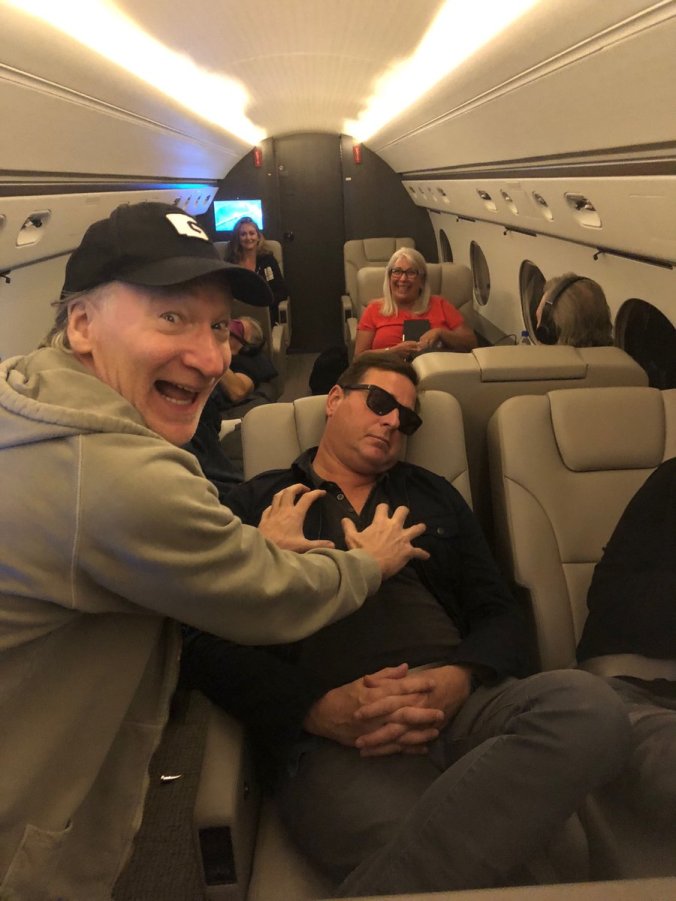
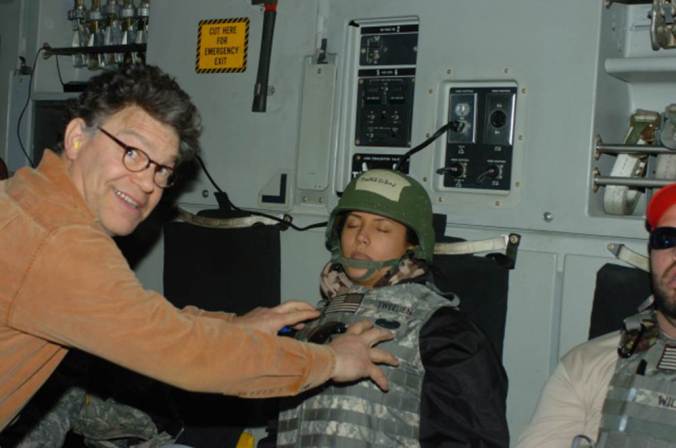
Bill Maher (that’s alleged comic Bob Saget as his “victim”) tweeted out a perfect parody of the infamous photo that triggered the demise of Al Franken, because his own party was fully committed to a sexual misconduct witch hunt, and they thought it might even lead to a successful execution of Plan J, to cancel out the election of President Trump.

Surely you remember the photo…

If there ever was a photograph and a situation begging for satire, this was it. The original photo was a gag that unethically used a sleeping young woman as a prop. Franken handled his apology badly. Then he set himself up as fair game for mockery by weasel-wording his way through the subsequent accusations of sexual harassment and groping, some of which occurred while he was Senator. Finally, he capitulated to a due-process-defying mob led by feminist vigilante Kirsten Gillibrand, and resigned his Senate seat in a snit. Later, Democratic Senators expressed doubts about their knee-jerk attack on Franken, but it was too late. The whole scenario was ludicrous. Ludicrous public events deserve mockery. [ The original version of this sentence read “pubic.” It was a typo, I swear. Thanks to reader crella for the heads up.]

Yet Maher’s tweeted gag is being widely condemned on social media, on a variety of theories, all bad. It’s “too soon,” some say.  Maher is a current events satirist: it’s never too soon. It’s wrong to joke about sexual harassment, others say. Who makes these rules? If the target is President Trump, about seven TV comics feel that they can joke about harassment, senility, nuclear war and incest. Then the ultimate declaration: It’s not funny. No, it’s not funny to those who don’t think it’s funny. It IS funny to those who do think it’s funny, and that’s all a comic cares about. For the record, and I loathe Bill Maher, I laughed out loud. Continue reading →