A wonderful, if infuriating, example of race- and gender-baiting was delivered earlier this year by pop culture pundit Emmanuel Hapsis, and a more ridiculous analysis you will seldom see. I missed it, but the post was no more valid then than it is now.
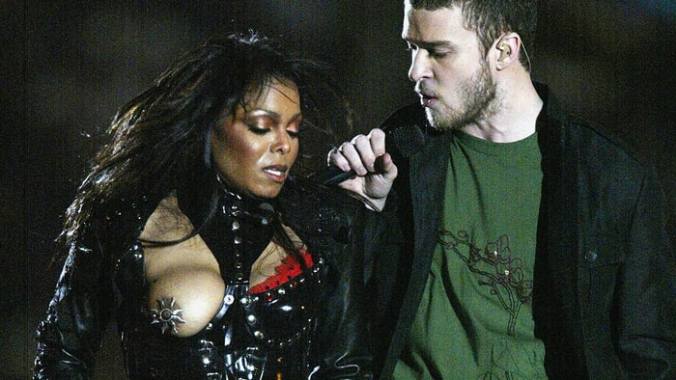
Returning, for some reason, to the infamous episode during the 2004’s Super Bowl halftime show, when Janet Jackson and Justin Timberlake conspired to turn the supposedly family-friendly Super Bowl into a strip tease, Hapsis’s piece is called “Nipplegate Revisited: Why America Owes Janet Jackson a Huge Apology.” During a choreographed duet with Jackson and while singing “Better have you naked by the end of this song,” (talk about rape culture!) Timberlake ripped a pre-rigged portion of Jackson’s bustier to reveal her naked breast. Jackson was severely criticized, as she should have been: after all, it was her breast, and she obviously agreed to allow it to make a surprise appearance, however brief.
Never mind. Hapsis sees the episode as exemplifying America’s “patriarchy,” “racism” and “sexism,” because obviously no white singers flashing ten-year-olds in TV land would be criticized, and no male singer who decided to let Mr. Wiggly make a guest appearance would be similarly pilloried. Continue reading →
Marni Nixon died last month at 86, and I have been intending to write about her ever since. An accomplished soprano with perfect pitch and a rare gift for mimicry, Nixon secretly dubbed in the songs for Deborah Kerr as Anna in “The King and I,” Natalie Wood as Maria in “West Side Story” and Audrey Hepburn as Eliza Doolittle in “My Fair Lady,” three of the most successful and honored Hollywood adaptations of Broadway musicals. In doing so she was assisting in the perpetration of a fraud on critics and audiences, but one that had, and indeed has, some legitimate ethical arguments, and rationalizations too, to justify it. Why is using a stunt singer any more dishonest than using a stunt man? Isn’t film about making the audience accept illusions in pursuit of art? If an audience member will be more likely to enjoy a film thinking that a major star can really sing, why is it wrong to make it possible for them to believe that, at least for a while?
The reasoning would have more power if long before Marnie did her secret singing Hollywood hadn’t already made a classic musical, “Singin’ in the Rain,” that pronounced the practice fraudulent. Marni Nixon was a real life Cathy Seldon, the Debbie Reynolds contract player forced to supply the singing and speaking voice for a talentless silent film superstar, Lina Lamont, whose real voice would make dogs run for refuge and men claw off their ears, and whose continued status as a money-making asset for the studio depended on making her successful in talkies.
Ironically, even “Singin’ in the Rain” engaged in the same fraud it was ridiculing. Debbie Reynolds was a competent singer, but a richer, more mature voice was needed to match the image of Jean Hagen, the terrific comic actress playing Lina. So when Debbie was shown secretly replacing Lina’s nightmarish singing voice with her own, another singer was secretly used, uncredited, to dub Debbie. Her voice fit Lina perfectly, because the voice put in Debbie’s mouth while she was supposedly putting her voice into Lina’s was the real voice of… Jean Hagen. Continue reading →
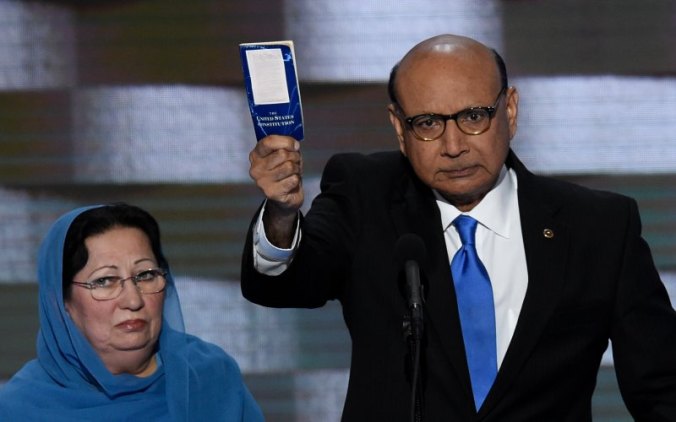
1. The unrestrained cheer-leading from the news media in contrast to its week-long sneer at the Republican is so shamelessly biased that American journalism risks crippling its ability to use its giant megaphone to sabotage Trump. They might at least pretend to be fair and objective. I get it: I find it horrifying that Trump is running too. The immediate and unrestrained effort to go stop him, however, is so openly unprofessional, and shows how far the news media’s ethics have deteriorated just since 2008.
2. We could see and hear, during the course of the convention, how Donald Trump’s boorishness and propensity for ad hominem attacks and personal insults have degraded both parties and political discourse generally. And to think, in 1988, Ann Richards was criticized for her George H.W. Bush attacks at the Democratic Convention, and her famous jibe that Bush was born with a “silver foot in his mouth.” The Democrats could have taken the high road, and would have benefited, as well as done the culture a favor. Nah.
3. The most unethical aspect of the convention was the party’s tacit embrace of Black Lives Matters, while the BLM protesters outside were directing white journalists to “stand in the back” while covering its protests, around the country police officers were facing increasing abuse, and in Baltimore, Marilyn Mosby was graphically illustrating BLM’s attack on the rule of law.
Democrats deserve to pay a high price for this, and I am confident that they will.
4. I owe Senator Eugene McCarthy an apology. I was among the many young supporters of the rebellious anti-war Democrat who felt betrayed when McCarthy refused to address his beaten troops at the 1968 Convention. He stayed in his Chicago hotel room, angry and resentful of how the party had steam-rolled him and his movement. I thought it was cowardly and selfish. Now, after thinking ill of Clean Gene all these years, I realize he might have been right after all. Being gracious isn’t ethical when you are required to become a symbolic pawn to the same dark, unethical forces that you have been telling your throngs to resist and battle despite long odds. If you pull a Cruz instead of a Sanders, you look like you are trying to torpedo your own party. Better, perhaps, to do what Gene did. His integrity told him that the best response was to neither to capitulate, nor be petulant, but just to retreat to fight another day.
I’m not sure he was right, but I’m no longer sure he was wrong.
I had a hard time finding anything unethical about Pokémon Go, the smartphone GPS scavenger hunt game that sends players all over the landscape to find and trap those adorable Japanese monsters that caused a trading card craze and more a decade ago. (I assume that anything that seems really dumb is likely to have ethics problems. You’d be amazed how often I’m right.) It seems benign. The game can be good exercise, it’s engaging for people who have no more productive avocation, and best of all, it gives American something to obsess about not named Bill or Hillary. There are some troubling signs: administrators at the National Holocaust Museum and Arlington National Cemetery felt that they needed to ask visitors not to play the game while contemplating the murder of six million Jews and the fallen heroes of foreign ways—what is these spoilsports’ problem?—and some people are letting the game endanger themselves and others, leading to these morons falling off a cliff, causing this idiot to drive his car into a tree, and prompting this in Arizona…
The Sixties witchery sitcom “Bewitched” is a guilty pleasure, mostly because of the superb cast and unabashed silliness of the enterprise. (I do avoid the episodes with Darrin 2, Dick Sergeant, who took over the role of Samantha’s befuddled mortal husband—without any explanation in the series—after the Definitive Darrin, Dick York, became unable to perform.) A new cable channel is running the series in the morning, and today I saw an episode that delivered a series of shocks that never would have registered in 1968, when it first aired. Some of them should have, though.
The episode, “A Majority of Two” (the title evokes the stage and film comedy “A Majority of One,” about a romance between a middle-aged Japanese man and a Jewish widow from Brooklyn) involves Darrin’s boss, the weaselly Larry Tate, conning Samantha into hosting a dinner for important advertising client Kensu Mishimoto, who is flying in from Japan. Sam agrees—after all, a nose twitch or two is all it takes—but asks Larry what to serve, Japanese or Western cuisine. Larry is prepared: he gives Samantha a note with the name of what Mishimoto’s secretary told Tate was the businessman’s favorite dish: Hung Ai Wan Goo Rash. There being no internet, Sam worries about how she will get the recipe.
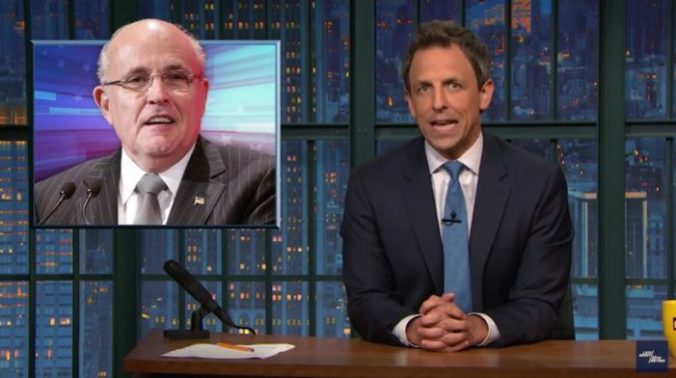
Seth Meyers is a comedy writer and performer, and his job, on the show following the Tonight Show, is to be funny, not to use the program as a platform for his political views. His predecessor twice-removed, David Letterman, increasingly ignored that line as time went on and he moved to CBS. This stratified his audience, and abused his role, but massaged Letterman’s massive ego. (Meyers’ immediate predecessor, current Tonight Show host Jimmy Fallon, may not always be funny, but he knows his place.) Meyers is relatively new to the job, and this week went much, much farther than Letterman ever went, while being supremely smug about it. Here were his hilarious comments last night:
MEYERS: So there were some incendiary and counterproductive responses to the tragedy in Dallas, but there were perhaps no worse response than that of former New York City mayor Rudy Giuliani, who complained, in perhaps the most galling and offensive way possible, that those peacefully protesting for police reform should shift their focus.
RUDY GIULIANI (on video): If I were a black father and I was concerned of my child, really concerned about it, and not in a politically activist sense, I would say, “be very respectful of the police. most of them are good. some can be very bad. and just be very careful.” I’d also say, ‘Be very careful of those kids in the neighborhood and don’t get involved with them, because son, there’s a 99% chance they’re going to kill you, not the police.’
MEYERS: Okay, first of all, don’t ever start a sentence with the phrase, “if I were a black father.” If you are black father, you don’t need to say it. And if you’re not, you should probably just shut the fuck up. And if Giuliani’s willing to say that some police can be very bad, you would think he’d see the value in the Black Lives Matter protests. But instead, he condemned them.
He may be a racist asshole, but he doesn’t play one on TV…
African-American actor Jesse Williams attracted national attention at the BET Awards last month as he accepted the BET Humanitarian Award. Williams launched into the racist black activist version of Authentic Frontier Gibberish, sending out sufficiently loud anti-white dog-whistles that he received a standing ovation from the throng. In response, a petition was placed on Change.org demanding that he be fired from his role on the inexplicably long running ABC medical drama “Grey’s Anatomy”:
“Jesse Williams spewed a racist, hate speech against law enforcement and white people at the BET awards. If this was a white person making the same speech about an African American, they would have been fired and globally chastised, as they should be, but there has been no consequences to Williams’ actions. There’s been no companies making a stand against his racist remarks and no swift action condemning his negative attitude. Why was Burke’s character fired from Grey’s Anatomy after his inappropriate homophobic slur, but nothing for Jesse Williams? Why the one-way street? Why the support for a hater? Why the hypocrisy? #AllLivesMatter All humans bleed the same color. #EqualConsequences4RacistBehavior”
The reference to “Burke’s character” ( Helpful Tip:When you are making a pitch in a petition, take the time to check your facts so people know what the heck you are talking about) was a reference to African-American actor Isaiah Washington, who was fired from his role as Dr. Preston Burke on “Grey’s Anatomy” in 2007 for using homophobic slurs in public, including The Golden Globes telecast, and on the show’s set.
Petitioning to have someone fired for their political opinions is an ethically-dubious enterprise at best, but the allegation of a double standard is apt, because it is a double-standard. The culture nourished by Barack Obama and his political-correctness obsessed regime accepts anti-white rants as legitimate and honorable, but holds the expressing of anti-gay sentiment as grounds for shunning and destruction. Writes professional gossip columnist, celebrity worshiper and silly person Perez Hilton:
“True, Isaiah Washington did ultimately get fired for saying hateful homophobic slurs — but comparing that to Williams’ uplifting speech about equality (that had everything to do with why he was on stage accepting his humanitarian award in the first place) doesn’t make much sense at all.”
Let’s clean that up a bit, shall we? Hilton, who is not only gay but incredibly gay, thinks that homophobic slurs are disgusting and therefore should forfeit the right to make a living, but anti-white diatribes are “uplifting,” so the comparison doesn’t make sense to him.
Here is what Williams said at the BET Awards; let’s see if you find it uplifting. I’ll interject the comments I might have shouted out during the speech had I been there and was willing to be pummeled to death, including notes, probably unnecessary, where Williams descends into Authentic Frontier Gibberish (AFG), social justice warrior dialect class: Continue reading →
The fact that I even know about this issue is both my reward and punishment for being a popular culture junkie.
To bring you up to date: Since the stars of the classic movie comedy “Ghostbusters” are now collecting Social Security (and one of them—Harold Ramis— is dead), Hollywood’s only sensible option to try to squeeze some more profit out of the property (and maybe introduce it to a new generation) was to remake the 1984 film. This was a risky enterprise, for even the sequel with the original cast more or less recognizable was a disappointment, and remakes of classics are inherently dicey. If an original film really was special and the stars truly stars, forcing younger contemporary stars to step into iconic shoes is asking for not just trouble, but humiliation. Poor Alex Cord, for example, never recovered from being cast as The Ringo Kid in a misbegotten remake of 1939’s “Stagecoach,” where he was supposed to replace John Wayne. It can work, as with Jeff Bridges’ turn as Rooster Cogburn, not only a Wayne role but the one that got him an Oscar, only if the remake is sufficiently excellent and different enough in tone and purpose that the original and the remake can co-exist without compelling unflattering comparisons. (“True Grit I” is a funny John Wayne valedictory with a great story; “True Grit 2” is more faithful adaptation by the Coen Brothers of a wonderful novel. I still like the original better.)
The best option, though, is often to make the reboot different in appearance and feel by switching race or gender. This is also helpful when everyone over the age of 13 has seen the original on TV about ten times already. The scheme attracts a new audience, ideally—the first “Ghostbusters” had a male teen demographic—and allows the remake to refer to the first version without seeming like pale copy. Almost never are the non-traditional casting versions big hits, but they can be quietly profitable. “Ghostbusters,” moreover, is a merchandising machine. The original spawned cartoon versions and action figures. Why wouldn’t the new movie?
However this is 2016 America, and everything is political as well as partisan. An all-female remake of “Ghostbusters” was launched with feminist swagger. The new version starring Melissa McCarthy (love her) , Kristen Wiig (great) andKate McKinnon ( also great), excellent comic actresses, given good material, would show that women can and do everything men can do—fight ghosts, make hilarious supernatural movies, be President of the United States. The July opening in an election year was no coincidence; it is part of the Hollywood effort to join the media’s efforts to make Hillary President despite, well, her lack of fitness to lead.
Although the usual naysayers when a classic is recast were immediately critical, most moviegoers were enthusiastic about the project. I know I was. Then the trailer came out. It is bad (you can watch it above). We are used to seeing great trailers for movies that turn out to be boring and horrible, but good movies with terrible trailers are rare because making previews has become a fine art.
The strikingly unfunny “Ghostbusters” trailer was especially ominous for a comedy. The usual method for hyping a mediocre comedy is to put all the funny bits in the trailer; I hate that, don’t you? Not only is the whole movie an unamusing slog with 6 minutes of laughs in 90 minutes of filler, but you’ve already seen the best gags. What does it say, though, when a trailer for an alleged comedy isn’t funny, and worse, the gags included don’t appear to be as side-splitting as the movie’s makers seem to think they are?
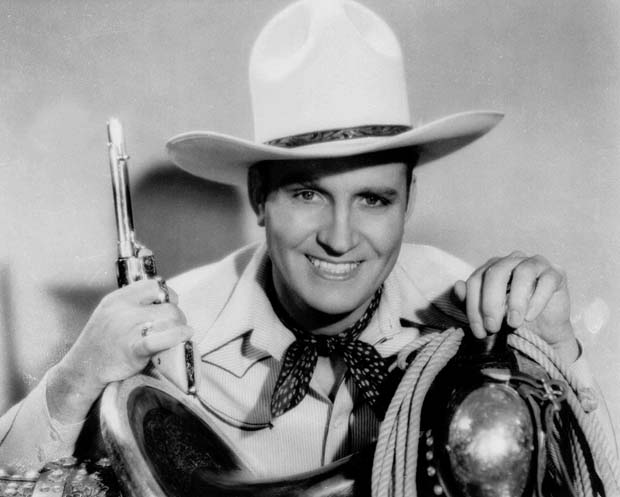
In a legal ethics seminar last week, I was talking about ethics codes and referenced Gene Autry’s version of The Cowboy Code as an example of how most ethics codes could be easily adapted to other professions. I noted that Gene had an amazing career for such an unimpressive looking and sounding performer, with five stars on the Hollywood Walk of Fame, the only individual with that many. (Live performance, radio, TV, movies, and recordings).
“He was also a big producer of pornography!” an elderly lawyer in the front row piped up.
“What?” I said. “Gene Autry? Where did you hear that?”
“Oh, it’s true,” he insisted. “Made him a lot of money. He covered it up pretty well, but the truth came out.”
“Well, I’ll check on that. If true, it’s disillusioning. Thanks.”
But it was not true. I have a lot of material–Gene was active in both show business and Westerns, as well as baseball, so his career was and is very interesting to me—and I searched it and the web for any hint of a pornography reference. I can’t even find a web hoax alleging it.
Not only did that unsolicited bit of false biographical information undermine the point I was making about ethics codes, it spread false information about, by every account, a very nice man and an idol to millions. Now almost a hundred people have it in their heads that the guy singing “Rudolph the Red-Nosed Reindeer,” “Here Comes Santa Claus,” and “Back in the Saddle Again” left the studio and filmed orgies.
I don’t know who the guy was that did that to Gene, but it was an irresponsible, reckless thing to do. You can’t make a statement like that in public and smear a great man’s reputation unless you are absolutely certain of your facts. Obviously he wasn’t sure of them, because they are complete fiction. It’s the kind of thing Donald Trump would say.
I’m usually a poor judge of the posts that attract controversy here. The Ethics Alarms commentary about the Jon Bon Jovi DirecTV ad showing the fading rock star singing the virtues of a “turn back time” feature that will allow subscribers to the satellite service to watch shows from the beginning after they have already run is now five weeks old, and it is still drawing traffic and–I also didn’t see this coming—abusive responses. I haven’t changed my mind about the ad being gratuitously and smugly callous and promoting societal indifference toward children, but I have learned some things from the responses to my pointing it out, especially the angry ones.
This blog isn’t called Ethics Alarms for nothing. Its objective is to help people be more sensitive to ethical issues and the right way to handle them, as well as to give them tools to keep their ethics alarms in working order. My ethics alarms were always unusually sensitive–being raised by my father will do that—and have become progressively more sensitive with attention, trial and error, and study. They aren’t perfect, but when they go off, they go off. If I can find out what they are ringing…training and experience help with that…then I will often write a post about the reason they rang out. My alarms went off every time that DirecTV ad came on, but it took me about four viewings to analyze why. Then I wrote the post.
The commercial has Bon Jovi explaining what’s so great about being able to “turn back time”: in addition to letting you watch the show you missed, he notes that you can have the mild salsa you turned down for a spicy variety, and retroactively decide not to have that second child you now regret. The child is shown drawing on the wall with crayons, and he vanishes as the crayons he was holding fall to the floor. The parents smile. Bon Jovi smirks.
I wrote,
“Why isn’t it immediately obvious that this shows antipathy to children, boys, and human beings generally? The human being who was made to go away because he was inconvenient and burdensome couldn’t have been a girl, because it would be a “war on women,” and the family couldn’t be Hispanic or black, because that wouldn’t have been funny, but a white couple erasing their son from existence because he misbehaves—now that’s comedy gold.”
The comments to the post made me realize that there is antipathy to children, and the concept of turning back time to eliminate an unwanted life is acceptable, and thus no big deal, to a large portion of our culture. Continue reading →




 Ethics Alarms