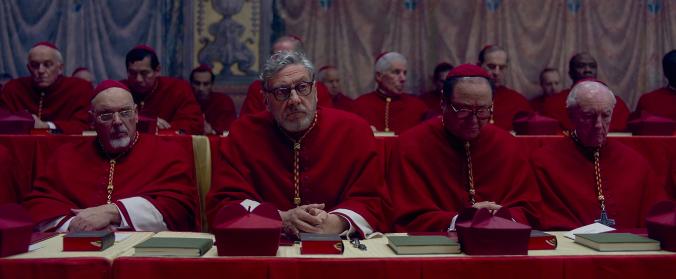
Above you will see three interpretations of what angels—you know, those benign, heavenly creatures we hear on high and observe, “Hark! They sing!,” the celestial guardians like the funny little old man who shows Jimmy Stewart that he’s really led a wonderful life, the kind of immortal being that appeared to Mary to tell her she was going to bear the Son of God, you know, those things?—really look like. The version on the left is from the Mike Flanagan horror series “Midnight Mass.” It’s a scary angel, but not as scary as the ones that show up in Robert and Michelle King’s scary TV series “Evil,” which look like this…
Yikes.
The version of Gabriel in the center is pretty much how I had been taught and told and shown how angels look for most of my life, and I assumed that was how they are represented in the Bible. Now, this is at least partially my own fault for not knowing the Bible better than I do, but when artists, churches, Sunday school teachers, movies, tree ornaments, Christmas cards and children’s books all show angels as friendly-looking Scandinavians with big, white, fluffy wings, I think I can be excused for assuming that there is at least as much authority for those representations as there is for anything else in the Bible—-an assertion to which Carnac the Magnificent (oh, look it up, ye of pop culture deficit!) would say to me, “You are wrong, Ethics Breath!”
I’m probably not celebrating Christmas anywhere but on Ethics Alarms this year. Last Christmas was truly awful in every way, with my wife Grace in pain and suffering from some creeping malady that killed her in February and that I was too blind to detect (and so were her doctors). We were also in our worst financial crunch in 25 years of running our ethics business, my son was having personal problems, and all was definitely not happy and bright.
I am certainly conflicted about the holiday this year. I am a passionate Christmas booster, as long-time readers here know, because I regard the secular holiday as a vital social balm as well as an ethics catalyst. It is a unique holiday that calls on us to be kind, generous and forgiving, and, if possible (I’m trying!) to just be happy for life and its wonders. I am not religious, but I do believe that this is a profoundly ethical time of year. We all need Christmas, frankly. I need it, even though I dread every minute of it this year.
One of the special features of Christmas is that it is soaked with nostalgia and traditions along with bittersweet memories of people and events long past. Charles Dickens got this aspect of the holiday exactly right; it is why I love “A Christmas Carol” so much and have so often participated in public presentations of the story. My last professional directing gig was a staged reading of it, and that was the fourth time I have overseen one; I also have organized and directed three mass “radio” readings, using conference call technology and the sound effects wizardry of Keith Bell. (Where is Keith these days? See, there’s another memory knocking!).
With The American Century Theater, I co-wrote and presented two Christmas musical revues: “If Only In My Dreams,” which centered on the letters GIs wrote home at Christmastime during World War II, and “An American Century Christmas,” a salute to the old-fashioned TV Christmas specials and perennial Christmas movies like the three that have Ethics Alarms “guides’ here: “It’s A Wonderful Life,” which I posted at Thanksgiving, “White Christmas,” which will be updated and posted soon, and on Christmas Eve this year, “Miracle on 34th Street.” The first revue was more popular, but the second was my favorite, because it was generated entirely by my own warm memories of what Christmas was like for me and my sister growing up in Arlington, Massachusetts.
Both of our parents were Depression kids in poor families and their Christmases were spare at best, so both were determined to make the holiday magical for their children. And it was. We would decorate the tree carefully and lovingly a week before the 25th—I remember my mother insisting that each strand of genuine tin tinsel saved for years be placed individually on the branches—and go to bed after hanging our (huge) stockings with visions of sugarplums dancing in our heads. When we got up on Christmas morning, my parents had meticulous constructed a “Christmas panorama,” with the giant stockings stuffed with gadgets, oranges, walnuts and small packages lying by the fireplace, and the whole living room covered with presents, mine on the left of the living room, my sister’s on the right. The gifts were mostly unwrapped, and the vista was ever spectacular.
My father, a photography fanatic who was terrible at his hobby, had the old home movie projector spotlights blazing. He would record Edith and I coming down the stairs to see the amazing treasure left by Santa as mom looked on beaming and eager to see our reactions. My parents insisted on going through this ritual even after we were in college! My mother wouldn’t let the tradition go.
In 1963, the week before Christmas, Bing Crosby hosted “The Hollywood Palace,” a live variety show that was always headed by some entertainment legend, though Bing had the honor more than anyone else. That week he introduced a new Christmas song, the last popular Christmas song to have an unambiguous religious context. That was “Do You Hear What I Hear?,” and the video above was what I saw live. Something in the song immediately resonated with me; I was always a Bing Crosby fan, following the guidance of my father, but I loved everything about the new song despite its childlike simplicity. I said so immediately following Bing’s rendition. Sure enough, the song was playing on our old Magnavox stereo when my sister and I came down the stairs in our pajamas on Christmas morning.
“Do You Hear What I Hear?,” Bing’s version of course though there have been hundreds of covers, is the first Christmas song I play every year as soon as whiffs of holly, evergreens and mistletoe are in the air. It throws my mind back to those magical Christmases that Grace and I tried to recreate for our son every year while he was growing up. That magic was significantly dimmed when my father died, in his sleep, on my birthday in 2009, leading to the saddest Marshall Christmas. The spirit fell away a bit more the next year, when my mother, who never got over losing the love of her life after 58 years of marriage, was in the hospital fighting a voracious hospital infestion that killed her two months later. Christmas was never the same after Mom died: it was her joy and obsession. Still Christmas reminds me of her, and Dad, and that lost magic…and Bing.
I was pondering when and whether to put up a post about “Do You Here What I Hear?” this year when I checked out Ann Althouse’s blog and discovered that she had posted the video as a joke after her post about Jill Biden getting a laugh at her Christmas comments wishing the assembled “joy.” Apparently some took her choice of words as a sly swipe at Kamala Harris’s ill-fated “joy” theme.
In the comments to the post, some wags made jokes about how the shepherd boy tells the king to bring the “child shivering in the cold” silver and gold when what the baby needed was a blanket or a space heater. Yeah, good one: they made those jokes in 1963. Some jackass wrote, “If you listen to the lyrics, “Do You Hear What I Hear” ranks right up there with “Santa Claus is Coming to Town” for supposedly secular seasonal songs with aggressively creepy quasi-Christian imagery applied to Progressive pieties.”
Oh, bite me. The song was never intended to be “secular” and how it can be heard as “anti-Christian” is beyond me. And Bing: he was a devout Catholic, and one of the reasons Crosby became the voice of Christmas is that he sang Christmas music with such reverence and conviction. (The other reason was that he had that amazing, rich, expressive voice.).
It is especially perverse to impugn the lyrics of a Christmas song written by a man with the first name “Noël.” “Do You Hear What I Hear” was written in October of 1962 during the Cuban Missile Crisis, by a married songwriting team that wondered at the time if it would be the last thing they ever did. Regney, the lyricist, was born in France and had studied music at the Strasbourg Conservatory and at the Conservatoire National de Paris. When France was overwhelmed by Hitler’s troops in 1940, he was conscripted into the German army. As a Nazi soldier, Noël secretly joined the French underground and served as a spy, passing information along to the resistance. Once he led German soldiers into a trap where they were massacred by French fighters who cut them down in a crossfire. Regney was shot too, but survived. He then deserted and worked with the French underground until the end of the war. Continue reading →
The Hollywood version of the Broadway cult musical “Wicked” appears to be a holiday box office smash. I suppose I’m going to have to see it, though “Wizard of Oz” worship alienated me long ago and how they can justify making a two hour, 45 minute film of just Act I of a three hour musical mystifies me. However, there is something to be learned from the nanny state’s British Board of Film Classifications (BBFC) felt that it had to put out these ridiculous trigger warnings for what is essentially a family movie:
I got sick of “Law and Order: SVU” long ago, so this 2019 episode, from the 20th season (and it’s still going!) escaped my ethics radar until I reached it by accident this morning and had to watch the whole thing as an obligation to Ethics Alarms.
The episode titled “Part 33” is a perfect example of how popular culture is corrupting American values and ethics problem-solving skills with Hollywood’s constant propaganda opposing personal responsibility, the Rule of Law, and promoting emotion-based judgement rather than decisions based on fact and logic.
This is a short one, but not am easy one, because bias is so likely to be involved.
Althouse posted the [I almost wrote “horrifying,” but that would be biasing you]clip above that has “surfaced” from a podcast earlier this year. (Isn’t it fascinating that virtually no one was paying attention to Harris most of the time until she was suddenly anointed?).
Your Ethics Alarms Ethics Quiz of the Day:
Is it fair to conclude that Harris is an idiot from that response?
Or can her supposed endorsement of astrology (which in my view is about like saying you worship the Greek gods) be excused as just typical politician pandering to a substantial voting block? Althouse links to a list of ten leaders who supposedly believed in astrology, a collection which I would take with about about a truckload of salt. The claim that Ronald Reagan “leaned on astrology for guidance” is particularly weak: he met with an astrologer once, and he indulged Nancy’s interest in the nonsense, as most loving spouses would.
One question that occurred to me as I looked at the list: what is the cut-off point before which it is fair to attribute an individual’s belief in astrology to the absence of scientific knowledge generally?
Here is another installment of a frequent topic on Ethics Alarms: non-traditional casting, DEI casting, and and virtue-signaling stunt casting just to appear woke. The position here as a long-time stage director who has been responsible for some audacious non-traditional casting in my time (I once cast the role Cole Porter with a woman) remains unchanged: if it works and the audience enjoys the show as much or more than it would have with a traditional casting choice, then all is well. (Full disclosure: casting Cold Porter as female did NOT work. At all…)
The mission of any stage production is to be fair to the show’s creators and make the production as effective theatrically as possible, not to make political or social statements that get in the way. (Prime example of the latter: this.)
Curmie sent me a link to “Yes, You Can Whitewash ‘Little Shop of Horrors’, But Please Don’t” at Chris Peterson’s Onstage blog. I love the musical (my old high school doubles tennis partner, Frank Luz, co-starred as the sadistic dentist in the original off-Broadway production and the cast album) based on the wonderful 1960 Roger Corman camp movie classic. I thought its creators would revive the genre, but Disney snapped them up (“The Little Mermaid”; “Beauty and the Beast”) and then half the team, Howard Ashman, died.
Peterson cites the license-holders’ quite reasonable casting note:
The jersey worn by baseball legend Babe Ruth when he “called his shot” in Game 3 of the 1932 World Series sold over the weekend for $24.12 million, setting the auction record for most expensive sports collectible. The previous record price for any sports collectible was the $12.6 million that a rare mint condition Topps 1952 Mickey Mantle card fetched in 2022. Babe’s jersey far eclipsed the $10.1 million a Michael Jordan Chicago Bulls jersey from Game 1 of the 1998 NBA Finals achived at auction that same year, the record for athletic attire until Babe broke it, like he shattered so many records when he was alive.
The sale raises many ethics issues, but the main one is that the exorbitant price is almost certainly based on a fabrication, a lie. It is similar to paying millions for the axe little George Washington used to cut down his father’s cherry tree.
J.D. Vance’s much maligned “cat ladies” snark , like many furiously slammed comments by conservatives and Republicans are, may have focused attention on to a societal trend seriously threatening the health of American society. (If only he could have articulated it better.)
Lately I have been bombarded with TV ads for Smalls cat food. The promotions and commercials claim that it is “human grade” cat food, and why not, since the TV spots feature disturbed individuals male and female, not just proclaiming these animal companions as their surrogates for children, but literally stating that they are children. “He’s my son,” a young woman says in one ad, speaking of her cat. “She’s literally my baby!” says some guy, also talking about a feline “fur-baby.” Literally!
This would be funny in a mordant way if it were not so ominous. I can’t blame cat food companies for taking advantage of the apocalyptic collision of progressive anti-family attitudes in the U.S. and pet mania: so many people do come to regard a dog or a cat as cheaper, more predictable, less demanding equivalent of a child. What is disturbing about the Smalls commercials is that they represent this mindset as healthy and normal.
For some reason, YouTube still has no clean, complete video of the infamous “breaking” performance that embarrassed the Paris Olympic games. (TikTok has one of the better ones, but I can’t embed TikTok.)
EA columnist Curmie flagged this ludicrousness for me [his analysis is here], knowing that my sock drawer problems precluded me from watching any of the goings on in Gay Paree. I didn’t know what to write about Gunn, having already expressed my belief that the dancing component of the Olympics was a breach of integrity and a betrayal of the mission of the Games. I didn’t specifically delve into the addition this time of “breaking,” aka breakdancing, which appears to me to be one more example of woke virtue-signaling in The Great Stupid, a kind of Olympics event reparations for blacks. (Why not clog dancing? Square-dancing? Russian squat-dancing? Tap-dancing? I hear that ballroom dancing may not be far off…)
I supposed technically Margeret Renkl isn’t a film reviewer for the Times: officially she’s a “contributing opinion writer who covers flora, fauna, politics and culture in the American South.” I don’t care: she criticizes an action movie that audiences are enjoying because it doesn’t deliver the progressive agenda propaganda that she thinks good little Big Brotherites should jam into the brains of the trusting public at every opportunity.
Renkle can bite me, and so can the Times for publishing her dreck.
Renkl and the Times concede that “Twisters,” which appears to be the non-superhero hit that Hollywood desperately needs, “ is a humdinger of a summer blockbuster that delivers exactly what theatergoers want in an action film: plenty of explosions, destruction, high-speed chases and heroism, all with a dash of wit and sexual tension thrown in. It is not — and does not aspire to be — high cinematic art.” However, it is, she argues, a missed “golden opportunity to talk about what scientists know and don’t know about how climate change might be affecting the formation, strength, frequency and geographic distribution of tornadoes, or why they now tend to develop in groups.”
No, it’s really not. A movie people want to see for escape and entertainment isn’t a “golden opportunity” for the writers and producers to bombard them with favored and faddish data related to progressive public policy. The Ethics Alarms standard response to the “Why are you talking/writing/singing about what you want to instead of what I want to” is “Write your own blog, direct your own play, produce your own movie or sing your own song.