Ethics Dunce: CBS

"That's Entertainment!"

It took a few days, but Boston viewers finally figured out that CBS’s broadcast of the city’s famous Fourth of July fireworks display was digitally altered to present a spectacular view of the display that is geographically impossible. Yes, CBS, network of Murrow and Cronkite, presented a phony, enhanced version of the fireworks without bothering to disclose to viewers what they were really seeing.

Yesterday Boston bloggers and observers began pointing out that it was  impossible to see the fireworks above and behind such famous locales as the State House, Quincy Market, and home plate at Fenway Park, because the display, as always,  was launched from a barge in the Charles River, located where it could not be seen from those places.

“According to CBS, you can see the fireworks from the right side of Quincy Market, even though Beacon Hill is in the way,’’ wrote Karl Clodfelter, a research scientist and a commenter on the Boston blog UniversalHub.com. “Also, they come up behind the State House when you’re standing across the road . . . which means the barge must have been parked on the Zakim* this year.’’ Continue reading

Thanking Dick Williams…Finally

The late Dick Williams, doing what great leaders do

If you are not a baseball fan, or under the age of thirty, you probably never heard of Hall of Fame manager Dick Williams, who died yesterday at the age of 84. I never met Williams myself, but I have been indebted to him for four decades. I never told him the immense difference he made in my life, just by doing his job.

In the winter of 1967, I was a devoted fan of my home town team, the Boston Red Sox, and had been since 1962.  Over that period I had listened to every single baseball game on my transistor radio when a game wasn’t on TV, which was most of the time, or when I wasn’t at the game, which was almost always the case. I was the only person I knew who followed the team, and for good reason: it was torture. The Red Sox were hopelessly mediocre on the way to awful, and hadn’t had a winning season in more than ten years.

It is a great character builder to follow the fortunes of a terrible baseball team. Almost every day, for six months, you are let down, and yet return to the scene of your despair the next, attempting to muster hope while steeling yourself against likely disappointment. You find yourself finding things to appreciate other than winning: the gallant veteran player who “plays the right way” (Eddie Bressoud, shortstop, 1962-1965); the exciting rookie who gives promise of a better future (Tony Conigliaro, right fielder—rest in peace, Tony); the unique talent who is worth watching for his own sake (Dick Radatz, relief pitcher, 1962-1966). These things help, but following a perennial losing team and caring about them is like being punched in the gut four or five days a week without knowing which day you’re getting it.

Since 1965, I had always reserved seats for the first day of the season and one of the last two home games, just in case those last games would be crucial to a (hahahaha!) Red Sox pennant drive. This was especially pathetic, since the team was getting worse. They had finished in a tie for 9th place in 1966, and as the 1967 season loomed, Vegas had them installed as 100-1 underdogs to win the American League pennant. In truth, the odds should have been longer. Nonetheless, I wrote the Red Sox and got my tickets, this time for the next to last day of the season.

The team was full of rookies and near rookies, and appropriately had hired a minor league manager, Dick Williams, to be the new skipper. Williams was something else, however: he was a gifted leader. One day, in the middle of Spring Training, a Boston scribe asked the new manager what the prospects were for the upcoming season. Would the team escape the cellar? Would there be forward progress? Williams’ answer was instant front page news:

“We’ll win more than we lose.” Continue reading

A Harsh Lesson We Must Learn From Atlanta’s Teachers

There isn’t much enlightening to say about the unfolding Atlanta teacher cheating scandal, but its implications must be faced, as difficult as that is.

Georgia Gov. Nathan Deal revealed this week that award-winning gains by Atlanta students were based on widespread cheating by teachers and principals. The Georgia Bureau of Investigation identified 178 teachers and principals – 82 of whom have confessed – in the biggest cheating scandal in US history. Not the first one, however; there have been a lot of them recently, across the country. The media is pointing to the U.S. education system’s increasing dependence on standardized tests as “the problem.”

I see: the testing made them do it. Continue reading

Marcia Clark, Exploiting the Anthony Verdict for Her Own Sake

Marcia Clark. OK, this really isn't Marcia, but the real picture of her doesn't look like her either.

Marcia Clark’s article on the Casey Anthony verdict is so tainted with obvious conflicts of interest that it should have been rejected by The Daily Beast…or rather would be rejected by any website more selective and less shameless than the Daily Beast. This would be any fair site that does not deal in over-the-top opinion as a matter of course.

Marcia, like her colleague Chris Darden, is a rather tragic figure these days. The former lead prosecutor in the O.J. case is struggling to make it as a pundit, freshly botoxed and rendered almost unrecognizable so as to be fetching in those close-ups. After she sold the inevitable cash-in book about the Trial of the Century, she has wandered in the C-List celebrity wilderness, and will soon join Newt Gingrich and William Shatner as a celebrity novelist. She will be remembered, quite correctly, as the prosecutor who botched the O.J. murder trial, even if we give Darden an assist for the gloves debacle. (Why cable news shows insist on recycling failures as experts is an enduring mystery, the mystery being “how can the producers look themselves in the mirror after choosing recognizable flops over less well-known but more accomplished authorities?”)

But Clark apparently saw an opportunity in the Casey Anthony verdict to rehabilitate her tarnished reputation, and grabbed it. The result is “Worse Than O.J.!”, a new low in self-serving analysis. Continue reading

“Professionalism?” What’s THAT? Julie Chen, CBS and the Descent of Broadcast Journalism

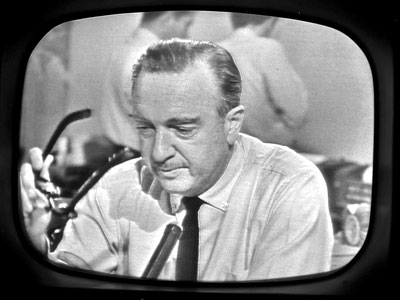
Walter could keep it together. Not Julie Chen.

The Casey Anthony verdict is doing some good: it is exposing the awful deficit in objectivity and professionalism in the broadcast media.

The latest example: while CBS’ “The View” rip-off, “The Talk,” was underway,  viewers saw co-host Julie Chen break down as she tried to read the news that Casey  Anthony had been found not guilty of killing her daughter Caylee. Chen attempted to read the verdict, but was overcome with emotion  and was unable to continue, asking her co-hosts,  “Help me out here.”

In 1937, radio broadcaster Herbert Morrison was correctly criticized for being unable to keep his composure and report the flaming destruction of the zeppelin The Hindenburg without weeping and becoming unintelligible. In 2011, a woman described in her official bio as a “news anchor; reporter; and journalist” couldn’t compose herself to read the news of a not guilty verdict. Continue reading

Ethics Dunce: Mercedes Colwin

It's a mystery: why would Fox News choose her as a legal analyst?

Attorney Mercedes Colwin, an attorney and Fox News commentator, just committed pundit malpractice while discussing the Casey Anthony verdict on Sean Hannity’s radio show. Her professional biography says that she has practiced criminal defense law. If so, she has done so laboring under some serious legal ethics misconceptions.

Said Colwin, in response to Hannity’s query about her past representation of guilty defendants:

“If my client says he did it, then I can’t defend him. I can’t then go into court and say he’s innocent; I’m an officer of the court, Sean!”

What??? Wrong, wrong, outrageously wrong, inexcusably wrong! And also: ARRRRRGHHHHH! Continue reading

Ethics, Porn, and the Creepy Professor

The Ronald Ayers saga raises the intriguing, Weiner-esque ethical issue of whether a college professor being creepy is sufficient reason to fire him.

The former economics professor was fired by the University of Texas for viewing pornography on an office computer, which the University’s policies forbade. The chain of facts has the ring of Kafka: 1) a student claims he hears “sexual noises” emanating from Ayers’ office, which 2) is considered sufficient provocation (the professor denied the accusation that he was not “master of his domain” at work) for the school to search his computer, which 3) uncovers evidence that he looked at some pornographic sites, and 4) also that he searched for the term “teen,” which 5) the university deems sufficient to indicate that he was searching for child pornography, so 6) they fired him, after three decades and tenure on the faculty.

University records say Ayers at first denied the allegations that he viewed pornography, but when confronted with a printout of his computer records, admitted that it may have happened “at the end of a long work day.” Ayers later told administrators seeing the porn was for “academic research.”

Uh-huh… Continue reading

Fick Sighting in Prince George’s County

Leslie Johnson, fick.

Ethics Alarms recently coined the useful term fick to describe the especially shameless individual who violates society’s ethical norms openly, publicly and flagrantly, without remorse or apology. It takes a certain kind of anti-social arrogance to be a true fick, with the gold standard established by Michigan lottery winner Leroy Fick, a millionaire who happily continues to collect food stamps because of a statutory loophole despite howls of indignation from his neighbors in one of the most fiscally-challenged states in the nation.  Other ficks who have come to light include Hugh Heffner despicable ex-fiance Crystal Harris, who plotted to humiliate him at the altar to launch a reality show. Of course, there is  longstanding Octo-fick Nadya Suleman, and celebrity fick Charlie Sheen.

Now lucky Prince George’s County in Maryland has a bona fide fick of its own.  Continue reading

Deadly Incompetence in Seattle….Luckily, It Was Just a Game

I know about the ADA, but still...hiring blind umpires who can't count just isn't working out...

It is rare that an ethics outrage repeats itself so closely that I could recycle a previous essay and just change the names. This occurred, however, in Seattle this past Saturday, in the baseball game between the Mariners and the San Diego Padres. San Diego’s Cameron Maybin walked on a 3-2 count (four balls are required by the rules) and eventually scored the only run of the game on Antonio Gonzalez’s fifth-inning single, allowing the Padres to defeat the Mariners 1-0 on Saturday night.

With one out in the fifth, Maybin walked when a pitch was called high by home plate umpire Phil Cuzzi. A video review of the at-bat by official scorer Dan Peterson confirmed the count should have been 3-2 when Maybin trotted to first base, meaning that his turn at the plate wasn’t completed. But Cuzzi, who like all umpires carries a pitch counter, saw that the stadium scoreboard showed a three-ball count before the pitch, and since 1) technology is always right 2) he wasn’t paying attention 3) he can’t count to “4” and 4) (or is it 3?) it isn’t like calling balls and strikes is his job or anything, he decided that the player had earned a base on balls. Continue reading

Comment of the Day: “The Washington Post Flunks Integrity, Conflicts, and Trustworthiness”

I do want to hold the line on featuring Comments of the Day that I think exemplify awful ethical reasoning, as opposed to those that are provocative and enlightening, to a minimum. This one, however, is too rich to ignore. It is the defense of an apparent journalist for the ethics-busting behavior of the Washington Post in the recent Jose Antonio Vargas incident using a dizzying array of alibis and rationalizations, including “they’re better than most,” “people don’t care,” “you have to cheat to stay in business,” “they are better than the alternative,” and others. It also resorts to the time-honored “who are you to judge?” and “you couldn’t do a better job.”

If this is typical of how journalists view their profession’s ethical obligations—and I think it is—the comment explains a lot. You can read my lin-by-line response after the original post. Here is the Comment of the Day, by okonheim: Continue reading