The parents of black teenager Michael Brown and the city of Ferguson, Missouri, have settled a lawsuit over his fatal shooting by a white city police officer in 2014, according to a court document filed on Monday. …Terms of the wrongful death settlement between Ferguson and Brown’s parents, Michael Brown Sr. and Lesley McSpadden, were not disclosed. U.S. District Judge E. Richard Webber approved the settlement and ordered it sealed.
“The gross settlement amount is fair and reasonable compensation for this wrongful death claim and is in the best interests of each plaintiff,” Webber wrote. Both James Knowles, the mayor of the blue-collar, largely black St. Louis suburb, and Anthony Gray, the lead attorney for Brown’s parents, declined to comment.
Wait, what?
A thorough investigation found Officer Wilson guilty of no crime, nor did the shooting appear to be the result of officer malfeasance or negligence. Brown’s parents, Michael Brown Sr. and Lesley McSpadden, meanwhile, took extraordinary measures to stir up racial hatred and anti-police sentiment, not just locally but nationally, sparking deadly riots in Ferguson and elsewhere, and leading to attacks on police. They even made a human rights complaint to the United Nations, based substantially on a lie (“Hands up! Don’t shoot!”) concocted by their son’s friend and credulously reported as fact by the news media. By what theory are Brown’s parents deserving of damages from Ferguson? By agreeing to this settlement, is not Ferguson setting the precedent that any time a black suspect is shot by a white police officer, it is a wrongful death mandating damages?
Your Ethics Alarms Ethics Quiz of the Day:
Was this settlement, whatever the amount, ethical?
I’ll launch the debate by saying that the city probably had no choice but to settle, as the sooner this whole catastrophe can get in the rear view mirror the better off the city will be. In the narrow sense, then, the settlement was in the city’s best interest and the responsible course.
Long term, however, I see nothing but bad results flowing from this result. If Wilson was not wrong, then Brown was at fault. If Brown was at fault, his family should not benefit. If Ferguson paid out a significant amount when its police officer behaved reasonably, then Ferguson just set a precedent that Black Lives Matter could have authored in its dreams.
If a black victim is shot by the police, it is racism and a wrongful death per se, whatever the facts are.
“A few hysterically censorious kids screaming for a professor’s termination for crimethink do not threaten the foundations of free speech, but Yale lauding them does. Relatively few thugs disrupting a speech and even physically assaulting a professor don’t call into question the culture’s support for free speech, but Middlebury offering weak slaps on the wrist and shrugs for that violent behavior does. A violent mob in Berkeley does not undermine the legitimacy of free speech doctrine — a mob is a mob — but Berkeley’s timorousness or indifference in the face of violent censorship does. Students furious at a professor disagreeing with them don’t call into question the nation’s commitment to freedom, but state officials refusing to guarantee a professor’s safety do. In short: the regrettable behavior of officials who have failed to stand up to disruption of speech are the people most responsible for legitimizing further disruptions of speech, whoever commits them.”
——Lawyer/blogger/ free speech champion Ken White, writing about efforts on both the Left and the Right to interfere with or punish speech and opinions they don’t approve of.
Well and truly said, Ken.
Ken continues,
“But we can, and should, do better. Commitment to free speech as an American value — as an element of American exceptionalism — has always required tolerating evil and injustice and idiocy. We don’t refrain from disrupting speech because the speakers deserve it, or because we’ve been treated fairly by the speakers or their allies. We refrain from disruption — and ought to punish those who disrupt — because free speech is the necessary prerequisite of a society based on individual rights and freedoms. It’s the right that’s the gateway to all other rights. Shrugging and abandoning it as a value is an abandonment of our commitment to all rights.”
Why is this so hard to teach in colleges? Perhaps because the faculties and administrators prefer that their students never learn it.
1.Senator Diane Feinstein redeemed some of the Democratic Party’s integrity by stating that James Comey’s revelations regarding Obama AG Loretta Lynch’s directive that he lie to the news media and the American people so they wouldn’t think Hillary Clinton was being investigated warranted hearings and its own investigation. This was easily the biggest story to come out of Comey’s testimony, as the U.S. government using its power to influence a Presidential election by spreading misinformation is far more serious than a foreign power influencing an election by allowing the public to see what a candidate and her party have been covering up. (I have stated the issue this way before, and will continue to do so, since it is accurate and true.) That this damning account was mostly buried by the New York Times, the Washington Post and the broadcast media is yet one more smoking gun (as if more were needed) proving just how partisan and untrustworthy the news media has become. It also should focus more attention on the still-percolating IRS scandal, speaking of subordinates interpreting a leader’s expressed desires as directives, as well as Barack Obama’s repeatedly demonstrated belief that the ends justifies the means in the 2012 campaign, the passing of the Affordable Care Act, the Iran deal, and more.
2. NY Times op-ed columnist Charles Blow, a smoking-gun himself since the Times’ refusal to discipline or can him when he repeatedly used anti-Mormon slurs to attack Mitt Romney, has become the loudest shill for “the resistance” at the paper–quite an achievement, since the whole paper is a shill for “the resistance”—reveals that 43% of the public (according to polls, remember, and we now know how reliable and unbiased they are) believe that Congress should commence impeachment hearings. Blow finds this tragic, but the only two interpretations of the data is that 43% of the public is civicly, legally and historically ignorant, that 43% of the public has been completely misled by the biased reporting of the news media, or that 43% have embraced the anti-democratic view of impeachment being pushed by progressives and “the resistance,” which is that it is a legitimate device to undo elections and ensure that the Left achieves permanent rule over us all. Writes Blow, sniffling,
“I know well that the very real obstacles to removal injures the psyche of those worn thin by the relentless onslaught of awfulness erupting from this White House. I know well that impeachment is one of the only rays of hope cutting through these dark times. I’m with you; I too crave some form of political comeuppance. But, I believe that it’s important to face the very real possibility that removal may not come, and if it does, it won’t come swiftly. And even a Trump impeachment would leave America with a President Pence, a nightmare of a different stripe but no less a nightmare.”
It should bother everyone that a man like this has a regular, high-visibility platform for his corrosive views. Impeachment is national convulsion that good citizens only hope for when a President has engaged in impeachable acts. Blow and other like him, who hope for those impeachable acts to justify removing a President they object to on ideological, personal or other grounds are just people with busted ethical alarms, bad citizens, bad neighbors, and dangerous to our democracy.
3. Here is an ethics train wreck from academia.A white professor at the University of Tennessee asserted via a multiple choice quiz ( Colleges use multiple choice quizzes?) that the statement “Black family bonds were destroyed by the abuses of slave owners, who regularly sold off family members to other slave owners” was wrong. A black student vehemently disagreed and challenged the teacher, who then threatened to “get” the student on Facebook. After the professor was pressured into resigning by the university, she emailed the class with a further attack on the student, without using her name. Naturally, the student has decided that this single incident shows the lurking perfidy of white social justice warriors, or to put it bluntly, “Can’t trust whitey!” How do people like the professor get hired? Since when is a professors position “unacceptable’ because it disputes conventional wisdom? Is race immune from non-conforming academic views? And why are college courses using multiple choice quizzes? [Pointer: Fred]
4. Also from Ethics Alarms Super Scout Fred: this study, showing that Oakland police officers “tend to speak less respectfully to black people than to white people during traffic stops, using language in these everyday interactions that can erode community faith in the police, according to a first-of-its-kind study of body-camera footage released Monday by Stanford researchers.” Ugh. Now that’s “ microagression,” and maybe not so micro.
Ethics diagnosis: incompetent training, negligent oversight, and dead ethics alarms.
5. CNN has a lot of work to do before it can claim to be a professional and trustworthy news source, and one obvious step is to fire Brian Stelter, the network’s alleged journalism ethics watchdog. His predecessor Howard Kurtz was pretty bad, but Stelter is pure flack, seeing his main function as defending CNN and his secondary function as denying media bias, since he is so shockingly biased himself.
Yesterday on his ironically-named show “Reliable Sources,” Stelter and guest Jeff Greenfield blamed President Trump for polls that show a steep decline in public trust of the news media. Greenfield said, “I think that has served that relentless campaign on Twitter and in his comments, fake news, fake news, fake news has been to convince that group of people that there is no such thing as a set of facts independent of your politics. And that has certainly served to continue and accelerate what you’ve talked about as a long process of declining trust in news.”
The downward trend will continue until prominent members of the news media admit that the reasons trust in journalism have declined precipitously are
That the mainstream media’s partisan bias is obvious and palpable,
That has proven itself untrustworthy, and
Arrogant hacks like Stelter and Greenfield make it clear to all willing to see reality that the news media thinks that there’s nothing wrong with its reporting.
As for President Trump, he has an ethical and professional obligation to focus attention on the news media’s shift into a partisan political force, both to prioect his administration and to ensure that the public isn’t deceived. The previous President was happy to ignore this dangerous development, because Obama foolishly thought he benefited from it. In truth, he and the nation would have benefited more by journalism that held him to higher standards and criticized him when he deserved it, which was often.
1. Mainstream media bias has been such a frequent topic on Ethics Alarms that I hesitate to focus on it even when, against all odds, what passes for American journalism has another rotting chunk fall off. The reaction of most of the media to the Comey testimony was a huge chunk, once again shocking me when I didn’t think my regard for this unprofessional profession could sink lower. Some commentators yesterday (they were conservative, but there is no reason a fair and objective liberal wouldn’t and shouldn’t come to the same conclusion) said that we are witnessing the birth of a mainstream media-progressive fusion political party. This is not a hysterical analysis. The New York Times coverage of the Comey hearing, for example, was so misleading and dishonest as to eliminate that paper from ever being regarded as a reliable political analyst again, at least until it cleans house and issues an abject apology to the nation. Ethics Alarms reader Greg did an excellent job detailing the Times’ disgraceful anti-Trump/pro-resistance spin in the thread on the Comey testimony post, as did journalist commenter Tippy Scales.
The Times knows its first take was untenable; you can tell by its editorial today, in which it already is changing the subject. If Comey had laid a glove on Trump (and he didn’t) regarding impeachable conduct and a route to removing him—which was the Left’s fervent hope and the resistance’s confirmation bias-driven fantasy—the Times would have been shaking its fist and demanding action in it Sunday pronouncement. Instead, it offered an extended whine about how Paul Ryan excused Trump’s clumsy handling of his communications with Comey by citing Trump’s inexperience, but that he had condemned President Obama for his inexperience, as if the two positions are inconsistent. First, they are not: Ryan did not support Trump’s nomination, though political inexperience was the least of his disqualifications. Second, the President’s cluelessness is directly relevant to the weaker than weak argument that he was obstructing justice by having the kinds of conversations with a subordinate that is commonplace in a business setting. The Times, as it has been doing a lot lately, simply assumes away an insuperable obstruction to its “resistance” position, , saying that “The president obviously knows that it’s wrong to interfere in an investigation.”
Like Hillary Clinton, apparent cyber-dolt, “obviously” knew that using a private server for State Department business violated classified communications law?
The same logic that Comey himself used to give Clinton a Stay Out Of Jail pass applies to Trump’s statements to Comey, but far more reasonably. Not only was he not, as Ryan said, “steeped in the long-running protocols that establish the relationships between D.O.J., F.B.I. and White Houses,” the President wasn’t interfering in the Flynn investigation by telling Comey he hoped it would end, and he couldn’t interfere in the Russian investigation by firing the FBI director. The Times editorial reveals the real impetus behind the paper’s determination to bring down the President who dared to be elected by “deplorables” who don’t march to the Times’ ideological lock-step: Trump “[struts] about at the head of the party, insulting everyone and everything in sight: staff members, allies, laws, diplomatic decorum and common sense.”
Yes, for once the Times is reporting accurately, but that’s not grounds for removing an elected President, and it does not justify misrepresenting facts to create a public groundswell based on bias, hate, fear and ignorance.
2. And when it is clear that the news media and the Democrats are coordinating in an “Anti-Trump” party, what is a responsible stance for the Trump Administration regarding news organizations who wave the anti-Trump banner at the expense of fair reporting? Continue reading →
The post about John McCain’s troubling performance during the Comey testimony inspired this thoughtful comment by dragin_dragon, a self-professed senior citizen (although I had no idea), on the related topic f officials knowing when age and/or infirmity create an ethical obligation to step down and retire in the interests of society.
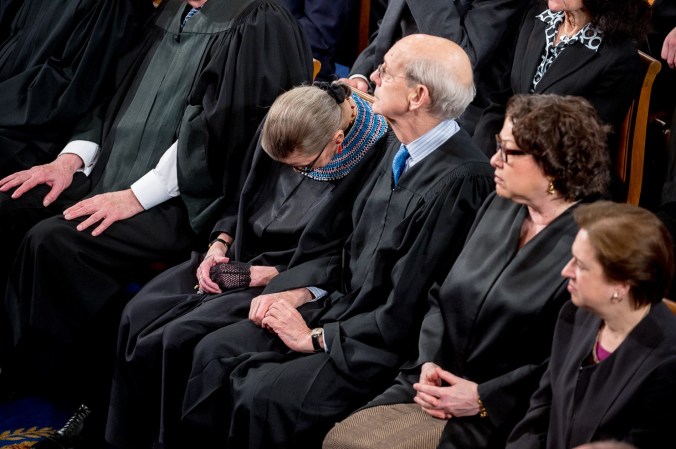
The confounding factor, and one that becomes a powerful rationalization for those who want to stay on in important positions long after their metaphorical pull-date, is that many of them can truthfully argue that their age-ravaged abilities are still better than most of the younger alternatives. Or, as my sister said during a discussion on this topic, “I’d rather have Justice Ginsberg with half her marbles than anyone Trump would nominate.” I bet that’s how Justice Ginsberg is thinking too. Then there was that attorney with a drinking problem who everyone in the firm agreed was twice as good as any attorney in the firm when sober, and 50% better when drunk as a skunk.
Does that mean the firm should be satisfied if he’s drunk all the time? Isn’t this the same as the age diminished once-brilliant judge?
There comes a time in anyone’s life when it should be obvious that it is time to “Hang up the guns”. In my own life, I am but 71, and I am seeing numerous anomalies in my behavior (walking into a room and wondering why I am here) and in my rational thought (I suspect most who have read my comments sometimes have the same question). I am getting to where I lose debates to my wife on a regular basis (she’ll tell you I’ve always done that). More to the point, I am AWARE of the beginning deterioration. I am wondering if John McCain and Ruth Ginsberg are.
Another thought had occurred to me, however. After realizing that there was some slippage, I have refused an opportunity to run for Alderman and for Mayor of our little newly-incorporated city, because I honestly did not feel I would be able to do the job, either of them, justice, either mentally (what’d you say my name was again?) or physically. I’m winded some mornings after tying my shoe-laces. However, I am reasonably certain that narcissism plays little part in my personality. I suspect it is a BIG part of most elected officials (city, county, state, national) personalities. The idea being “Nobody but ME can do this job properly”, or in some cases, “Nobody but me can do this job, period, well or poorly.” Continue reading →
The post on Facebook hysteria over the U.S.’s decision to withdraw from the largely symbolic Paris climate change accords has drawn perplexing commentary. The post did not assert a position on climate change, nor did it defend the reasons given for the withdrawal. The post simply stated that it was irresponsible and dishonest to claim dire consequences of the decision when the accord itself is almost entirely symbolic, requires nothing, in the sense that there are no enforcement mechanisms, and can’t possibly carry the existential weight that social media, politicians, pundits and activists are claiming. It is all appeal to emotion and ignorance.
And it is. Especially since most of the social media hysterics haven’t read the accord and are illiterate regarding climate science.
And they are.
I guess I knew that both climate change flacks and those suspicious of them would shift gears into the messy issue itself and its controversial research and models. The dreaded (and misleading) “97% of all scientists” stat even made its appearance, although, again, it was irrelevant to the post.
Finally, Zoltar Speaks!, Popeye-like, declared that “I ain’t gonna take it, ’cause I can’t take no more!” after a side debate over whether the infamous hacked e-mails among climate-change researchers “proved” that there was a conspiracy to distort the science on climate change (no, they prove that the scholarly research community members are not as objective and independent as they are professionally obligated to be, and that this makes their conclusions inherently untrustworthy). He produced an epic essay in response, so long and detailed that he posted it on a satellite blog. With his permission, I am posting it in it’s entirety here.
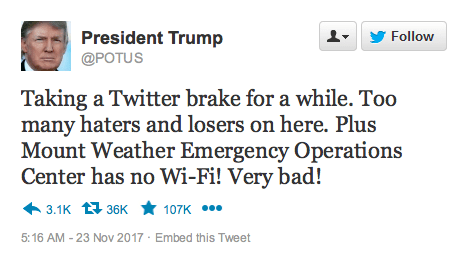
I’ve GOT it! Make Trump move to the Mount Weather Emergency Operations Center! Problem Solved!
Flat learning curve. That’s really the most alarming thing about President Trump’s tweet barrage over the weekend, as he responded stupidly, irresponsibly and offensively to the terror attack in London. It proved that he hasn’t learned a thing, despite repeated Twitter-assisted catastrophes that in the past have turned potential victories into embarrassments, mere mistakes into disasters, and whimsy into large clubs for his enemies to beat him bloody with. How could he not be wary when he considers a tweet? What happened to “Once burned, twice shy?” How about 6,348 times burned? How analytical do you have to be to think, after hitting yourself in the head squarely with a 2 X 4 and realizing that it is permanently dented (the head, not the board), “Wow! That hurt! I sure don’t want to do that again!”?
And yet here we are.
I can’t say I’m surprised, and that itself is depressing. But I’ve dealt with enough alcoholics in my life who I have asked, following particularly devastating relapses that placed everything they cared about (or should have cared about) in jeopardy, “Why would you do that, after all you have been through?”…and watched them shrug, shake their heads, and say, in various words, “I can’t explain it, and you’ll never understand.”
After the two attacks on Saturday, the President’s tweets weren’t all terrible. The second one read, “Whatever the United States can do to help out in London and the U. K., we will be there – WE ARE WITH YOU. GOD BLESS!” Then, like a binge drinker out of rehab who takes a small sip of chablis at a reception, POTUS was on a Twitter bender—a Twender. He began exploiting the tragedy to lobby for his stalled travel ban. He blamed the attacks on political correctness. He mocked the Mayor of London. He somehow saw the episode as revealing the hypocrisy of gun control advocates. Metaphorically, the President of the United States was reeling and staggering all over the street, singing “Barnacle Bill,” stopping traffic and vomiting on pedestrians. Continue reading →
I guess no good deed really does go unpunished: I stand up for the vile and hateful comedian’s legitimate use of “nigger” in a witticism on live TV, and the former host of “Politically Incorrect” caves to political correctness, which he has sworn repeatedly that he will never do.
“Well, you know, I’ve been through this so many times. There’s a lot of people in America who have, of course, nothing to do except look for something to get mad at. And I’ve been a frequent target and I’m happy to provide that service. So, you know, I always say, as I’ve said many times in these kind of situations, if I hurt somebody’s feelings, I’m always sorry about that, I’m not trying to hurt somebody’s feelings. But if you want me to say I’m sorry what I said was wrong, no, sorry, I can’t go there.”
I guess what he meant is that he can’t go there when he’s only using vile language to denigrate conservative women who feminists and NOW don’t regard as worthy of their alleged principles, in attacks that make his ideologically sympatico crowd secretly snicker and chuckle because those twats deserve it.
This time, however, he offended the all-powerful race grievance lobby by calling himself—himself!— a “house nigger,” in a “Gone With The Wind” reference prompted by a Republican Senator asking him if he’d do field work. Lacking the integrity and fierce belief in the Jester’s Privilege that he has proclaimed before when it wasn’t progressives carrying the torches and pitchforks, Maher capitulated like Galileo, even though in this case, he had been neither vicious nor insulting, just “offensive” to those who want to ban words—you know: liberals.
Midnight Friday morning, CNN was analyzing the GOP’s perplexing win in Montana’s special election for the House of Representatives—perplexing to Ethics Alarms because the winner, Gianforte, is a dishonest thug, but perplexing to CNN because their reporters were desperately hoping for a sign that voters were turning on President Trump, something their network has been working on for many months. CNN’s Media reporter Dylan Byers then blurted out this remarkable statement:
“There’s this conversation that’s happening among people following the news industry, which is how can we bridge the sort of gap between all of those conservatives who don’t trust the media, and get them to start knowing that, you know, we’re acting in good faith, with good intentions? Maybe you can’t, because they’re not even listening. From the second, it’s not as though they’re reading the article and considering it, or listening the audio and considering it. They’re just not paying attention to it, because they don’t trust us.
And this, by the way, you look at the tapes of Trump there. Two things have happened. One, over the course of several decades, the conservatives have done a masterful job at capitalizing the waning trust in media and using it to their advantage. But a second thing has happened, too, which is, on occasion, more than the media would like to admit, we have not told the story of conservative Americans, disenfranchised Americans, who believe that they are losing their country. The story we have largely been telling is a story that is more or less in step with the arc of history as defined by Barack Obama and Hillary Clinton. It does not mean we favor them to win. It just means that sort of vision of a progressive future, a global future, and that is not one that resonates with so many conservative American voters.”
“The story we have largely been telling is a story that is more or less in step with the arc of history as defined by Barack Obama and Hillary Clinton.”
It is notable that none of the three journalists on the panel with Byers challenged this damning characterization. Continue reading →
Becoming the first Ethics Alarms comment to achieve a Comment Of The Day on consecutive days is Ryan Harkins. Ethics Alarms has a fair number of lawyers contributing regularly, as well as teachers, doctors, a theologian, business owners, managers, ex-military, scholars, and other professionals, plus practitioners of various trades and the arts. I have been hoping for more engineers to join the discussion, and Ryan brings that perspective along with his communications skills.
Here is Ryan Harkins’ Comment of the Day on the post, The Good Hoax:
While I was a graduate student at the University of Wyoming, one of my office mates was approached by a group who offered, for a couple of thousand dollars, to do all the research for his Master’s Degree and write up the results in a guaranteed-to-pass thesis. Supposedly my office mate tracked down some of the reviews of this group and found that some had indeed managed to attain a Master’s using services like this. As a disclaimer, I didn’t personally follow up on it, or investigate to see if people were later identified for their fraudulent activity.
A year or two later, my advisor was showing me a website that generated very scientific-sounding, but utterly meaningless journals, complete with references. The abstracts this random generator produced weren’t too far off from some of the jargon-laden examples quoted above. One of the claims to fame of this website was that it had actually managed to get a couple of these randomly-generated papers approved at conferences. I think this link to SciGen will take you to the site my advisor found.
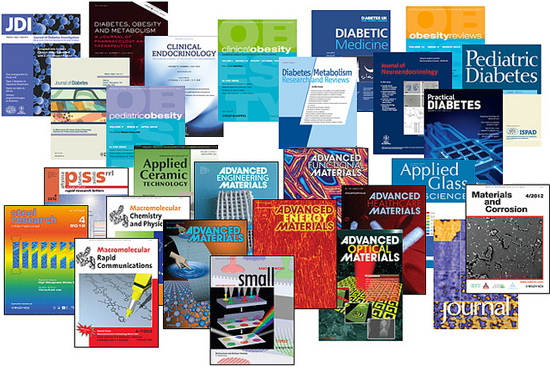
My time in academia impressed on me that journal papers are far from the infallible entity we would like them to be. There were people in my field (theoretical computer science) that had a reputation of getting three papers out of each finding they’d made: the initial paper, the correction of the initial paper, and the correction of the correction. I was always worried that, if I ever actually made any findings worth publication, I would have missed some error in my logic that would render my results invalid, and yet people for decades hence would utilize my results in their research, leading to error cascading down for generations. Continue reading →