UPDATE: Cyber-Zombie Peter Cushing And The Prospect Of Cyber-Zombie Carrie Fisher Remind Actors To Fight For Control Of Their Post-Mortem Acting Career

cgi

It looks like I wasn’t the only one who felt that Peter Cushing was being abused by finding himself in “Rogue One” without his prior consent. Of the late actor being digitally inserted into a role he never agreed to play and deliver lines he never contracted to deliver, I wrote…

The emerging technology raises many ethical issues that didn’t have to be considered before, but when it comes to using a dead actor in a new role, the ethics verdict should be easy. It’s unethical, unless a performer  gives informed consent for his image to be used post mortem in this fashion. Presumably, the consent or the lack of it will be part of future negotiations and standard contracts. Actors who agree to have their images used as cyberslaves will also probably want to limit the uses of their names and images.

Cushing’s exploitation and the subsequent death of Carrie Fisher with widespread speculation that she would soon be added to the “Star Wars” franchise’s army of CGI clones have now sounded the alarm loudly. But apparently many actors were already aware of the threat, and taking affirmative action to control their destinies. Continue reading

The Professor’s Blackface Salute: An Ethics Mess

oregon-blackface-mashup

Halloween costumes, political correctness, law, privacy, and the Niggardly Principles—this one has it all.

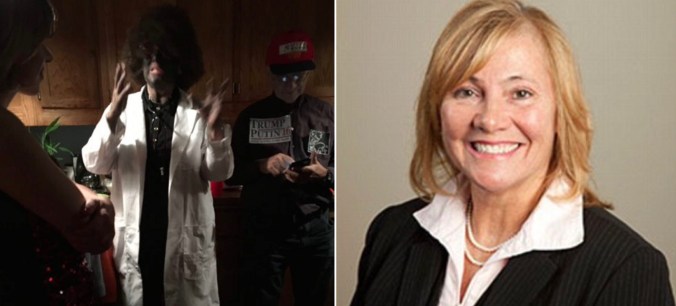
Last Halloween, University of Oregon law professor Nancy Shurtz dressed as Dr. Damon Tweedy, the author of Black Men In A White Coat , as an homage to the African American physician and author. She did this at a Halloween party in her own home. Nobody at the party appeared to misunderstand the gesture or the intent of the costume, in part because she could explain it on the spot, and because they knew that Shurtz was no racist. Shurtz had also told the students who were invited that she would be “going as a popular book title,” hence the blackface, Afro wig, white coat, and  stethoscope.The university report on the episode states that Shurtz “was inspired by this book and by the author, that she greatly admires [the author] and wanted to honor him, and that she dressed as the book because she finds it reprehensible that there is a shortage of racial diversity, and particularly of black men, in higher education.”

But as always happens now because there is no such thing as a reasonable expectation of privacy even in one’s own home, reports of Shurtz in costume and make-up got out into the campus at large, and inflamed the predictable outrage. The university launched an investigation that culminated in a critical report prepared by an attorney and the university’s Office of Affirmative Action and Equal Opportunity.  Shurtz issued an apology—for her private conduct within her own home that was pounced upon by Political Correctness Furies, since she appears to be one herself-–on November 1. Some of her colleagues on the faculty and many students demanded that she resign, and she may have to yet. Shurtz has been censored and suspended, and is now on paid leave. It being claimed that her wearing the costume–within her own home as a gesture that all agreed was intended as benign and that nobody at the party either objected to or failed to understand— created “a hostile environment” at the school. This is apparently because

“as part of the uproar, students said things of which the administration disapproved: The report specifically notes that students used “other offensive racially-based terminology during class times in the context of discussing this event and broader racial issues.” It related that “some of the witnesses reported that the students’ reactions to the event were racially insensitive or divisive.” And it apparently viewed such statements as relevant to whether Shurtz’s own speech was properly punished.”

The report, meanwhile, concludes that the costume constituted “harassment,” and that her intentions are irrelevant.

Writes First Amendment expert Prof. Eugene Volokh: Continue reading

“Rogue One” Ethics: Peter Cushing Returns From The Grave

He's baaaaack!

He’s baaaaack!

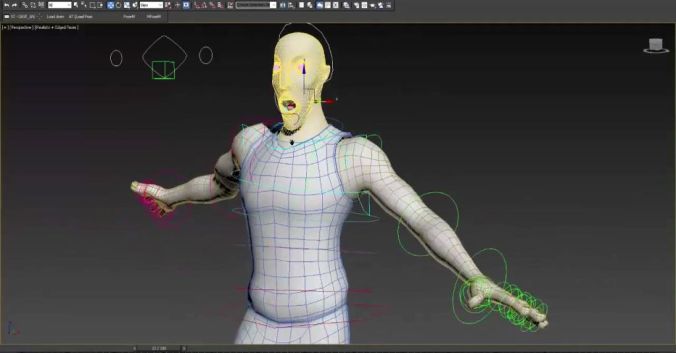
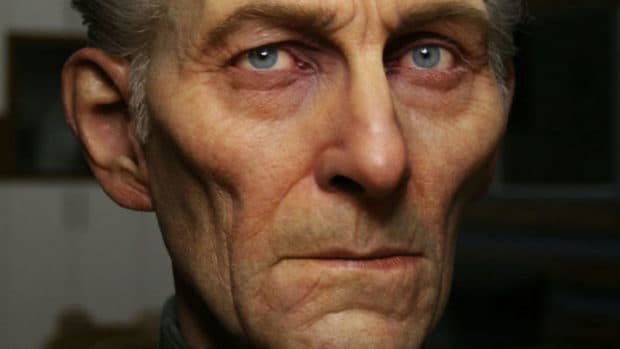
Hammer Films horror icon and Christopher Lee foil Peter Cushing died in 1994 from prostate cancer. That couldn’t stop the makers of the latest “Star Wars” movie from bringing his image back from the grave.  The gaunt-faced British actor—an early “Doctor Who”!—played Grand Moff Tarkin in the original “Star Wars,” a bad guy, Cushing’s specialty. Since “Rogue One,” the current addition to the series, is a prequel, Tarkin is alive again (he went down with the Death Star in Episode IV). Instead of recasting the part, the producers decided to recreate Tarkin/Cushing using CGI technology. Lucasfilm-owned digital effects house Industrial Light & Magic reanimated Cushing’s likeness so that a recognizable Tarkin could make a convincing  appearance in “Rogue One.” The results are not perfect, but it is still one step closer to allowing future movies to cast avatars of long dead stars to interact seamlessly with live performers.

We have recently seen actors like Arnold Schwarzenegger, Jeff Bridges and Anthony Hopkins digitally youthened, but forcing a dead actor’s image to perform is a different matter entirely. The use of computer animated images of dead performers to do the bidding of their director masters evokes memories of “Looker,” a science fiction film directed and written by the late Michael Crichton of “Jurassic Park” and “Westworld” fame. In that 1981 movie, a corporation transferred the images of living models to a computer program that could use the new cyber-models to do and say anything more effectively and attractively than the models themselves in television ads. Then the company had the models killed—less residuals that way.

The emerging technology raises many ethical issues that didn’t have to be considered before, but when it comes to using a dead actor in a new role, the ethics verdict should be easy. It’s unethical, unless a performer  gives informed consent for his image to be used post mortem in this fashion. Presumably, the consent or the lack of it will be part of future negotiations and standard contracts. Actors who agree to have their images used as cyberslaves will also probably want to limit the uses of their names and images. No porn films, for example. No uses of an actor in a role he would have never agreed to playing while alive. Don’t make John Wayne shoot someone in the back. Don’t show Fred Astaire as clumsy on his feet; don’t make Jimmy Cagney a weenie.

Allowing another actor to use a dead one’s face and body, like Andy Serkis wore his cyber King King suit, is a closer call. If it is clear that the dead actor isn’t the one doing the acting, and that digital technology is being used as the equivalent of make-up, maybe that practice is just icky rather than unethical, provided the credits are clear.To make Cushing’s Tarkin live again on screen, “Rogue One’s “film-makers hired Guy Henry, a 56-year-old British actor who resembles Cushing. Henry played the part of Tarkin on the set, then the tech wizards transformed him into a Cushing clone. Continue reading

Late Nominations For 2016 Jerk Of The Year: Lena Dunham And Daniel Goldstein, Ivanka’s Jet Blue Harasser

jet-blue-tweet

I’m pretty sure the Ethics Alarms 2016 Jerk of the Year Award was locked up a while ago, but two new challengers for the title at least strengthen the field:

1. Daniel Goldstein, attorney

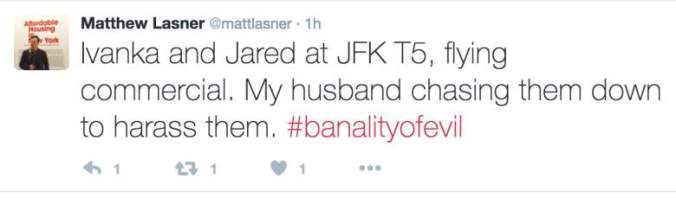
Goldstein, in the cabin of a JetBlue flight on which Donald Trump’s daughter, Ivanka, was also a passenger, verbally accosted the soon-to-be First Daughter before take-off. Holding a child in his arms, the New York lawyer started shouting, “Your father is ruining the country!” Then he asked, “Why is she on our flight? She should be flying private!”

Ivanka, who had her own kids in tow, tried to ignore him and attend to her family until he was removed from the flight by JetBlue personnel. “You’re kicking me off for expressing my opinion?” he yelled as he was led off the plane.

What a rude and obnoxious jerk.

Other observations: Continue reading

Yes, Poker Champ Phil Ivey Cheated, Even If He Didn’t Think He Did

baccarat2

Phil Ivey is known as one of the best all-around professional card players in the world, in part because he notices things that other players, even great ones, may not. While playing baccarat at the Borgata Casino in Atlantic City in 2012, Ivey and a friend noticed  inconsistencies on the back of the cards that allowed him to read some of them as if they were marked. He even asked the dealer to position the cards so he could see them better, as in “see what nobody else noticed, giving him an unfair advantage.” Some advantage: he and his associate, Cheng Yin Sun, won $9.6 million at baccarat over four visits to the casino, then won an additional $504,000 betting their winning at the  craps table.

A federal judge has now ruled that the two must repay the $10 million. What they did is called “edge-sorting,” and it is considered cheating, though technically the ruling was that Ivey and Sun breached their contract with the casino.

In baccarat, players bet on the relative value of two hands of two cards each before the hands are dealt or the cards are revealed. The game is  played with six or eight decks of cards placed into a dealing “shoe,” and the object is to bet on the hand that will have a total value closest to nine. If a player knows the value of the first card in the shoe before it’s dealt, the player has a significant advantage over the house. Borgata accused Ivey and Sun of exploiting defects in playing cards manufactured by Gemaco Inc. that were not cut symmetrically during the manufacturing process, so Ivey and Sun were able to spot the manufacturing defects and  read the “marked”  cards without actually touching or defacing them themselves. The New Jersey Casino Controls Act requires that all casino games offer “fair odds to both sides.”  Without intending to or knowing, the casino was creating unfair odds against itself, and these two players made out like bandits as a result.

Ivey’s lawyer argued in a court filing that since his client never touched the cards, his advantage was like the casino trying to distract players with “free alcohol served by only the most curvaceous and voluptuous females in the industry.” Continue reading

Are No Professions Safe From The 2016 Post Election Ethics Train Wreck? Now Even Restaurant Critics Have Gotten On Board!

circus-train-wreck

As a professional ethics specialist, I find the enthusiasm with which alleged professionals have used the election of Donald Trump to excuse their abandonment of such ethical values as fairness, responsibility, respect and citizenship deeply discouraging, and I am seriously considering becoming a beachcomber. I already knew that the journalism profession no longer could distinguish ethics from a hairy crab, so this wasn’t too surprising, nor was it too much of a shock that the New York Times has become a non-stop anti-Trump fear-fest and rant machine. Let’s see, in today’s edition alone  there is a hit piece on Trump advisor Steve Bannon called “Bannon’s Coriolanus Rewrite,” then  “Donald Trump’s Racial Ignorance,” “Where the Right Went Wrong,” (an amazing title, given the current balance of political power after Hillary’s botched campaign), “How the Truth Got Hacked,” “Is Democracy in Danger?” “Trump, the Russian Poodle,” and “Is This Collective Trauma?” The  last, I guess,  explains why mass trauma is inevitable for progressives, moderates and “Never Trump” Republicans when “the political order they long took for granted — defined by polarization, yes, but also by a commitment to basic principles of democracy and decency — is suddenly gone.”  One would almost wonder from that sentence which side of the political spectrum is calling for armed insurrection, pre-inaugural impeachment, and the overturning of the election results. The Times is also a showcase for columnists whose minds have snapped like dry branches in the wind,  causing them to leap manically onto the Trump Hysteria Express. Economist Paul Krugman has long been a hyper-partisan scold for whom fairness is alien territory, but this tweet was spectacularly vicious even for him:

“Thought: There was (rightly) a cloud of illegitimacy over Bush, dispelled (wrongly) by 9/11. Creates some interesting incentives for Trump.”

An ethical newspaper wouldn’t want someone capable of such a comment working for it.

Many broadcast journalists were stunningly unprofessional, indeed amateurish, on election night. Martha Raddatz choked up with emotion reporting Clinton’s loss; now there’s an objective reporter. Rachel Maddow described the evening as a “nightmare.”

Education has been racing journalism to the ethics barrel bottom for years, but I did not expect universities to send such intimidating messages to their students that they were expected to either be in mourning or on the verge of emotional breakdowns because the Democrats lost. Once, higher institutions of learning aimed to teach students critical thinking skills so they could make up their own minds regarding civic affairs. High school administrators and teachers also forgot their duties, and allowed students to skip school because, you know, TRUMP!!!!, and “ARRRGHHHHH!!!!”

Lawyers have lost their ethical bearings, of course, as have law professors, with perhaps the best example of the latter being the Georgetown Law Center adjunct who claims that the Constitution is unconstitutional, because following it will elect Donald Trump. My law alma mater isn’t faring too well in the train wreck: another professor, Paul Butler, argued that Supreme Court justices shouldn’t normally attack a President Elect, except when it’s Donald Trump.

Other academics have disgraced themselves. A prominent historian, for example, even resorted to making up history to provide an excuse for Democrats losing to such a horrible creature. Professor Larry Lessig of Harvard Law, who heads an ethics institute there, is encouraging electors to be “faithless,” as in “double-cross the voters who elected them.” Some ethics institute you have there, Harvard!

Artist, actors and show business professionals have debased themselves even more than usual, beginning with the Broadway cast of “Hamilton’s” breach of the Performer’s First Commandment: DON’T ABUSE THE AUDIENCE. They have even started turning on each other: Jon Voight, whose sin was that he expressed support for the man elected President, was booed at recent awards show by his fellow actors. Nice.

But as bad as this has been, I didn’t expect food critics to be corrupted. Continue reading

Ethics Alarms Presents “Fake News” Friday! Episode I: Poynter’s Code of Principles

fake-news-sites

Poynter is a serious and justly respected  nonprofit school for journalism and journalism ethics organization. Naturally, it has been drawn into the “fake news” debate, which is unfortunate, since the issue itself has arisen not so much as part of a much-need effort to purge the new and old news media of biased and misleading news reporting, but as part of partisan attempt by the mainstream news media and others to find some explanation, any explanation, for Donald Trump’s election that doesn’t involve a genuine public rejection of Barack Obama and Hillary Clinton. Poynter, as far as I’ve been able to determine, is scrupulously non-partisan, or perhaps hides its Democrat tilt better than the rest of its profession. Now it is being used by those who are not so trustworthy.

Poynter was in the news yesterday as a result of Facebook’s announcement that it will start “fact-checking, labeling, and burying fake news and hoaxes in its News Feed. Mark Zuckerberg announced that his social media platform will collaborate with a small list of media organizations, including Snopes, Factcheck.org, ABC News, and PolitiFact to accomplish this, and noted that these are part of an international fact-checking network under the guidance of Poynter.

Here’s a fact to check: Snopes, Factcheck.org, ABC News, the Associated Press, and PolitiFact are all partisan-biased operations to a greater or lesser extent. Facebook itself is a partisan biased organization. That Facebook would blandly cite three of these four to reassure anyone but the Democratic National Committee is proof positive that this is a cynical, untrustworthy exercise. Continue reading

Julia Ioffe’s Vile Tweet: Now The Question Is Whether There Are Any Depths Of Unprofessional Conduct And Unhinged Bias That Disqualify A Journalist [UPDATED]

trump-incest-tweet

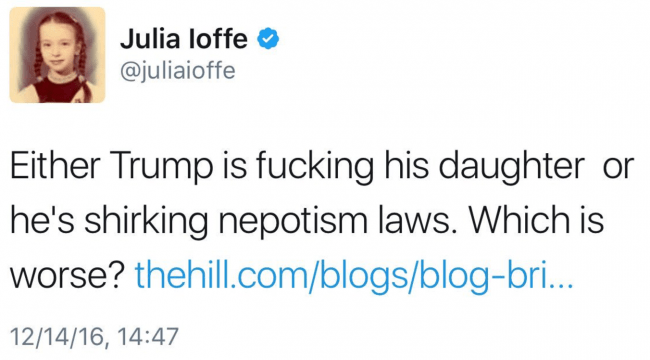
Julia Ioffe, a columnist at “Foreign Policy” and a contributing writer for “Politico Magazine” was moved to issue the above tweet by accounts that First Daughter Ivanka Trump would serve as First Lady while Melania Trump remained in New York to care for the Trump’s young son . Oh, nice! Keep it classy, news media!

Ioffe now joins John Oliver, Charles Blow, Harry Reid, The View, Harvard Law professor Larry Lessig and others on a growing list of nominees for the 2016 Ethics Alarms Award as the most unsavory passenger on the 2016 Post Election Ethics Train Wreck. The problem is that she isn’t a British comedian, a race-baiting Times columnist, a full-time asshole, a talk show hosted by celebrity ignoramuses, or an especially deluded academic. Ioffe is supposed to be a journalist whose analysis can be trusted, and the vicious character and unrestrained hate that her tweet reveals should disqualify her for that profession. Before Donald Trump—you know, the new President whom the New York Times decreed is exempt from ethical treatment?—such a public statement would have disqualified any journalist and ended her career immediately. This would have happened because journalism organizations once valued not just professional conduct and objectivity but the appearance of it.

The tweet wasn’t just disgusting, it was incompetent, misleading and stupid:

  • The news report has been denied by the Trump transition team, so the alleged journalist was spreading “fake news.”

There have been almost two dozen permanent or temporary First Ladies who had other family relationships with Presidents, including daughters, daughters-in-law, nieces, sisters, cousins, and aunts. Three daughters assumed the First Lady role when their mothers died: Letty Tyler Semple for President Tyler,  Mary Harrison McKee for President Benjamin Harrison, and Margaret Wilson for Woodrow. Oddly, none of them were accused of having sex with their fathers. Margaret Wilson shared First Lady duties with President Wilson’s cousin Helen Bones, who had worked for the first Mrs. Wilson as personal secretary. Thomas Jefferson, Andrew Jackson, Martin Van Buren and Chester Arthur were widowers, so their First Ladies couldn’t be spouses. Jefferson’s daughter Martha Randolph, Jackson’s niece and daughter-in-law Emily Donelson and Sarah Jackson were all First Ladies.  James Buchanan and Grover Cleveland were bachelors when they assumed the presidency,  so Cleveland’s sister Rose Elizabeth served as his First Lady until he married Florence Folsom fifteen months into his administration, and Harriet Lane, Buchanan’s niece, acted as his hostess and was the first Presidential spouse referred to as the “First Lady.” Many other non-spouses served in the capacity for limited amounts of time for reasons comparable to Melania’s conflicts.

In short, Ioffe is ignorant of American history and didn’t know what she was tweeting about, but did so anyway, misleading the public. Continue reading

The Ethics Meltdown Of Elie Mystal Continues

Surprise! This isn't MY head exploding. It's Elie Mystal's!

Surprise! This isn’t MY head exploding. It’s Elie Mystal’s!

“Above the Law”‘s Elie Mystal has crossed over from being a provocative, if often emotion-driven and unprofessional, legal news analyst to being an Angry Black Man for whom law and justice is tangential. As Ethics Alarms covered here, Mystal already has proclaimed that the existence of a single intransigent juror who hung the jury in the Michael Slager trial proves that whites are incapable of race-blind justice. In his latest stage of racist fury, Mystal now wants black jurors to sabotage the justice system.

“Black people lucky enough to get on a jury could use that power to acquit any person charged with a crime against white men and white male institutions. It’s not about the race of the defendant, but if the alleged victim is a white guy, or his bank, or his position, or his authority: we could acquit. Assault? Acquit. Burglary? Acquit. Insider trading? Acquit.Murder? … what the hell do you think is happening to black people out here? What the hell do you think we’re complaining about when your cops shoot us or choke us? Acquit. Don’t throw “murder” at me like it’s some kind of moral fault line where the risk of letting one go is too great. Black people ARE BEING MURDERED, and the system isn’t doing a damn thing to hold their killers accountable. Sorry I’m not sorry if this protest idea would put the shoe on the other foot for a change.”

You can read the rest; it’s all like this. Mystal is bonkers. There’s no reasoning or fairness in his screed. He’s just fulminating, growling and slobbering like a rabid dog. It’s sad. Nobody can take anyone who expresses this kind of irrational hate as a response to frustration seriously. He’s not accurate, he’s not truthful, he’s not responsible. He has left law and logic so far behind he may never work his way back to them.

I’ll touch on just a few splashes of Mystal’s projectile hate-vomit: Continue reading

Remember California Attorney Mary Frances Prevost, Who Plagiarized Ethics Alarms? Guess What!

Yup, I saw THIS coming...

Yup, I saw THIS coming…

She’s been suspended.

For the third time.

Good.

To recap…Back in 2012, Mary Frances, who  describes herself on her website as “California’s Top Criminal & DUI Attorney,” posted an essay allegedly authored by her called  “The Trayvon Martin Case Trainwreck: George Zimmerman’s Attorneys Need To Shut Up!”

Oddly, it was posted the same day and shortly after my Ethics Alarms post, “Next To Board The Trayvon Martin Ethics Train Wreck? Why, The Lawyers, Of Course!”

Mary Frances’s was almost word for word the same post, plus some original material at the end. She had ripped me off. She hadn’t even tried to disguise it. This is called stealing, and I believe, shows that an individual lacks the honesty and trustworthiness to practice law.

I took three deep breaths, wrote a post about her plagiarism, e-mailed Prevost and required four things. First, an explanation if she had one; then an apology, a retraction, and proper credit. I didn’t demand damages, as I could have.

Mary Frances’s response was astounding. She didn’t have the courtesy to respond to my e-mail, but went on Facebook to accuse me of plagiarizing her, a neat trick, since my post pre-dated hers. Then she insulted me repeatedly, apparently unaware of how hypocritical it is to claim another lawyer is lacking in legal analysis skills and writing ability when you just published his essay as your own. I posted her whole rant here; it is deranged, making it especially funny that she accused me of being “off my meds.”

The Facebook post was defamation per se: malicious, and deliberately false. I contacted a California attorney, who agreed it was defamation, but said that based on her reputation, he felt it would  not be worth the money, the trouble or all the attacks she was capable of to go to war with her. He also dissuaded me from filing an ethics complaint, saying that unlike some states, California frowns on ethics complaints when there are grounds for lawsuits, and also tends to discount complaints from non-California lawyers.

“Just wait,” he said. “She’ll get hers. Lawyers like this almost always do.” Continue reading