The Rockettes Look Mostly White. So What?

In a classic cheap shot, race-baiting, virtue-signaling feature that is now standard fare in the mainstream news media, the New York Times implied that the Radio City Music Hall Rockettes are racist. The article, headlined in the print edition “Where All Your Christmases Are White.” included a cutline, “At the Rockettes holiday show I saw, there were more camels onstage than black women.” That made me read the article. I wasn’t aware that the EEOC had a camel/black woman percentage requirement. You learn something every day.

After pointing a bony finger and whispering “racist,” the author does note that while only one of the 40 dancers in the performance she saw appeared to be black, this was something of a deceptive proportion. “Among the 80 dancers who make up the Rockettes corps, 10 percent are women of color, a spokeswoman for the company told me; you are only seeing half the cast during any given show because there are so many performances to fill — on weekends, up to six a day,” Ginia Bellafante writes. Ah. So if she saw the other troupe of 40, there would have been seven black dancers. (OK,  “dancers of color,” whatever THAT means.) Not only would seven have outnumbered the camels,  it would make a percentage of  17.5.  12.3% of the population is black. Tell me what the point of this feature is again, New York Times?

Ginia also hints that the problem may be that the kickline looks too white. ” [A]ny variance in skin tone is obscured by lighting and makeup that have the effect of creating a stultifying homogeneity, which is the point and amounts, ultimately, to an eerie celebration of whiteness,” she writes. You know, I’ve seen the Rockettes many times, not that I don’t find kick-lines boring or have a single vivid memory of a performance. I never sat there, watching these impossibly tall, long-legged women kick over their heads, and spent my time counting how many of the looked white, or thought of the performance as having anything to do with race at all. Doing so would be like watching an exciting NBA game, where about 75% of the players are black, and think of it as  “an eerie celebration of blackness.” As they say, Ginia, if the only one hearing the dog-whistle is you, you’re the dog. Continue reading

The Good News: This Hasn’t Happened Here…Yet. Well, Not Exactly…

I detest memes, but like all other rules, there are exceptions. Sometimes, only a meme will do.

Of the many warpings and distortions of a healthy culture we have seen emanating from the ideologically extreme, one of the more insidious is the antagonism towards humor. This episode speaks for itself.

The UNICEF on Campus chapter at the University of London sent five local comedians a request to perform at a club sponsored event. However, the requirements to be hired led all five to turn down the job.

Fisayo Eniolorunda, the club’s event organizer, wrote in an email, “Attached is a short behavioural agreement form that we will ask for you to sign on the day to avoid problems.”

Problems like actually being funny, apparently.

The “behavioral agreement” states,

“This comedy night… aims to provide a safe space for everyone to share and listen to Comedy. This contract has been written to ensure an environment where joy, love, and acceptance are reciprocated by all. By signing this contract, you are agreeing to our no tolerance policy with regards to racism, sexism, classism, ageism, ableism, homophobia, biphobia, transphobia, xenophobia, Islamophobia or anti-religion or anti-atheism. All topics must be presented in a way that is respectful and kind. It does not mean that these topics can not be discussed. But, it must be done in a respectful and non-abusive way.”

Respectful of whom and not abusive in what way? Oh, never mind. The agreement is a joke itself. What does “love and acceptance” have to do with humor? Does Fisayo Eniolorunda know what “Comedy” is? Of course comedy doesn’t have to be cruel or mean, but then an audience that would lay out such rigid standards can’t be trusted to judge what cruel, mean, respectful, non-abusive, safe—lordy, especially “safe”–or funny is. These are subjective standards being judged by people who are so besotted with ideological mania, virtue-signaling addiction and political correctness that they can’t be trusted. Continue reading

The “White Christmas” Ethics Guide (REVISED And UPDATED)

I’m looking at some holiday movies to add to the Ethics Alarms library of annotated classics—no, ethics and “A Christmas Story” are irrelevant, it being a child’s remembrance and hardly literal–but I might as well begin with  revising and revisiting the “White Christmas” guide, which first appeared in 2012. 

I still like the film—my wife hates it—being a fan of all four stars, especially Bing and Danny, as well as the director, Michael Curtiz.  I do like it a bit less each time I see it, mostly from an ethics perspective, and the successive revisions reflect that.

I still get misty when the old general, played by Dean Jagger, gets saluted by his reunited army unit, which has gathered at his struggling, snowless, Vermont inn on Christmas Eve to remind him that he is still remembered and loved. Nonetheless, “White Christmas” is by far the strangest of the Christmas movies, and also the most unethical. Though everything works out in the end, the characters in the sloppy plot spend the whole movie lying, extorting, betraying, manipulating and generally mistreating each other, always with no recriminations at all, and usually with no consequences either.

In his addendum last year to my original post, Michael West found the film foundering from the second the opening credits ended. He began with the script for the opening scenes—General Waverly* is played by Dean Jagger; Captain Bob Wallace is Bing Crosby, and Private Phil Davis is Danny Kaye:

Opening Scene in the Jeep as they hear the Entertainment show.

GEN CARLTON (To Adjutant): What’s this all about, Captain?

ADJUTANT: A little entertainment for the men, sir. Tonight’s Christmas Eve.

GEN CARLTON: These men are moving up tonight, General Waverly. They should be lined up for full inspection!

GEN WAVERLY (To Carlton): You’re absolutely right. (To Adjutant): There’s no Christmas in the Army, Captain.

ADJUTANT: Yes, sir.

GEN WAVERLY (To Carlton): There’s always a slip-up or two during a change in command. The men get a little loose. But I know I’m leaving them in good hands.

GEN CARLTON: (To Waverly): Thank you, General. (To Driver): Sergeant, take me to headquarters immediately! We’ll have those men turned out on the double!

The Sergeant looks at General Waverly.

GEN WAVERLY: Goodbye, Sergeant. Take the short cut.

SERGEANT: Yes, sir!

The jeep pulls off and makes a half circle. The Adjutant makes a gesture, as if to stop it. Waverly stops him. The Adjutant turns to him.

ADJUTANT: That’s not the way back to headquarters!

GEN WAVERLY: Joe, you know that, and I know that, but the new General doesn’t know it. Or he won’t for about an hour and a half.

ADJUTANT: That Sergeant’ll be a private tomorrow!

GEN WAVERLY: Yes… isn’t he lucky?

SCENE CHANGE TO ENTERTAINMENT SITE:

CAPTAIN BOB WALLACE and PRIVATE PHILIP DAVIS are doing a number on stage to entertain a mass of 200 or so soldiers. GENERAL AND ADJUTANT just starting to take seats, off to one side where they are not noticed by the performers. ABOUT 6 SOLDIERS seated in audience. They look off, see General, start to rise. The General notices them – motions for them to sit down again, indicating he doesn’t want attention called to himself. Captain Wallace sings “White Christmas”.

CPT WALLACE: Well that just about wraps it up, fellas. It’s certainly too bad General Waverly couldn’t be here for this little yuletide clambake ’cause we really had a slam bang finished cooked up for him. I guess by now you know the Old Man’s being replaced by a new Commanding General fresh out of the Pentagon…it’s not a very nice Christmas present for a division like us that’s moving up. The Old Man’s moving toward the rear. That’s a direction he’s never taken in his entire life. Well all I can say is we owe an awful lot to General Waverly and to the way…

GEN WAVERLY: ATTENTION!

Every man is at attention and every head has turned to where General Waverly has taken up a position near the front of the platform.

GEN WAVERLY: Captain Wallace, who’s responsible for holding a show in this advanced area?

CPT WALLACE: Well sir as a matter of fact it was…

PVT DAVIS: …me Sir! It was my idea sir. Uh, I mean when you gotta entertainer sir of the caliber of Captain Wallace, sir…I mean sir…it’s Christmas Eve, sir. And well, sir, I mean that if you were in New York, Sir, you’d have to pay six sixty or even eight eighty to hear a great singer like Captain Wallace, sir.

GEN WAVERLY: I’m well aware of Captain Wallace’s capabilities. Who are you?

PVT DAVIS: Er…Phillip Davis, sir. Private First Class, sir.

GEN WAVERLY: Well, at ease, Davis.

DAVIS: Yes, Sir!

WAVERLY: I said, At Ease!

DAVIS: Oh, uh, Yes, sir, thank you sir.

WAVERLY: This division is now under the command of General Harold G. Carlton, and I don’t want anyone to forget it — not that he’ll let you. He’s tough — just what this sloppy outfit needs. He’ll have you standing inspection night and day — you may even learn how to march. And if you don’t give him everything you got, I may come back and fight for the enemy. Merry Christmas!

ASSEMBLED MEN: Merry Christmas!

GEN WAVERLY: Well, I guess, all I can say is, how much I…what a fine outfit…How am I going… (to Wallace) don’t just stand there, how am I going to get off…?

CPT WALLACE: We happen to have a slam-bang finish…He turns to the musicians, gives the downbeat.

They play “THE OLD MAN,” which is sung by the entire outfit.

ARTY FALLS IN VICINITY…Soldiers crouch…then finish singing.

GENERAL AND ADJUTANT DEPART.

MORE ARTY FALLS, ON SITE…Men scatter. Captain Wallace and Private Davis try to get men to cover. Private Davis man handles the Captain to cover as a wall collapses where he had just been standing.

For starters, we see a mass of soldiers in an open air situation within effective range of enemy artillery fire. A single well-placed artillery round could eliminate approximately 200 soldiers — more than an entire World War 2 Infantry Company (whose authorized strength is about 190-195 men; but given this stage of the war and attrition, this could easily be 2-3 companies of EXPERIENCED soldiers). Someone in the chain of command KNOWS this to be true and authorized this gathering despite the obvious danger. We know for certain that the Adjutant knows what the gathering is, as he answers in line #2 precisely what is going on. But an Adjutant has no command authority, so someone else authorized the gathering. We have to assume General Waverly didn’t know until the Adjutant answered General Carlton’s inquiry based on General Waverly’s later questioning of Captain Wallace. We can’t ever be sure who actually made the decision to have the entertainment occur at that location since Private Wallace, breaking an incredible number of military bearing protocols, interrupts a Captain, to answer a General. This Private, Private Davis, accepts all responsibility for the decision to expose upwards of 2 companies-worth of men to devastating artillery fire.

This information leaves us with two options: Either it really was Private Davis’s idea to have the venue at that location, in which case, Private Davis’s commanding officer and the various commanding officers AND EVERYONE ELSE in their chain of command are colossally INEPT for agreeing to the idea. The second option is that Captain Wallace DID indeed make the decision to have the venue at that site, and now he’s standing there like a lump allowing a subordinate to cut him off mid-sentence, a military no-no, and then allowing the subordinate to take the heat of any potential censure that was forthcoming. Of course, since he’s a Private trying to cover for his boss, he’ll say anything, so I won’t even ding him for the horrible excuse that 200 men should be exposed to German artillery fire because CPT Wallace is a famous singer – we all know it’s worth dying to hear Bing sing…

But of course, even General Waverly doesn’t seem to mind that 200 of his soldiers are idling around with a population density rivaling that of Bombay, just one artillery strike away from having more in common with mist than with humanity. When HE discovered what was going on by the Adjutant’s answer in line #2, he should have immediately ordered the soldiers disperse and had about two dozen commissioned officers who had every ability to stop the farce standing in his headquarters receiving the most royal dressing down of their careers and maybe a few firings.

What possibly does General Waverly think outweighs the need to disperse a mass of soldiers within effective range of artillery? Why, a Christmas music concert of course! It is Christmas Eve, after all!  Now, the Army does a really good job bending over backwards for the morale, welfare, and recreation of soldiers, much more than was ever considered a military precedent. BUT, we learn from the dialogue, the entire division is on orders to “move up tonight.” This somewhat vague description could range anywhere from simply occupying a section of the line to relieve a unit coming back or it could mean they are initiating a major offensive operation. We learn, however, that this movement, whatever it is, is occurring in mere hours. Having experienced large movements of soldiers myself, I know that if a Division is stepping off in a few hours, the men down to the platoon level are ALREADY in their assembly areas doing final preparations. This is apparent to the new commander, General Carlton, who is astonished that the men aren’t doing their final checks of equipment and gear.

Which leads us to the next bit: General Waverly is none too concerned about the unjustifiable exposure he’s tolerating of his…well, now General Carlton’s men…as we know Waverly has just been replaced by General Carlton, who, trope-tastically, we learn is one of those wretched new leaders who is probably horribly incompetent. The movie lets us know early on that he’s a despicable piss-and-vinegar type when he is mad that the men are having Christmas entertainment. Never mind that we now know that Carlton is severely concerned about a huge mass of men within artillery range open and exposed as well as not anywhere near where they ought to be to initiate movement of the entire Division.

The movie also lets us know he’s a jerk because it pushes the whole “fresh out of ________” trope. The usual way this plays out is the “fresh out of West Point” or “fresh out of ROTC” smear applied to new Lieutenants who assume Platoon Leadership with little to no actual experience. Unfortunately, this doesn’t exactly play out on the General level. Yes, the General ranks expanded rapidly during World War II, but an individual didn’t become one by being a complete buffoon (and yes there are always exceptions — but General Carlton, who seems to have a sense of urgency that no one in Waverly’s sphere of influence seems to possess, does not seem to be the exception).

Never mind, we’ll go on with the traditional “smearing of the new guy who replaces the beloved experienced leader.” In the original script I copied and analyzed, the dialogue was OVERTLY insubordinate and actively undermining of the men’s confidence in their new commander. In the corrected dialogue, though cleaned up a lot, there are still hints of undermining the new guy’s authority before he even makes a decision as the commander. There’s General Waverly’s smart-ass “There’s no Christmas in the Army” jab as a response to Carlton’s concern about the location and timing of the entertainment event — which he says “knowingly” to the Adjutant, who, we must remind ourselves no longer works for the Waverly but for Carlton.

There is the extra-rotten move when Carlton, recognizing the imminent danger as well as the horrifying breach of schedule in implementing the plan of operations, indicates he plans to move to Headquarters immediately to begin rectifying the situation and is undermined either by the Sergeant driving Carlton or by General Waverly himself. The driver decides to undermine Carlton’s ability to fix the problem by taking an extra long route back to headquarters. Between a driver and a singing-private, this division is apparently full of the lowest-ranking guys thinking they know best when to leave a behind-the-schedule division exposed to enemy fire just so they can catch a few tunes from Bing. The only other possible explanation is that General Waverly, himself, with a nod-nod wink-wink, authorized the driver to follow the reckless plan to take an hour-and-a-half detour, which we assume will require another hour-and-a-half correction before Carlton can get to Headquarters. Just as with the Adjutant before, let’s again consider that this driver no longer works for Waverly, but for Carlton The Sergeant is being openly insubordinate.

Even if Waverly was not responsible for the three-hour diversion, he immediately became complicit when the Adjutant, in an apparent realization who his new boss is (Carlton), moved to correct the driver but was stopped  from doing so.by General Waverly

The last bit of insubordination and undermining  the chain of command comes from the subtle digs Captain Wallace makes during his speech. His “Fresh out of the Pentagon” disdain undermines faith that Carlton may be a good commander, followed by the snide “not a nice Christmas present” for the division is enough to get any soldier censured. Soldiers and peers WILL whisper about their leaders, but an open act of insubordination like that? Stamped out like a spark in a dry forest… I won’t even address the fact that it’s a COMMISSIONED OFFICER making the openly insubordinate comments and a CAPTAIN no less. He would be dismissed and transferred immediately.

But hey, I suppose Waverly recognized all their rotten conduct when he feebly tried to make things right by saying “hey guys, he’s a good commander, never mind all the stuff we said before and our attitudes we displayed before!” A few moments later, just to do Carlton some justice, the artillery shelling arrives.

Then the movie moves into its funny guilt extortion phase. Army private Phil Davis (Danny Kaye) rescues his smooth-singing captain, Bob Wallace (Bing Crosby) from being crushed by a falling wall in a World War II bombing raid, and injures his arm in the process. (It’s not a plot feature, but the battlefield set for the entire opening sequence is itself unethically unprofessional by being chintzy even by musical standards: it looks like they are filming a skit for a Bob Hope Christmas Special.  I thought it was lousy when I saw it as a kid. Michael Curtiz deserved better; the man directed “Casablanca.” Show some respect.) Phil then uses Wallace’s debt of gratitude to coerce him into accepting the aspiring comic as a partner in Wallace’s already successful civilian act. This is obviously unfair and exploitative, but Bing accepts the ploy with good spirits, and the next we see  the new team of Wallace and Davis knocking ’em dead and rising in the ranks of stage stars.

The act looks terrible. Bing was never much of a dancer, a game hoofer at best, and you don’t feature the greatest voice in the history of American popular music by having him sing exclusively duets. Nevertheless, all we see of the team’s rise is both of them singing and corny dancing inferior to what Bing did with Bob Hope in the “Road” movies.

Never mind. They have a show on Broadway, and as a favor to a mutual army buddy, they agree to watch the boonies nightclub act of “The Haynes Sisters” (Rosemary Clooney as Betty, and Vera-Ellen, of wasp-waist fame, as kid sister Judy. Did you know that in the “Sisters” number, Clooney sang both parts? ). Bing is immediately smitten with older sister Rosemary, but there is a tiff over the fact that younger sister Judy fooled them into seeing their act: she, not her brother, had sent the letter asking for a “favor.”

This is the first revealed of many lies woven into the script. This one is a double beach of ethics: Judy uses her brother’s name and contacts without his permission or knowledge, and lures Wallace and Davis to the night club under false pretenses.

Bing dismisses Judy’s cheat by noting that everyone “has an angle” in show business, so he’s not angry. Rosemary is, though, and reprimands Bing for being cynical. That’s right: Vera/Judy uses their brother’s name to trick two Broadway stars into watching their little act, and Rosemary/ Betty is annoyed because Bing/Bob (Bing’s bandleader, look-alike, sound-alike brother was also named Bob) shrugs off the lie as show business as usual. True, Betty is technically correct to flag the Everybody Does It rationalization, but shouldn’t she be grateful that Bob isn’t reaming out the Haynes sisters and leaving the club in a huff? OK, nice and uncynical is better than nice and cynical, but Bob is still giving her and Judy a break. As the beneficiary on Judy’s angle, Betty is ethically estopped from complaining that Bing/Bob’s reaction was “I don’t expect any better.” I can, she can’t. He should expect better: accepting unethical conduct allows it to thrive.

As we soon find out, however, Betty often flies off the handle.

Continue reading

Ethics Hero: Bob Cousy

I was thinking of adding “Boston Celtics and pro basketball legend” to the title, but I depressed myself thinking it was necessary, which of course it is. When Bob Cousy retired, in 1962, there wasn’t a more famous NBA star alive. Now, not only is the play-making wizard who led the Boston Celtics through the beginning of their unparalleled dynasty unrecognizable to most Americans, so is the kind of basketball he played, before it was all dunking and styling by pituitary cases.

But I digress.

In the newly published book “Last Pass” by Gary Pomeranz,  Cousy, the Hall of Fame Boston Celtics captain who led the team to its first six championships, opened up about his relationship with Bill Russell, the great, enigmatic, difficult, defensive genius  who was the center on Cousy’s teams, and on many Celtics championship teams thereafter. Russell was the first back superstar in sports-crazy, perpetually racist Boston,  and as he reaches 90, Cousy is reflecting on what he did, and what he didn’t do, as the white superstar on a team whose brilliant black center was often the target of racists. In the Boston suburb of Reading, vandals once broke into Russell’s home, spray-painted racist graffiti on walls and defecated on his bed. The Cooz, as he was called, is remembered as being  ahead of his time as an NBA player in his sensitivity to race and civil rights. Still, Cousy blames himself for not having done enough, and for not having understood the depth of prejudice Russell faced as an African-American in Boston. Cousy told the historian that he wants to make amends. Continue reading

When Ethics Alarms Don’t Ring: The Racist Christmas Tree

As a holiday prank, two Minneapolis police officers decorated a  Christmas tree inside a Minneapolis Police Department precinct in a primarily African-American area with  half-crushed cans of malt liquor, crumpled bags of Takis chips and Funyuns, a cup from Popeyes and two packs of Newport cigarettes, all highlighted by a strip of yellow crime-scene tape.

Merry Christmas.

Naturally, a photo of the tree made it to social media. The officers responsible were placed on leave after the local African American community and public officials expressed anger and outrage, including Mayor Jacob Frey, who described the tree as “racist, despicable, and well beneath the standards of any person who serves the city of Minneapolis.” Continue reading

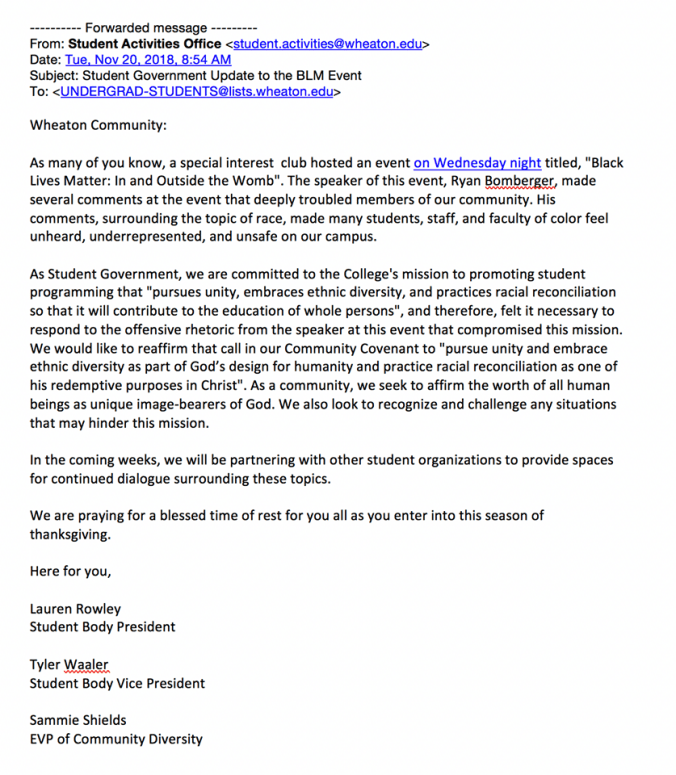
Unethical Quote Of The Month: Wheaton College

What prompted this anti-educational, anti-discourse “message to the Wheaton community”?

Ryan Bomberger of the Radiance Foundation gave a presentation entitled “Black Lives Matter In and Out of the Womb” at the evangelical Wheaton College (in Wheaton, Ill.) on November 14. He was the guest of the Wheaton College Republicans. Bomberger’s talk criticized  BLM leadership for announcing its solidarity with Planned Parenthood, the “leading killer of black lives.” Bomberger  is a biracial African American conceived in rape, adopted, and then raised in a mixed-race family. He responded  to the allegations in the letter by saying that Rowley, Waaler, and Shields had demonized him, and said he had been told that only Shields among the three signatories had attended his talk.

“I would think it would be against the college’s mission to intentionally mislead students,” Bomberger wrote in response to the student leaders’ backlash against him.

“I am a person of color, a clarifying fact which you conveniently left out of your letter of denouncement. I was primarily presenting a perspective of those who are never heard, always underrepresented, and are actually unsafe — the unborn,” he said. Continue reading

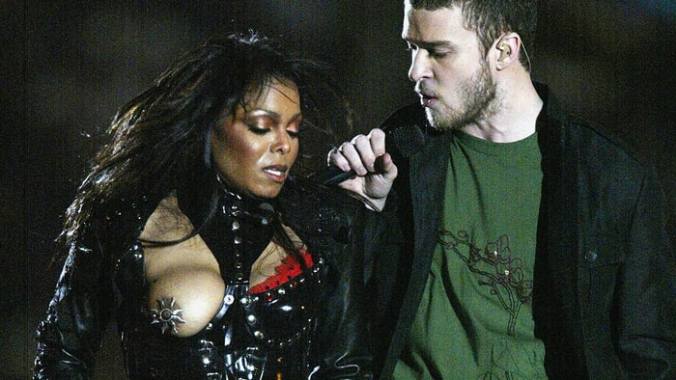
My Birthday Comment Of The Day! On “Nipplegate Ethics: No, We Don’t Owe Janet Jackson Any Apology At All”

Shortly before the bells tolled twelve and my birthday/Finding Dad Dead In A Chair Day came to an end, I received not one but THREE comments on a two-year-old post. I love it when this happens—it has been happening a lot lately—because it gives me a chance to read with new eyes and accumulated wisdom past ethical verdicts to see if they measure up to my current standards. Sometimes I think I was bit too certain of myself, and sometimes I even detect some serious omissions in my analysis, but not with this post, a vivisection of a ridiculous, race-bating defense of Janet Jackson infamous breast-baring at the 2004 Super Bowl. A pop culture blather-artist named Emmanuel Hapsis,  had revisited the incident , and in the increasingly unhinged manner of the woke which we have witnesses since. declared that the episode exemplified America’s “patriarchy,” “racism” and “sexism.”  “Janet’s first crime was being a woman and the second that she was a black woman,” Emmanuel wrote.

Well, few show business scams have been as easily figured out as this one, and the question is whether those who refuse to believe what is absurdly obvious—Sure, it was just a series of amazing coincidences that Justin Timberlake, during a choreographed duet with Jackson and while singing “Better have you naked by the end of this song,” somehow and completely accidentally ripped a neatly cut portion of Jackson’s bustier to reveal her naked breast, except that her nipple was covered by an elaborate pasty—almost as if she knew it was going to be exposed.  Timberlake lied, then later admitted that the stunt was planned, though he didn’t have to, because everyone knew it was planned who had an IQ above freezing and wasn’t in line to buy shares of “Prisoners of Love”. Jackson kept to her story that it was all a big surprise. I wrote, and would write again,

“Jackson also got a career boost from the fiasco, which is exactly why she agreed to the stunt, and if she paid something for the contract breech, she could afford it. As for the public criticism of her unannounced peep show, race and sexism had nothing, zero, nada to do with it. When you have to reach this far back and distort reality this absurdly to make the case about how racist and sexist America can be, you really need to find another cause, because you’re lousy at this one.

There are real examples of racism and sexism out there. Using fake ones like this to caterwaul about it just makes it easier to deny them.

Not only does America not owe Janet Jackson a “huge” apology, America owes her none at all. Emmanuel Hapsis, however does owe America a huge apology, for trying to further divide it, and for trying to make the public more ignorant than it already is.”

When the post first ran, somebody sicced a college class on me or something, and I received numerous, almost identical rebuttals, most of which were too incoherent or idiotic to pass moderation. I also banned one persistent troll who kept writing the same comment that essentially asked how anyone could be so mad as to not believe Jackson’s contrived story? (I am a veteran stage director and choreographer, and I can tell a staged bit when I see one, not than any yahoo couldn’t recognize this one.)

So along comes someone named Troy who gifted me with one of those comments that is so fascinatingly devoid of logic, coherence or ethics grounding, and so wonderfully besotted with woke buzzwords and mirages, that I just had to post it as a Comment of the Day. First, it shows you the kind of junk that doesn’t usually get posted here. Second, it is instersectionality wackiness on brilliant display—yes, holding Janet Jackson to account for flashing a family audience to get cheap publicity for her upcoming album is linked to slavery, lynching, police brutality, and white privilege. The screed also begins with and is built around a false analogy, as are so many screeds these days. You see, Madonna is white, Madonna is a singer, and Madonna has exposed various parts of her body in a carnal fashion, so for a black performer to be criticized for similar self-exposure is a double standard, or so Troy believes.

Super Bowl half-time spectacular live in prime time with the largest TV audience of the year including children, you moron.

I wonder: how many people are out there who “think” like this? How did they get that way? Who can stand being around them? Are they multiplying? How can that be stopped? How do you reason with someone this addled? What is the critical mass of people like this that renders the nation too stupid to function at all?

Excellent, if troubling, questions all. Thanks, Troy!

Here is Troy’s Comment of the Day on Nipplegate Ethics: No, We Don’t Owe Janet Jackson Any Apology At All: Continue reading

Comment Of The Day: “Ethics Quiz: CNN And Marc Lamont Hill”

More self-flagellation is in order: the problem when one gets behind in posting important Comments of the Day, new entries tend to push themselves into line, making it harder to catch up. The quiz about whether CNN was ethical to fire Marc Lamont Hill spawned this too- interesting- to- put- off discourse on the use of violence in activism in the U.S.  To recap, Hill had told the U.N, in the course of advocating pushing the Jews into the sea,

“Contrary to western mythology, black resistance to American apartheid did not come purely through Gandhi and nonviolence. Rather, slave revolts and self-defense and tactics otherwise divergent from Dr. King or Mahatma Gandhi were equally important to preserving safety and attaining freedom.”

To this,seasoned Ethics Alarms commenter Isaac wrote,

He’s also wrong about uprisings and violent tactics being “equally important” to African freedom and equal rights in America. Not even close to true. If anything such tactics, while understandable, hindered the hard uphill battle being fought by the likes of Douglass and King. You can trace virtually every single concrete step forward in both the abolition and civil rights movements to peaceful activists, non-violent advocacy, and people working within the American systems to change them. Not sexy, but true.

This sparked Michael R’s Comment of the Day on the post Ethics Quiz: CNN And Marc Lamont Hill:

I would disagree with you on your points about violent tactics. Violent self-defense was an integral part in the Civil Rights movement in the 1950’s and 1960’s. The Deacons for Defense and other armed groups of black men provided armed guards for civil rights leaders. Without groups of armed black men like the Deacons for Defense, CORE would have been wiped out. The KKK would have won and the civil rights movement would have collapsed. Continue reading

Mississippi Stinking

Gee, I wonder why feminists aren’t cheering the Cindy Hyde-Smith victory in the Senate run-off in Mississippi yesterday.  After all, she is the first female U.S. Senator in the state. And she’s a woman, and weren’t we told in the 2016 election that this alone mandated voting for a candidate, and nothing else should matter?  Admittedly, Hyde-Smith was an especially stinky candidate—inept, unqualified, addicted to sticking her foot in her mouth—but then so was Hillary Clinton. Why does being a woman outweigh all that baggage when the candidate is a Democrat but not when she’s a Republican? Or is the theory that electing a black Senator cancels out the “vote for any woman over any man”  rule?

I need this written down, I guess.

Of course, the losing Democratic candidate, Mike Espy, was pretty stinky himself, corrupt and dishonest, as well as addicted to race-baiting when the opportunity arose. He was required to quit Bill Clinton’s Cabinet after multiple accusations of corrupt dealings and illegal gift-accepting, then accepted a $750,000 consulting deal from former Ivory Coast president Laurent Gbagbo’s government in 2011. Espy’s former client is now standing trial for “crimes against humanity.” After Espy came under scrutiny for lobbying for Gbagbo, he claimed he had dropped the  contract once he learned that Gbagbo was a “bad guy.”  Continue reading

Morning Ethics Warm-Up. 11/27/18: Unethical Perry Mason, Icky Science, Race Card-Playing Democrats, Intrusive Bosses And Slanted History

Good morning…

1. They are showing “Perry Mason” reruns again on cable TV. That was the show that made my generation want to be lawyers, under the delusion that a defense attorney could regularly prove a criminal defendant innocent. (Pssst! They are almost all guilty.) The show holds up, but boy, Perry was sleazy. In an episode I watched while I was sick, he had his investigator tell the hapless prosecutor, Hamilton Burger (Ham Burger to his friends) that he had found an incriminating piece of evidence that proved someone other than Perry’s client had committed murder. Ham relied on the information and got the killer to confess once he was faced with the production of the “smoking gun.” But Perry’s investigator hadn’t really found anything.

Having one’s agent lie to the state prosecutor is a serious ethics breach. Perry also caused the DA to tell a falsehood to get the confession, though Burger wasn’t lying, since he believed Perry’s contrivance. Prosecutors are no more allowed to lie than other lawyers, but when they do lie “in the public interest,” they seldom get more than a slap on the wrist from courts and bar ethics committees, if that. Burger didn’t seem very upset that Perry conned him, because the real killer was caught. The ends justifies the means, or did in “Perry Mason.”

2. Ick or ethics? A Chinese scientist claims that he had successfully employed embryonic gene editing to help protect twin baby girls from infection with HIV. We are told that bioethicists in China and elsewhere are reacting with “horror.” Writes the Times,

“Ever since scientists created the powerful gene editing technique Crispr, they have braced apprehensively for the day when it would be used to create a genetically altered human being. Many nations banned such work, fearing it could be misused to alter everything from eye color to I.Q….If human embryos can be routinely edited, many scientists, ethicists and policymakers fear a slippery slope to a future in which babies are genetically engineered for traits — like athletic or intellectual prowess — that have nothing to do with preventing devastating medical conditions.”

As with cloning, my view on this controversy is that a new technology does not become unethical because of how it might be used. That unethical use will be unethical, and that is what needs to be addressed when and if the problem arises. (Airplanes could be used to drop atom bombs!) The fear of “designer babies” also seems to be an example of “ick”—it’s strange and creepy!—being mistaken for unethical. Making stronger, smarter, more talented and healthier human beings is not in itself unethical, even if it is the stuff of science fiction horror novels and Josef Mengele’s dreams. Continue reading