Say Howdy To The Latest Addition To The Rationalizations List: #1D, Higgins’ Misconception”

Higgins

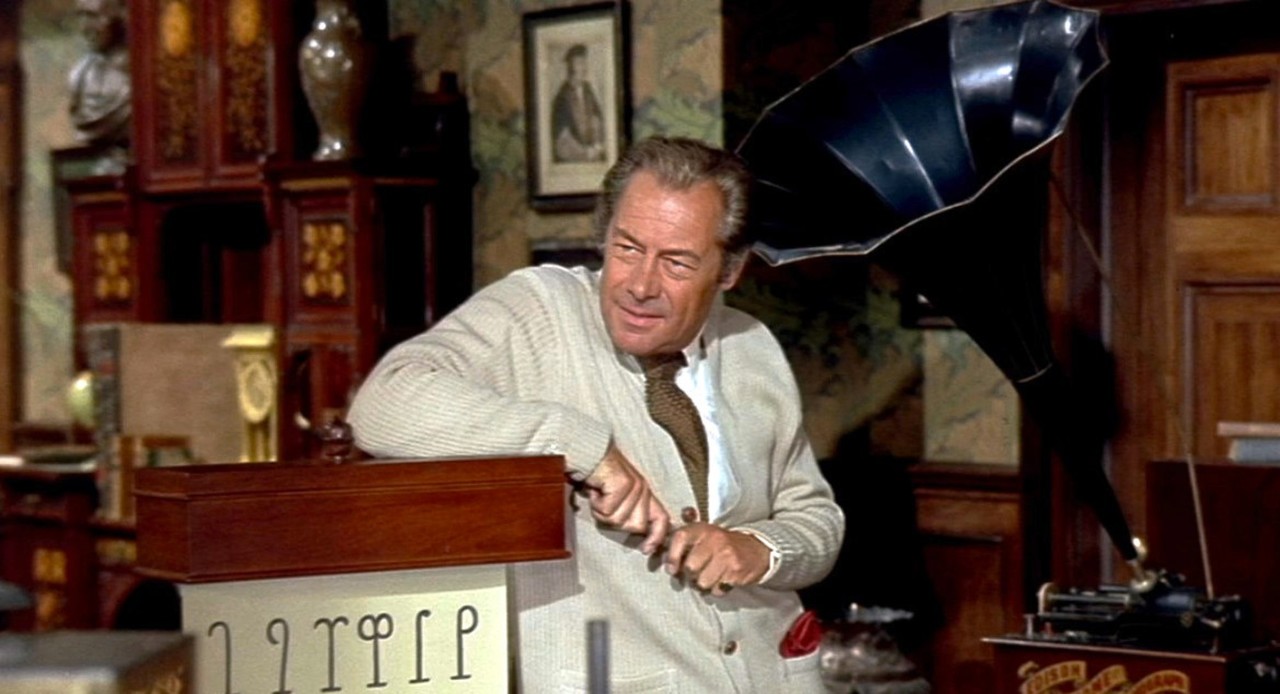
The title of Rationalization 1D comes from literature, specifically George Bernard Shaw’s 1912 drama, “Pygmalian,” better known today for its musical adaptation,”My Fair Lady.” The moment when Shaw’s obnoxious and misanthropic antihero Henry Higgins defines his rationalization occurs in Act 5; Alan J. Lerner lifted it almost verbatim for his book of the musical. Arrogant speech expert Higgins, having been rebuked by Eliza, the flower girl whom he taught to speak like an upper-class British woman to win a bet, for his cruel and uncivil conduct toward her says in his defense,

HIGGINS. … If you come back I shall treat you just as I have always treated you. I can’t change my nature; and I don’t intend to change my manners. My manners are exactly the same as Colonel Pickering’s.

LIZA. That’s not true. He treats a flower girl as if she was a duchess.

HIGGINS. And I treat a duchess as if she was a flower girl.

LIZA. I see.

HIGGINS. Just so….The great secret, Eliza, is not having bad manners or good manners or any other particular sort of manners, but having the same manner for all human souls: in short, behaving as if you were in Heaven, where there are no third-class carriages, and one soul is as good as another.

I immediately thought of this exchange when Gov. Andrew Cuomo of New York, in his rambling denial of multiple sexual harassment and sexual assault allegations, proclaimed his innocence (His victims don’t understand him!) by arguing that as a red-blooded Italian he’s just wired to be physically demonstrative, and treats everyone the same way.

Continue reading

Sunday Ethics Warm-Up, 8/1/2021: Simone Biles-Free Zone Edition!

Tower shooting

I don’t think that we need to debate the ethics of deranged mass shootings. The first one I was ever aware of occurred on this date in 1966. Charles Whitman, a former Eagle Scout and Marine, brought a stockpile of guns and ammunition to the observatory platform atop a 300-foot tower at the University of Texas. He had packed food and other supplies, and before settling in for 90 minutes of deadly target practice, killing some victims from as far away as 500 yards—he was a trained marksman—Whitman killed the tower receptionist and two tourists. He eventually shot 46 people, killing 14 and wounding 32 before being killed by police. The night before, on July 31, Whitman wrote a note saying, “After my death, I wish an autopsy on me be performed to see if there’s any mental disorders.” Whitman then went to his mother’s home to murder her, using a knife and a gun. He returned home to stab his wife to death.

Whitman’s story does raise medical ethics issues. He was seeing a psychiatrist, and in March told him that he was having uncontrollable fits of anger. Whitman apparently even said that he was thinking about going up to the tower with a rifle and shooting people. “Well, your hour is up, Mr. Whitman. Same time next week, then?” The intersection of mental illness with individual rights continues to be an unresolved ethics conflict 54 years later. In addition, the rare but media-hyped phenomenon of mass shootings has become a serious threat to the right of sane and responsible Americans to own firearms. See #5 below.

1. The King’s Pass in show business. A new book by James Lapine tells the antic story of how the Sondheim musical “Sunday in the Park With George” came to be a Broadway legend. Lapine wrote the book and directed the show. The cult musical—actually all Sondheim shows are cult musicals–eventually won a Pulitzer Prize ( you know, like the “1619 Project”) and bunch of Tony nominations. I was amazed to read that the show’s star, Mandy Patinkin, at one point walked out on the production and was barely persuaded to return. Lapine writes that he never fully trusted Patinkin again. Why does anyone trust him? In fact, how does he still have a career? Patinkin has made a habit of bailing on projects that depended on him. He quit “Chicago Hope,” and later abandoned “Criminal Minds,” which had him as its lead. To answer my own question, he still has a career because of “The King’s Pass,” Rationalization #11. He’s a unique talent, unusually versatile, and producers and directors give him tolerance that lesser actors would never receive. Mandy knows it, too, and so he kept indulging himself, throwing tantrums and breaking commitments, for decades. He appears to have mellowed a bit in his golden years.

2. Speaking of Broadway, the ethical value missed here is “competence”…There is more evidence that the theater community doesn’t realize the existential peril live theater is in (the medium has been on the endangered list for decades) as it copes with the cultural and financial wreckage from the Wuhan Virus Ethics Train Wreck. Just as theaters are re-opening, the Broadway theater owners have decreed that audience members will be required to wear masks at all times.

I have one word for that: “Bye!” Maybe some fools are rich, submissive and tolerant enough to pay $100 bucks or more for the privilege of being uncomfortable for three hours. Not me. My glasses fog up when I wear masks. I have been vaccinated; I’m fairly sure I was exposed to the virus before then and had minimal symptoms, and much as I believe in live theater, I will not indulge the politically-motivated dictatorship of virtue-signalling pandemic hysterics. The industry is cutting its own throat, but then theater has never been brimming with logic or common sense.

Continue reading

For Ethics Alarms, The Controversy Over The Unmarried Pregnant Art Teacher Is An Easy Call

pregnant teacher

I lost an ethics training client over the issue now raising its ethically-muddled head in New Jersey. Several years ago, during a day long seminar I taught for a teachers association, I stated that a teacher who taught grade school, middle school of high school students while pregnant and unmarried was harming her students, and that responsible school were ethically entitled to make pregnancy outside of marriage grounds for dismissal. Literally all of the attendees were outraged (even the two men in the group), though none could articulate a valid argument against what I said. (“The right to choose!” is not a valid argument in this context.)

I was right, they were wrong. The controversy now over a Catholic school art teacher who is demanding that she should have been able to keep her job despite being pregnant is much easier, or should be.

Victoria Crisitello was an art teacher at the New Jersey’s St. Theresa elementary school in Kenilworth. In the course of negotiating for a raise, she mentioned that she was having a baby. Weeks later, she was fired by the principal, a Roman Catholic nun, who explained that she was being terminated “because she was pregnant and unmarried.” “Sex out of wedlock violates a fundamental Catholic belief that the school in this instance felt it could not overlook,” lawyers for St. Theresa’s wrote in a petition to the state Supreme Court. Crisitello’s lawsuit was tossed out by two trial court judges, only to be restored each time when an appeals court sided with the ex-teacher. Now the state’s highest court, acting on an appeal by the school, has agreed review the case, which raises the continuing thorny question about the relationship between the government and religion.

Continue reading

An Everyday Ethics Conundrum: Free Air

air pump

Help me out with this one, if you can.

Our car has a slow leak in my right front tire. It get about seven pounds low every three days or so, and it has not been convenient for me to spend the time to go to the dealer and have the thing plugged. For several months now I have just filled the tire at the closest filling station, which has two air pumps (one is perpetually broken) that require six quarters to start the air coming.

About a week ago, both of the air dispensers—including the busted one— began sporting signs announcing that air would now be $2.00 for five minutes rather than $1.50. At the time, that caused me additional annoyance since I only had six quarters, and had to get change at the 7-11 to acquire the additional fifty cents. But when I put in the coins, the air turned on after only six quarters, as it always had. I finished filling the tire in about a minute, wasting the other four minutes of potential air, assuming the change in price had just occurred and the owner hadn’t yet adjusted the machine. But today when I went to fill up the once-again underinflated tire, it still only took $1.50 to start the air flowing.

The question: Am I ethically obligated to inform the owner of this? Do I owe him a buck for the last two air purchases?

From The Signature Significance Files: A Question For “The Ethicist” That Proves The Questioner Is Ethically Obtuse

GoFundMe for car

When I read the headlined question in an April installment of “The Ethicist” advice column in the New York Times Magazine, I would have done a spit-take if I had just taken a sip of something. It was “Is It OK to Use Money Raised for a Child’s Cancer Care on a Car?” What? No it’s not “OK,” you idiot! The questioner has to write to a professor of philosophy like Kwame Anthony Appiah, who is the current version of the Times’ ethics expert, to puzzle out that query? Why not ask a neighbor, a minister, a friend who isn’t in jail, a reasonably socialized junior in high school?

Then I started wondering what percentage of American think that question is a really tough one, and I got depressed.

Here was the whole question:

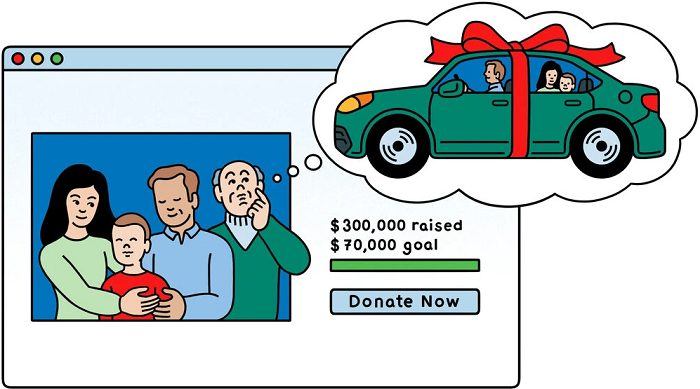
My grandchild is being treated for leukemia. A friend of the child’s parents set up a GoFundMe page for them. They’re both well loved and have siblings who know a ton of people. So the goal was surpassed in three hours, and donations totaled more than double that amount. They plan to donate anything over and above direct hospital-related expenses to leukemia research organizations.This couple have some needs that aren’t strictly related to the child’s care, like a new car. Am I rationalizing by saying they need to drive the child to the hospital and should use some of this money for a dependable car? Is there a strict line you would not cross? And is it germane that they’re not extravagant and extremely honest?

I don’t need to discuss Appiah’s answer; he got it right. If he hadn’t, he would need to have his column, his teaching position at NYU and his degree in philosophy taken away. My concern is how hopelessly inept our culture must be at installing the most basic ethical principles if someone grows to adulthood unable to figure out in a snap that if one receives charity to pay for a child’s medical expenses, it is unethical, indeed criminal, to use the money to buy a car.

This isn’t hard, or shouldn’t be. Why is it? If the GoFundMe raised more money than is needed for the purpose donors contributed, the ethical response is to send the now un-needed fund back, with a note of thanks. (Appiah, after far more explanation and analysis than should be necessary—but he does have a column to fill—-eventually points this out.) No, you do not give the extra contributions to “leukemia research organizations,” because the donors could have contributed to those on their own, and didn’t give the money after a general appeal for all leukemia sufferers. They gave money for this particular child’s treatment. Doing as the family plans is a classic bait-and-switch. The questioner doesn’t comprehend that, either.

Then the rationalizations for theft start. “This couple have some needs that aren’t strictly related to the child’s care, like a new car.” “Strictly” is such a wonderful weasel word; it greases slippery slopes so well. Again, “The Ethicist” is forced to explain the obvious: the donors weren’t contributing to a needed car, they were giving to support leukemia treatment. If the family wants a new car, let’s see what that GoFundMe will bring in.

Which of the family’s needs couldn’t be sufficiently linked to the child’s welfare to support a rationalization for using the funds? “Am I rationalizing…?” Of course you’re rationalizing; in fact, I think even this ethically illiterate correspondent knows this is rationalizing, and is just hoping that an ethics authority will validate an unethical calculation. The tell is that she feels it necessary to add that they are only seeking a reliable car, not a Lexus. But come on. “Think of the children!”(Rationalization #58) Isn’t this desperately ill child worth, not just a reliable car, but the most reliable car?

As if any further evidence was needed that this reader of “The Ethicist”—and wouldn’t you think that if she did read the column, she might have picked up just a teeny smidgen of ethical thinking over time?—has no clue at all, we get, “[I]s it germane that they’re not extravagant and extremely honest?”

What is that, some kind of cut-rate version of the King’s Pass? Actually, it is: this is a blatant Rationalization #11A, ”I deserve this! or “Just this once!” (The King’s Pass is #11.) The theory is that ordinary, greedy, sneaky people shouldn’t use money intended to save the life of a child to get a new set of wheels, but thrifty, honest, good people deserve a little leeway.

What percentage of the population thinks like this? 25% 50%? 90%?

In his answer, “The Ethicist” does provide an unintended hint regarding how Americans end up thinking this way. Like most academics, he’s a socialist, so he writes, “It is immoral that anyone here has to borrow large sums of money for essential medical treatment, especially for a child….we need to expand the pinpoints of empathy to … light the way toward a country where health care is treated not as a privilege but as a right.” Bad Ethicist. Bad! That’s a false dichotomy, and he knows it, but he’s spouting progressive cant now. Health care is like many other human needs that we have to work and plan for as individuals, and recognize that the vicissitudes of fate sometimes turn against us. If health care is a right, surely a home, sufficient food, an education—heck, why not a graduate-level education?—a satisfying job, guaranteed income, having as many children as one’s fertility allows, child care and transportation also should be “rights.”

Why shouldn’t it be ethical to use other people’s money to get a reliable “reliable” car?

This Is IT! In Charlottesville, Va.’s Schools, The Apotheosis Of The Great Stupid!

Lake Wobegon

This would be funny, if it were not so ominous. In fact, it already was funny, many years ago when monologist/author Garrison Keillor (now cancelled for alleged sexual harassment: he doesn’t exist any more) introduced the fictional Minnesota community where so many of his shaggy dog stories were set, with “Welcome to Lake Wobegon, where all the women are strong, all the men are good-looking, and all the children are above average!” [Laughter from the NPR audience.] All but the most dim-witted could get the joke in the last part, for it is impossible for everyone in any group to be above average.

Ah, but that was before The Great Stupid spread over the land like one of the Egyptian plagues in the Bible. Neither irony nor logic flickered in the brains of the Charlottesville, Virginia’s school board, which is patting itself on its mass back for the achievement of identifying 86% of its students as “gifted.” This qualifies those brilliant students for the system’s special, theoretically challenging, gifted classes.

The revelation was made during a Charlottesville school board meeting last week, and the members were thrilled. This was, obviously, impressive progress. Of course, one doesn’t have to be gifted to figure out what’s going on here. As in the memorable past cases of Washington D.C.’s rogue mayor Marion Barry telling the media that D.C.’s crime rate was pretty low as long as you didn’t count all the murders, and rogue President of the United States Bill Clinton explaining that he did not have sex with that woman, Miss Lewinsky, because oral sex isn’t sex, Charlottesville is adopting the now epidemic Rationalization #64, Yoo’s Rationalization or “It isn’t what it is.”

We had seen many signs that this was coming, notably in the efforts of New York city’s communist mayor, Bill de Blasio, to change the admission standards of the New York City’s elite specialized high schools because not enough minority students (except for Asian-Americans of course) were getting in. It is also an extension—heh, I almost said “logical extension”!—of the woke fundamentalist article of faith that skin color itself should be considered a qualification on par with, indeed above, such characteristics as skill, knowledge, achievements, experience, character and intelligence—thus resulting in Kamala Harris becoming Vice-President of the United States.

Continue reading

Comment Of The Day: “Casting Ethics: ‘Anne Boleyn’ And Discriminatory Double Standards”

Oh, I just love this Comment of the Day by Curmie, who was AWOL from the ethics comment wars for far too long, and whose return recently has made my heart soar like a hawk. I love it for many reasons, including, of course, the fact that it is well written and enlightening, far more so than my post that prompted it, which focused narrowly on the double standard of applauding the having a performer of one race portray another, but only when it’s the “right” races involved.

As with my posts about ethics issues in another lifetime passion, baseball, I know that many readers nod off when the framework is theater. But the conceit of Ethics Alarms is that the ethics issues and process of analysis are often universal regardless of where the dilemmas and conflicts pop up. As it happens, baseball and theater happen to be two realms that I know a lot about.

But not as much as Curmie, at least as far as theater is concerned. I had hoped that he would weigh in on the casting of a black actress as Anne Boleyn, and he did.

Here is Curmie’s Comment of the Day on the post, Casting Ethics: “Anne Boleyn” And Discriminatory Double Standards.

***

Literally two minutes after reading this post, I saw that Katori Hall had been awarded the Pulitzer Prize for Drama for her play The Hot Wing King. I don’t know the play—its Off-Broadway run was cut short by COVID, and as far as I can tell it hasn’t been published.

I do, however, recognize her name as the playwright of The Mountaintop, in which the two characters are Martin Luther King, Jr. and an employee of the Memphis hotel in which he is spending what he doesn’t know is his last night on earth. (Spoiler alert: she’s really an angel preparing him for what is to come.) It is a good, borderline great, play: by turns moving, humorous, and incisive. But what comes immediately to mind is the production by a student group at Kent State University, in which a white actor was cast as King. The director, of course, claimed the casting decision wasn’t a gimmick. (Newsflash: it was a gimmick.)

The original idea was to alternate the role between a white and a black actor to be, in the director’s words, “a true exploration of King’s wish that we all be judged by the content of our character and not the color of our skin.” The black actor had to drop out of the production, and the white one played the role throughout the run.

Continue reading

Ethics Dunce: Yahoo! Sportswriter Shalise Manza Young

Naomi-Osaka interview

The withdrawal of female tennis star Naomi Osaka from the French Open because she wasn’t allowed to ignore rules all the other players were forced to play by has inspired a revealing amount of criticism…of the concept that stars should have to abide by the same rules and laws as everybody else. Since this is a massive ethics blind spot that defies persuasive advocacy, I’ve been somewhat surprised that so many commentators and athletes have been willing to put such an unethical position in print.

I shouldn’t have been, I guess. Osaka (predictably) played the victim, suddenly revealed that she suffered from depression (the old reliable “I’m not bad, I’m sick!” ploy satirized in “Officer Krupke”), and she had the triple benefit of being Asian, Black and female, the “Get Out Of Accountability Free” hat trick (that’s hockey, but you get the point) in the Age of The Great Stupid.

I was originally going to dedicate this post to the fatuous commentary of New York Times columnist Kurt Streeter, to whom all sports is about race, on l’affaire Osaka. “Using social media posts, first last Wednesday then on Monday, Osaka called out one of the most traditional practices in major sports: the obligatory news conference, vital to reporters seeking insight for their stories, but long regarded by many elite athletes as a plank walk. After monumental wins and difficult losses, Osaka has giggled and reflected through news conferences and also dissolved into tears. In Paris, she said she wanted nothing to do with the gatherings because they had exacted a steep emotional toll,” he wrote. “She sent a message with significant weight: The days of the Grand Slam tournaments and the huge media machine behind them holding all of the clout are done. In a predominantly white, ritual-bound sport, a smoothstroking young woman of Black and Asian descent, her confidence still evolving on and off the court, holds the power. Get used to it.”

Get used to what? Star athletes (and politicians, and other celebrities) thinking that if they are successful enough and popular enough, they get to break rules and get away with it? We’re used to that. But the point is that she doesn’t have the power. Tennis authorities fining her and threatening to kick her out of upcoming tournaments proved it. So she threw a tantrum, quit, took her ball and went home, and that’s admirable to Streeter, or anyone else? Well, but, you see, “it is impossible to know the depth of Osaka’s internal anguish” as “the rare champion of color in a tennis world dominated by fans, officials and a press corps that is overwhelmingly white.” Oh, gag me with a spoon. I’d be willing to suffer a lot of internal anguish in an enterprise I could make over 50 million dollars in a year, as Osaka has. Who wouldn’t?

Continue reading

Ethics Observations On The Naomi Osaka Affair [Corrected]

Osaka2

On Ethics Alarms yesterday, the controversy involving the current top female pro tennis star, Japan’s Naomi Osaka, was relegated to the morning warm-up rather than a stand-alone post. If you were not following EA yesterday, here’s a quick summary:

Citing her annoyance with repetitious questions from the news media that undermined her confidence, the 23-year old announced that she would violate the 2021 official Grand Slam rulebook, which requires players to participate in post-match news conferences. Violations result in fines of up to $20,000, but since Osaka made over 55 million dollars last year alone, more than all but the most elite U.S. professional athletes, this fine would be like a late fee at the library to normal people. I wrote in part,

This is literally an example of a star announcing that rules are for lesser mortals. Verdict: Ethics Dunce. The reason Osaka makes so much money is that athletes are paid heroes and entertainers, and submitting to the idiocy of reporters is part of their job. Fines obviously aren’t enough: a tennis player who refuses to fulfill her obligations to the sport should be banned from competing until she does.

Yesterday, after winning her first round match at the French Open, Osaka was fined (but only $15,000), and tennis officials proved that they read Ethics Alarms (I jest) and told Osaka that continuing her boycott of the media would result in her being suspended from the current tournament and others. Good. The organization had no other choice, unless it wanted to directly endorse the King’s Pass (Rationalization #11). If Osaka was allowed to snub the media with minimal consequences (for her), then no other player would feel obligated to cooperate either. Rennae Stubbs, a former player who is now a coach and ESPN analyst, stated the obvious while most of the players and former players were expressing sympathy for Osaka: “You cannot allow a player to have an unfair advantage by not doing post-match press. It’s time consuming, so if one player is not doing that and others are, that is not equal.”

Continue reading

The Scott Rudin Reckoning

Rudin

If you are not a active follower of show business, you may not recognize the name Scott Rudin. Heck, I am an active follower of show business, and I only began actively registering his name in my RNA lately because of the sudden shift in his fortunes. Rudin, in case you’re normal and barely noticed, has long been one of the most celebrated and powerful producers in Hollywood and Broadway. His productions have made billions; he has created too many stars to list, and his work has earned an Emmy, a Grammy, an Oscar and 17 Tony Awards. The problem, except that it wasn’t a problem until recently, is that Rudin is a toxic, bullying, abusive jerk who makes working with or for him a living hell. He’s not a sexual predator, like Harvey Weinstein, so his misconduct has not been strictly illegal. Moreover, while he is an extreme case, his obnoxious type has hardly been rare in show business. One could say it is closer to the norm.

Yet suddenly, Hollywood, Broadway and the entertainment business have begun a cultural shift. It was undoubtedly spurred by #MeToo, but in the end it may be more significant that #MeToo. This highly influential industry is beginning to reject the King’s Pass. As much as I hate to say anything good about show business culture, this is an unquestionably ethical development that could have wide reaching effect far beyond movies, plays, TV shows and music.

The King’s Pass is described in the Ethics Alarms Rationalizations List thusly:

11. The King’s Pass, The Star Syndrome, or “What Will We Do Without Him?” One will often hear unethical behavior excused because the person involved is so important, so accomplished, and has done such great things for so many people that we should look the other way, just this once. This is a dangerous mindset, because celebrities and powerful public figures come to depend on it. Their achievements, in their own minds and those of their supporters and fans, have earned them a more lenient ethical standard. This pass for bad behavior is as insidious as it is pervasive, and should be recognized and rejected whenever it raises its slimy head.  In fact, the more respectable and accomplished an individual is, the more damage he or she can do through unethical conduct, because such individuals engender great trust.

It is one of the most pervasive of all ethical perversions, and throughout human history, as reliable as an aspect of human nature. If you are successful and valuable to organizations and people, you can get away with bad, even terrible conduct that ruins lesser mortals. The rule reigns in business, academia, politics, government, sports and, of course, entertainment. One can speculate on why Scott Rudin’s unexpected fall has become a possible catalyst for weakening the iron grip of The King’s Pass, but for the moment, let’s focus on the fact that he has.

Continue reading