Tit For Tat Ethics: The Anti-Biden-Pro-Trump Flags

Anti-Biden flags

Two stories about vulgar flags hanging on houses were so similar, I thought they were a single episode. In fact, they occurred in different states. It didn’t help that in both stories, the politically correct, silly and near-useless news media refused to actually reveal the facts because they might be “offensive.”

In Charlotte, North Carolina, a flag with “graphic language” directed at President Joe Biden and Vice President Kamala Harris hangs in front of a home down the street from Mallard Creek Elementary School. Teachers and neighbors are upset at “the profane language and blatant disrespect for the President and Vice-President,” and complained that this was was “a terrible example” to set for kids. The house is on a street on the route for all the buses to get to the school.

What exactly is “the graphic language”? We’re supposed to guess: that’s today’s woke journalism, as in “lousy journalism.” Some comments from neighbors are also revealing. A neighbor told the local Fox affiliate, “If she’s concerned about that, then she needs to be getting on these rap songs and everything else.”

Yeah, that’s a classic deflection, in the style of a nice round, ten rationalizations, like 2.Whataboutism, or “They’re Just as Bad,”8, The Trivial Trap (“No harm no foul!”), 8A. The Dead Horse-Beater’s Dodge, or “This can’t make things any worse,” 16., The Consistency Obsession, 22, “There are worse things,” 26, “The Favorite Child” Excuse,” 33. The Management Shrug: “Don’t sweat the small stuff!,” 44. “It’s Not The First Time, ” 50A. Narcissist Ethics , or “I don’t care,” and #58. The Golden Rule Mutation, or “I’m all right with it!” The response doesn’t address the issue at hand, it just shrugs it away.

Too bad they don’t teach basic ethics in the U.S.

Continue reading

Ethics Quote Of The Month: New York Times Columnist Ross Douthat

seusscancelled-header

“It was mildly creepy to hear that the custodians of Theodor Geisel’s estate, Dr. Seuss Enterprises, consulted with a ‘panel of experts’ and decided to cease publishing six Seuss titles because they ‘portray people in ways that are hurtful and wrong.’ But it was much creepier that so few people notionally in the free-expression business, so few liberal journalists and critics, seemed troubled by the move.”

New York Times columnist Ross Douthat, one of the paper’s three token conservatives (or perhaps “non-knee-jerk Democrats” is more accurate), in his column, “Do Liberals Care if Books Disappear?”

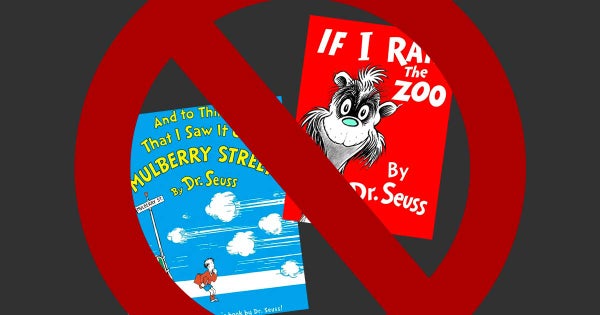
The question is a rhetorical one. Douthat knows the answer, and so do regular Ethics Alarms readers: “Only if the books that disappear are those they agree with.” Though the column focuses on the Dr. Seuss metaphorical book-burning, Douthat properly interprets what it signifies. Of course, he is appropriately late to the party, for it was obvious well before “If I Ran the Zoo” was under attack that the totalitarian-tending Democrats and their progressive supporters and allies were in favor of “good” censorship. Never mind—Americans rushed to their mailboxes to vote an anti-free speech regime into power anyway.

Better late than never for Ross, I guess. Here are some highlights (but read his whole piece):

Continue reading

The New Racism, Now Available At Cornell…Oops! Never Mind! Racism? What Racism?

Cornell racism

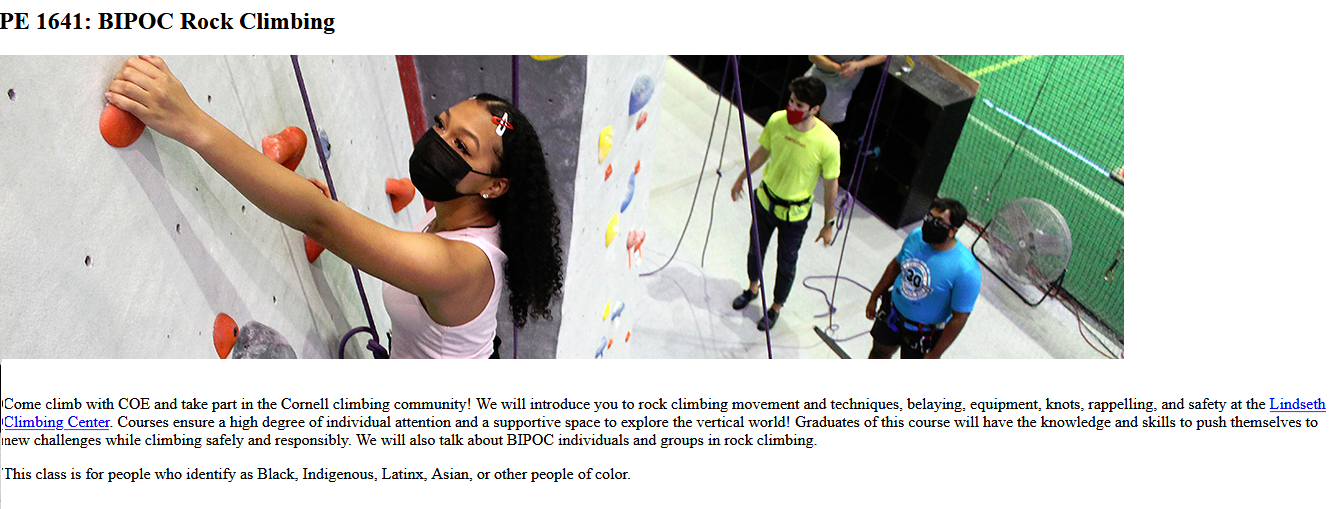
How brazen are our indoctrination institutions as they attempt to enshrine the new racism as an American norm? This brazen: Cornell launched a segregated rock-climbing course excluding white students, described as a class will provide a “high degree of individual attention” focusing on “BIPOC individuals and groups in rock climbing.” Campus Reform confronted school authorities about the discriminatory and facially illegal course description, and the school quickly backed down, pulled the description, changing it to one stating that the class is “open to all” students who are “interested in learning rock climbing with this special focus.”

Wow. Cornell must be really certain that all of its students have been thoroughly woked if it took an outside conservative website to get the school to reverse itself. Or perhaps they were confident that any Cornell student who had the perception, intelligence and integrity to flag this outrage would know that he or she risked being driven off campus by an angry mob, not that this would be a bad thing. I would not stay in a college run by administrators who openly discriminate like that, and it wouldn’t matter what group they were discriminating against.

Continue reading

Ethics Quote Of The Month (Yes, It’s More Impeachment Analysis, And I’m Sick Of It Too, But This Is Important): Professor Jonathan Turley

Shredding-the-Constitution

..Even with acquittal all but ensured, there was no room for constitutional niceties like free speech or due process. There was only one issue — the same one that has driven our media and politics for four years: Trump. Through that time, some of us have objected that extreme legal interpretations and biased coverage destroy our legal and journalistic values.

—-George Washington University Law School professor Jonathan Turley, constitutional law expert, on the conduct of the Democrats before and during the just-completed second Trump impeachment trial.

This statement, as well as the rest of his article for The Hill yesterday, was not only astute (though Turley’s observations should have been obvious) but personally welcome, in part because it tracked exactly with what I have been writing here for four years, but  in no small part because I was almost finished with a post making the same points. For Turley to make them is, of course, better, since a lot more people, though not nearly enough, pay attention to what he says. It was especially welcome because not one but two friends (among others) had made fatuous and indefensible assertions about the impeachment in the past two days, inspiring me to start that now redundant post.

My theme was going to be about how their now completely unhinged, Ahab-like mania to destroy the former President had led them to deny the importance of what once were accepted by liberals and conservatives alike—but especially liberals before their rebranding as “progressives”—as crucial, indispensable, core American values relating to personal liberty and government interference with it. The rationalizations employed in this scary process are stunning.

Prime among them as been 2020’s rationalization of the year: “It isn’t what it is,” #64. As I noted in the previous post, a Facebook friend (whom I strongly suspect was one of the self-exiled progressive Ethics Alarms commenters) wrote on the platform to the usual acclaim of  “likes” and “loves” that the 57 Senators who voted for this corrupt impeachment were voting “for democracy.” They were in fact doing the opposite, and in many ways, as Turley’s article explains (though again, it should be obvious.) Then, in a discussion with a more rational friend, another lawyer, about how the House impeachment had deliberately bypassed due process, I was told that there is no right of due process in an impeachment proceeding, nor should the prohibition of ex post facto laws and bills of attainder apply. Here was a lawyer making technical arguments against ethics. “Legally, due process only applies to life, liberty, and property,” she lectured. “A job is none of those.”

I could rebut that, but the point is that both the Declaration and the Constitution mark out basic values of our society, not just laws, but ethical values. “Due process” means fairness, and this lawyer, an alleged progressive, was arguing that the government doesn’t have to be fair while depriving the public of an elected official and that elected official of his job, and that individual of his ability to seek that job or another one. This is what hate and arrogance have done to the Left.

Continue reading

Self-Checkout Ethics

Self-Checkout-Loss

I am embarrassed to admit that this issue never occurred to me begore a friend sent me an article about it. Or maybe I should be proud.

Voucher Codes Pro is a company that offers coupons to internet shoppers. It surveyed 2,634 people, and almost 20% said they had cheated while using a grocery store self-checkout. Over half of the cheaters said they took advantage of the system because they realized being apprehended was unlikely. A 2015 study of self-checkouts with handheld scanners conducted at the University of Leicester audited a million self-checkout transactions over a year’s time.Out of $21 million in sales, goods worth nearly $850,000 left stores without being scanned and paid for.

How does this happen? There are several techniques:

  • Ringing up a T-bone ($13.99/lb) with a code for a cheap ($0.49/lb) variety of produce is known as “the banana trick.”
  • When a pricey item leaves the conveyor belt without being scanned, it’s “the pass around.”
  • Then there is “the switcheroo,” where you peel the sticker off something inexpensive and place it over the bar code of something pricey. You do have to make certain that the two items are about the same weight to avoid triggering the “unexpected item” alert on some machines.

“Anyone who pays for more than half of their stuff in self checkout is a total moron,” reads a comment in a Reddit discussion on the subject. Another one says, “There is NO MORAL ISSUE with stealing from a store that forces you to use self checkout, period. THEY ARE CHARGING YOU TO WORK AT THEIR STORE.”

I guess this would apply to gas stations too.

Continue reading

Morning Ethics Warm-Up, 2/10/2021: Happy Birthday, Jimmy! [UPDATED!]

Jimmy Durante was born on this day in 1893 (“The Snozzola” died 87 years later, in 1980. He’s a semi-regular around here, because it’s Jimmy’s famous line from “Jumbo” (1935) (“Elephant? What elephant?”) that describes the Ethics Alarms offense of resolutely refusing to admit an ethic breach that cannot be denied.

My father was a lifetime admirer of Jimmy, and eventually I joined him: we had all of his albums, and as a stage director I often played his renditions of a ballad (like “I’ll Be Seeing You”) for singers to demonstrate the importance of phrasing and expression, both of which Durante excelled at despite having a distinctive but hardly euphonious voice. He also impressed me with his professionalism. When my father was handling marketing for a Boston banking association, he helped arrange for his organization to be one of the sponsors of Jimmy’s show, which came to the Prudential Center in Boston. The Snozz was over 70 then, but he always seemed ageless, and his energy in person was even more impressive than it was on TV (in fact, Durante had learned to tone down his enthusiasm on the small screen, because it became exhausting to watch). He made his entrance in the stage show rushing on from the wings while singing and flinging his fedora to the back of the stage, where it landed neatly on the head of his band’s bald drummer. My father managed to get our family backstage (though Jimmy was not available because he had a charity appearance right after the show) and I talked to the drummer. I asked him how often Jimmy landed the hat on his head. He replied, “He’s never missed.” He went on to say that his boss rehearsed that bit for hours every week and before every show. It was a split second grace note, but Jimmy insisted on doing it perfectly.

Durante had a stroke after a show when he was almost 80, and never fully recovered. My father, who was uncomfortable expressing emotion face to face but wrote beautiful and touching letters (I hated getting them because they always made me cry; still do), wrote Jimmy, who was then bedridden, a letter thanking him his long entertainment career and explained what his work had meant to Dad. Jimmy’s wife Margie wrote back to say she had read the letter to Jimmy, and he had mouthed the words “Thank you.”

1. Politicizing everything. UCLA’s star gymnast Nia Dennis is getting accolades for turning her floor routine into an ” exuberant and powerful celebration” of black culture. Says Slate, “This routine has everything. Dennis pays tribute to Colin Kaepernick (she kneels!), Tommie Smith and John Carlos (she raises a fist!), and Kamala Harris (like a soror, she strolls and she steps!).” That’s funny: the only way I would recognize a reference to Harris would be if Nia cackled and blathered nonsense. The routine is more dance than gymnastics, but it’s a diabolical gimmick (don’t blame Nia: she has a woke choreographer, Bjoya Das). Any judge that doesn’t give the routine the highest marks knows he or she will be cancelled as a virulent racist.

2. Then there’s the Jeep ad…I’m not going to bother with surveying the ethically dubious Super Bowl ads this year, since they all are unethical for supporting the NFL’s ongoing negligent homicide, but I can’t let Bruce Springsteen’s obnoxious Jeep ad pass. Here it is:

[Whoa! That video was pulled from YouTube shortly after I posted it! I also can’t find a link that has it.]

“To The ReUnited States Of America.” Right. Springsteen is hardly an honest advocate for “the middle,” as a vocal Democrat and anti-Trump shill. The country is supposedly “re-united” because a Democrat is President. The entire theme of the ad is a cynical exercise in Rationalization #64, “It isn’t what it is.” Donald Trump was “divisive” because Democrats decided to paint him as such. Enforcing immigration laws shouldn’t be divisive. Withdrawing from an unapproved treaty with no actual impact shouldn’t be divisive. Calling the biased news media what it is shouldn’t be divisive. Now, calling half the country racists , Nazis and morons IS divisive, and the party that just won control of Congress and the White House has been doing that for four years. Surveys show that that half of the country is more angry, alienated and distrustful than ever, and for some very good reasons, like the current unconstitutional impeachment trial. Got it, Bruce: when Republicans win a national election it’s divisive,and when Democrats win one, it’s unifying.

Update: Apparently Jeep has received so many complaints about Bruce that they decided it was a major gaffe. How can this happen? It happens when the entire company and its ad agency is so overloaded with Democrats and progressives that they can’t see what’s right in front of them.

Continue reading

Is It Ethical For Responsible Americans To Remain On Facebook?

Facebook-Censorship

There was some sort of good news but also seriously ominous news regarding Facebook’s increasingly brazen efforts to distort public debate and to use its power to restrict free speech. Unfortunately, the good news wasn’t nearly good enough, and the rest might just be the proverbial straw that breaks the metaphorical camel’s back, at least for me.

On the slightly positive side was that the giant social media platform has reversed several instances of content removal after review by the company’s “independent” (I am not convinced how independent it is) oversight body. Facebook’s new 20-member Oversight Board released its first verdicts yesterday, and overturned four of five censorship decisions. Facebook is now allowed seven days to restore the banned content.

But why does it take seven days? It doesn’t really: this is a stall. With time sensitive material, the license just compounds the harm.

Now the board will decide whether to keep former President Trump’s page banned permanently. That should tell us whether the review system is legitimate or a sham with a purely political agenda, for there can be no justification for blocking the words, views and opinions of any prominent national leader, particularly a President, and particularly particularly one who is routinely savaged with twisted accusations every day by the news media and every second by other Facebook users. The Oversight Board will issue a decision in the next 90 days as the ban continues. It’s a another transparent stall. This isn’t a hard call, and if it is for anyone, then that is signature significance for disqualifying bias.

Continue reading

Ethics Quote Of The Month: Glenn Greenwald

A republic

“Unleash this monster and one day it will come for you. And you’ll have no principle to credibly invoke in protest when it does. You’ll be left with nothing more than lame and craven pleading that your friends do not deserve the same treatment as your enemies. Force, not principle, will be the sole factor deciding the outcome. If you’re lucky enough to have important and famous media friends…you have a chance to survive it. Absent that, you have none.”

Glenn Greenwald, in his post on the attempted “canceling” of writer Will Wilkenson over a facetious tweet.

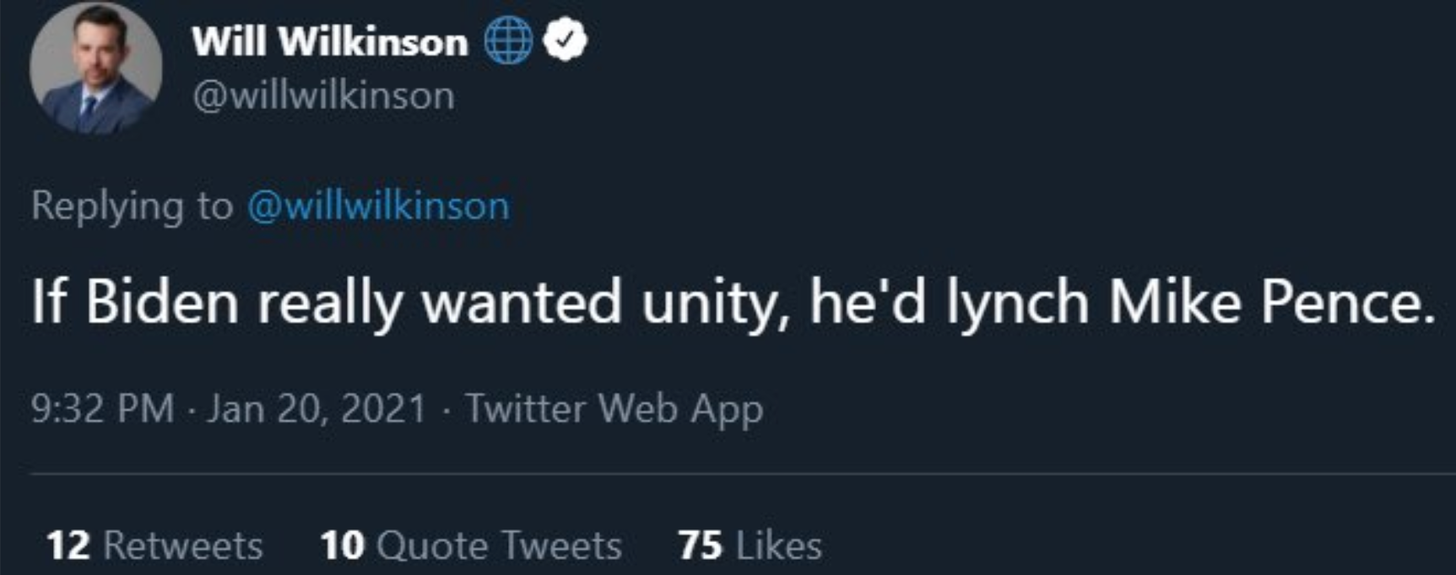
The “monster” Greenwald is referring to is mob anger and indignation, magnified by social media, and enabled by self-preservation and cowardice. His essay, titled “The Moronic Firing of Will Wilkinson Illustrates Why Fear and Bad Faith Mob Demands Reign Supreme,” was triggered by the recent firing of an intellectual I never heard of by a think tank I never heard of, as well as his looming dismissal by the New York Times. His “crime” was this tweet…

Willkerson tweet

…which a hoard of online cretins and power-hungry wastrels pounced upon, falsely calling it a call to do violence to the ex-Vice-President and thus mandating his public humiliation and rejection.

As Greenwald correctly concludes, no reasonably intelligent reader could think the tweet, posted the night of Joe Biden’s inauguration, was anything but a pointed joke. Extreme Trump supporters were furious with Pence for not taking action to reject the 2020 election results. Anti-Trump extremists wanted Pence to remove President Trump using the inapplicable 25th Amendment ploy, which he correctly refused to do (and could do constitutionally anyway.) Thus lunatics on both sides of the U.S. ideological divide could be unified in their anger and hatred toward Mike Pence, ironically making his mistreatment a potentially unifying act. Wilkinson rueful point was valid (if clumsily made), and he wasn’t personally advocating violence against Pence. But a wealthy hedge fund manager and large-money GOP donor, Gabe Hoffman, condemned the tweet which he claimed “call[ed] for former Vice President Mike Pence to be lynched.” Hoffman asked the New York Times, which employs Wilkinson as an opinion writer, to comment on its ” ‘contributing opinion writer’ calling for violence against a public official,” then tweeted to Wilkinson’s other employers, the Niskanen Center, a moderate public policy think tank, to pressure them as well. The Center quickly fired Wilkinson, while his fate with the Times hangs in the balance. A spokesperson for the paper told Fox News: “Advocating violence of any form, even in jest, is unacceptable and against the standards of The New York Times. We’re reassessing our relationship with Will Wilkinson.”

Naturally, as happens in 99% of these increasingly common episodes, the victim of the deliberate misunderstanding resorted to a grovelling apology, saying in part,

“Last night I made an error of judgment and tweeted this. It was sharp sarcasm, but looked like a call for violence. That’s always wrong, even as a joke. It was especially wrong at a moment when unity and peace are so critical. I’m deeply sorry and vow not to repeat the mistake. . . . [T]here was no excuse for putting the point the way I did. It was wrong, period.”

No, actually it didn’t look like a call for violence, and apologizing for something it wasn’t but was deliberately misrepresented as being for malicious purposes is far worse than the tweet itself.

Continue reading

Ethics Quiz: The Fake Inspirational Story

1927NYYankees5

Ethics Alarms touched on this area here, when I related the example of a defense lawyer who won over the jury in the sensational Richard Scrushy fraud case with a vivid but made-up anecdote:

My favorite ethics moment is when Scrushy’s main trial lawyer, Jim Parkman, is asked about his headline-making anecdote in his opening statement, in which he quoted his grandmother as always telling him”every pancake, no matter how thin, has two sides.” “Did your grandmother really say that?” Parkman’s asked on camera. “No,” he admits after a long pause. “But she could have!”

Lying to a jury would seem to be a serious ethical violation for a lawyer, and by the wording of the rules, it should be. But every lawyer I’ve discussed Parkman’s tactic with agrees that such non-substantive lies would never result in professional discipline. (I think they should be.)

But what about inspirational stories and anecdotes that aren’t true? Does the end justify the means? Brian Childers’ story about Tommy Lasorda reminded me of another Lasorda story. Managing in the minors before becoming the third-longest tenured manager with a single team in baseball history, the ever-ebullient leader of the Spokane AAA team was faced with a dispirited squad that has lost nine straight games. Tommy bucked them up by reminding the players that the 1927 Yankees of “Murderer’s Row” fame, then and now the consensus choice as the greatest baseball team of all-time, also lost nine games straight. His team was cheered, and not only broke out of their slump, but went on a winning streak.

Asked later if it was true that the team of the Babe, the “Iron Horse” and the rest ever lost nine in a row, Lasorda answered, “Hell, I don’t know. But it turned my team around when they thought so!!”

Continue reading

Bizarro World Ethics: A Vicious Young Jerk’s Unethical Act Is Celebrated And His Victim Vilified In A Cautionary Tale Of What Happens When Society Allows Its Values To Be Turned Inside Out. Part II: The Times And Its Readers

Mimi

In Part I, describing the horrific personal destruction of 18-year-old Mimi Groves (above)–the antiseptic term “unethical” does not adequately convey the pure viciousness and wrongfulness of the act—I attempted to clarify what the entire scenario represents, a near complete distortion of values and ethical norms with ominous implications. I mostly left out the enthusiastic participation of the New York Times in this destructive process, first, because it was not directly involved in Jimmy Galligan’s hateful and pernicious conduct, and second, because of space considerations. Thus we have Part II.

The Times signaled its sentiments and objectives in the headline of its feature, written by reporter Dan Levin: “A Racial Slur, a Viral Video, and a Reckoning.” “Reckoning” means, in this context, a settling of accounts, a judgment, or earned punishment. In the view of the Times writer and the editors who allowed it to be published, Mimi Groves was justly punished by her black classmate, who plotted–plotted is a fair description—to derail her education and future prospects, and did so. What was the conduct that earned the “reckoning”? Groves used a word, in a general context, that the social justice establishment has ruled, on its own authority, can never be uttered for any reason, or published in print—unless the individual responsible is black, in which case it may be rude or less than desirable, but otherwise it’s OK.

At the time the word “nigger” was used by Groves in a three second video on social media, and today, popular songs embraced by her age group and peer group used the same word repeatedly, and made millions of dollars as a result. At the time the word “nigger” was used by Groves in a three second video on social media, popular movies showed black characters calling other black characters that same word in jest, or affectionately, or for shock value.The actors playing those characters, notably Samuel L. Jackson, who has earned a bundle as the spokesperson for a major credit card,while using teh word “nigger” more times on screen that any actor in film history, have not faced any “reckoning.” The screenwriters who put those words in his mouth faced no “reckoning”; the directors who permitted the dialogue to be read and the studios that sent the wave of “niggers” into theaters and streaming services faced no “reckoning.”

Just this month, Netflix premiered an adaptation of August Wilson’s play “Ma Rainey’s Black Bottom,” directed by acclaimed social justice warrior director George C. Wolfe, an African American. When a stream of “niggers” was unleashed about ten minutes into the fim, never to stop, I was genuinely confused. How could this be, when I have a file of professors and teachers who faced sanctions, protests, suspensions, and professional destruction, not by referring to any black individual as a nigger, but by using the word in the context of discussing legal, ethical and cultural implications of language.

Yes, I was confused, and I am a lawyer, a writer, an ethicist and a teacher with more than four times as much experience in life as Mimi Groves when, as a child, she mistakenly thought a casual use of the word in a social media message wouldn’t upset anyone, much less put a dedicated life assassin on her trail.The the New York Times holds that Mimi deserved her “reckoning,” and made sure that if anyone inclined to tar her as a racist unfit for human association on this woke culture we are breeding didn’t know that she had to be punished and why, a major feature in the nation’s most read, circulated and quoted newspaper would spread word of her disgrace. The paper’s verdict is clear: Jimmy Galligan struck a blow against “systemic societal racism.” He’s a hero, even though literally nothing he did was ethical, fair, or just:

Continue reading