At halftime in the Brigham Young University (BYU) and Stanford University’s (Stanford) football game in California, Stanford’s band devoted its halftime show to insulting the Mormon faith The skit was called “Gay Chicken,” and featured a mock wedding ceremony of two women,using the words of the Church of Jesus Christ of Latter-day Saints marriage ceremony that declares a man and woman united “for time and all eternity.” In the skit, the wedding officiant quoted Genesis 1:28 and directed both women to “be fruitful and multiply and replenish the earth.”
Gee, that sounds so hilarious I can’t imagine why the many Mormons in the crowd would feel attacked! They should have been laughing their heads off! Well, some people just have no sense of humor….
After all, his crimes were non-violent. He’s African-American, and systemic racism has caused the “over-incarceration” of black men. He’s a man of God, and the Bible tells us to forgive. It says that there should be redemption even after heinous wrongdoing. Should Charles Southall III even spend time in prison at all?
For more than three decades, he has led the First Emanuel Baptist church in New Orleans and Baton Rouge. But the minister also embezzled donations from congregants that were supposed to fund charity projects and building improvements. He stole grant and loan funds from the Edgar P Harney Spirit of Excellence Academy that he had created, and deposited them in a bank account controlled by him and an accomplice. He converted rental and sale payments on properties owned by his church. All together, the minister took about $900,000, and used the money to pay off his personal expenses and purchases.
He pleaded guilty and has pledged to pay back what he can. The guess is that Southall will spend less than a decade in prison, probably much less. Are you satisfied with that result?
I’m not.
The verdict here on Ethics Alarms is that even a decade isn’t enough. This man has done far more harm than the typical thief, even more than the typical thief of nearly a million dollars. He took money that was supposed to help the needy. He misused funds families of ordinary means gave to the church in the spirit of charity and generosity. He abused their trust, and quite possibly damaged the faith of many of them. Southall betrayed his profession, and it is a profession that is supposed to bolster virtue and values in society, not make a mockery of them.
What Southall did is worse, in my view, than armed robbery. It deserves the same kind of harsh sentence Bernie Madoff received for stealing the assets of foundations, investors and retirees. Madoff took billions, and was sentenced to 150 years, because that was the maximum the law allowed. Madoff, however, didn’t steal his money in the name of God, charity, and community service.
150 years locked up for Southall seems about right to me.
Snell is a lawyer, which is how he gets on TV to spout Democratic Party talking points, on the theory that biased, irresponsible propaganda is somehow more credible when a lawyer issues it. Still, lawyers aren’t supposed to lie or deliberately deceive the public. No, Tristan, you idiot, that is not a Nazi salute. I am hardly a frequent church-goer, but even I’ve been at services where the congregation was urged to raise hands exactly like this.
William MacAskill is a philosopher, a professor at Oxford who has a new book out for the riff-raff, “What We Owe the Future.” MacAskill is a key spokesman for the so-called “effective altruism” movement which advocates “longtermism,” a an ethical position prioritizes the moral worth of future generations and obligation of present society to protect their interests. You know where this goes, right? “Longtermists argue that humanity should be investing far more resources into mitigating the risk of future catastrophes in general and extinction events in particular,” writes New York Magazine. Got it. This is a another climate change activist group shill trying to get civilization to shut down based on speculation, scaremongering and dubious science.
Ann Althouse, who has the time on her hands to read the increasingly leftist New York Magazine so I don’t have to, flagged an interview with MacAskill, and had the wit and integrity to note that the philosopher so focused on the value of future lives never mentioned abortion nor was asked about it. Ann, who initially pronounced the Dobbs decision monstrous, does have integrity, and tracked down another recent book-promotion interview where abortion was raised. Asked whether his movement should be anti-abortion, MacAskill says no, and when pressed on his reasons (admittedly lamely), resorts to pure jargon and doubletalk, ducking the issue: Continue reading →
In Part 1, I wrote: “Performance artists generally and across all levels and regions tend to be incompetent at ethical analysis, and their ethics alarms aren’t merely dysfunctional, they are warped.” Unfortunately, this applies to aspiring performance artists among amateur ranks as well.
RGV Productions works with The Door Christian Fellowship Ministries of McAllen, and thus was responsible for live-streamed performances of a youth production of the Broadway hit “Hamilton” this weekend at the Door McAllen Church in McAllen, Texas.The production added scenes and dialogue and changed lines. During the climactic (and historical) duel between Aaron Burr and Hamilton, for example, the titular character says, “What is a legacy? It’s knowing you repented and accepted the gospel of Jesus Christ that sets men free. You sent your sinless son of man on Calvary to die for me!”
Sure doesn’t sound like Alexander to me! At the end of the show, a pastor delivered a sermon that included a passage you will never hear on Broadway, except as satire: “Maybe you struggle with alcohol, with drugs, with homosexuality, maybe you struggle with other things in life, your finances, whatever, God can help you tonight. He wants to forgive you for your sins.”
Uh, can’t do that. The licensing rights to perform any show that hasn’t passed into the public domain specifically forbid it. Now, to be fair, RGV Productions and the church never obtained the rights: they are still unavailable, as is the norm when a Broadway show is in its initial run. Never mind: these disrespectful scofflaws did the show, or their mutant version of it, anyway. Continue reading →
Once again, I have proven to be a lousy prognosticator when it comes to which posts will generate the liveliest discussions. The Ethics Quiz about the propriety of buying Adolf Hitler’s watch provoked many excellent comments and trenchant observations, and Steve-O-In NJ’s Comment of the Day is certainly among them.
Here it is…
***
Something as unique and personal as Hitler’s watch probably belongs in a museum, but if a private person owns it, he has the right to sell it. My question is why would anyone want something like that and what would he do with it once he had it? Doesn’t that say something about the buyer? People collect all kinds of odd things, but collecting something like this is odder than most.
As a Roman Catholic, I was brought up on the idea that certain amounts of power remained within certain objects, especially physical remains. That’s why Church altars often hold holy relics, the more important the church, the more important the relics it holds. There was some serious fear when the cathedral of Notre Dame in Paris had that fire a few years back that the crown of thorns, supposedly worn by Christ Himself, and the tunic of St Louis, worn by that saintly King on crusade, would be destroyed and with them the physical link to those personages. I don’t think the belief in relics and similar items is unique to Catholicism, I think it was around long before that. Supposedly the tree that Siddhartha achieved enlightenment under, the burning bush where Moses received his mission from God, and the three items that the sun goddess Amaterasu gave to the first emperor of Japan all exist still. You can see the first two if you are willing to travel, the three items are kept at the Great Ise Shrine in Japan and none but the appointed guardian clerics are allowed to see them.
I think that the human belief that after revered or reviled figures are no longer in this world that something of them remains and can be accessed via whatever physical links there are transcends modern religion and goes back to very early beliefs. The belief that certain symbols have certain power is also a very ancient belief, and why, to this day, we all seem to believe that the display of the cross will repulse a vampire or similar creature. Does any of this make logical sense? Not really, but we are humans, not Vulcans, and therefore the feelings associated with these beliefs remain part of us.
Those feelings can be played upon and amplified, of course, and a lot of individuals do just that, to harness them and hopefully lead others into doing as they say or making the leap from feeling to action. Symbols can serve as points to rally around or against and focusing points for causes. That’s why in the various crusades and jihads it was common for the victor to throw down symbols of the defeated.
Supposedly, in this modern era, we are supposed to have moved past giving these symbols inordinate amounts of power. However, certain political figures have found that rallying against certain symbols is a shortcut to power and mob rule. There is a certain level of dopamine rush that goes with feeling like you’re a righteous member of a righteous cause, and another kind of thrill that goes with destroying a symbol that someone says is bad. The problem is that, like any other kind of addiction, it becomes harder and harder to get the same amount of high with the same actions. Eventually you graduate to hurting and even killing others that you associate with whatever is opposed to your righteous cause.
There is nothing per se unethical about dealing in historical artifacts, whether they be associated with those were thought of as very good or those who are thought of as very evil. Any unethical actions lie within the use of those artifacts. Would I personally want to own some item that was personally possessed by a genocidal dictator? Not really. Do I have a problem with someone else owning such an item? No. Do I have a problem with such an item being displayed in a museum? No. Destroying the physical reminders of History is ultimately unhelpful.
Do I wonder what the owner or buyer of such an item is thinking? Yes. However, unless I actually discuss it with him, I don’t get to assume he’s a bad guy. Am I going to empower someone who claims victimhood to insist on the concealment or destruction of anything? No. I think the sanctification of victimhood ultimately leads to the pussification of society.
Mark Tapscott is a veteran Washington, D.C. political pro and investigative journalist (who has weighed in at Ethics Alarms a time or two). Late yesterday he focused on clarifying the troubling Rolling Stone story I wrote about here.
That Rolling Stone piece was headlined, “SCOTUS Justices ‘Prayed With’ Her — Then Cited Her Bosses to End Roe,” an allegation that fed directly into the pro-abortion trope that the Dobbs decision was substantially motivated by theological fervor rather than legal analysis. In the Ethics Alarms post, I expressed skepticism that the story could be accurate because no mainstream media source had picked it up, and also because any Justices praying with a representative of a religious organization before ruling on a case in which that organization had submitted a brief would create a neon-bright appearance of impropriety. On the other hand, I found it unlikely that the publication would drop such a “bombshell” without strong evidence, since its news reporting credibility was on lengthy probation after its phantom UVA “gang rape” story fiasco in 2015.
Now the verdict’s in, thanks to Tapscott: Rolling Stone apparently hasn’t learned anything about journalism ethics the last seven years. In a “Culture” column for PJ Media, Tapscott explains:Continue reading →
I am a minister in a Church of Christ. We are non-denominational, but as a whole we share a common belief system that tends to be the same from church to church. For those of you who aren’t familiar with what that means, it means that our core beliefs are the same, but each church operates under a group of people that are native to that church and meet the biblical requirements of elder.
I started my ministry back in 2004. Though I went to a college almost 500 miles from my hometown, I tried to get an internship at a local church that was associated with the Church of Christ in the town I grew up in. It came down to me and another young gentleman and while the church was kind to me, the reason they gave me for not giving me the job is that they did not want a local. Fair enough: I wished them luck and ended up taking a internship in a different state altogether.
I bring this up because less than 1.5 years later I returned to that church with my new wife for the Christmas holiday. The size was almost 1/2 less than I remembered and the general atmosphere was somber. We figured that many of the members were traveling like we were and we didn’t think much of it except at the very end of the service where worship was hi-jacked by the leadership (without letting the visitors know) to take a survey.
Question one: “What do you think we could have done better?” Continue reading →
For 20 years, leaders of the Southern Baptist Convention — including a former president now accused of sexual assault — routinely silenced and disparaged sexual abuse survivors, ignored calls for policies to stop predators, and dismissed reforms that they privately said could protect children but might cost the SBC money if abuse victims later sued…The historic, nearly 400-page report details how a small, insular and influential group of leaders “singularly focused on avoiding liability for the SBC to the exclusion of other considerations” to prevent abuse. The report was published by Guidepost Solutions, an independent firm that conducted 330 interviews and reviewed two decades of internal SBC files in the seven-month investigation….
“Survivors and others who reported abuse were ignored, disbelieved, or met with the constant refrain that the SBC could take no action due to its (structure) — even if it meant that convicted molesters continued in ministry with no notice or warning to their current church or congregation,” Guidepost’s report concluded….
Above are some of the 220 people who, since 1998, worked or volunteered in Southern Baptist churches and were sentenced for sex crimes. Continue reading →
“Hello everybody! Welcome to another exciting challenge on the game show everyone is talking about, “You’re the Supreme Court!” Today, we take on a challenge that crosses into legal, ethical and logical gray areas. What is the right way to handle a football coach who won’t stop praying on the football field? Are you ready, contestants? Here we go!”
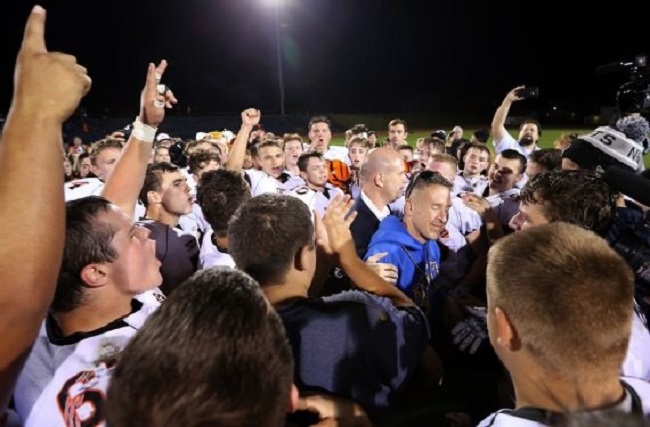
Former Bremerton (Wash.) High School assistant football coach Joseph Kennedy began “taking a knee” at midfield long before NFL players were Kaepenicking. Kennedy knelt in prayer at midfield after games, and was often joined by members of the team. Bremerton public school officials fired him from his job in 2015 when he refused to stop his on-field prayers, which his superiors said violated the Constitution’s prohibition against government endorsement of religion. Bremerton sued, and all this time his case has been winding its way through the system, finally reaching the Supreme Court in oral argument this week.
The question before the Court is whether Kennedy’s on-field prayers are protected by the First Amendment’s guarantee of religious liberty or violate the First Amendment by promoting his religion in a government supported setting. The justices will issue their opinion decision in June. Continue reading →