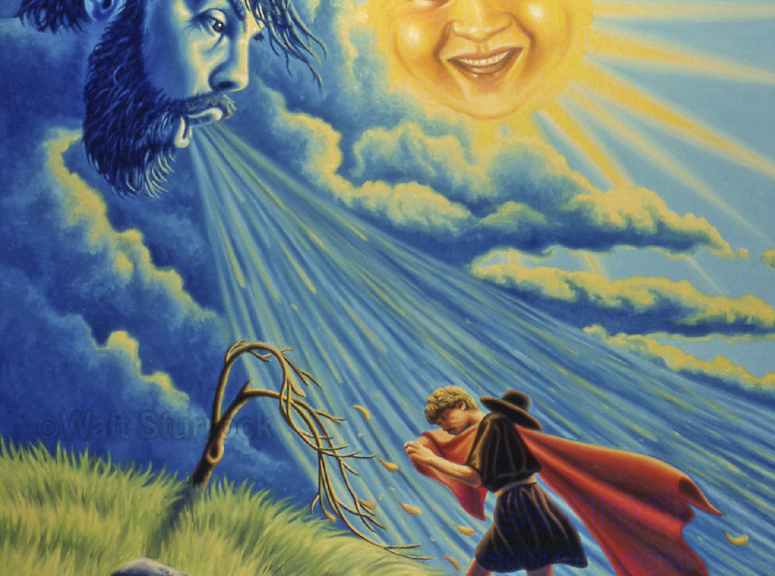
[ Like the hillbilly who pledged to take a bath every week whether he needed it or not, this is a post from 2011 that I vow to re-post every ten years whether I need to or not. It is the mystery post of Ethics Alarms: a throw-away essay on a slow ethics day that is one of a handful that accumulates new views regularly. (Another post in this category is here, but that is a bit more understandable.) I was moved to do another re-post because an episode of “Mad Men,” which I am finally watching (and glad, because it is an excellent ethics series) had a character using Aesop’s Worst Fable Ever to explain advertising philosophy. I wrote the original post talking with my late wife how Aesop’s Fables were joining Mother Goose stories, Edward Lear limericks and American folk songs in the Discarded Bin of our culture. I then stumbled upon a fable I had never read or heard about. To my surprise the post attracted intense criticism from fans of the story; I even had to ban a commenter who got hysterical about it. Apparently there are a lot of Sun-worshipers out there. Anyway, here it is again.]
Today, by happenstance, I heard an Aesop’s Fable that I had never encountered before recited on the radio. Like all Aesop’s Fables, at least in its modern re-telling, this one had a moral attached , and is also a statement of ethical values. Unlike most of the fables, however, it doesn’t make its case. It is, in fact, an intellectually dishonest, indeed an unethical, fable.
It is called “The North Wind and the Sun,” and in most sources reads like this:
“The North Wind and the Sun disputed as to which was the most powerful, and agreed that he should be declared the victor who could first strip a wayfaring man of his clothes. The North Wind first tried his power and blew with all his might, but the keener his blasts, the closer the Traveler wrapped his cloak around him, until at last, resigning all hope of victory, the Wind called upon the Sun to see what he could do. The Sun suddenly shone out with all his warmth. The Traveler no sooner felt his genial rays than he took off one garment after another, and at last, fairly overcome with heat, undressed and bathed in a stream that lay in his path.”
The moral of the fable is variously stated as “Persuasion is better than Force” , or “Gentleness and kind persuasion win where force and bluster fail.”
The fable proves neither. In reality, it is a vivid example of dishonest argument, using euphemisms and false characterizations to “prove” a proposition that an advocate is biased toward from the outset.
The first of the morals is vague and presumptuous. Why is persuasion “better” than force? Because it works? If the North Wind was successful in blowing off the man’s coat, would that then mean that persuasion and force were equally “good”? The fable with such a moral isn’t even making an ethical judgment; it is, instead, registering a vote for consequentialism: “If it works, it’s good; the end justifies the means.”
All the contest really proves is that the North Wind is an air-head, and the Sun rigged the competition by tricking the North Wind into an unfair test. What if the competition had been to determine who would be able to get the man to put on his coat? I don’t know about you, but I’m betting on the Wind. Windy wouldn’t have to blast, either: “The North Wind gently puffed, and the man shivered in the suddenly cool breeze. The Wind puffed colder and gustier, and soon the man hurried to don his coat.” Is that persuasion, or force? “Meanwhile, the Sun beat down ever harder with his withering rays, but the more sweat that appeared on the sweltering man’s brow, the less inclined he was to wear his heavy coat.” The fable decides from the outset that the Sun’s power is gentle and persuasive, and the Wind is, by definition, “Force.” If that is the assumption in my new, equally plausible adaptation, then the moral must be “Force is better than Persuasion.”
The alternate version of the fable’s moral, “Gentleness and kind persuasion win where force and bluster fail,” is worse. It arbitrarily assigns benign motives and virtues where none are in evidence. To begin with, the whole contest is unethical, violating basic principles of fairness, respect, autonomy, empathy, and caring, as well as the Categorical Imperative. A man is walking along the road, minding his own business, and these two bullies decide to use him as a prop to settle their argument, to torment him for their own amusement. [ 2015 Observation by JM: In this it is reminiscent of the contest between Satan and God in the Bible regarding Satan’s ability to make Job turn from God.] Neither the Sun nor the Wind are ethical; their objective is wrongful, and their treatment of the man irresponsible. The fact that one of them may harass the victim more gently than the other is hardly reason for praise.
Even that characterization is false. The Sun’s heat is “gentle” and “kind” only because Aesop calls it so. If the man stubbornly refused to take off his coat (fearing, perhaps, that the North Wind would start gusting again), and the Sun burned ever hotter until the man dropped dead of heat stroke, would the Sun still be called “gentle” and “kind”? Was the man killed by “persuasion”? In truth, both the Wind’s gusts and the Sun’s heat are varieties of Force; the fable, like the Bush Administration calling waterboarding “enhanced interrogation” instead of torture, is a lesson in obfuscating reality and manipulating perceptions by using deceptive language.
If one is going to propose a fable to pass along wisdom to children and others, there is an obligation to actually be wise, and above all, to tell the truth. Here, Aesop (or, more fairly, those who write his “morals”) is expressing a personal abstract preference as a universal truth, when it is no such thing. Sometimes persuasion is more effective than force, in which case persuasion is preferable, since it allows the one persuaded to exert free will without coercion. If both persuasion and force will have the same effect, force should yield to persuasion. But if persuasion is ineffective, and having a party do something or not do something will prevent great harm to others, force may be required, justifiable, and right. In such a case, persuasion is not “better;” in fact, it is useless.
Nor is gentle and kind persuasion necessarily superior to firm and relentless persuasion. It all depends on the circumstances; deciding whether to use force, which is sometimes necessary and unavoidable, is a complex issue, ill-served by disingenuous and bias-laden fables.
Well, they can’t all be winners, Aesop, but this fable really needs to be pulled from the collection. It’s nothing but hot air.


An honest, ethical takeaway about the need for discernment is hiding in there somewhere. Something like, “Think before you act- at times, gentle persuasion proves more effective than force.”
I can’t think of any other fable morals that use conditional language, though. What I wrote reads like a fortune cookie.
Maybe…Just because you have a hammer, doesn’t mean everything is a nail.
This story reminds me of the Eddie Murphy / Dan Aykroyd movie Trading Places.
In the end, the moral of the story was that the Duke brothers were indeed the bad guys for using people they way they did, and in the end the actual result of their bet was deemed irrelevant. Instead, THEY got the comeuppance they deserved for running afoul of the Categorical Imperative.
–Dwayne
Sometimes the fables make sense, and sometimes they don’t. I’ve never been a fan of the tortoise and the hare. The message was slow and steady wins the race, but that’s not what the story conveyed at all. The tortoise didn’t win; the hare lost either due to cockiness or procrastination.
The fable is not unethical and it is not misleading. It’s simply being tortured — ethically.
You’re right that the stated moral of this fable is ethically warped, for the reasons you provide. However, there is still an important lesson we can derive from the fable, even if it’s not the same as the one that’s written.
Maybe I’m just looking at Aesop’s fables through an existential lens, but I think many of them have descriptive or socially practical lessons rather than morally dogmatic ones. “Be aware that this consequence may follow that behavior,” as opposed to “this is the correct behavior.” My understanding is that the fables didn’t originally end with explicit morals, and that those were tacked on by people who compiled them into books for children, not trusting the children to think for themselves about what the story might teach. Most morals evolved from pragmatism in some context, so when we look deeper than the dogma, we can guess what the original purpose may have been. (I say this as a staunch anti-dogmatist.)
The lesson I draw from The North Wind and the Sun is that if you’re trying to get someone to do something, regardless of your reasons, be aware that they will likely resist force. We can understand why, too: surrendering to force makes them more vulnerable. If the North Wind succeeded in removing the traveler’s coat, the man would be even colder. Obviously the man is going to cling to the coat and tell the North Wind, “Bite me!”
It is often easier and more effective to create the conditions under which a person wants to do what you want them to do or think they ought to do. The Sun may be harsh and manipulative in the fable, but the man was willing to remove his coat because he knew he would be comfortable after having done so. Unlike the North Wind, the Sun created an environment where it was safe to remove the coat.
In the fable, the North Wind and the Sun are toying with a human for their own amusement. That’s unethical. However, in real life you may want to persuade someone for ethical reasons. Maybe you want to influence them away from a habit that will harm them or others. You may want them to reconsider their opinions about a policy. If you take the North Wind approach and tell them that they must abandon their destructive behavior or incorrect views, they will tighten their coat. On the other hand, if you actively look for things you can agree with them on and validate those, they will feel safer in opening their mind and reflecting on the reasons that changing their behavior or views might be a good idea.
Most of the time this process should be done transparently. However, if someone doesn’t want to admit the reasons for their behavior or views, you can help them save face by addressing them without explicitly acknowledging them.
This is all a pragmatic lesson, but that doesn’t make it unethical.
Does that make more sense?
For the record, here’s what you wrote about the fable in 2015, EC:
“Influencing a person through knowledge of them can be done ethically, but when the person’s own well being is not one of the top priorities, the practice is unethical. This story is about how empathy is useful, but demonstrates an unethical use of it. In this respect, it is akin to the adage, “you catch more flies with honey than with vinegar.” Knowing what the flies want is applied effectively to influence their behavior, but the purpose is to kill them.”
There’s at least one other of Aesop’s fables which I believe is worse than this one: The Satyr and the Traveler. A satyr finds a traveler in the cold, who is blowing on his hands to keep them warm. The satyr invites the traveler into his home and gives him a meal. However, when the traveler blows on his soup to cool it down, the satyr throws him out. Supposedly the ability to blow either hot or cold air represents duplicity.
This makes no sense for several reasons. Firstly, the audience already knows that what the traveler is doing is perfectly normal and sensible, so what are we supposed to learn when he is punished for it? Secondly, the traveler doesn’t actually engage in any duplicitous behavior, unlike the protagonists of some other fables. How is the reader supposed to tell what blowing hot and cold is meant to represent?
Thirdly, with the benefit of basic thermodynamics, we understand that “blowing hot” just means blowing body-temperature air at one’s cold extremities, and “blowing cold” means doing the same thing to soup that is warmer than one’s body (and to clear away the convection currents so that more room-temperature air can absorb the heat from the soup). The traveler isn’t changing the temperature of his breath; blowing on something brings it closer to the his body temperature, regardless of whether it’s hotter or colder.
Fourthly, being able to adjust the temperature of one’s breath depending on the needs of the situation would be a convenient ability, not an evil.
Finally, as implied by the above point, honest people need to say different things depending on the situation. Nuanced thought requires being able to see the strengths and weaknesses of the same idea or creative work, although a person would likely not both praise it and condemn it on balance. Brief research indicates that Aristotle lived a few centuries after Aesop, so maybe the ideas of Aristotelian virtues weren’t around at the time, but there must have been some concept of balance between two harmful extremes. Sometimes we need things hotter, and sometimes we need things colder, and so we have to be able to produce both when the situation calls for it. (Merely balancing extremes is actually not a very helpful definition of virtue, I find, but that’s a topic for another day.)
I submit the The Satyr and the Traveler as the most morally and logically incoherent of Aesop’s fables.
Yikes. You’re right, EC, that’s terrible. Blowing air was clearly some kind of Achilles Heel for Aesop. Never encountered that fable before. Now I’m sorry I have…
Here is the challenge with the interpretation of fables; sometimes they are more like a Rorschach test of the readers ethics. Examples:
Aphra Behn comments on it as “The sycophant with the same breath can praise/ Each faction and what’s uppermost obeys”.
John Ogilvy portrays the satyr as the Devil, and ends with
Fiends and Saints convertible be, for where
We spy a Devil, some say a Saint goes there.
It is amazing how much art works have been produced based on this fable; examples of paintings are in the link below.
https://en.wikipedia.org/wiki/The_Satyr_and_the_Traveller
I don’t know about this. Fables are stories with a simple structure. However I would not necessary call it an ethics story, as that assumes too much, and may tell more about the reader than the fable. One interpretation is that the exercise of soft power may yield better results than the exercise of hard power. It is easier that catch flies with honey than with vinegar. Seduction may yield better results than force. Instead of seduction you may also use a ruse. The Iliad may be an example, as Troy was defeated by a gift instead of years of fighting. Maybe that makes this fable ethics free.
I would hardly call the Trojan Horse a gift! That’s like calling a package from the Unabomber a gift. Not to be pedantic, but the Trojan Horse story isn’t in the Illiad. It’s in the Aeneid.
while I am reviewing my copies of Aesop’s fables (I have been familiar with this fable for a long time so I would not characterize it as an obscure or lesser fable), I have to strenuously oppose your suggestion that the Trojan Horse was not a gift.
it was not in the Iliad and was hardly in the Aeneid.
but, as the story goes, the Trojans were known for their horsemanship. They took pride in their equine abilities.
(though recently reading the Iliad, everyone was prized for their horse skills.)
so, as the story goes, the Greeks gave up on their attack on Troy. As they went back to Greece, they gave the Trojans a parting gift: the Trojan horse, which was an appeal to the Trojan’s vanity about their horsemanship.
the Trojans readily accepted it.
that allowed the invincible walls of Troy, built by Poseidon, to be destroyed from the inside, as they were not vulnerable from attack.
I hate this format. Screwing up my comments.
anyway, if I recall, it was Odysseus’ idea to give the Trojan Horse to the Trojans
he was the tricky one and, basically, the Greeks tricked the Trojans to welcoming them in.
-Jut
Wait, what? It wasn’t a gift, it was a trap.
Aeneid,Book 2 – The Burning of Troy
63 sections 804 lines
Summary
Everyone in Carthage quiets down as Aeneas begins his tale about the fall of Troy. Aeneas begins telling of the fall of Troy and the Trojan Horse. The Trojans believe that the Greeks have left, and so they go to the beach and see the deserted Greek camp. The Trojans discover the huge horse on the beach and wonder about its purpose. Laocoon arrives on the beach and expresses his distrust of the horse. Shepherds bring an unknown man to the Trojans on the beach, who then begins to speak. The man begins to speak, and reveals himself to be a Greek named Sinon. Sinon speaks about the jealousy of Ulysses. The Trojans ask Sinon to continue telling the story of the Greek desire to leave Troy. In Sinon’s tale, the Greeks learn that they can only leave Troy by means of a human sacrifice. Sinon claims that he was chosen as the sacrifice, based on Ulysses’ contrivance. Priam comforts Sinon and asks about the horse left on the beach. Sinon prays to the stars for the ability to break his oath to the Greeks. Sinon discusses the role of Pallas Minerva in the Trojan War. Calchas proclaims that the Greeks must sail back to Greece. Sinon concludes his speech about the Trojan Horse. While Laocoon is sacrificing a bull, two snakes come from Tenedos and head for the beach. The snakes encircle Laocoon and his two sons. Laocoon screams. The snakes head for the citadel in Troy, and the Trojans debate why Laocoon was killed. The Horse is let in the city. The Trojans, heedless of omens warning them about the Horse, celebrate the end of the war. Night falls.
The Greeks slip out of the Trojan Horse and kill the few Trojans on guard. The ghost of Hector visits Aeneas in a dream. Aeneas and Hector speak, and Hector tells Aeneas to flee from the city. Aeneas wakes up and sees the devastation already consuming the city. Troy is burning, and Aeneas snatches his weapons to defend the city. Panthus, a Trojan priest of Apollo, comes to the house of Anchises and informs Aeneas of the desperate situation. Aeneas collects a band of Trojans to fight the Greeks in Troy. Aeneas and his companions are compared to ravaging wolves as they fight and kill Greeks. Aeneas and his companions run into a band of Greeks led by Androgeos. Coroebus encourages the Trojans to equip themselves with Greek arms. Cassandra is seen being dragged from the temple of Minerva by Ajax Oileus. The Greeks, including Ajax and the Atrides, attack and are compared to the violence of a storm. In the ensuing battle, many Trojans are slaughtered. The Greeks assault Priam’s palace. Aeneas sneaks into Priam’s palace via a secret entrance and climbs to the roof to help in the Trojan defence. Pyrrhus, son of Achilles, leads the Greek assault on the threshold of Priam’s palace. He is compared to a snake. Aeneas sees the inner halls of Priam’s palace as Pyrrhus breaks through the gate. Pyrrhus’s assault is compared to a rushing river. Priam prepares to defend his palace. Hecuba addresses Priam, and asks him why he is preparing for battle. Pyrrhus slaughters one of the sons of Priam. Priam addresses Pyrrhus and criticizes him. Pyrrhus responds to Priam. Aeneas looks around and is horrified at the defeat of the Trojans. His family and home come to mind. Aeneas sees Helen hiding in the temple of Vesta, amid the flames of a burning Troy. Aeneas criticizes Helen and her role in starting the Trojan War, and wonders if she should suffer no punishments. Venus appears to Aeneas and stays his hand. Helen is saved, and Aeneas is reminded of the dangers his family suffers. Venus continues to speak, and shows Aeneas the destruction of Troy as wrought by the gods themselves. Venus concludes her speech by pointing out Minerva, and tells Aeneas to stop fighting and flee from Troy. Aeneas sees that all is lost, and Troy is compared to a tree being cut down.
Aeneas returns home to fetch his family, but his father Anchises refuses to leave. The entire household attempts to convince Anchises to change his mind. Aeneas responds to his father, Anchises. He despairs of their fate if they should stay in Troy. Aeneas reequips himself for battle, but Creusa, his wife, pleads with him. A flickering flame appears around the head of Iulus. It doesn’t harm him, and Anchises interprets the omen. A second omen appears in the sky, accompanied by thunder. Anchises is persuaded. As danger approaches, Aeneas plans the escape from Troy. Aeneas lifts his father on his shoulders and leads Iulus by the hand. Creusa, his wife, follows from behind. As Aeneas and his family flee Troy, Greek soldiers are everywhere. Arriving at the temple of Ceres outside of Troy, Aeneas notices that one person was missing. He rushes back into Troy. Aeneas returns to his house, but the Greeks have taken over everywhere. He continues searching for his wife. The ghost of Creusa appears, larger than life, and addresses Aeneas. Creusa tells Aeneas that she will remain at Troy, and bids farewell. Aeneas cries. The group of exiles outside the city has grown. As dawn arrives, Aeneas leads the band of Trojans into the mountains.
You are indeed correct. Literature was not my thing at school, and I heard the story of the Iliad and Odyssey told in history class, and the telling included the Trojan horse.
What is the meaning of the ‘gift’ of the horse? It is a duplicitous gift, a ruse. Now there is a lot of commentary about Christopher Nolan’s new film “The Odyssey”, where applications are drawn about the future of Western Civilization, and where the ethics of toxic compassion and Western guilt becomes the new hors of Troy. That is a thing about allegories, they are often a Rorschach test for the ethics of the reader.
https://pjmedia.com/jamie-wilson/2026/05/13/civilizational-suicide-we-have-become-troy-n4952831
Very interesting analyses of Aesop’s Fables.
My criticism flows to Hans Christian Andersen’s the Princess and the Pea. Even as a small child I thought it rude to complain about the hospitality and accommodations offered to a traveling stranger on a stormy night. A real princess might be that delicate to feel the pea underneath 20 mattresses and 20 featherbeds, but a real princess would be more polite. Rude or not, apparently she and the prince lived happily ever after.