Dear Idiots: Please Stop Making Me Defend The Bigoted Baker

I am pleased that the Supreme Court will be taking the case of Jack Phillips, the Colorado baker who refused to sell a wedding cake to a gay couple because, he said, they wanted it to be customized, and doing so would offend his faith.  His claim is based on the First Amendment, which prevents the government from making you say what you don’t want to say as much as it prevents the government from stopping you from saying what you want to.

Colorado’s courts denied that Phillips was doing anything but saying that he doesn’t like or respect gays sufficiently to make the exact same cake for them that he would make for non-gays.  I agree with their holding that his actions violated the public accommodations laws. I wrote when this case first reared its frosted head…

“The court’s conclusion  is impossible to rebut. The cake the baker was asked to bake for the gay wedding differed not at all from one he would normally sell a straight couple. In truth, this had nothing to do with expression. He was just refusing to serve a gay couple because of their sexual orientation. Selling them a standard cake would neither constitute, nor would it be recognized as a “message” in support of gay marriage.

The Court agreed that a wedding cake with a customized message celebrating a same-sex marriage as such might implicate First Amendment speech issues, but “we need not reach this issue,” the court said. “We note, again, that Phillips denied Craig’s and Mullins’ request without any discussion regarding the wedding cake’s design or any possible written inscriptions.”

In other words, Phillips was gratuitously and unnecessarily being a cruel jerk. An alleged Christian who is unable to detect the basic Golden Rule application in treating fellow citizens with the minimal level of respect inherent in allowing them to buy a standard wedding cake requiring no “Yay Gay!” or “Charlie and David Forever!” messages in pink frosting deserves no sympathy or quarter from the law. Could the couple have just shrugged and found another bakery? Sure, they could have. Linda Brown could also have just shrugged and found an all-black school to attend, too.

The gay couple are not the villains here. Jack Phillips broke the social contract, as well as the law.”

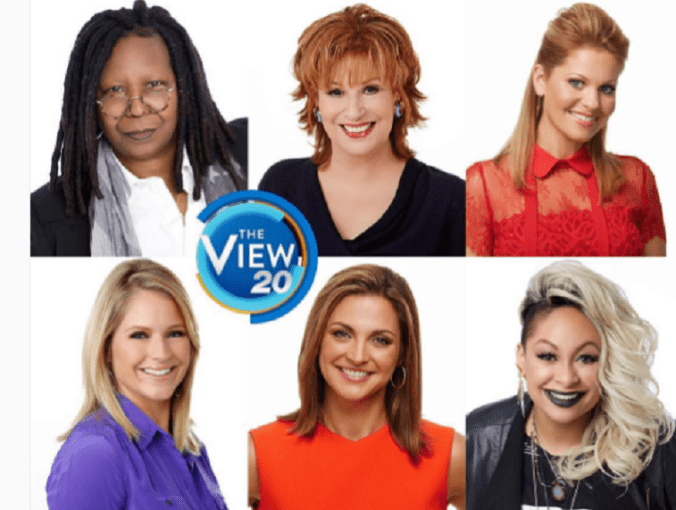
Now that SCOTUS has decided, by agreeing to review the case,  that he has perhaps a scrawny, shaky legal leg to stand on before they kick it out from under him, Phillips and his lawyer are taking a premature victory lap, as if making it quite clear that you think gays are second class citizens is something to be proud of (and, sadly, too many still think it is.) Their publicity campaign took them all the way to The View, a wise choice. After all, nothing can make an unethical position seem more persuasive than when it is being attacked by idiots, and idiots of the left-wing persuasion are pretty much what ABC’s “Six Opinionated Female B and C List Celebrities Sitting Around Slamming Conservatives”  daytime show has to offer. (To be fair, the show usually has one even dumber right-wing idiot on hand to make the left-wing idiots seem astute by comparison.) Continue reading

Comment of the Day: “Morning Ethics Warm-Up, 6/30/17.”

As he usually does, when he’s feeling frisky,  reader Extradimensional Cephalopod (above right) has dived into the issue of “health care rights” with gusto and perception. As I often do whether I’m feeling frisky or not, I have some cavils about the assumptions being made at the outset.

A right is a moral or legal entitlement to have or obtain something or to be able to do something. Moral and legal rights are two different things. When someone says, as did my friend on Facebook that started this debate. “I believe health care is a right,” he had to be asserting a moral right to healthcare, since a legal right to health care doesn’t exist. If he said, “I believe health acre should be a right,” then he would have clearly meant a legal right. That’s a policy issue. When someone argues that there is a moral right, then they are making the case for a legal right that doesn’t exist. The law in an ethical society ought to protect and advance moral rights, and society must agree what those rights are. Thus when he says, early on, “Note that a right isn’t something we owe Note that a right isn’t something we owe people just because they exist.,” he signals that he is describing legal rights only.   Moral rights are what we owe  people just because they exist. That’s why the Declaration begins with Jefferson saying that “we are endowed by our Creator” with “unalienable rights.”

Here is Extradimensional Cephalopod‘s Comment of the Day on #5 in the post, “Morning Ethics Warm-Up, 6/30/17.”

Let’s start at the beginning. We need to define the phrase “healthcare is a right”.

A “right” is a protection or entitlement we collectively decide to give to people at the expense of our some of our freedoms because we think that society will be more robust, sustainable, able to advance, or generally pleasant to live in as a result. That’s very similar to the basis for ethics, as far as I can tell. A right is a meta-law, a limitation on what laws can be made. Rights may be conditional. Note that a right isn’t something we owe people just because they exist. It’s something we decide we owe them because we want to live in a world where people have that right–because it’s safer for us, or because it means the world will still be there for our descendants, or because it allows civilization to progress to something better, or because we want others to be happy, or all of the above. This will be important later.

Therefore, when we say, “healthcare is a right”, what we mean is “in order to make society more robust, sustainable, able to advance, or generally pleasant, we choose to sacrifice some of our individual freedoms to provide everyone with healthcare.”

We’re half done. Now, what is “healthcare”?

Let’s actually distinguish it from health insurance, because we’re smarter than Congress. Health insurance, like any insurance, is a gamble, in which people periodically pay a small amount of money to an insurance company, which will pay them back a larger amount of money (whatever is necessary, to the limit of what they are insured for) if the person’s health is in danger in a way that neither of them can predict. The idea is that the insurance company can’t predict who needs the money, but they can predict how many will need money and how much, statistically, so they accept enough money from people that they can afford to pay the people who end up needing more money. Continue reading

Observations On Britain’s Charlie Gard Ethics Fiasco

A recipient of Great Britain’s national health care, infant Charlie Gard was born with  a rare genetic condition resulting in what is probably irreversable brain damage.  He cannot move his arms or legs, eat or even breathe without a ventilator.

After 10 months of being kept alive, Charlie’s caretakers, the Great Ormond Street Hospital for Children in London, announced that it was time for Charlie to die. Chris Gard and Connie Yates, Charlie’s parents, wanted to take him to the United States to try an experimental treatment available here. The doctors at the hospital refused to allow them to take the child, and vetoed their decision, even though the parents had received sufficient funds from donations to pay for the effort.  In  the resulting lawsuit, British courts sided with the hospital. The parents then brought the case  to the European Court of Human Rights, which declined to hear the case last week. The previous court rulings that it was in Charlie’s best interest to withdraw life support and that the state, not the parents, got to make this life and death decision stood.

The  parents, Chris Gard and Connie Yates, appeared on a video this week,, sobbing and saying their son would be removed from life support at the hospital. “He’d fight to the very end, but we’re not allowed to fight for him anymore,” Gard said in the video statement. “We can’t even take our own son home to die.”

Initially, the hospital would not delay the fatal  disconnection of the child from life support so family members could gather and say goodbye. It has since relented.

Observations: Continue reading

Morning Ethics Warm-Up: 6/30/17

1. Traffic here is cratering in the run-up to the 4th, guaranteeing that for one of the few months in Ethics Alarms history, June 2017 will have seen significantly less traffic than its previous year’s equivalent. 2017 and 2016 are now in a dead heat.

I have some theories: by this point last year the campaign was heating up, and I was being sufficiently critical of both parties and candidates to make everyone happy. Ethics Alarms also started getting a lot of those paid Hillary shills commenting; I banned more commenters in 2016 by far than any other year. Also because of the campaign, there were an unusual number of posts shared by hundreds and even thousands of readers, as well as a record number of the anomalous posts that double or even triple the daily average. Those, I have found, are completely unpredictable. What I consider important or especially astute essays almost never attract readership; the runaway posts are usually about something relatively trivial.

On the other hand, the blog has many more followers in 2017, more consistently high-quality comments, and, as my life partner continues to remind me with dagger glances, revenue is holding steady…

2. There was another Ethics Hero tale to tell yesterday, though the only one I had time for was the group in Texas that bought a car for a young fast-food worker.

Major League Baseball umpire John Tumpane, assigned to a Pittsburgh Pirate home series, was walking from his hotel to the ball park across the Roberto Clemente Bridge when he saw woman climb over the railing to the outside of the bridge. He decided to approach her, and in response to his queries, she told Tumpane she just wanted to get a better view of the Allegheny River below.

The look on her face and the tone of her voice told Tumpane otherwise, so he grabbed her and refused to obey her demands that she let her go…and jump. Another  bystander saw what was going on and joined him, grabbing the woman’s free arm. A third grabbed her legs through the railing as Tumpane implored the gathering crowd to call 911. The three men held on  until emergency responders arrived. Continue reading

Morning Ethics Warm-Up: 6/21/17

1. No, there is nothing “ironic” about Rep. Steve Scalise being shot. I finally lost my restraint and pointed out to a gaggle of left-wing Facebook friends that their writing that Scalise’s shooting was “ironic” because he opposes gun control, or because one of his rescuers was gay (because he opposes gay marriage) was as much a of a hateful comment as saying that it was “karma” (another popular sentiment from progressive friends) or that he “reaped what he sowed” (yet another). They protested loudly and angrily that this was an unfair rebuke on my part, that they were not cheering the crime, just observing that the shooting was “ironic” which, they insisted, it was.

Disingenuous and evasive.

The seriousness,  criminal, hateful and absolutely inexcusable nature of Scalise’s shooting had absolutely nothing to do with his political beliefs unless you agree with the shooter, who used those beliefs as his motive. Karma, “reaped what he sowed” and irony (which implies an amusing or humorous nature) all signal and are intended to signal the same sentiment in the Facebook echo chamber—“It’s a shame that he got shot, but in a way he asked for it.” Oh, how those who sought to signal their virtue and their dislike of Scalise just hated to be called on the ugly impulses behind their words, and how they wriggled and spun to deny it.

What made the shooting ironic? Why, Scalise opposes gay marriage, I was informed. That’s neither a logical nor a justified answer. Although gays find it satisfying and expedient to automatically attach the label of  homophobia to those who haven’t yet adapted to one of the fastest cultural paradigm shifts in U.S. history, there is no evidence that Rep. Scalise believes that LGBT individuals cannot or should not be medical or law enforcement professionals. Scalise’s position on gay marriage is irrelevant to his shooting, unless that position—the same position Barack Obama and Hillary Clinton held for a very long time—makes you think his shooting and the subsequent assistance of gay citizens is somehow deserved and funny. Similarly, the fact that Scalise was shot does not undermine the justification for his support of the Second Amendment, except in the closed minds of Second Amendment opponents. Nor does that make his shooting “ironic,” except to those whose gut reaction was “He was shot? Serves him right. Let’s see how he likes it.”

So many progressives have become so instinctively hateful and bitterly partisan that they are incapable of realizing it.

2. Are there any ethics takeaways from last night’s Republican victory in Georgia’s 6th District? Pundit Charles Glasser wrote that “Ossoff raised $23.6 million to make a symbolic run against President Trump, most of it from Marin County, California and Martha’s Vineyard in Massachusetts. Running the numbers, Democrats might have been better off considering that same amount would have bought 855,072 school lunches (at $2.76 each); 236,000 elementary school textbooks (at $100 each) or even 956 Priuses (at $24,685 each). Max Weber said that the purpose of a bureaucracy is to maintain or expand its own power. Who cares about children, education or the environment when there’s power to be grabbed?”

As a rule I object to the “spending money on A is unethical because you could have spent it on B” line of reasoning, since it can be applied to almost any purchase. Nonetheless, that’s a lot of money to be used by outsiders to influence a local election, particularly when the donors also decry the effect of money in politics. And as with Hillary Clinton’s defeat, this result suggest that money isn’t nearly as decisive as those who want to constrain political speech think it is. Continue reading

Comment Of The Day: “Ethics Quote Of The Week: Ken White of Popehat”

This excellent comment requires no introduction, just reading. 

Here is Ryan Harkins’ Comment Of The Day on the post, “Ethics Quote Of The Week: Ken White Of Popehat”:

One thing I have noticed on those rare occasions when I truly listen to someone whose viewpoint is diametrically opposed to my own is that I discover there are indeed legitimate points being made and legitimate concerns that need to be heard. That doesn’t mean that I experience a paradigm shift. I will still believe that opposing viewpoint is incorrect, but at the same time I discover that my understanding of that opposing view was actually wrong.

There’s a great deal of satisfaction in being right, and I confess that at times I am more concerned with being right than with listening to someone whom I think is wrong. But there may be much more to the desire to be right than mere ego. Our brains are wired to find the simplest and easiest course. We learn actions that can then be performed by rote, without even thinking about them. That is why we find ourselves, upon walking into the kitchen, opening the refrigerator door and staring at food for five minutes before we recall we really entered the kitchen to find a flashlight. Our brains have developed a pattern that says: “enter kitchen, open fridge”. Having the right answer is a great thing, for our brain can discard all else and hold onto that right answer. It is easier. Simpler. Life now makes sense and we can proceed with cataloguing the more important details in life (the current Kardashian scandal or the names of all the Pokemon and their evolutions).

Being challenged in our right answers is uncomfortable. It can be especially distressing when someone presents us with a set of facts that, at least on the surface, contradict our right answers. We have two choices when confronted with such a challenge: we can either try to hone our own arguments, or we can retreat and try to insulate ourselves from further confrontation. We’ve seen quite a bit of the latter. We develop little adages about how it is impolite to discuss religion and politics — the two most important areas of life, and the two areas most likely to spark an argument. We surround ourselves with like-minded people, listen to the news that most appeals to our viewpoints, and never venture outside the echo-box. Certainly all these tactics are easier than constantly assimilating new arguments, researching new theories and developments, stringing together logical narratives, and perhaps even adjusting our own viewpoints when our conclusions lead us to recognize errors in our previous judgments.

I’ve read a little bit recently on St. Thomas Aquinas, and in reading I gained a peek into life in the universities of the thirteenth century. Students did not come to a university to attend lectures. They essentially apprenticed themselves to a master, who then did not teach so much as dialogue. They demanded that their students ask questions and find answers themselves. I read an account of how universities would host open debates, and the masters would throw their students into the ring to answer the challenges and objections people would raise. Continue reading

Comment Of The Day: Why That “We’re Glad You’re Our Neighbor” Sign Is Unethical (As Well As Obnoxious)

Mrs. Q, who is keeping Ethics Alarms current on the oppressive politically correct environment slowly poisoning Portland, Oragon, was moved to issue another report in reponse to the Ethics Alarms post about a virtue-signalling sign popping up live wild-flowers on yards across America here is her Comment of the Day on the post, “Why That “We’re Glad You’re Our Neighbor” Sign Is Unethical (As Well As Obnoxious)”…(I’ll be back at the end.)

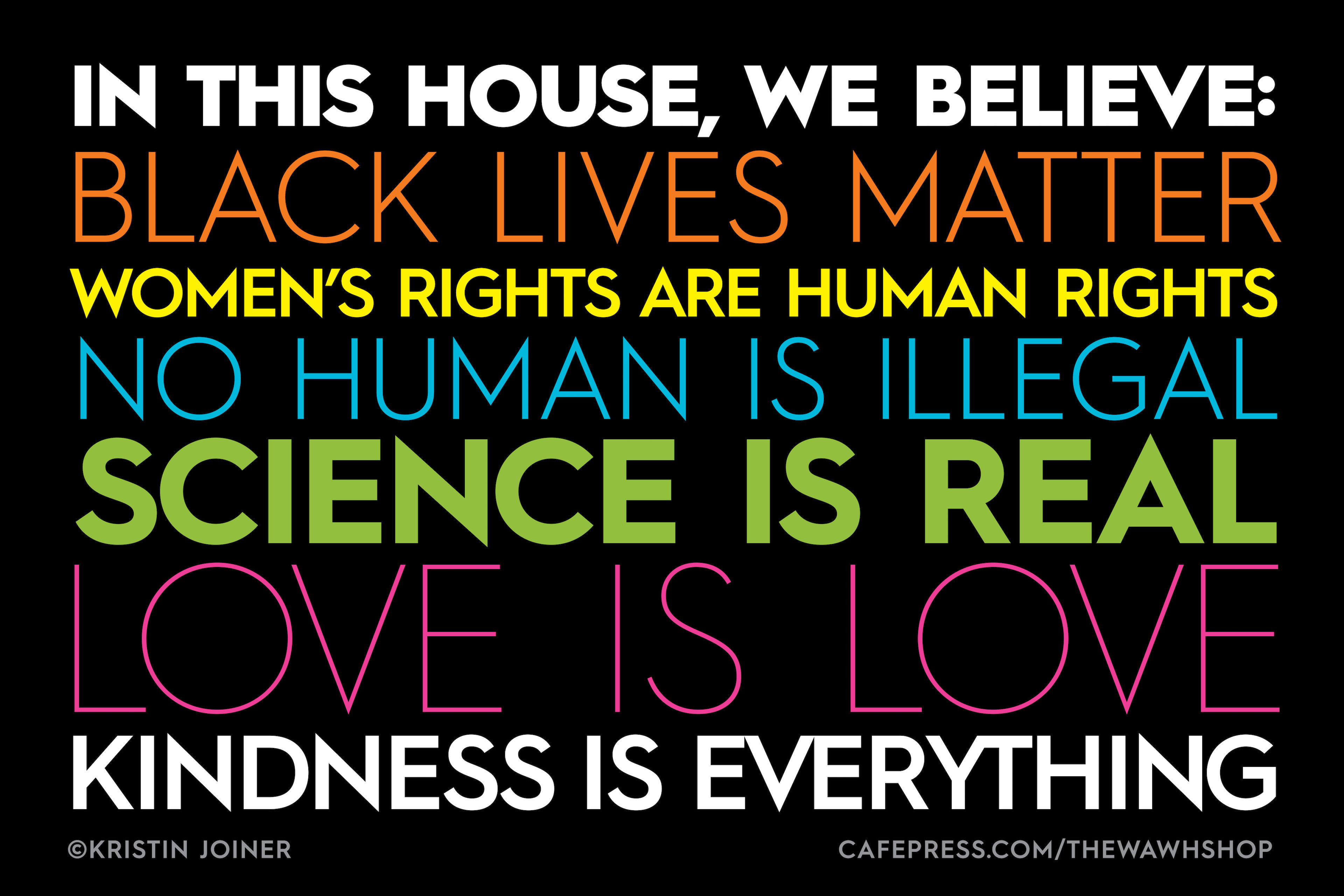
This yard sign is just about everywhere in the city including businesses, churches, schools, and city offices.


This one is also popular. I love how the “Science is real” part is in green.

Black Lives Matters signs often accompany the 2 above. Also on businesses, schools, etc.

This one is mostly on businesses/community centers but some residents have this sign taped to their living room windows.

What’s most interesting is that all the problems this town suddenly has with “hate” came after the anti-Trumpers started putting these signs up. I told a (former) friend that I thought these signs were virtue signaling and devisive and smug I didn’t appreciate that every day everywhere an average citizen can’t take a walk or go to the gym without knowing the political opinions of the home/business/agency owners.

She promptly quoted Eleanor Roosevelt’s “No one can make you feel inferior” mantra. Funny enough she’s white, I’m not, and instead of actually listening to me, you know as a special downtrodden minority, she dismissed my concerns altogether about how such signs may negatively affect a community (and then she cut me out of her life. Yep, so tolerant). Continue reading

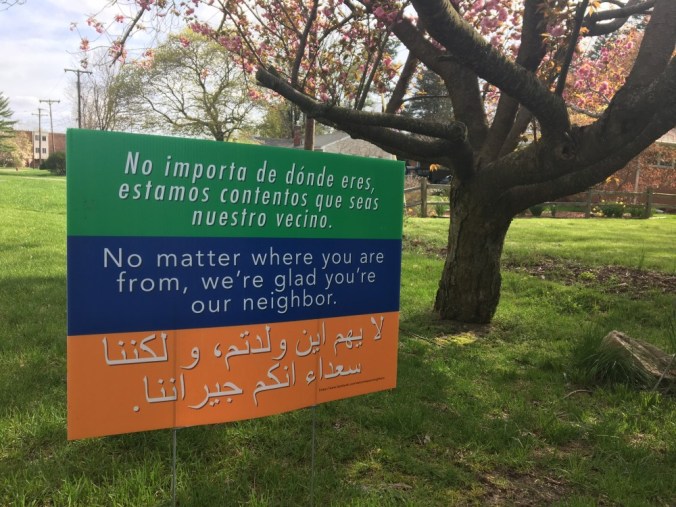
Why That “We’re Glad You’re Our Neighbor” Sign Is Unethical (As Well As Obnoxious)

NPR claims that people get teary-eyed viewing this supposedly viral sign in front of houses across the country. I’ve only seen two in my neighborhood, thank goodness, and they irritate me no end. Why? The sign is dishonest, unfair and divisive. It is also political, while pretending not to be.

First, the sign is not what it represents itself as being. It is not written for an actual neighbor. If it were, the sign would be remote and rude. I welcome new neighbors personally, not by putting garish signs on my lawn.  The sign is blatant virtue-signalling, telling the neighborhood that this household is in favor of diversity, love, and immigration…as if lots of other people are not. If it is not a public sign designed to rebuke those people, whoever they are, then why the sign? If everyone in the neighborhood welcomes Americans of all colors and origins—and I know of no Klan chapter in Northern Virginia—then the sign is a straw man. I’m sure, however, that Hispanic-Americans or Muslim-Americans who see these signs on lawns might be moved to think: Wait, does this mean that many people in this community DON’T welcome us as neighbors? How are we to recognize them?

That’s not a healthy or welcoming message, but hey, if it makes the homeowner seem enlightened and virtuous, it’s a net win. Continue reading

Morning Ethics Warm-Up: 6/9/17

1. News Item: “More than 130 imams and Muslim religious leaders in the United Kingdom have said they will refuse to perform funeral prayers for the Manchester and London terrorists as a rebuke to the “dastardly cowardice” of the “vile murderers.” Notes Ethics Alarms issue scout Fred, “This time it’s religious institutions refusing [to provide a service based on religious/political beliefs and conduct], and it’s based on the actions of the people they’re refusing to pray for or bury. On the other hand, anyone born in Scotland is entitled to the government’s services even if he’s No True Scotsman. By analogy, is it right for them to deny funerals to Muslims, even the most egregiously sinful?

I’d have to do more research on Islam than I have time for right now to address that question, but it’s an interesting one.

2.  As a follow-up to New Orleans’ lamentable decision to remove statues honoring Confederate figures (discussed on Ethics Alarms here), The Atlantic published an exhaustive brief against the “myth” that Robert E. Lee was worthy of his reputation as a noble human being who fought for Virginia out of loyalty to his “country,” but who deplored slavery. I have criticized the hero-worship of Lee as well, but much of what is in Adam Serwer’s article was completely unknown to me. If accurate, it is horrifying. Just one example:

“Lee’s cruelty as a slavemaster was not confined to physical punishment. In Reading the Man, the historian Elizabeth Brown Pryor’s portrait of Lee through his writings, Pryor writes that “Lee ruptured the Washington and Custis tradition of respecting slave families,” by hiring them off to other plantations, and that “by 1860 he had broken up every family but one on the estate, some of whom had been together since Mount Vernon days.” The separation of slave families was one of the most unfathomably devastating aspects of slavery, and Pryor wrote that Lee’s slaves regarded him as “the worst man I ever see.”

3. I’ll discuss the Comey testimony in detail later, but I came close to writing about the unseemly and self-indicting display of gleeful anticipation by much of the news media (and “the resistance,” of course) over what they were just certain would be the smoking gun to get President Trump impeached. CNN had a countdown, second by second, on-screen the whole previous day, like Christmas was coming. Ann Althouse nicely summed up how foolish and ugly this was: Continue reading

Ethics Quiz: Martina Navratilova’s “Open Letter”

Court the tennis icon (right); Court the anti-gay rights advocate (left)

Martina Navratilova, the 18-time tennis Grand Slam champion, wrote an “open letter”  to the Margaret Court Arena at Melbourne Park (Do arenas read letters? I did not know that!) as the Australian Open, always played there, looms in January. Navratilova, a feminist and gay rights activists, argued for removing Court’s name from the venue, despite her undeniable status as a ground-breaking female tennis star, because of Court’s recent statements  hostile to gay marriage, lesbians, and the transgendered.

In the letter, which is as diplomatic and mild as such a letter could possibly be (and Martina has always been an excellent writer), Navratilova says that her position is not based on Court’s “headline-grabbing comments in 1990 when she said I was a bad role model because I was a lesbian.” However, Navratilova focused on Court’s “statements she made in the ’70s about apartheid in South Africa,” in which she opined that ” South Africa dealt with the “situation” (meaning people of colour) much better than anywhere else in the world, particularly the US,”  and, more recently, her anti-gay, anti-trans positions. The 74-year-old  Court had said she would boycott Qantas airline “where possible” in response to its support of same-sex marriage, saying, “I believe in marriage as a union between a man and a woman as stated in the Bible.” This week, interviewed on  a Christian radio station, Court said “tennis is full of lesbians” and that older players lure younger ones into gay sex. Court also said that transgender children are the work of “the devil.”

Concludes Martina’s open letter to the arena:

It is now clear exactly who Court is: an amazing tennis player, and a racist and a homophobe. Her vitriol is not just an opinion. She is actively trying to keep LGBT people from getting equal rights (note to Court: we are human beings, too). She is demonising trans kids and trans adults everywhere….How much blood will be on Margaret’s hands because kids will continue to get beaten for being different? This is not OK. Too many will die by suicide because of this kind of intolerance, this kind of bashing and yes, this kind of bullying. This is not OK.

We celebrate free speech, but that doesn’t mean it is free of consequences – not punishment, but consequences. We should not be celebrating this kind of behaviour, this kind of philosophy. The platform people like Margaret Court use needs to be made smaller, not bigger.

Which is why I think it’s time to change your name.

This is as well-argued a case for one side of the issue as anyone could make.

Here’s the other side: Margaret Court’s name was placed on the arena because she was a great tennis player and a pioneer in her sport, not to honor her political and social views. She still was a great tennis player. That hasn’t changed.

Your Ethics Alarms Ethics Quiz of the Day:

Do Margaret Court’s political views and anti-LGTBQ statements create an ethical obligation to remove her name from Margaret Court Arena?

Continue reading