It’s Thanksgiving, And Time For The Complete “It’s A Wonderful Life” Ethics Guide [Updated And With A New Introduction For 2017 ]


Last year (to the day) when I posted the Ethics Alarms ethics guide to Frank Capra’s 1946 masterpiece “It’s A Wonderful Life,” one of the great ethics movies of all time, as this blog’s official welcome to the holiday season, I wrote, “I suspect we need it more in 2016 than usual.”  As it turned out, we need it even more in 2017.

Multiple forces have been hard at work for a full year now, roiling the nation, painting the future as dire and the present as unbearable, trying to divide us and even to encourage discord and conflict during this special time when we are supposed to remember what is most important in life. In case you have been infected, it’s not politics and not partisan agendas, but love, family, community, kindness, and friends. The simple message of Frank Capra’s masterpiece—it has aged far better than his other films, including, and maybe especially, “Mister Smith Goes To Washington”—that no one is a failure who has friends, is vital to recall when so many are rejecting friends because they don’t conform to some ideological talking point. This is madness, and watching and heeding “It’s A Wonderful Life” is a better remedy than Thorazine.

Senate Minority Leader Chuck Schumer actually told his Twitter followers this week to bring a chart prepared by a  think tank to attack the Republican tax plan during Thanksgiving dinner. This is part of the effort to politicize everything in our lives, by zealots who value power over humanity, country, and spirituality. They belong with Mr. Potter, not George and Clarence.

I need this movie more in 2017 than usual for other reasons. It has been a year in which I have lost many peers and cherished friends, and listened to too many of the living bemoan the passage of time and looming mortality.  I don’t think like that—a lifetime gift from my brave and fatalist father—but I can’t pretend that the game clock isn’t running out, or not face the fact that I have not sunk anywhere near the baskets I could have and should have. Fortunately, what I wrote in an earlier year introducing this post still resonates…

Everyone’s life does touch many others, and everyone has played a part in the chaotic ordering of random occurrences for good. Think about the children who have been born because you somehow were involved in the chain of events that linked their parents. And if you can’t think of something in your life that has a positive impact on someone–although there has to have been one, and probably many—then do something now. It doesn’t take much; sometimes a smile and a kind word is enough. Remembering the lessons of “It’s a Wonderful Life” really can make life more wonderful, and not just for you.

Have a terrific Thanksgiving, everyone.

And here we go:

1. “If It’s About Ethics, God Must Be Involved”

The movie begins in heaven, represented by twinkling stars. There is no way around this, as divine intervention is at the core of the fantasy. Heaven and angels were big in Hollywood in the Forties. The framing of the tale seems to advance the anti-ethical idea, central to many religions, that good behavior on earth will be rewarded in the hereafter, bolstering the theory that without God and eternal rewards, doing good is pointless.

Yet in the end, it is an ethics movie, not a religious one. George lives an ethical live, not out of any religious conviction, but because step by step, crisis after crisis, he chooses to place the welfare of others, especially his community and family, above his own needs and desires. No reward is promised to him, and he momentarily forgets why we act ethically, until he is reminded. Living ethically is its own reward.

We are introduced to George Bailey, who, we are told, is in trouble and has prayed for help. One has to wonder about people like George, who resort to prayer as a last resort, but they don’t seem to hold it against him in Heaven. The heavenly authorities assign an Angel 2nd Class, Clarence Oddbody, to handle the case..He is, we learn later, something of a second rate angel as well as a 2nd Class one, so it is interesting that whether or not George is in fact saved will be entrusted to less than Heaven’s best. Some lack of commitment, there— perhaps because George has not been “a praying man.” This will teach him—sub-par service!

2. Extra Credit for Moral Luck

George’s first ethical act is saving his brother, Harry, from drowning, an early exhibition of courage, caring and sacrifice. The sacrifice part is that the childhood episode costs George the hearing in one ear. He doesn’t really deserve extra credit for this, as it was not a conscious trade of his hearing for Harry’s young life, but he gets it anyway, just as soldiers who are wounded in battle receive more admiration and accolades than those who are not. Yet this is only moral luck. A wounded hero is no more heroic than a unwounded one, and may be less competent as well as less lucky.

3.  The Confusing Drug Store Incident

George Bailey’s next ethical act is when he saves the life of another child by not delivering a bottle of pills that had been inadvertently poisoned by his boss, the druggist, Mr. Gower. This is nothing to get too excited over, really—if George had knowingly delivered poisoned pills, he would have been more guilty than the druggist, who was only careless. What do we call someone who intentionally delivers poison that he knows will be mistaken for medication? A murderer, that’s what.  We’re supposed to admire George for not committing murder.

Mr. Gower, at worst, would be guilty of negligent homicide. George saves him from that fate when he saves the child, but if he really wanted to show exemplary ethics, he should have reported the incident to authorities. Mr. Gower is not a trustworthy pharmacist—he was also the beneficiary of moral luck. He poisoned a child’s pills through inattentiveness. If his customers knew that, would they keep getting their drugs from him? Should they? A professional whose errors are potentially deadly must not dare the fates by working when his or her faculties are impaired by illness, sleeplessness or, in Gower’s case, grief and alcohol.

4. The Uncle Billy Problem

As George grows up, we see that he is loyal and respectful to his father. That’s admirable. What is not admirable is that George’s father, who has fiduciary duties as the head of a Building and Loan, has placed his brother Billy in a position of responsibility. As we soon learn, Billy is a souse, a fool and an incompetent. This is a breach of fiscal and business ethics by the elder Bailey, and one that George engages in as well, to his eventual sorrow.

5. George’s Speech

Continue reading

“Hello. Yes, Once Again, I Want You To Meet Larry. You Remember That He Was A Respected Harvard Law Professor, But The Scourge Of Anti-Trump Mania Has Left Him Silly And Obsessed. Won’t You Help Sufferers Like Larry With A Generous Donation?”


The steady deterioration of former Harvard Law professor Lawrence Tribe is truly a cautionary tale. Bias makes you stupid, but Larry had IQ points to spare, once.  Trump Derangement makes you stupid, and this strain of political hostility is far, far worse than the Clinton, Bush and Obama strains. Once Tribe was infected, his intellect was in peril.

Then he became addicted to Twitter. I tell my legal ethics seminar attendees that Twitter lowers a lawyer’s IQ by anywhere from 40-60 points. Once, Larry could have sustained that and still given me a good game of Scrabble. On top of his ossifying liberal bias and the ravages of Trump Derangement, however, Twitter delivered the coup de gras to his gray matter.

We saw the beginning of this in 2016, when he shattered a basic legal ethics tenet–Larry used to teach this stuff–with a mind-blowing tweet. After Trump’s election, Tribe began making silly claims that the President was impeachable,  and took to Twitter to spread batty “resistance” conspiracy theories, while calling a White House aide  “non human.”

Now it seems beyond dispute, sadly, that Lawrence Tribe is in the end throes of Anti Trump Brain Virus infection. Continue reading

Morning Ethics Warm-Up, 11/19/17: The Censorious, The Irresponsible, The Topless, The Panicked, And The Soon To Be Dead

Good Morning!

1 Good-bye Charlie! To get things off to a happy start this Sunday, let’s ponder the news that Charles Manson’s death is imminent. Good. What’s worth pondering is why our society allowed him to live at our expense since 1969. If the justice system has to maintain some ultimate punishment for the worst of the worst crimes  if only to stake out the position that some conduct forfeits the right to exist in a civilized nation—and it does—then Manson should have shuffled off this mortal coil, or rather had it shuffled off for him.

Mark this down as one more area where California has arrived at the wrong answer to an ethics problem.

2. “Knock-knock!” Who’s there? “Child molester!” Child molester who? “Child molester? What child molester? We don’t see any child molesters…” According to internal  documents, the Jehovah’s Witnesses has instructed congregation leaders, called elders, to keep child abuse secret from law enforcement as a matter of policy since at least 1989.

The religious group’s headquarters, known as the Watchtower, sent a letter in 1997 to  local elders across the U.S  instructing them to send to a written report about anyone currently or formerly serving in a position of responsibility known to be have sexually abused a child. A California appeals court last week upheld an order for the Witnesses to pay $4,000 for each day it does not turn over the documents to the court, and the tab currently stands at $2 million. The ruling stems from a case in San Diego, where a man sued the Jehovah’s Witnesses for failing to warn congregants that a child predator was in among them.

Osbaldo Padron was sexually abused as a child by an adult member of his congregation named Gonzalo Campos. Campos confessed to sexually abusing seven children, but although leaders at  the Watchtower knew this,  they continued to promote him to higher positions of responsibility and took no action to protect tne children he came in contact with.

Nice. I guess I’m not going to be polite and chat with those people who knock on my door with copies of the church’s newsletter—you know, “The Watchtower”?—any more.

Is it possible that everyone in the church’s leadership missed the Catholic Church’s scandal in this area? Nobody saw “Spotlight”? Nobody there has a drop of decency or integrity?

Fascinating. Perhaps after he loses his Senate race, maybe Roy Moore will consider a new gig at the Watchtower. Continue reading

Fun With Witch Hunts! If The Harvey Weinstein Ethics Train Wreck Has To Run Over Someone, Roy Moore Is A Great Choice, But Still…[UPDATED!]

From the New York Times:

“Republicans in Washington seemed near panic Thursday in the light of a news report in which four women said Roy S. Moore, the Republican nominee for a United States Senate seat in Alabama and an evangelical Christian, had made sexual or romantic overtures to them when they were teenagers and he was in his 30s. Senator Mitch McConnell of Kentucky, the Republican majority leader, said Mr. Moore should step aside ahead of the Dec. 12 special election if the allegations were true.”

“Sexual or romantic overtures,” eh? We are now officially entering the Witch Hunt Zone. Bill Cosby has been accused of drugging and sexually assaulting women. Harvey Weinstein has been accused of sexually harassing many women in the workplace, as well as committing sexual assault and rape. Kevin Spacey was first accused of throwing a 14-year old boy onto a bed,and laying on top of him until the boy managed to get away—30 years ago. Now a controversial politician—he’s controversial because so many Republicans somehow think he is qualified to be an elected official when he clearly isn’t, and the only controversy is over whether they have no scruples, or are merely too dumb to be let outside without a leash—is being accused of “pursuing” three girls ranging in age between 16 and 18 and one girl who was 14 almost 40 years ago, when he was in his early thirties.

Unlike in the cases of Weinstein, James Toback, and most (I haven’t waded through all of them) of the Hollywood types now riding the Weinstein Ethics Train Wreck, only one crime is being claimed against Moore. It is also worth considering that the age of legal consent in Alabama is 16. A thirty year-old hitting on teens that young is certainly creepy, but it’s not illegal, and if Alabama says its legal, it is also saying it isn’t so creepy that the State wants to discourage it.

Thus we are left with just one accuser, Leigh Corfman, whose accusation involves alleged wrongdoing by Moore.. She  says she was 14 years old in 1979 when  Roy Moore introduced himself to her and her mother as they were sitting outside an Alabama courthouse. Moore was a 32-year-old assistant district attorney at the time. He  offered to watch the girl while her mother went inside for a child custody hearing.  Alone with her, Moore asked Corfman for her phone number, and later asked her out on a date. (We do not know if he asked her age.) On the first date, Corfman says, Moore drove her to his home  about 30 minutes away, told her how pretty she was and kissed her. On the second and final date, she says, he took off her shirt and pants and removed his clothes. He touched her over her bra and underpants, she says, and guided her hand to touch him over his underwear. Corfman says she then asked Moore to take her home, and he did.

Ew. Continue reading

Comment Of The Day: “Megyn Kelly, William Saroyan, Ethics, Me, And Us: A Rueful Essay” (#2)

The second of the Comments of the Day sparked by my musings on Megyn Kelly’s descision to move from a job where she excelled to a completely different assignment at which, at least so far, she is crashing and burning like the Hindenburg. The first, by  Extradimensional Cephalopod, was very different, an abstract analysis of the phenomenon that bedevils Kelly, and many of us. The second, a personal account of the dilemma in action, is no less enlightening, but very different.

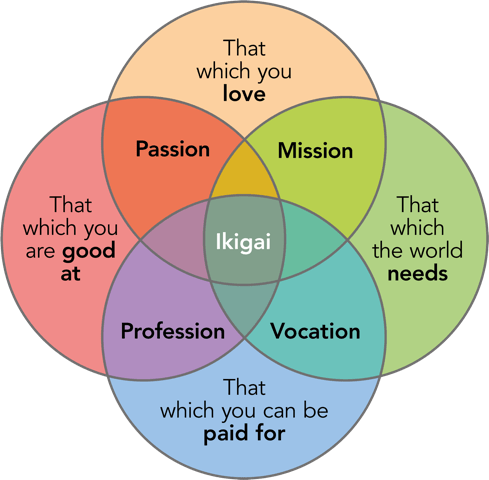
The comment also reminded me that I have never posted about the Japanese concept of Ikigai, and I should have. There is no English equivalent for the word: ikigai  combines the Japanese words ikiru, meaning “to live”, and kai, meaning “the realization of what one hopes for.” Together the words encompass the concept of “a reason to live” or the idea of having a purpose in life. Ikigai also invokes a mental and spiritual state where individuals feel that their lives have value—to them, to loved ones, to society.

Ikigai odes not spring from actions we are forced to take, but from natural, voluntary and spontaneous actions. In his article titled  “Ikigai — jibun no kanosei, kaikasaseru katei” (“Ikigai: the process of allowing the self’s possibilities to blossom”) Japanese wrter Kobayashi Tsukasa says that “people can feel real ikigai only when, on the basis of personal maturity, the satisfaction of various desires, love and happiness, encounters with others, and a sense of the value of life, they proceed toward self-realization.”

Sounds simple.

It isn’t.

Here is Alex’s Comment of the Day on the post, Megyn Kelly, William Saroyan, Ethics, Me, And Us: A Rueful Essay:

This topic is close to my heart, so time for some confessions and public reflections.

As I’ve previously mentioned I’m a software engineer, over a decade of experience, and modesty aside, a darned good one at what I do. The main areas of work I’ve been involved in are speech recognition, accessibility and development runtimes (think along the lines of the Java runtime). It was not necessarily world transforming work, but it had an impact and passionate following by our users. Pay was good if slightly low for the experience I had, and as of late I was getting tired of the work and wanted to try something new – also, a reasonable salary increase was not going to hurt.

So I start my job hunt, both internally and externally. At the end it comes down to two very good offers: One working for a social media giant with at a still-to-be-determined role with extremely good pay and no clear route for advancement. The other working closer to hardware (I’m an EE but never worked on it professionally) with lower pay (still an improvement over my previous job) at a clearly defined role with an advancement development plan and with the goal of putting people in space.

Putting it like this it sounds like a home run, but with a family in the line – I’m a single earner with three kids – the financial sides are a big consideration. There were so many things to balance: money, prospects for advancement, happiness, commute time, personal fulfillment, and yes, societal value of my work. It was not an easy decision, there were difficult conversations with my wife and even more than a year later some days I wonder if this was the right call (I went with the space company…Yay!) Continue reading

Comment Of The Day: “Megyn Kelly, William Saroyan, Ethics, Me, And Us: A Rueful Essay” (#1)

My post over the weekend, one long in germination, regarding the personal and societal dilemma of balancing one’s duty to oneself, one’s duty to be useful  and the infuriating hard-wired human tendency to always seek something different and better, received a gratifying response and at least two Comments of the Day.

This is the first, by frequent COTD auteur Extradimensional Cephalopod, is a marvelous supplement to my post, and I wish I had written it myself, except I couldn’t have.

Here is EC’s Comment of the Day on the post, Megyn Kelly, William Saroyan, Ethics, Me, And Us: A Rueful Essay:

One of the central principles of Buddhism is “life is suffering”. Clarified, it means that conscious beings inherently have some concept of how they want the world to be that is different from how it actually is. Alternatively, if the world is already how they want it to be, either the chaos in the world will bring it out of alignment with their desires, or they will eventually become dissatisfied as their minds develop further. This is what the bartender in Saroyan’s story is referring to. It’s the existential condition; “condemned to be free”, as Sartre put it.

Having studied desire and motivation from an existential point of view, I’ve codified eight motivations that lead people to form goals. They are based on three dichotomies: experience versus control, greater and lesser quantity, and order versus chaos.

Greed/ambition: the desire for more control or more accomplishment (acquiring more possessions or becoming more important).
Gluttony/celebration: the desire for more of an experience (greater intensities or more constant access).
Wrath/boldness: the desire to break through limits by exerting control (disregarding rules or doing the impossible).
Lust/curiosity: the desire to remove limits on one’s experiences (experiencing the unknown).
Hubris/scrupulousness: the desire to impose limits through one’s control (absolute, perfect control over something).
Envy/dedication: the desire to impose limits on one’s experiences (obsession or tunnel vision).
Sloth/contentment: the desire to have less control (having responsibility or having to pay less attention).
Cowardice/prudence: the desire to have less of an experience (avoiding pain or discomfort). Continue reading

The Tragedy Of Shahid and Aasia, Or “Murder Isn’t For Idiots”

From Pakistan comes this story, which alternatively sounds like a Coen Brothers black comedy or that lost Shakespeare tragedy, “Shahid and Aasia.”

Aasia Bibi, 21, lived in the small village of Alipur. She was in love with a young man, Shahid Lashari, but her Muslim parents forced her to marry another man of their choosing. After the marriage, Aasia continued to see her lover secretly, and they decided on a desperate plot. Shaid procured some poison, and the bride put it her husband’s milk.

Unexpectedly, he refused to drink it. Maybe it tasted funny: this is what any good “How to Poison Your Spouse” book would have explained. Milk is a really bad drink to poison. Then Aasia left the poisoned milk lying around, and her enterprising mother-in-law used  it to make a traditional yogurt-based drink and served it to 27 members of her extended family.

Wait: how much milk did Aasia expect her husband to drink?  Was she married to the Pakistani Paul Bunyan? Assuming he wasn’t twenty feet tall like Paul, the term “overkill” comes to mind, and appropriately so, for “Oopsie!” does not begin to express the magnitude of her mistake. All of 27 people who drank the yogurt—see, yogurt always tastes like its poisoned— passed out and were rushed to the hospital.  Seventeen of them died. Aasia’s husband, however, remains hale and hearty.

Observations:

1 I liked “Romeo and Juliet” better.

2. Moral luck is a bitch. Still, if you poison food and leave it around, you are asking for random bad things to happen. Usually it isn’t this many or this bad, but you never know. Continue reading

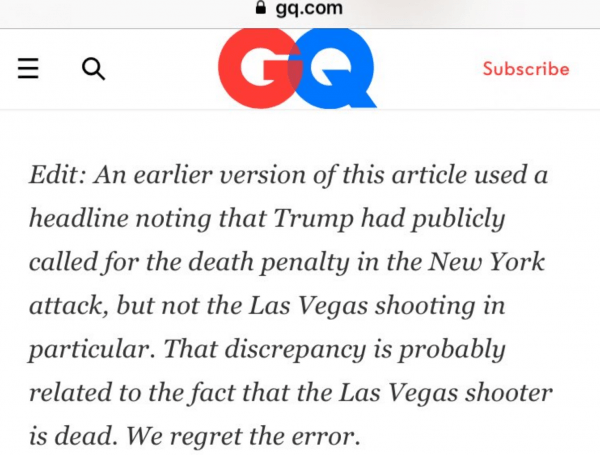
From The Ethics Alarms “Confirmation Bias” Files: GQ’s Reasonable Assumption

After all, the New York terrorist was a Muslim, and the Las Vegas shooter was a white guy, and you know that Trump…oh.

Oh yeah.

Right.

You know, this wasn’t hard to check. The biased national news media is so eager to pounce, so devoid of even the tiniest sense of obligation to give the benefit of the doubt to the President of the United States, that they make fools of themselves over and over again.

Just to connect the dots, and maybe it’s stating the obvious and I apologize if I’m spelling this out unnecessarily, but this is the same phenomenon that leads to excited news stories representing an indictment of Paul Manafort for sleazy activities unrelated to the Trump campaign or Russia as the beginning of the end for dastardly Trump-Russia collusion cover-up.  Exactly the same.

We can’t trust people whose news judgment is so polluted by hate and bias….unless, of course, we want to be influenced by hate and bias. And a depressing number of people do want to be.

This is not an ethical state of mind. Have I mentioned lately that bias makes you stupid?

________________

Pointer and Source: Instapundit

Ethics Dunce: Christ Church In Alexandria, Virginia

I’m sorry, George. You know. Morons.

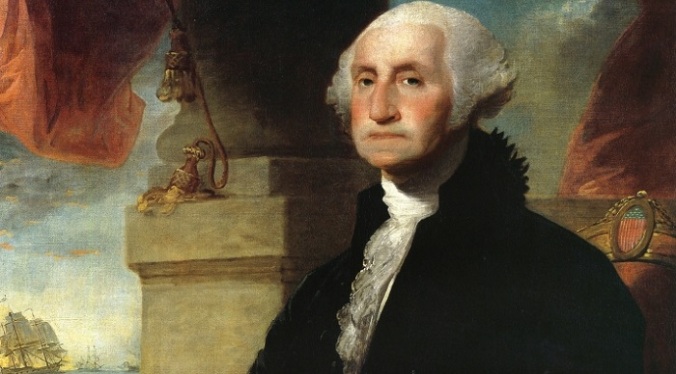
Christ Church in Alexandria, Virginia—the city where I and my family live— announced that it will take take down a memorial plaque  marking the pew where Washington sat with his family.

“The plaques in our sanctuary make some in our presence feel unsafe or unwelcome,” church leaders said. “Some visitors and guests who worship with us choose not to return because they receive an unintended message from the prominent presence of the plaques. Many in our congregation feel a strong need for the church to stand clearly on the side of ‘all are welcome- no exceptions.”

The unspoken but implied rationale is that George Washington was a slave-holder, and that this outweighs everything else. Never mind that the entire white population when he was alive believed that blacks were a lower breed of human. Never mind that it would have been literally impossible to grow up in agrarian, slavery dominated Virginia as a member of the plantation class without embracing slavery. Never mind that Washington continued to ponder the injustice of the practice, and eventually decided never again to buy or sell another slave while advocating slavery’s eventual abolition.  In his will, Washington left directions for the emancipation after Martha Washington’s death, of all the slaves who belonged to him.  Never mind that.

Never mind that without George Washington’s courage, leadership, aversion to excessive power and astonishing charisma and trustworthiness, there would be no United States of America. Continue reading

Ethics Essay Of The Month: Andrew Sullivan

I used to read Andrew Sullivan’ blog regularly: he was smart, gutsy,a good writer, and willing to buck conventional wisdom> then the gay marriage controversy heated up—Sullivan is gay– and Andrew lost it. His focus and once-reliable rationality became distorted by anger, bias and emotion. He eventually gave up blogging because he determined that it was emotionally unhealthy; maybe he finally recognized that he needed a break. By that time, I had stopped reading him.

His brilliant essay in New York Magazine suggest that Andrew has his groove back, which means that his observation are thoughtful and worth pondering. The topic is tribalism, and he writes in part,

Over the past couple of decades in America, the enduring, complicated divides of ideology, geography, party, class, religion, and race have mutated into something deeper, simpler to map, and therefore much more ominous. I don’t just mean the rise of political polarization (although that’s how it often expresses itself), nor the rise of political violence (the domestic terrorism of the late 1960s and ’70s was far worse), nor even this country’s ancient black-white racial conflict (though its potency endures).

I mean a new and compounding combination of all these differences into two coherent tribes, eerily balanced in political power, fighting not just to advance their own side but to provoke, condemn, and defeat the other.

I mean two tribes whose mutual incomprehension and loathing can drown out their love of country, each of whom scans current events almost entirely to see if they advance not so much their country’s interests but their own. I mean two tribes where one contains most racial minorities and the other is disproportionately white; where one tribe lives on the coasts and in the cities and the other is scattered across a rural and exurban expanse; where one tribe holds on to traditional faith and the other is increasingly contemptuous of religion altogether; where one is viscerally nationalist and the other’s outlook is increasingly global; where each dominates a major political party; and, most dangerously, where both are growing in intensity as they move further apart.

Sullivan goes on to explain that this development is antithetical to the model the Founders intended for their new nation:

The project of American democracy — to live beyond such tribal identities, to construct a society based on the individual, to see ourselves as citizens of a people’s republic, to place religion off-limits, and even in recent years to embrace a multiracial and post-religious society — was always an extremely precarious endeavor. It rested, from the beginning, on an 18th-century hope that deep divides can be bridged by a culture of compromise, and that emotion can be defeated by reason. It failed once, spectacularly, in the most brutal civil war any Western democracy has experienced in modern times. And here we are, in an equally tribal era, with a deeply divisive president who is suddenly scrambling Washington’s political alignments, about to find out if we can prevent it from failing again.

Bingo.

Sullivan explains the evolutionary basis of tribalism and why it is so deeply rooted in the human psyche. Then he writes, Continue reading