Harvard’s Black Mass: An Ethics Problem With No Answer


Impossible.

Impossible.

P versus NP…the Hodge conjecture…the Riemann hypothesis…the Yang–Mills existence and mass gap The Navier–Stokes existence and smoothness. The Birch and Swinnerton-Dyer conjecture. These are some of the unsolved problems of mathematics, but they are child’s play compared to the unsolvable ethics dilemma concocted at Harvard College.

Is Harvard right to allow students to hold a historic recreation of a Black Mass? Is Harvard wrong? Is it unethical for the students to engage in the project? Is it gratuitously insulting to religion, particularly Catholicism? Does it even matter if it is?

To bring you up to date:

The Harvard Extension Cultural Studies Club is planning to recreate a “satanic black mass” on campus next week, enacted by Satanic Temple, a New York-based, Satanist group that engages in outrageous displays to draw attention to First Amendment rights. “Our purpose is not to denigrate any religion or faith, which would be repugnant to our educational purposes, but instead to learn and experience the history of different cultural practices,” the HECSC said in a statement.

The statement lays the foundation for a hung jury in seeking an ethics verdict. Since the Black Mass was originally devised to denigrate the holy mass, saying that recreating the mass isn’t intended to denigrate religion is the kind of thing Captain Kirk used to say to evil, logic-bound computers to make smoke come out of their hard drives. “It-is-true-but- it’s-not-true-but-nothing-can-be-true-and-not-true–KABOOM!“ Continue reading →

HGTV And Corporate Cowardice: Hold Companies Accountable For Stifling Speech, Opinion, And Thought

"Remodeling Homes, and Wrecking Democracy"

“HGTV: Remodeling Homes, and Wrecking Democracy”

Once again,  a company that is in effect punishing an American for his or her views on a complex social or political issue is being excused as simply “watching out for the bottom line.” This time, it is cable network HGTV, which cancelled a planned cable show about home repair because one of the prospective stars expressed an opinion adverse to gay activists. Last week, it was the NBA; before that, the agent of activist vengeance was Mozilla, and before that, A&E, until it decided that it was more profitable to do one “right thing” (not punish the duck call eccentrics for being open about who the network and its viewers always knew they were) rather than what it had decided earlier was the “right thing” (“STONE THE BIGOTS!!!”). None of these profit-making organizations are the least bit interested in what is right or wrong, of course, and probably don’t give the ethical implications of their acts a moment’s thought. All they are worried about is money, and what they will grandstand as their “principled decision” will always, amazingly, coincide with whose bullying tactics are more likely to succeed. Continue reading →

“To Rialto Unified School District School Administrators: Don’t Be Moronic!” Sorry, But If You have To Write That Memo, It’s Already Too Late…

Assignment: Pro or Con: "Sarah Palin is the spawn of Satan." Cite authorities...

Assignment: Pro or Con: “Sarah Palin is the spawn of Satan.” Cite authorities…

Here’s a  helpful hint for middle school teachers: if you are going to ask your students to write essays arguing that the the Holocaust never happened, the fact that your Interim School Superintendent is named “Mohammad Z. Islam” may raise some eyebrows with the JDL. Honestly, when I read this story and saw that name, I was sure it was a hoax that had been picked up by the news media.

Nope. The name is real, but more disturbing, the eighth grade writing assignment in California’s Rialto Unified School District required students to write advocacy essay, based on authority and research, mind you, on “whether or not you believe the Holocaust was an actual event in history, or merely a political scheme created to influence public emotion and gain wealth.” Future topics for pro and con debate: Continue reading →

A Donald Sterling Ethics Train Wreck Surprise: Something GOOD May Come Out Of This Mess!

French_Revolution_GuillotineBut I doubt that it will feel very good.

Even more than usual, I was physically nauseated by the Sunday morning network news shows this weekend, which all blurred together in a nightmarish display of how lazy and biased the news media is, and how aggressively it now seeks to make Americans complacent, ignorant, and ethically stunted. I’m not sure which of these journalistic disgraces it was—I think it was “Meet the Press”—where the host, briefly attempting to inject some content into his panel’s obligatory Donald Sterling bashing, asked if it mattered that his comments were intended as private. “There is no privacy any more!” a female panelist exclaimed, not as protest or complaint, but as a dismissive rebuttal. Oh. Well, that settles it then! We should now assume that any of us can be publicly pilloried and humiliated for what we say in our homes, bedroom, automobiles, and safe rooms.  Next issue! Boy, the President killed at the White House Correspondents dinner, didn’t he?

Over at ABC, the token conservative this week in that “roundtable,” Laura Ingraham—the allegedly smart, ultra-right wing, acerbic former Supreme Court clerk for Justice Thomas turned radio host—couldn’t manage the presence of mind or the wit to point out that fellow panelist Van Jones had just compared NBA players—you know, the African Americans who make more money in a week than you make all year?—-to black slaves, and twice at that. What good are you, Laura, if you can be intimidated like that, and allow a shimmering opportunity to illustrate the racial double standard being used today for cynical political ends, so the public might start paying attention? No, Laura had her own agenda, so she wasn’t paying attention. She was there to use the Oklahoma “botched” execution as a platform to inveigh against—abortion. I would call her performance pundit malpractice, but how one can be judged incompetent on a Sunday public issues show, when the shows themselves are journalistic abortions?

Retribution is coming for all, however. Eventually, thanks to the excessive and imprudently unrestrained abuse being heaped on Donald Sterling, these knaves, bumblers and hypocrites are going to have to face the reality of the dilemma they have created for themselves, because the standard they so happily apply to Sterling—deceptively safe and easy because he’s objectively repulsive–is now going to be applied to everyone including their champions and heroes, , and the carnage will be unrelenting. And it will be good for the culture, I think, because like the French Revolution, the force unleashed by the politically correctness bullies, race-hucksters and Bigotry Furies will prove unmanageable, and consume its creators. Continue reading →

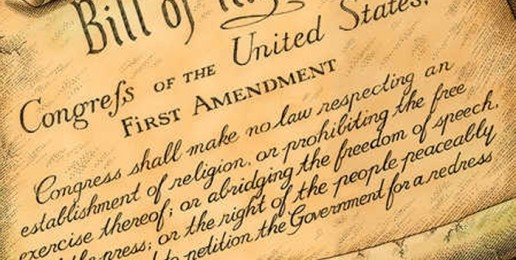
A Brief Ethics and Culture Lesson For First Amendment Pedants

First-Amendment-on-scroll1

Thousands or pundits and web commenters, perhaps hundreds of thousands, in their concerted effort to justify the speech and thought police, (at least as long as the Enforcers are not likely to disapprove of their thoughts and speech), are mocking those who cite the First Amendment as authority for the proposition that the treatment of Donald Sterling, and others, are harmful, sinister, and un-American. The pedants are technically correct, of course. When someone who is fired for posting something offensive on Facebook screams, “My First Amendment right of free speech has been violated!”, that typically speaks of a poor civic education. The Bill of Rights only constrains government action, not private transactions. No rights, which are enumerated and protected from government incursions by the Constitution, have been lost or affected when only private action is involved.

That does not mean, however, that when private action opposes an individual’s Constitutional rights, it is necessarily acceptable, fair, harmless, reasonable or right. Indeed, the government and law serves a crucial function by delineating and encouraging cultural and ethical values. The principles articulated in the Declaration of Independence, the Constitution and the Bill of Rights do not merely constrain government. They form the basis of the ethical values that make the United States a unique culture, and point the way to what Americans, as Americans, regard as right and wrong.

Thus, while searching though a friend’s private e-mail account isn’t a violation of one’s right to privacy under the 10th Amendment, violating a fellow citizen’s privacy is wrong, and the Bill of Rights stands as authority that it is something important to each individual that should be respected. The Constitution and the 13th, 14th, and 15th Amendments won’t and can’t stop Americans like Sterling from being bigots in their private dealings, but they send a clear message that bigotry is not approved by the United States and was not by those who have charted our ethical course. Privately interfering with someone’s right to worship as they please is wrong, and the fact that the government is prevented from doing it tells us so. The First Amendment’s existence also tells us that preserving free speech—open, fearless, speech—is essential to core American values, because it also supports free thought, that which tyrants and dictators fear. Yes, we all have the right to make free speech, thought and discourse costly, difficult and painful, but we should not. We have the right to punish severely the non-conformist, the iconoclast, the rebel, or the citizen who may be a little late, or slow, or reluctant, to accept the conventional wisdom of the moment. We have the right to do it, but it is wrong. It is un-American. The Constitution tells us so.

Addendum: After I wrote the post, I encountered this.


Comment of the Day: “Clayton Lockett Is Dead, Right? Then 1) Good! and 2) His Execution Wasn’t “Botched””

capital-punishmentThere are well-established group of ethics topics that will always cause spirited debates here, because they are issues that have always divided public opinion and always will: morality vs ethics, drug legalization, abortion, war, social justice, socialism, plus various controversies involving race, sexuality and gender. I try to wade into these only when a current even beckons, as to some extent the arguments are futile and familiar, and too many people refuse to think or listen anymore, retreating to slogans and reflex positions articulated by others.

I decided to wade into one of the most polarized, of these, capital punishment, when the Clayton Lockett execution in Oklahoma sparked a national debate that seemed strange to me, and indeed driven by the unwarranted assumption, uncritically accepted by the news media, that the painlessness of executions were a crucial feature of making them ethical as well as societally palatable. It also opened the question of whether one execution that doesn’t follow the script necessarily calls capital punishment itself into question. I confess: both in my post’s title and in the tone of my responses to anti-death penalty commentators, I intentionally sought to roil the waters of debate, and was determined not to allow the nice people who usually express compassion for the pain and suffering of humanity’s worst and deadliest escape with the usual pieties.

Sure enough, this annoyed the heck out of some readers. Responding to the emphatic objections of one, Isaac delivered a personal and powerful rebuttal. Here is his Comment of the Day on the post Clayton Lockett Is Dead, Right? Then 1) Good! and 2) His Execution Wasn’t “Botched:” Continue reading →

Clayton Lockett Is Dead, Right? Then 1) Good! and 2) His Execution Wasn’t “Botched”

Capital punishment foes have no shame, and (I know I am a broken record on this, and it cheers me no more than it pleases you), the knee-jerk journalists who have been squarely in their camp for decades refuse to illuminate their constant hypocrisy. In Connecticut, for example, holding that putting to death the monstrous perpetrators of the Petit home invasion was “immoral,” anti-death penalty advocates argued that the extended time it took to handle appeals made the death penalty more expensive than life imprisonment—an added expense for which the advocates themselves are accountable.

A similar dynamic is at work in the aftermath of the execution of convicted murderer and rapist Clayton Lockett in Oklahoma.Witnesses to his execution by lethal injection said Lockett convulsed and writhed on the gurney, sat up and started to speak before officials blocked the witnesses’ view by pulling a curtain. Apparently his vein “blew,” and instead of killing him efficiently,  the new, three-drug “cocktail” arrived at as the means of execution in Oklahoma after extensive study and litigation failed to work as advertised.  Why was there an excessively complex system involving multiple drugs used in this execution? It was the result of cumulative efforts by anti-death penalty zealots to make sure the process was above all, “humane.” Of course, the more complicated a process is, the more moving parts it has, the more likely it is to fail.

Continue reading →

Ethics Quiz: “Ick!” Or Unethical—The Arabic Pledge Of Allegiance

"I pledge allegiance to the flag...that the terrorists who speak this language want to tear down..."

“I pledge allegiance to the flag…that the terrorists who speak this language want to tear down…”

In the latest smoking gun example of how the administrators of public schools are widely recruited from the Homes For The Bewildered, we learn of Rocky Mountain High School in Fort Collins, Colorado, where the principal, Tom Lopez, and his staff agreed to let the school’s “Cultural Arms Club” lead the student body in an Arabic version of the Pledge of Allegiance, one that replaced  “under God,” the ill-advised addendum to the Pledge added by Congress when the U.S. felt under siege from “godless Communism” with  “under Allah.”

As further proof that they should be managing a street corner balloon establishment, the school’s administration professes amazement that parents and citizens are upset with this, and as more evidence yet, places the blame on the students. After all it was their idea, and if they voted to have their fellow students recite the pledge in duck voices, or Pig Latin, or punctuated with “Heil Hitler!” salutes and “der Fuhrer” in place of “God,” I’m sure that would be okey-dokey too. Continue reading →

Ethics Alarms On NPR: The Sterling Ethics Train Wreck

V.-Stiviano-Donald-Sterling

You are welcome to read the transcript and/or  listen to my interview on NPR yesterday with Michel Martin, both of which can be found here.

It’s too bad, really. They seem like such a nice couple…

Comment of the Day: “Comment of the Day: ‘An Unethical Website, Golden Rule Malpractice And The Worst Anti-Bullying Program Ever'”

Atom bomb cloud

Responding to according2grayson’s passionate defense of non-violence and the Golden Rule while encountering bullies (as well as while opposing despots on the march), Steve-O-in-NJ enriched Ethics Alarms with an epic response including historical perspective, ethics and personal experience.

Here is his terrific post—long but not to be missed—and the Comment of the Day, on Comment of the Day: “An Unethical Website, Golden Rule Malpractice And The Worst Anti-Bullying Program Ever”:

I question this litany of life experiences, since it sounds a bit too pat and a bit too neat to be real, or at least it sounds sanitized/incomplete. Those with truly outstanding records usually don’t feel the need to trumpet them. That said, I wasn’t there, so maybe it is all true.

I know I tried the non-violent approach a few times, and it just lead to more bullying. I also tried the fight-back approach, smashing one bully’s head against the sidewalk and nearly strangling another, and it frankly didn’t get much more done beyond getting the bullies off my back temporarily. That said, a temporary respite from abuse is better than absorbing abuse every day without a respite. What really broke one group of problem people was a combination of finally going to the authorities and the people overreaching.Despite the justified criticism of Catholic schools (a whole separate discussion), they did have one very big thing going for them: no one who was enrolled had to be, or had any right to be, and dismissal or necessary discipline was easily accomplished. Continue reading →