Lawrence O’Donnell and the Missing Religious Bigotry Ethics Alarm at MSNBC

Really?

Religious bigotry? Hey, whatever works!

Is this really how it is going to be? Are the media protectors of President Obama really going to stoop to anti-Mormon bigotry to attack Mitt Romney?  First New York Times columnist Charles M. Blow writes disparagingly about the Mormon “magic underpants” with nary a peep of  protest or discipline from his bosses at the New York Times, and now MSNBC host Lawrence O’Donnell spews out this last night as Romney’s three primary wins were being tallied:

“Mormonism was created by a guy in upstate New York in 1830 when he got caught having sex with the maid and explained to his wife that God told him to do it. Forty-eight wives later, Joseph Smith’s lifestyle was completely sanctified in the religion he invented to go with it. Which Mitt Romney says he believes.” Continue reading

Why Does American Public Education Stink? The Answer: Incompetence, Stupidity, and Fear. The Proof: THIS…

Ah, that look that only a dedicated New York public school teacher can spark!!!

Over at Popehat, Ken has been on another roll, and his latest effort, as depressing and enraging as it is, is a real contribution to our understanding of the kind of entrenched foolishness, cowardice and incompetence in our nation’s public school administration that is gradually rendering the schools useless and our children uneducated.

Spurred by a New York Post story that seemed too horrible to be true, Ken set out to research the claim that the New York School system has compiled a long list of topics that are banned on student tests for a variety of reasons, prime among them that someone, somewhere, will be offended by them.  After some digging on the New York City Department of Education’s websites, what he found  was worse than how the Post had described it.

In an Appendix, he discovered a list of  test question topics “that would probably cause a selection to be deemed unacceptable by the New York City Department of Education… In general, a topic might be unacceptable for any of the following reasons:

  •   The topic could evoke unpleasant emotions in the students that might hamper their ability to take the remainder of the test in the optimal frame of mind.
  •     The topic is controversial among the adult population and might not be acceptable in a state-mandated testing situation.
  •     The topic has been ―done to death in standardized tests or textbooks and is thus overly familiar and/or boring to students.
  •     The topic will appear biased against (or toward) some group of people.

Using those criteria, and undoubtedly using astounding numbers of hours and taxpayer dollars, the Department came up with the following jaw-dropping list of banned test subjects. I’ll flag with red the taboos that are especially outrageous or idiotic, though perhaps I should note the two or three that might be appropriate. Continue reading

Ethics Quiz: What if the Westboro Baptist Church Is Just Kidding?

I know just how you feel, Homer.

This is a unique Ethics Alarms quiz, because I am offering it while having absolutely no idea what the answer is, or even, perhaps, what the right question should be.

The story you can read here describes the Westboro Baptist Church’s interactions with an openly gay DJ. You will recall that the church’s followers have achieved infamy by loudly protesting on the scene of private funerals for military personnel killed in combat, with “God Hates Gays” being one of their signature protest signs. Yet the DJ, when he visited the group, found them to be friendly, unthreatening, civil and kind. They hugged him. The asked him over for dinner.  The surprised and puzzled writer suggests that the Fred Phelps followers’ act may be a form of First Amendment-testing performance art, sort of like Bill Maher. Maybe they aren’t really hateful after all. Maybe they just act that way!

My Ethics Quiz question for you to consider:

Does the fact that they can be kind, tolerant and accepting in the privacy of their abode make the Westboro Baptist Church protesters less unethical, more unethical, or does it make no difference at all? Continue reading

Ethics Hero Emeritus: Rushworth Kidder (1944-2012)

Not everyone named Rush is an uncivil blow-hard. This Rush, Rushworth Kidder, was a dedicated ethicist, teacher, author and philanthropist who was one of the pioneers in the field of professional ethics. His trademark phrase was “moral courage,” but it was more than a motto: Rush thought about it, taught it, and lived it.

He founded his Institute for Global Ethics in 1990, just as the idea was beginning to take hold that organizational ethics was something that needed to be formalized and made part of the culture in companies and professional communities, and unlike many who were to enter the field as it grew, Kidder never sold out. He wasn’t in the field of ethics to make a buck. He believed. Continue reading

Your Weekend Ethics Update

Sure, it's touching..but is it sincere?

Here’s what you may have missed if your attention was focused on non-ethical considerations over the weekend:

  • A Washington, D.C. Charter school has been using scenarios out of horror movies to teach math—to third graders.
  • Saturday Night Live gave fallen child star Lindsay Lohan a chance to be something other than an addict and scofflaw again. Was it exploitation or was it kindness? Kind exploitation, perhaps?
  • Rush Limbaugh became a victim of his own mouth, attacking a Georgetown Law student’s advocacy of insurance-covered contraceptives not by questioning her logic—which is questionable—but her character, and in crude and degrading terms. Indefensible.
  • At least two NFL team, it was revealed, put bounties on the heads of opposing teams’ stars, offering thousands to players for knocking them off the field and into hospital beds. Unethical, a violation of league rules, cheating, and criminal…and the reaction of players is, “What’s the big deal?” A culture problem perhaps?
  • While conservatives were rending their garments in grief over the sudden death of conservative web warrior Andrew Breitbart (and too many liberals were disgracing themselves by applauding an early demise that left his young children fatherless), a far more influential and infinitely more ethical conservative voice left us: scholar, author, social scientist, philosopher, historian…and Ethics Hero Emeritus… James Q. Wilson.
  • Rush apologized after his sponsors began to flee. With great power comes great responsibility, and Limbaugh has more power than he can possibly be responsible for. He still is accountable.
  • Finally…Is a forced apology a “real” apology? It depends.

Ethics Hero Emeritus: James Q. Wilson (1931-2012)

“Denmark or Luxembourg can afford to exhibit domestic anguish and uncertainty over military policy; the United States cannot. A divided America encourages our enemies, disheartens our allies, and saps our resolve—potentially to fatal effect. What General Giap of North Vietnam once said of us is even truer today: America cannot be defeated on the battlefield, but it can be defeated at home. Polarization is a force that can defeat us.”

James Q. Wilson wrote that, in an essay on America’s polarization. The scholar, author, philosopher and social scientist who died yesterday at the age of 80 was a passionate conservative who believed in winning arguments, influencing policy and changing conduct with the power of ideas, facts, studies and analysis. That the media, especially the conservative media, treated the death of Andrew Breitbart as a thunderclap and the death of Wilson as a footnote tells us as much as we need to know about our culture, values and intellect. I watched GOP presidential candidate Rick Santorum respond to the news of Breitbart’s death as if the culture warrior was the equivalent of Martin Luther King. Breitbart died too young, at 43; he had a family, and reputedly was a nice guy. But his contribution to the American scene was to use his various websites to increase the intensity of partisan warfare, and to help banish fairness, compromise, civility and mutual trust from public discourse. One of the last videos of Brietbart showed him screaming insults at Occupy protesters.

I had stopped using Breitbart’s sites for source material: I couldn’t trust them. The editing of James O’Keefe’s ACORN sting was one strike; the misleadingly truncated Shirley Sherrod speech was another. I wasn’t going to wait for a third. It tells me something alarming about conservatives in this country that such an unethical new media figure could be so lionized upon his death, when his methods were so frequently aimed at destruction rather than elightenment.

Wilson, in contrast, got substantive and wide-ranging results.His 1981 essay “Broken Windows” argued that community policing, rather than mere law enforcement, was the secret to changing urban culture. He wrote (with co-author George Kelling): Continue reading

Weekend Ethics Catch-Up

If you took an ethics break this last weekend of February, here’s your Ethics Alarms make-up assignment:


Robot Ethics: Let’s Not Get Silly About It

Today seems to be “Ethics Questions That We Shouldn’t Have To Ask Day,” and Andrew Sullivan, over at the Daily Beast, phrases his entry this way:

“Is Sex With A Robot Adultery?”

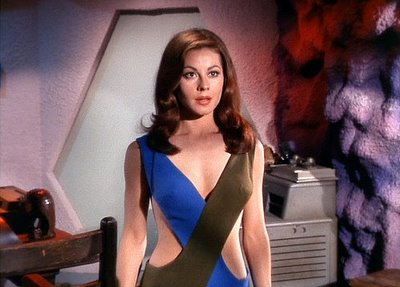
Sherry Jackson as a robot on the original "Star Trek." Lovely, convincing, but still basically a toaster.

Gee, I don’t know, Andrew: is sex with a toaster adultery? What has Sullivan asking such nonsense is a new book called Robot Ethics, which has some legitimate issues to explore, and then some other phony controversies included to get publicity and interviews. The field of robot ethics still includes little that hasn’t been thoroughly explored by Robert Heinlein, Isaac Asimov and on “Star Trek: The Next Generation,” but as a few of these dilemmas are likely to enter reality from science fiction in the foreseeable future, it is reasonable to dust off the issues again as long as we don’t get silly about it. Getting overly excited for the Boston Globe, however, Josh Rothman writes: Continue reading

Ethics Hero: Richard Dawkins

The headlines shout out: “World’s Most Famous Atheist Admits: I Can’t Be Sure God Doesn’t Exist!”

Wow, what a confession. Stop the presses.

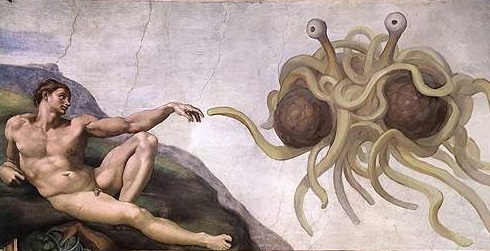
Can anyone be 100% sure this doesn't belong in the Sistine Chapel?

To his great credit, and knowing how the 50% (that is, those of below median intelligence, a sad number of whom reside in the profession of journalism) would react, Prof. Richard Dawkins, the British evolutionary biologist who is point man for the atheist assault on religion, told a student audience at Oxford during a “discussion” ( translation: informal debate) with the Archbishop of Canterbury that he thinks “the probability of a supernatural creator existing is very very low,” but he can’t be 100% certain.

Well, of course not. While this will be taken as a sign of weakness by the faithful who, of course, are 100% certain of the Supreme Being’s existence, no honest, intelligent, fair individual suffering from less than clinical levels of egomania and omniscience could possibly claim to know with certainly where the universe came from. Bravo to Dawkins for his honesty and integrity.

Comment of the Day: “Charles M. Blow’s Anti-Mormon Tweet, Chapter 2…”

Michael, who is now the Ethics Alarms all-time leader in the Comment of the Day category, scores another with a thought-provoking post inspired by the New York Times’ stunning disinterest in its columnist tweeting a religious slur about Mitt Romney. I’ll have some added reflections at the end. Here is his Comment of the Day onCharles M. Blow’s Anti-Mormon Tweet, Chapter 2…”:

“I remember an article about this when I was in college. In analyzing how the news media treated different races, they came up with the PC Hierarchy. Anyone higher on the hierarchy can criticize or be insensitive to anyone below them. If there is a conflict between two groups, the one higher on the PC scale is assumed to be right”

PC Hierarchy of RacesContinue reading