From The Ethics Alarms Archives: “The Siena Research Institute’s Lousy Independence Day Gift: Misleading, Biased and Incompetent Presidential Rankings”

Now and then an old post suddenly get a lot of clicks. Often this will draw my attention to an essay I had forgotten: such was the case with this post from 2010. Someone on Reddit put it up for discussion, and last week the old post had hundreds of views. I was intrigued and re-read it. Good post!

I would change a few observations—in the intervening years we have learned that Woodrow Wilson was even worse than I thought—and add some, but the post was long, and a thorough evisceration of this embarrassing survey’s results would require a book.

***

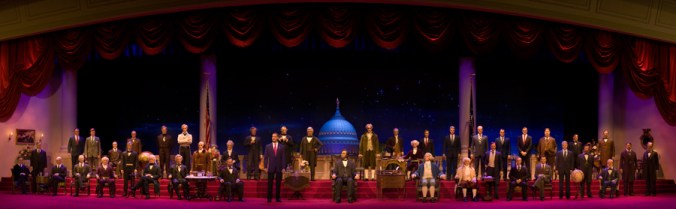
The Siena College Research Institute persuaded over 200 presidential scholars to participate in a survey designed to rank America’s forty-three Chief Executives. There is great deal to be leaned from the resulting list that the Institute proudly released on July 1; unfortunately, very few of the lessons have anything to do with the men on it.

The list shows us that:

  • A survey is only as good as its design
  • Historians who call themselves “presidential scholars,” working together, could do no better in their supposed area of expertise than to arrive at a ranking that would get most 7th Graders a C in junior high school History, raising serious questions about how history is taught in our universities, but perhaps explaining why Americans choose to be so ignorant of their nation’s past.
  • Historians are, as a group, biased toward liberal causes, against conservatives, and in favor of people who are like them.
  • They are unable to recognize their biases, even when a list like this one makes them stunningly obvious.

Lists are mostly for fun and to start arguments. When one purports to make historical judgments, however, and the individuals doing the judging are supposed to be experts, there is still a responsibility to try to do the task fairly, competently, and responsibly. Continue reading
Perspective From Michael Crichton On Experts And Predicting Crises

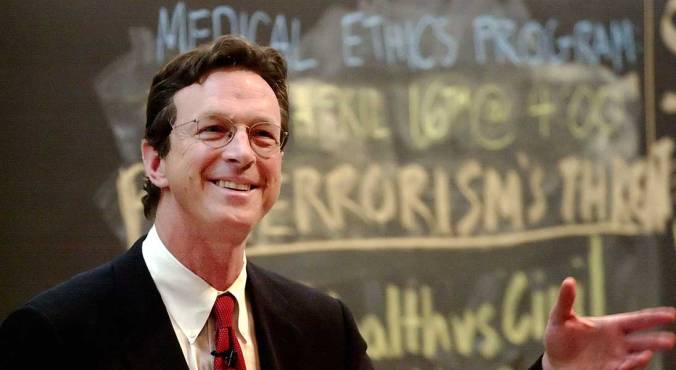
Michael Chrichton was a unique and relentlessly positive influence on our culture, popular and otherwise, before his death in 2008 at the age of 66.  Trained as a doctor and scientist, he applied his knowledge, his brilliance, and more importantly, his remarkable powers of lateral thinking and unbiased analysis, to myriad  fields, always aimed at a form of public education that was fueled by entertainment.  He taught, he wrote best-selling novels, he was a futurist, he directed movies, he created TV shows.   Mostly he thought, and through the fruits of his thought, made ordinary people smarter, at least those smart enough to pay attention. Yes, he thought a lot about ethics. You can learn more about his career and interests at his website, here.

Michael Crichton was especially interested in threats and crises, how they happen and our reactions to them. His first hit novel, “The Andromeda Strain” was about a deadly virus. He would have been very helpful right now. Though he was himself an expert on many topics, he was wary of the abuse of expertise; though he was a visionary, he was was a vocal skeptic of predictions and assumptions. Crichton, I think, would have found the current weaponizing of hindsight bias to find a new way to demonize President Trump as revolting and dishonest as I do.

In this 2002 lecture, Crichton discussed the media’s obsession with speculation, and society’s unwarranted confidence that the future is predictable, especially when experts are doing the predicting. Some selections: Continue reading

Ethics Dunces: The U.S. Congress. Again

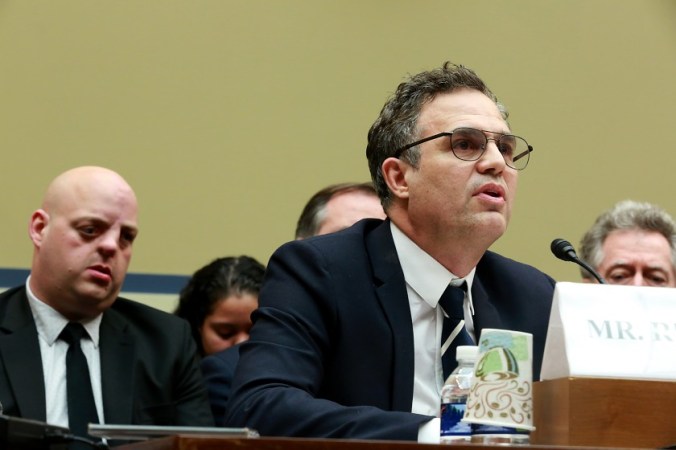
Actor Mark Ruffalo (he plays the Hulk in The Avengers  movies, but it wasn’t because of that role) was invited to testify before Congress last year on public policy involving  public health, chemistry, toxicology, and epidemiology. He has no expertise in these areas at all. The reason was that he starred in “Dark Waters,” which I wrote about here.

Ruffalo is a 9/11 truther, believing  that the U.S. government helped destroy the World Trade Center. That would be enough for me to ding him as an authority on anything, but he has embraced other conspiracy theories as well, like this one.

Never mind: he was presented to the public as an authority on pollution whose opinions on environmental matters have weight. The don’t, and they shouldn’t.

This is a repeat offense. Members of Congress are addicted to the unprofessional and insulting stunt of inviting actors and performers to testify as substantive witnesses on topics that they acted about in movies. As a professional director, I can state with absolute certainty that if an actor is really an expert in something their character was supposed to experience or know something about, 1) that actor is very unusual, and 2) there will still be thousands of real authorities who know a lot more.

Nevertheless, Congress keeps doing this, apparently believing that the public is so naive and gullible that they really believe that because a performer credibly pretends to know what a script-writer prepares to make them sound like the know, they really are experts. Sadly, a lot of the public does believe that. (More sadly, a lot of actors do too) Continue reading

Comment Of The Day: “Easter Sunday Ethics Warm-Up, 4/12/2020: Missing The Easter Bunny”

In today’s Warm-Up, I expressed my problems with Mark Tapscott’s blog post, titled “He Is Risen! Eight Reasons To Believe.”

To summarize the thrust of my criticism as I reiterated it in my replies to his comment and others, Mark argues persuasively that the authors of the Gospels were, at least in this case, trying to tell the story as they heard it, and were not trying to embellish or distort it in the telling to make it more credible in its time. Good. That does not mean, however, that the story they heard is in fact true. The post was also aimed in part at debunking conspiracy theories about the Resurrection being a hoax. Taking Mark’s argument as that, and that alone, it is also persuasive. However, proving something was not intentionally false does not prove it is true.

I will do this however: at the end of my discussion, I said that I regarded Mark’s argument as a tautology, where a controversial document is cited to prove the accuracy of the document itself, and that I regarded that device as intellectually dishonest. Mark’s response persuades me that my  assessment was unduly harsh and unfair, and I both retract and apologize to him for it.

Moreover, the fact that he chose to respond in person so quickly reaffirms my original favorable assessment of his professionalism and character.

Here is Mark Tapscott’s Comment of the Day on Item #4 in the post, “Easter Sunday Ethics Warm-Up, 4/12/2020: Missing The Easter Bunny”:

First, thank you for your kind words regarding my secular writing. I hope that my work in that area continues to merit your approbation. We are, as I believe Confucius is reputed to have said, “cursed to live in interesting times.”

Unfortunately, my reaction is not nearly so positive regarding your critique of my post on eight reasons to believe Jesus was literally resurrected from the dead three days after His crucifixion, just as He said He would be.

“Intellectually dishonest” and tautological? With all due respect, your readers deserve more candor than that from you. You accuse me of these two errors because: “All of his reasons are based on New Testament text. If one believes that the New Testament text is true and accurate, then you don’t need any more reasons. His is a self-ratifying argument.”

If my post was simply arguing for the credibility and historical accuracy of the New Testament, your statement might well more accurately represent what I wrote. I did indeed assume the accuracy of the New Testament accounts of Jesus’ resurrection, but the eight reasons I offered concerned characteristics of the scriptural accounts and events that point a reasonable reader to their credibility. Continue reading

On The Recent Steele Dossier Revelations: An Open Letter To An Un-Named Former Ethics Alarms Commenter, Written In Disappointment And Disgust

Dear You Know Who You Are,

As you remember, well over a year ago you staged a grandstanding, insulting exit from participation on this blog, declaring that I had “drunk the Kool-Aid.”  Your false claim was provoked because I had successfully navigated through  lies, calculated disinformation and lawbreaking—engineered by those within and without the U.S. government—to conclude that a coordinated effort had been and was underway to overthrow the elected President of the United States. At this point, the fact that your accusation was based on your own blindness and bias is not subject to rational denial or debate.

I knew that at the time, of course. I also felt, and feel, that for you to behave that way, in public, here, was a personal as well as a professional betrayal. We had, I thought, a cordial and mutually respectful relationship. We had exchanged details about the high and low points of our lives face to face.  We are in the same field and profession. I trusted you.

I have provided you some slack in my ultimate judgment on your character because I know that, as we say here often, bias makes us stupid, even the best of us. I have seen this particular bias make many people, even some smarter than you, as difficult as it may be for you to conceive of that, both stupid and  destructive, apparently without a glimmer of self-realization. I recognize that it the phenomenon is, at this point, indistinguishable from an illness, one triggered by emotion and group-think. Thus I am, up to a point, sympathetic, just as I am regarding so many of my Facebook friends who figuratively make asses of themselves every single day  because they are addicted to “likes” and peer approval. Some of them are even lawyers, but you know…lawyers. That is a professional group, along with historians, politicians, historians, scholars, psychiatrist, educators and, of course, journalists, that has broken its duty of trust with the public as it joined a dangerous and unconscionable effort to break our democracy. Continue reading

The Hydroxychloroquine Ethics Train Wreck

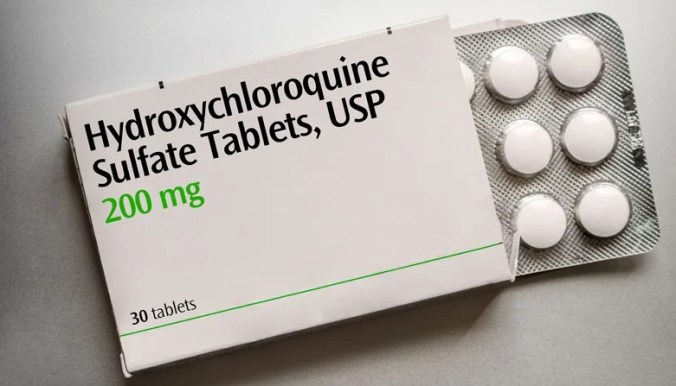
Ever since those two idiots (or maybe one dead idiot and a diabolical spouse) used fish tank cleaner to try to protect themselves from the Wuhan virus and the news media tried to claim the President killed the dead one by recommending the drug (though not the fish tank cleaner), this has been one of those situations where it is impossible to separate legitimate information from the news media  vendetta against Trump and what the actual situation is. Journalists really can’t help themselves; here are Peter Baker, Katie Rogers, David Enrich and , the Times’ regular Trump character assassins, in what is supposed to be a news story:

“Day after day, the salesman turned president has encouraged coronavirus patients to try hydroxychloroquine with all of the enthusiasm of a real estate developer.”

Nah, there’s no mainstream media bias! Did the Times ever, even once, call Obama the “community organizer-turned President”? How about “the former enthusiastic pot smoker” turned President?

As I’ve mentioned here before, the official talking point buzzword is that the President “touted” the drug, which is only available by prescription. Some experts, not infected with the Trump Hate virus, have had a reasonable reaction to his optimism. for example,Dr. Joshua Rosenberg, a critical care doctor at Brooklyn Hospital Center, told reporters,

“I certainly understand why the president is pushing it. He’s the president of the United States. He has to project hope. And when you are in a situation without hope, things go very badly. So I’m not faulting him for pushing it even if there isn’t a lot of science behind it, because it is, at this point, the best, most available option for use.”

Meanwhile, the Food and Drug Administration issued an emergency order late last month allowing doctors to administer it to coronavirus patients if they saw fit. Many have seen fit. David Lat, the founder of the legal gossip site Above the Law, itself a virtual card-carrying member of the resistance, declared that the drug had saved his life during his hospitalization for the Wuhan virus. Continue reading

Now Entering The Ethics Alarms “Bias Makes You Stupid” Hall of Fame: James Hohmann

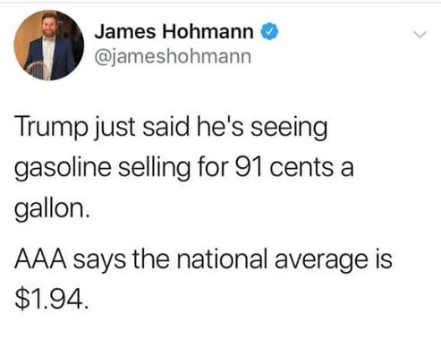
His bio says that Hohmann is a Stanford University grad and a national political correspondent for The Washington Post, as well as  the author of The Daily 202, the Post’s political newsletter. Here is his recent tweet:

I wonder if he had the same math teachers as Mara Gay and Brian Williams (Item #2)?

The reporter was so eager to mock the President that he concocted a  cheap gotcha! and made himself look foolish. Or maybe not at the Post: this is similar to a lot of the alleged “lies” on the Post’s Trump Lie list, and about as well reasoned: “The President said that he had seen gas selling for 91 cents a gallon, when the average price was $1.94.”

Again I ask, how can the public trust journalists like this to do political analysis? Why would they, unless readers want biased reporting?

_____________________________

Pointer: Instapundit

Aside: A commenter at the Instapundit link above writes,

I may have shared this story on here before, but I remember in my Latin American History course at college, a journalism major raised her hand and asked the following:

“I’ve been doing the reading like you assigned, but there’s one thing I don’t understand. They keep talking about the Andes, but they never say what that is. Are they like some sort of political group?”

True story.
I got more, too.


Comment Of The Day: “Saturday Ethics Warm-Up, 4/4/2020: Letting The Perfect Be The Enemy Of The Good, And Other Blunders,” Item #2

With so many people freaking out about computer models, this seems like a good time for some perspective!

Here is JG’s Comment of the Day on the post, “Saturday Ethics Warm-Up, 4/4/2020: Letting The Perfect Be The Enemy Of The Good, And Other Blunders,” (Item #2):

I’m a math major from the late 60s so I do love numbers but wasn’t subjected to subsequent generations of educators preaching the genius of computer generated models (CGM).

My first job after college was in the research department of a well-known consulting company. One of the whiz kid consultants from Stanford was all about computer models (this is when we were still using teletypes to communicate with the mainframe).

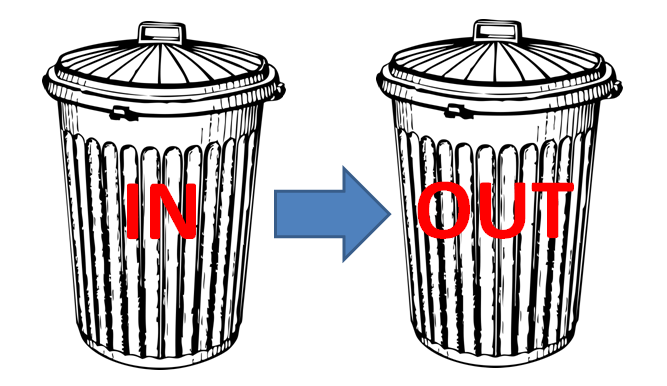
I’ll never forget how impressed I was with his modeling and he, very wisely, cautioned me that it was difficult to remove personal bias from a computer model. He told me that our brains work more efficiently than any computer and, when faced with a problem that may require analyzing huge data series (i.e. perfect project for a computer), we, with our human brains, already have a “gut” conclusion which creeps into the modeling and very well may influence its neutrality. That piece of advice has stayed with me lo these 50 years and makes me skeptical about the reliability of any computer-generated model. Continue reading

Ethics Observations On A Case Study In Combining Bad Journalism With Bad Science

Yes, it’s the New York Times again. I use that paper for the majority of the Ethics Alarm unethical journalism posts for a few reasons. One is that the paper comes to my door every day, so I read a lot of articles that I might miss on the web.  Another is that the Times is the most successful and influential newspaper in the country,  and its work is more closely followed and more criticized than any other paper, and most news sources generally. The Times also advertises itself as the nation’s “paper of record,” placing itself on a pedestal with standards of integrity and reliability that it is obligated to meet….and does not. Finally, the paper is unacceptably biased in its political coverage and editorial product.

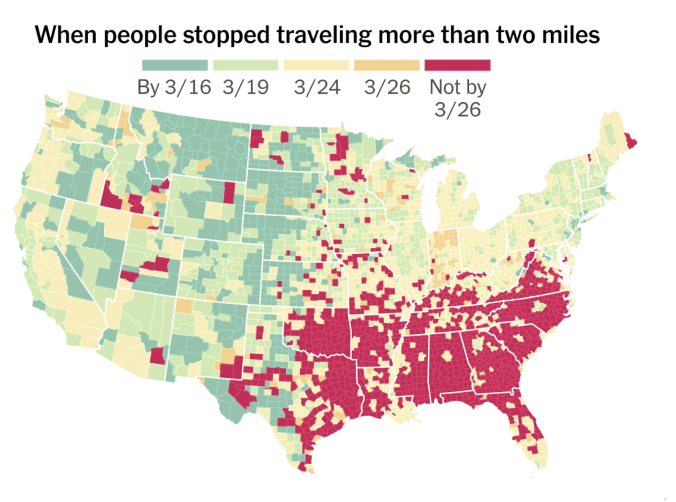
Today’s “Where America Didn’t Stay Home Even as the Virus Spread”  is far from then times at its worst. It is, however, unacceptable and unethical. I’m not even in disagreement with the piece’s main thesis, which is that the regions that have not imposed shelter at home restrictions on the public are at more risk of exploding Wuhan virus cases. That makes sense; that’s even obvious. However, the Times’s main tool in making a case was the map below, which it explained this way:

“Stay-at-home orders have nearly halted travel for most Americans, but people in Florida, the Southeast and other places that waited to enact such orders have continued to travel widely, potentially exposing more people as the coronavirus outbreak accelerates, according to an analysis of cellphone location data by The New York Times. The divide in travel patterns, based on anonymous cellphone data from 15 million people, suggests that Americans in wide swaths of the West, Northeast and Midwest have complied with orders from state and local officials to stay home.”

Continue reading

High Noon Ethics Showdown, 4/2/2020: Reality Dawns

Yyyyyyup!

Interestingly, the usually busy street bordering on our cul de sac looks just like this right now, except Gary Cooper isn’t anywhere to be seen…

1. What? The U.S. does NOT have more Wuhan virus cases than China? How can that be??? Senator Ben Sasse (R., Neb.), hardly a knee-jerk Trump apologist, who sits on the Senate committee that deals with classified intelligence, said the Chinese Communist Party continues to lie about the death toll from the virus. He has said information he has viewed shows the United States does not surpass China in terms of deaths. This was obvious to anyone not actively trying to use the spread of the illness for partisan advantage, but it’s nice to have confirmation.

“The claim that the United States has more coronavirus deaths than China is false,” Sasse said yesterday. “Without commenting on any classified information, this much is painfully obvious: The Chinese Communist Party has lied, is lying, and will continue to lie about coronavirus to protect the regime. Beijing’s garbage propaganda shouldn’t be taken seriously by the World Health Organization, by independent journalists, or by the American epidemiologists who are going to beat this terrible virus.”

This, of course, further impugns the news media. Stephen Kruiser wrote,

“Every day, they find new ways to reinforce the “Enemy of People” status that they have been earning every day in the Trump era. They’ve routinely scolded anyone who accurately refers to the virus as being of Chinese origin, screaming “RACISM!” as if they were getting paid each time they uttered or typed the word. What has been most insidious has been the parroting of whatever China reports about the virus. Almost everyone in American media has been acting as ChiCom public relations lackeys, taking everything that the Chinese government says and passing it along without questioning any of it.”

Continue reading