“Should Bystanders Have a Legal Duty To Intervene?” Of Course Not, But It’s Worth Thinking About Why It’s A Terrible Idea

The real mystery is why a law professor would ever conclude that it was a good idea.

Amos N. Guiora, a professor at the University of Utah’s S.J. Quinney College of Law, has authored The Crime of Complicity: The Bystander in the Holocaust, In it, he addresses the   bystander-victim relationship, focusing on the Holocaust. He comes to the remarkable conclusion that a society cannot rely on morality, ethics and compassion alone to move its members to come to the assistance of another human being in danger. He insists that it is a legal issue, and that society should make the obligation to intervene a legal duty, and  non-intervention a crime.

Wow. Here is a shining example of how bias can make smart people not only stupid, but blind. I have not read the book (I did listen to this podcast), because his contention is self-evidently anti-ethical, and typifies the attitude that has led to the criminalizing of so much in U.S. society that rigorous enforcement of the law would make the nation a police state. The Holocaust is the worst possible starting point for this issue: to state the most obvious absurdity, if the government is the victimizer, who would enforce the laws against not assisting victims? I get it, though: the professor is angry and bitter that the international community and Christians didn’t forcefully intervene before Hitler was on the verge of liquidating Non-Aryans from the face of the earth. But no law within imagination would have prevented this unique catastrophe. Nor would the kinds of laws he advocates improve the fate of most victims, or be practically enforceable.

Ethics Alarms has discussed the duty to rescue often and in great detail, and often notes, “when ethics fail, the law steps in.” The second stage of that statement is “and usually makes a mess of it.”  This is the compliance/ethics divide so exposed by corporate compliance rules, regulations and laws, which have done little to improve corporate conduct, and have provided cover for complainant and creative misconduct, like Wall Street leading up to the 2008 crash. Giving up on the teaching and strengthening of ethical values in society in favor of mandating what the state regards as “right” by inflicting punishment degrades society and insults humanity, treating it as if it is incapable of learning to care about others and society at large.  It also seldom works. The duty to rescue exists, but society must encourage and foster it by nurturing ethical society members, not by threatening them with punishment.

Society cannot mandate compassion—a law requiring charity?—kindness—a ticket for not rescuing an abandoned dog or helping a blind man across the street?—honesty–fines for telling a date that you’ll call the next day when you won’t?—-or courage —Sweep that child up whose in the path of a semi, or to jail. Of course it can’t. Increasing reliance on the state to force what a powerful group regard as “good behavior” is the catalyst of the current totalitarian bent of the American Left. Doesn’t the professor realize that what he is advocating leads directly to the Holocaust, and not away from it?

This is one slippery slope that needs a fence around it. Continue reading
Ethics Quiz: Never Mind Breastfeeding In Church, What About Gus the Asparagus Man?

If churchgoers’ sensibilities regarding mothers breastfeeding during a religious service are worthy of respect and deference, what about their sensibilities regarding people dressed like vegetables?

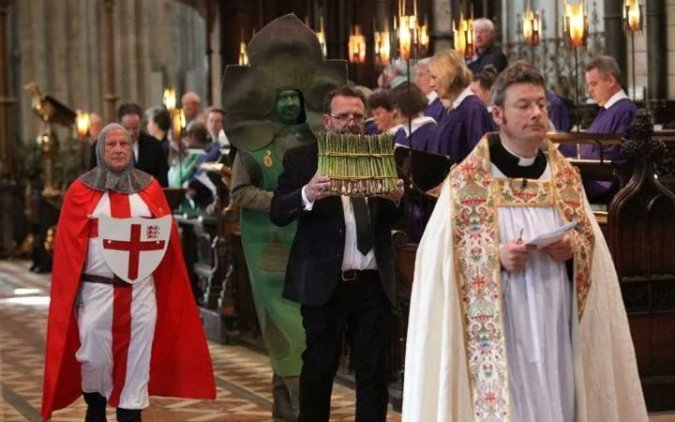
This past Sunday, England’s Worcester Cathedral  kicked off the region’s annual Asparagus Festival with a unique ceremonial blessing. A man in a suit and tie carried a bundle of the vegetable to the front of the church, followed by a man costumed as a spear of asparagus (Gus the Asparagus Man) and someone costumed as St. George, shield and all. The cathedral’s Precentor then blessed the crop.

Many churchgoers were offended. “This is an absurd pantomime-type scene that makes a mockery of Christian worship,” said one.  A popular religious blogger asked, “Where’s the sprout liturgy, or equality for mushrooms? Would the Dean really permit a walking fungus to participate in an act of divine worship?”

Your Ethics Alarms Ethics Quiz of the Day is..

Was it unethical for the Church of England to present such a whimsical service to its unsuspecting members?

The values to consider here are trust, fairness, respect, and responsibility.

What do you think?

________________________

Pointer: Fred

Ethics Hero, Corporate Division: Merck

Sometimes, though their implacable foes would refuse to acknowledge it, big corporations do the right thing even without a metaphorical gun at their heads. This week’s Economist magazine relates an amazing example that the public needs to know about, especially since it challenges popular stereotypes about Big Pharma.

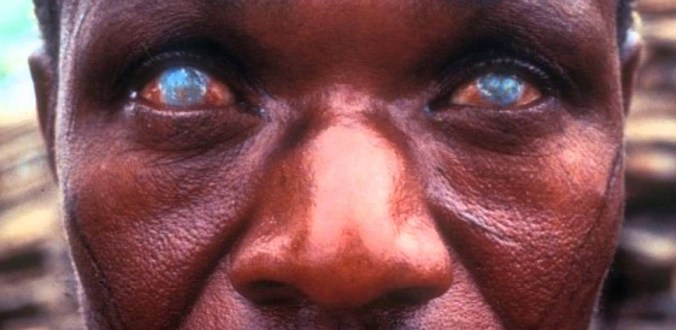
The Economist begins by horrifying us with a deadly aspect of life in third world countries that are hot and wet: “neglected tropical diseases,” or NTDs. These are neglected because the populations that suffer from them are poor and far away, but they affect more than a billion people. Among the scourges, all parasitic, are Buruli ulcer, Chagas disease, guinea-worm disease, leishmaniasis, river blindness, trachoma and yaws. There are 18 pernicious maladies currently listed as NTSs.

In the 1970s, mega-pharmaceutical firm Merck developed the drug ivermectin after tests on animals with parasitic infections. William Campbell, one of the firm’s parasitologists,told company executives that the new drug might be effective against the parasite that caused onchocerciasis, or river blindness, which  afflicts populations in in parts of Africa, Latin America, and  Yemen.  He was given the green light to find out.

The first human trial of ivermectin as treatment for river blindness took place in Senegal in 1981, on patients who had the early stages of the disease—itching, rashes— but no damage to their eyes yet. The results were encouraging,  indicating that ivermectin was safe for humans and highly effective at stopping the disease before it blinded its victims.  Merck, however, now faced the problem that has impeded cures for all the neglected tropical diseases: those who needed ivermectin were too poor to buy it, and so were the nations where they lived. Big corporations are not charities; they have investors, stockholders and a bottom line. They are not accustomed or programmed to give away their products.

Yet Merck made a corporate decision that Bernie Sanders and Elizabeth Warren say is impossible. Starting in 1987, it made an open-ended commitment to distribute as much ivermectin as was needed to eradicate the river blindness worldwide. In the next ten years, it swallowed the cost of 100 million doses. Continue reading

Yale’s Core Values Betrayal: The Case Of The Student’s Unnecessarily Provocative Philosophy Essay

It certainly appears as if U.S. higher education is sailing toward the shoals of ethics bankruptcy, full speed ahead. It also appears that Yale, although it’s part of a tightly bunched armada, is leading the way.

A law suit called Doe v. Yale tells a jaw-dropping tale that once would have been unbelievable, “once” meaning “before a large segment of the culture accepted the proposition that free expression and thought were undesirable unless they met certain lockstep requirements that will ease the way to a progressive utopia.” The plaintiff, a male student, claims that Yale punished him for the offense of writing a class essay that offended a female teaching assistant.

According to his lawsuit, in late 2013 a philosophy teaching assistant filed a complaint with the university’s Title IX office, complaining about a short paper “Doe” had written in the class she was helping to teach.  The essay discussed Socrates’ discussion, recounted in Plato’s “Republic,” of the three divisions of the soul and their relationship to justice. It applied the Greek philosopher’s ideas to rape, arguing that the crime was also an irrational act in which  the soul’s appetites and spirited components overwhelm its reason, which must have primacy for mankind to be moral and just.

The Title IX coordinator, an associate dean in the Graduate School of Arts and Sciences named Pamela Schirmeister, told Doe that his essay was “unnecessarily provocative.” By daring to discuss rape, he had committed an offense against the teaching assistant. He was told to have no contact with the teaching assistant, and ordered to attend sensitivity training at the university’s mental-health center—re-education and indoctrination, in other words. “Doe” was now, he was told, a “person of interest” to Yale, meaning that that the college was now going to be watching him with a grounded suspicion that he was a potential danger to the campus.

What followed, a few months later, were two dubious accusations of sexual assault by female students, both handled with the slanted, pro-accuser, due process-avoiding  approach that has become epidemic on campuses since President Obama’s Dept of Education issued its infamous “Dear Colleague” letter in April of 2011.  Ethics Alarms has discussed some of these cases and the letter, but that is not the topic before us today.

Today the topic is the suppression of free speech, thought, and expression on college campuses.  Continue reading

How Do We Know The Democrats Can’t Find Any Ethical Reason Not To Confirm Judge Gorsuch? Because They Searched And Searched, And The Best They Could Come Up With Was THIS [UPDATED]

Pathetic. Desperate.

Typical.

“And it’s a HAIL MARY PASS!!!!!!!”

Today headlines screamed—do mark the journalists and news organizations, for they exemplify Prof. Glenn Reynold’s jibe, “Democratic operatives with  bylines”—that Supreme Court nominee Neil Gorsuch had committed plagiarism in four passages of his 2006 book “The Future of Assisted Suicide and Euthanasia,” which was based on his 2004 Oxford dissertation, before he became a judge.

That’s a stretch, and more than that, making this a major new story now indicates bias.

In the most egregious of the passages cited, Gorsuch included a description of the famous “Infant Doe” case that tracks closely with the description in a 1984 law-review article by Abigail Lawlis Kuzma. Both versions primarily quote from the court opinion: Kuzma’s article tracks equally closely to the original opinion, a 1982 Indiana court ruling that was later sealed, a  pediatrics textbook, “Rudolph’s Pediatrics,” and a 1983 article in the Bloomington Sunday Herald. Gorsuch cited all of these, but did not cite Kuzma’s article.

He should have. That’s a citation error, but probably not plagiarism. Several the sentences in the book and the article are identical or close to it, and Gorsuch should have used quotation marks. However none of the sentences involved anything but factual  and technical descriptions. For example,the article states that “Esophageal atresia with tracheoesophageal fistula indicates that the esophageal passage from the mouth to the stomach ends in a pouch, with an abnormal connection between the trachea and the esophagus,” and Gorsuch wrote, “Esophageal atresia with tracheoesophageal fistula means that the esophageal passage from the mouth to the stomach ends in a pouch, with an abnormal connection between the trachea and the esophagus.” 

Now, if I were writing about esophageal atresia, about which I know nothing, in the course of an analysis of a larger issue, I would probably re-phrase that passage, perhaps writing, “When the esophageal passage from the mouth to the stomach ends in a pouch, with an abnormal connection between the trachea and the esophagus, this is the condition called esophageal atresia with tracheoesophageal fistula.” I haven’t added anything original, though. There are no new thoughts or content. My re-phrasing would just dodge the accusation of plagiarism. When I wrote my thesis, which involved reviewing multiple biographies of every U.S. President, it was not uncommon for me to find paragraphs in the earliest materials that were worked over and re-phrased again and again, with no quotes but citations.

The National Review, a conservative publication, so its position will be discounted as biased and partisan, tracked down Kuzma, who waved off the plagiarism charges:

“These passages are factual, not analytical in nature, framing both the technical legal and medical circumstances of the “Baby/Infant Doe” case that occurred in 1982. Given that these passages both describe the basic facts of the case, it would have been awkward and difficult for Judge Gorsuch to have used different language.”

Weeell, that’s laying it on a bit thick. Gorsuch certainly could have done a more academically acceptable job of re-stating the substance of what she wrote; it’s not THAT “awkward and difficult.”

Continue reading

Ethics Hero: Notre Dame Political Science Professor Vincent Phillip Muñoz

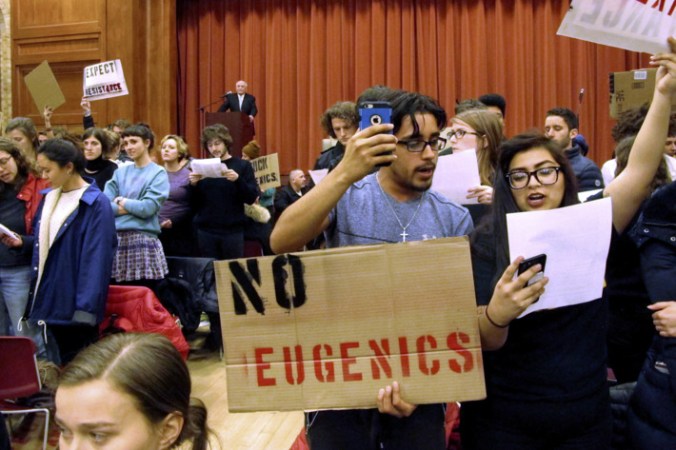
Vincent Phillip Muñoz is the Tocqueville Associate Professor of Political Science and Concurrent Associate Professor of Law at The University of Notre Dame. Following the violent protest that prevented his announced lecture at Middlebury College earlier this month, Prof. Muñoz invited Murray to speak at the University of Notre Dame next week. This occasioned some protests and objections from students and faculty at his own college, and he responded with an essay at RealClearPolitics, writing in part…

Charles Murray is speaking at Notre Dame because I and another Political Science professor assigned his book “Coming Apart” in our classes. His visit is one of several outside lectures that are part of this semester’s Constitutional Studies offerings. My class, “Constitutional Government & Public Policy,” addresses some of the most important and divisive issues in American politics: abortion, gay marriage, religious freedom, inequality, freedom of speech, death penalty, race and the meaning of constitutional equality, immigration, euthanasia, and pornography.

 The class is designed to prompt students to think more deeply and thoughtfully about contemporary moral and political issues. I don’t assign a textbook or “neutral” readings that summarize the issues; I require students to read principled thinkers who advocate vigorously for their respective position. I want my conservative students to read smart, persuasive liberal thinkers, and I want my liberal students to read thoughtful conservatives. Educated citizens can give reasons for their beliefs and can defend intellectually the positions they hold. That requires that we understand and articulate the positions with which we disagree.

…“But Murray is controversial and will make students feel uncomfortable,” my faculty colleagues say. Don’t I know that he has been accused of being racist, anti-gay, and a white nationalist? I’m told that bringing him to campus is not fair to Notre Dame’s marginalized students.

I have no desire to inflict unwanted stress or anxiety on any member of the Notre Dame community, especially our minority students. I appreciate the concern for student well being that motivates some of the opposition to Murray’s visit. But I believe what is most harmful to students—and, to speak candidly, most patronizing—is to “protect” our students from hearing arguments and ideas they supposedly cannot handle.To study politics today requires handling controversial, difficult, and divisive topics…

The price of a real education is hearing powerful arguments that make us realize our opinions are based on untested assumptions. Only then, when we realize that we do not know as much as we think we know, can genuine learning occur.

I invited Dr. Murray to Notre Dame months ago…Given what happened at Middlebury, it would be cowardly to disinvite Murray now. Rescinding his invitation would communicate that violence works; that if you want to influence academia, sharpen your elbows, not your mind. It would tell those who engaged in violence—and those who might engage in or threaten violence—that universities will cower if you just appear intimidating. Rescinding Murray’s invitation would teach exactly the wrong lesson…

Notre Dame faculty critical of Murray have implored me to think about the larger context of what his visit means. I am. That is why I will not rescind his invitation. As a professor and program director, my job is to do what we are supposed to do at universities: pursue the truth through reasoned dialogue and discussion. Whether you find Charles Murray’s scholarship persuasive or objectionable, his visit offers an opportunity to learn. That is why I invited him to speak at Notre Dame. After Middlebury, it’s all the more important that he do so.

It is almost an insult to academia to call Prof. Muñoz ‘s statement heroic. It should be obvious. Dissenters from the position he articulates should be instantly recognizable as regrettable outliers, the opponents of academic freedom and freedom of thought, the advocates of censorship and ideological indoctrination. Yet increasingly it is this traditional view of higher education that Muñoz advocates that is under attack. Continue reading

Catching Up On “Instersectionality,” And Finally Paying Attention

There are more than 22,000 tags used here, even if you eliminate the duplicates due to my typo problem, and still  “intersectionality” is not among them. I have seen the term, mostly recently, but only in contexts that led me to dismiss it as leftist, scholarly jargon, the kind of word radicals throw around to confuse their opposition and make people think they are intellectual when they are really arguing nonsense. I wasn’t wrong: it is one of those words. Still, it is a useful one, because it helps explain several phenomena of great importance, which can be collectively described as the increasing totalitarian tilt of the political left, especially since the election of Donald Trump. I should have realized the importance of the word long  ago and investigated: I apologize. Bias makes me  stupid too.

Over at New York magazine, Andrew Sullivan had one of his lucid moments—when he can bypass his anger at anti-gay attitudes (the bias that makes HIM stupid), Sullivan can be brilliant—, and delivered a perceptive essay about “intersectionality,” beginning with the recent disgrace on the Middlebury College campus, where a student protest designed to prevent sociologist Charles Murray from speaking turned into a violent riot, injuring a professor. Do read all of Sullivan’s article, but here are some key passages:

[W]hat grabbed me was the deeply disturbing 40-minute video of the event, posted on YouTube. It brings the incident to life in a way words cannot. At around the 19-minute mark, the students explained why they shut down the talk, and it helped clarify for me what exactly the meaning of “intersectionality” is.

“Intersectionality” is the latest academic craze sweeping the American academy. On the surface, it’s a recent neo-Marxist theory that argues that social oppression does not simply apply to single categories of identity — such as race, gender, sexual orientation, class, etc. — but to all of them in an interlocking system of hierarchy and power. At least, that’s my best attempt to define it briefly. But watching that video helps show how an otherwise challenging social theory can often operate in practice.

It is operating, in Orwell’s words, as a “smelly little orthodoxy,” and it manifests itself, it seems to me, almost as a religion. It posits a classic orthodoxy through which all of human experience is explained — and through which all speech must be filtered. Its version of original sin is the power of some identity groups over others. To overcome this sin, you need first to confess, i.e., “check your privilege,” and subsequently live your life and order your thoughts in a way that keeps this sin at bay. The sin goes so deep into your psyche, especially if you are white or male or straight, that a profound conversion is required….

Like the Puritanism once familiar in New England, intersectionality controls language and the very terms of discourse. It enforces manners. It has an idea of virtue — and is obsessed with upholding it. The saints are the most oppressed who nonetheless resist. The sinners are categorized in various ascending categories of demographic damnation, like something out of Dante. The only thing this religion lacks, of course, is salvation. Life is simply an interlocking drama of oppression and power and resistance, ending only in death. It’s Marx without the final total liberation.

It operates as a religion in one other critical dimension: If you happen to see the world in a different way, if you’re a liberal or libertarian or even, gasp, a conservative, if you believe that a university is a place where any idea, however loathsome, can be debated and refuted, you are not just wrong, you are immoral. If you think that arguments and ideas can have a life independent of “white supremacy,” you are complicit in evil. And you are not just complicit, your heresy is a direct threat to others, and therefore needs to be extinguished. You can’t reason with heresy. You have to ban it. It will contaminate others’ souls, and wound them irreparably….Murray’s old work on IQ demonstrates no meaningful difference between men and women, and Murray has long supported marriage equality. He passionately opposes eugenics. He’s a libertarian. But none of that matters. Intersectionality, remember? If you’re deemed a sinner on one count, you are a sinner on them all. If you think that race may be both a social construction and related to genetics, your claim to science is just another form of oppression. It is indeed hate speech….This matters, it seems to me, because reason and empirical debate are essential to the functioning of a liberal democracy. We need a common discourse to deliberate. We need facts independent of anyone’s ideology or political side, if we are to survive as a free and democratic society. Trump has surely shown us this. And if a university cannot allow these facts and arguments to be freely engaged, then nowhere is safe. Universities are the sanctuary cities of reason. If reason must be subordinate to ideology even there, our experiment in self-government is over.

This outburst was apparently too much for Andrew, his old libertarian/conservative persona emerging full-force after a long hiatus, so his piece suddenly shifts into a standard issue anti-Trump rant. It’s fascinating to see, because Andrew apparently hates the President so much that he can’t perceive that the same antipathy created by “intersectionality” that he rebuts regarding Murray (after all, Sullivan is friends with Murray), applies to the President (whom he detests) as well. The proof is how Trump’s misogyny and opposition to illegal immigration has led the Left to presume that he is racist, classist and homophobic as well. He’s not. But, to quote Sullivan against himself, “But none of that matters. Intersectionality, remember? If you’re deemed a sinner on one count, you are a sinner on them all.”

Thus Sullivan pivots to blaming all of the social and political tilt he correctly deems as dangerous on Donald Trump, and in doing so, he becomes the partisan hack he so often appears to be: Continue reading

Fast Food Ethics: Subway’s Chicken TASTES Like Chicken—Isn’t That Enough?

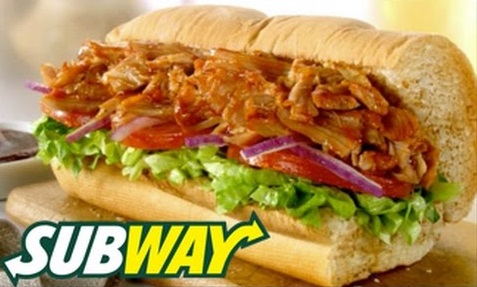
OK, what's in this Teriyaki Sweet Onion Chicken sandwich? (Hint: It's a trick question...)

OK, what’s in this  Sweet Onion Chicken Teriyaki sandwich? (Hint: It’s a trick question…)

DNA researcher Matt Harnden at Trent University’s Wildlife Forensic DNA Laboratory, working out of  Peterborough, Ontario, analyzed six popular chicken sandwiches served at various fast food chains. Unadulterated chicken should have 100% chicken DNA, or close to it. Seasoning, marinating or processing meat  bring that number down some , so fast food  wouldn’t be expected to have a perfect score.

The chicken in the following sandwiches were tested: McDonald’s Country Chicken – Grilled,Wendy’s Grilled Chicken Sandwich, A&W Chicken Grill Deluxe,Tim Hortons Chipotle Chicken Grilled Wrap, Subway Oven Roasted Chicken Sandwich, and Subway Sweet Onion Chicken Teriyaki, which is made with chicken strips.

The lab tested two samples of five of the chicken meat fillings, and one sample of the Subway strips. From each of those samples, the researchers isolated three smaller samples and tested each of those. The scores were then averaged for each sandwich. The results? Continue reading

Nate Silver Explains How Not Only Does “Bias Make You Stupid,” It Makes Others Stupid Too.

natesilverEthics Alarms covered some of this topic years ago in a post about how the news media’s unceasing and uncritical fawning over Barack Obama made him a less effective, indeed a bad, President. (If someone can find the link, I’ll post it. I don’t have the energy this morning.) Now polling and stat guru Nate Silver has written an intriguing analysis of the 2016 election that argues that liberal news media bias—you know, that thing that doesn’t exist—perversely helped elect President Trump. In an earlier January essay, Silver wrote,

National journalists usually interpreted conflicting and contradictory information as confirming their prior belief that Clinton would win. The most obvious error, given that Clinton won the popular vote by more than 2.8 million votes, is that they frequently mistook Clinton’s weakness in the Electoral College for being a strength. They also focused extensively on Clinton’s potential gains with Hispanic voters, but less on indications of a decline in African-American turnout. At moments when the polls showed the race tightening, meanwhile, reporters frequently focused on other factors, such as early voting and Democrats’ supposedly superior turnout operation, as reasons that Clinton was all but assured of victory.

In his most recent article, Silver explains… Continue reading

Vintage Fake News: The Ridiculous Doomsday Clock

Doomsday clock showing 3 minutes to midnight

I’m sure you have noticed that the scary Doomsday Clock, which tells us how long we have until “midnight,” aka. nuclear Armageddon, has been on the move again.

NBC News recently announced that the dreaded Clock was ticking like the soundtrack of “24 Hours, proclaiming: “Thirty seconds closer to global annihilation!”   The New York Times, which now averages at least eight “President Trump is a menace to civilization!!! ARGGH!!!” columns, editorials or news stories every…single…day, duly announced, “Thanks to Trump, the Doomsday Clock Advances Toward Midnight.” Across the pond, the UK’s Independent stated as fact, “We’re closer to doom than any time since the Cold War!”

Why? Because the Doomsday Clock says so!

Can we officially make that “The Ridiculous Doomsday Clock?” This has to be the most useless and malfunctioning timepiece in recorded history.  Even a stopped clock is right twice a day: this damn thing is never right.

The Bulletin of The Atomic Scientists dreamed the gimmick up back in 1947 , and its initial setting was “seven minutes to midnight” as in…

What sense did it make to have a clock already set at seven minutes to 12? Why wasn’t it at least a seven-minute stopwatch? What was its setting during the Black Plague? Did the dinosaurs have a Doomsday Clock? Did a wise Diplodocus and a precocious Stegasaurus see a meteor coursing through the Jurassic skies and conclude, “Oh oh. Eventually one of those is going to land here, and we’re all toast. Move the Doomsday Clock to 80 million years before midnight, let’s settle our affairs, and tell the rest of the gang that the mammals are coming…”?

The group of egg-heads devising the clock explained that it symbolized ” the urgency of the nuclear dangers that the magazine’s founders—and the broader scientific community—are trying to convey to the public and political leaders around the world.” OK, I can see that as a minor, fear-mongering news item in 1947—kind of like the climate change hysteria is now—but I would also say that when a group describes a peril as urgent and it hasn’t urged in 70 years, that isn’t just old news, it isn’t newsworthy at all. Continue reading