Good News On Business Ethics? Maybe: The Ethics Research Center’s 2014 National Business Ethics Survey

ERC surveyThe Ethics Resource Center, a distinguished Washington, D.C. based ethics research and consulting firm, performs a survey of business employees every two years to measure trends in workplace ethics. It’s 2013 survey and report was released last week, and appears to bear good tidings. Workplace misconduct is on the decline, the data says.  41 percent of employees observed misconduct in 2013, way down from 55 percent in 2007. Moreover, ERC’s “National Business Ethics Survey,” which polled 6,400 U.S. employees, found that only 9 percent of employees polled felt pressure to compromise their standards in 2013, down from 13 percent in the previous survey in 2011.

ERC Chairman Michael G. Oxley  (of Sarbanes-Oxley fame) said in a release,“The results of the survey are encouraging and show that companies are doing a better job of holding workers accountable, imposing discipline for misconduct, and letting it be known publicly that bad behavior will be punished.”

Among the survey’s intriguing findings:

  • “Over the last two years, observed misconduct fell in every one of the 26 specific categories we asked about in both NBES 2011 and NBES 2013.
  • “Pressure to compromise standards, often a leading indicator of future misconduct, also was down – falling from 13 percent in 2011 to nine percent in the latest survey.”

Less encouraging are these: Continue reading

NFL Commissioner Roger Goodell’s Super Bowl Deception

"Well, I may not remember any of it, but the Commissioner says I'll life a long life..."

“Well, I may not remember any of it, but the Commissioner says I’ll live a long life…”

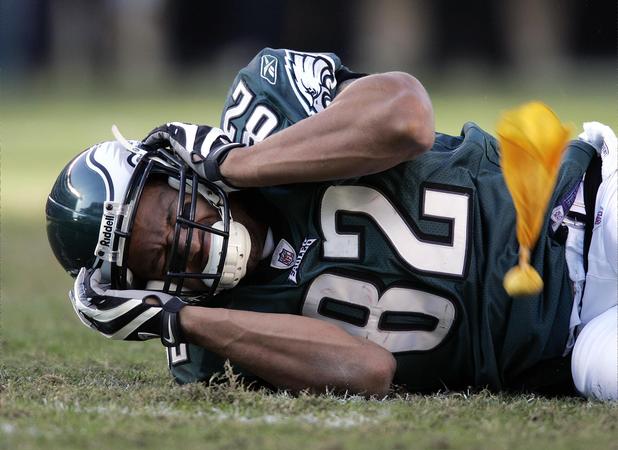
Today millions of Americans will gather around televisions, partying and cheering the spectacle of young men maiming and killing themselves for our entertainment pleasure during America’s most popular sporting event, the Super Bowl. An unknown but significant number of those athletes, we now know, are likely to be unable to recognize family members by the time they are 45, and several may take their own lives in despair.  Nonetheless, the official position of the National Football league is that all is well, and Commissioner Roger Goodell was touring the Sunday morning news shows to put out the propaganda claim that  pro football is good for everyone, even the players who accumulate concussions like the rest of us collect aggravation.

Presumably to appeal to the large proportion of the Super Bowl audience who know little about the sport, as well as the gullible fans who do, Goodell told Fox News Sunday host Chris Wallace (who, if he had the knowledge, wit and integrity,  should have stopped him and protested) in response to Wallace’s question about the NFL’s ongoing concussion scandal, that NFL players live longer and are on the whole healthier throughout their lives than the general population.

This is deception, and intentionally misleading.

Goodell is taking advantage of the fact that all the measures of the mortality of pro football players are flawed, which is why last year the NFL Players Union commissioned Harvard to do a 100 million dollar study of the health of ex-players and how to improve it.  The union claims that the average age of death of an ex-NFL player is 57 years, which would directly contradict Goodell’s claim.  This figure is supported by a 2011 study by the University of North Carolina, as well as insurance company actuarial statistics.

The figure, however, seems statistically unlikely.  Measuring the life expectancy of any group of adult men, even those engaged in risky behavior, will yield an average life expectancy that is better than the general population. Why? Because men in the general population die as infants, children, young adults, and before they would be old enough to play football. Thus the NFL and defenders of the brutal game continue to promote the 2012 study that found that NFL players outlive the general population. If accurate—and the players find the study difficult to believe, as do I—it can be argued that this study is also flawed. It compares apples—strong, affluent, college educated upper-middle class men—to oranges–everyone else, including the poor, unemployed, uneducated and poorly nourished. Attempting to get around this problem, one blogger compared the deaths of NFL players to other celebrities whose death notices were prominently published. His conclusion: there was no denying the fact that pro football players appeared to die sooner that non-football players from the same general class, but there was no justification to believethe mid-fifties mortality figure.

So do we know how much playing pro football lowers life expectancy, or even if it does? No….and neither does Roger Goodell. The studies are in conflict. However, we do know that a disproportionate number of the players who may live well into their golden years will do so unable to think clearly, remember their children’s names, or care for themselves, because they accepted big paychecks to allow their brains to be permanently bruised and catastrophically damaged. I don’t call that living or being healthy, and Goodell shouldn’t pretend that it is, or cite as fact what is a disputed contention at best.

Playing pro football isn’t good for you, and if the studies ultimately prove that ex-NFL players are really likely continue breathing as long as the rest of us despite their brain injuries, that just helps us understand why they have been killing themselves.

_________________________

Sources: CP24, Boston.com, Lotsa ‘Splaining, USA Today, Forbes

The State Of The Union Deceptions

Pinocchio_Disney

Washington Post Factchecker Glenn Kessler has become increasingly non-partisan in his assessment of political decsption since the sheen fell off of Barack Obama. He’s not there yet, but increasingly Kessler has refused to pull his punches regarding the President’s habitual dissembling. Although he did not give out any of his trademark “Pinocchios” for the biggest whoppers in Tuesday’s State of the Union message (ah, for the days when a blunt President Ford had the integrity to  say, “The State of the Union is not good!”) because, well, he just doesn’t on the State of the Union, okay?—Kessler did point out six significant examples of deceit, dishonesty, or misrepresentation:

 I.   “The more than eight million new jobs our businesses have created over the past four years.” Continue reading

The Fifth Annual Ethics Alarms Awards: The Worst of Ethics 2013 (Part One)

This is the first installment of the Worst.  It says something, and not something happy, that this segment of the year-end awards are more than twice as voluminous, and far more competitive, than the “Best” of 2013 ethics. Well, nobody said it would be easy….

Ethics Train Wreck of the Year

trainwreck

Obamacare, a.k.a Affordable Care Act. This is quite an achievement, as there were at least two other three Ethics Train Wrecks rolling along in 2013 that would have been easy victors in a less horrible year. One of them, The Trayvon Martin- George Zimmerman Ethics Train Wreck, was last year’s winner, and still wreaked ethics carnage across the culture, thanks to Zimmerman’s trial (which never should hev been brought), the biased media coverage, the incompetent prosecution, the inept judge, and then afterward, the ignorant and/or racially motivated attacks on the jury for doing its job well and fairly against overwhelming odds. Yet as bad as this hangover from 2012 was, the Sandy Hook Ethics Train Wreck was arguably even worse. The news media decided to go Soviet and abandon all pretense of objectivity, essentially becoming an Obama Administration propaganda tool for gun control. Elected officials lied their heads off; so did the aroused NRA. Gun owners talked and behaved like they were about to be Gulaged. Legislators shamelessly used the grief of victims to stampede public opinion; children became props; fake statistics were everywhere; brain-damaged Gabby Gifford was programmed to read child-like messages as if they were the conclusions of research papers. The President’s total lack of political leadership skill again came front and center, then, when he had failed to do what he promised to do, the opposition was vilified by celebrities like Jim Carrey, who called them murderers and worse.

But the Affordable Care Act lapped both of these. It revealed itself to be a five-year long train wreck that just took a break after an earlier stretch where the bill was passed without due diligence by its supporters and using a cynical by-passing of due process. A Presidential lie intentionally devised to deceive the public was repeated for the five-year span, and then exposed when the law began to take affect….but not before the law inspired Republicans to force a reckless and irresponsible shut-down, a mini-train wreck within the train wreck.  The website debacle was initially spun by the news media (not working worth a damn isn’t a “glich”), then the evidence of near criminal ineptitude became impossible not to report. The indisputable evidence that the President of the United States had sold a program under false pretenses came to light, prompting dozens of politicians, bloggers, pundits and reporters to destroy their credibility forever (I hope) by desperately trying to either rationalize the lie ( “the ends justify the means”), call it something other than what it was (The New York Times’ disgraceful “incorrect promise” was one low point), or simply deny that it was a lie at all (Democratic Chair Debby Wasserman Schultz, setting a new low for personal dishonesty, itself an achievement in her case). Then, when the public pressure and political fall-out became unbearable. the President just began amending the provisions of his own law on the fly, except that it was the nation’s law, and it’s unconstitutional to do that—this, after the mantra from Democrats and the news media during the shut-down debate was that the ACA was “settled law.”  HHS Secretary Sibelius misled Congress, the White House denied that her stated goals were goals once it was obvious they wouldn’t be met; and nobody was held responsible for yet another Obama Administration debacle. And there’s a lot more, with the train wreck still moving at top speed.

Fraud of the Year

Iowa State University biomedical sciences assistant professor Dong-Pyou Han, who resigned after admitting he tainted blood samples to get desired outcomes in research animals, allowing him to claim a break-through in the effort to develop an AIDS vaccine. The National Institutes of Health had awarded Han’s research team $19 million in multi-year grants.

Incompetent Elected Officials of the Year

  • Elected Body (National): House Republicans, who staged a wholly useless, expensive and damaging government shut-down on “principle,” without ever articulating what that principle was sufficiently for anyone responsible to agree with them. Runner-Up: The California House Legislature, which passed a law allowing illegal aliens to practice law.
  • National Elected Official:  President Obama.  From being incapable of working with Congress, to refusing to fire incompetents, to not knowing what was going on in his own administration, to drawing red lines he wasn’t willing to defend (and then advocating killing people just to show he was willing to defend them), to undermining the trust and faith in both his office and himself by uttering unequivocal lies, President Obama had one of the worst years of self-inflicted miscalculations, errors, failures and reversals of any U.S. President in history. I’m sorry to have to say it, but it’s true.
  • Local Elected Official: Storey County (Nevada) Assemblyman Jim Wheeler (R). Wheeler told a group that if his constituents demanded it, he would vote (with a heavy heart)  to reinstate slavery, as he felt doing so would be his duty as a representative. Runner-up: Maryland House of Delegates Member Don Dwyer (R), who after a drunk driving and drunk boat piloting episode, the latter injuring several people, blamed his conduct in part of feeling betrayed over his colleagues approval of gay marriage in Maryland.

Sexual Harasser Of The Year Continue reading

Ethics Quote Of The Week:

“Voters are significantly more conservative than nonvoters on redistributive issues and have been in every election since 1972. Voters may be more liberal than nonvoters on social issues, but on redistributive issues, they are not. These redistributive issues define a fundamental relationship between citizens and the state . . . and are central to ongoing conflicts about the scope of government. It is on these issues that voters offer a biased voice of the preferences of the electorate.”

—– Political scientists, Jan E. Leighley of American University and Jonathan Nagler of New York University in their new book, “Who Votes Now? Demographics, Issues, Inequality, and Turnout in the United States.”(Quoted by Dan Balz in the Washington Post)

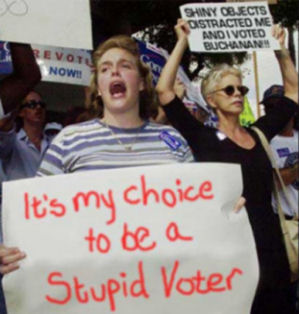
idiot-votersA better example of the warped and unethical thought habits of the Left it would be hard to find.

So the results of an election based on who actually has the initiative, knowledge, civic responsibility and sense to vote are now called “bias,” are they? Talk about academics wearing their own biases tattooed on their foreheads: naturally any conservative consensus is illegitimate, right boys? Continue reading

College Admissions Diversity Deception, Student Ethics Corruption

shabazz_Wisconsin

See that young black man in the photo above, gracing the cover of the University of Wisconsin admissions brochure? The one apparently cheering for the Badgers at a Wisconsin football game? His name is Diallo Shabazz, and as a student at the school in 2000 had never been to a game in his life when someone photoshopped his head into a crowd shot to let potential applicants know how diverse the University of Wisconsin was. This infamous incident, which Jon Stewart had a ball with in the day (is the Daily Show really that old?), is apparently more the norm that we thought at the time.

Tim Pippert is a sociologist at Augsburg College in Minnesota. He and his researchers looked at more than 10,000 images from college brochures to compare the racial composition of students in the pictures to the colleges’ actual demographics. They discovered that diversity, as depicted in the brochures, was over-represented. “When we looked at African-Americans in those schools that were predominantly white, the actual percentage in those campuses was only about 5 percent of the student body,” Pippert told NPR. “They were photographed at 14.5 percent.” Continue reading

Want A Perfect Example Of “Deceit”? Here You Go:

"Believe me, once you get the hang of deceit, you'll wonder how you ever got through a day without it!"

“Believe me, once you get the hang of deceit, you’ll wonder how you ever got through a day without it!”

A substantial number of people don’t understand what “deceit” is, or think that what constitutes deceit isn’t a lie. Deceit, which I used to joke was the official language of Washington, D.C. until it was changed officially to Blatant Mendacity, is when a statement is literally true, but stated in such a way or in a context intended to make the reader or listener believe something that is not true at all. The fact that the statement may have been factual in a pure sense does not diminish its unethical character as a lie. Its intent is to deceive. It is a lie, just a particularly insidious one, aimed at the trusting, unwary, undiscerning and gullible.

I am always looking for a good example of this peculiar form of deception, and they don’t come much better than this.

Drexel University professor Robert Brulle performed a study he eventually called “Institutionalizing delay: foundation funding and the creation of U.S. climate change counter-movement organizations,”  and it was subsequently published  in Climatic Change. Brulle identified 91 organizations that oppose anti-climate change policies, and added up the annual operating budgets of these groups, many of which are active in many issues and that devote a small percentage of their funding to climate change matters at all. He then characterized the resulting total of about $900 million per year from 2003 to 2010 as representing the resources dedicated to blocking the regulation of greenhouse gas production. Brulle’s  study also treats foundation grants to these organizations if every dollar given is earmarked for climate policy opposition. Taking the hand-off from the study’s framing, The Guardian headlined its findings, “Conservative groups spend up to $1bn a year to fight action on climate change.” Notice the “up to,” which would apply if every cent given to organizations like the American Enterprise Institute, The Reason Foundation, The Cato Institute, The Heritage Foundation, the Hoover Institute, the Hudson Institute and many others were only expended or intended to be spent on anti-climate change position papers and advocacy. This isn’t just a gross exaggeration: it’s a lie, intended to be misleading. Continue reading

Anti-Smoking Ethics—And A Subversive (But Ethical!) Suggestion

"Sorry, sir, but sort-of-looking-like-you're smoking's not allowed in here, and besides, a phony study will be finding it deadly any day now."

“Sorry, sir, but sort-of-looking-like-you’re smoking’s not allowed in here, and besides, a phony study will be finding it deadly any day now.”

Little noted in the news winds was the fact that a major study reported in the Journal of the National Cancer Institute found “no link between the disease and secondhand smoke.” Oh!  Well, never mind then. The supposed deadly effects of second hand smoke gave hoards of health-policing citizens leave to not only be obnoxious and confrontational–“You have no right to pollute my lungs!”—but also to ban a legal consumer product in public places as well as to stigmatize anyone using the products as selfish sociopaths perpetrating slow-motion serial murder.

The second-hand smoke theory always seemed too convenient to me. Many years ago, I permanently soured my relationship with the head of a large Washington association, a non-smoker (as am I, except that I don’t presume to tell others what legal products to entertain themselves with), by opposing his ban on smoking in meetings and offices (and, eventually, his employees’ own homes) because he thought it was dangerous.  He trumped me by producing a couple of fishy studies that, it appears, were in fact as fishy as I suspected at the time. I would like to see a call for accountability on this: how did data now shown to be completely without factual basis manage to surface, become accepted in the regulatory establishment, and be used to bully smokers for decades?

And if you think this reminds me of the over-hyped scientific “consensus” on global warming and climate change, you are exactly right. Continue reading

Gallup’s Honesty And Ethics Ratings Of Occupations

shattered-trustThe annual Gallup survey is out. You can read Gallup’s commentary here, and see the details here. (you’ll need an Adobe reader.)

Gallup’s big announcement this time is that the Clergy has declined in perceived trustworthiness since 2012, but that’s a stretch: the percentage of respondents who rated the men and women of God as “high” or “very high” in honesty and ethics declined 5% from last year, but all of the most trusted professions had similar drop-offs, including the perennial winners, Nurses (down 3 points) and Pharmacists (down 5).  The Clergy still is among the most trusted professions, and that’s especially impressive since almost half the country doesn’t believe the basic premise of their calling. I think the Gallup reasonably figured that trumpeting that the clergy’s ratings had hit a new low would garner more publicity than “Car mechanics trusted more now than ever!”, which the data also would support. (They still aren’t trusted much.)

The real surprise is how little any of the professions have changed their public standing. TV reporters, near the bottom, are still as trusted as they were in 1998. Members of Congress, held in even lower esteem, are about where they were in 2009. Lawyers, mirabile dictu, are the most trusted since this survey began, which is not to say they are trusted—they are tied with TV Reporters. The only real head-scratchers are that Ad Executives are at an all-time high—why?—and that lobbyists score so much lower than the people who tell them what to do, Business Executives, and the people they corrupt, Members of Congress. I think it’s because most people have no idea what lobbyists do, but it sounds shady. Continue reading

“How Dare Universities Charge Such High Tuition?” KABOOM!* #1: Georgetown University Law Center

headexplode

Kaboom.

James Feinerman, the James M. Morita Professor of Asian Legal Studies at Georgetown University Law Center, who also serves as its associate dean for transnational programs, was hired by the U.S. government as an expert witness  to bolster the prosecution in a spying case, and apparently plagiarized a substantial potion of the report submitted to the court from <sigh–there goes that value of THAT degree> Wikipedia.The defense picked up on the uncited cribbing and the federal court is now examining whether the sources used by Wikipedia are reliable enough for his report to be accorded any validity. The Government, meanwhile, represented by assistant U.S. attorneys Peter Axelrod and John Hemann, is stuck with making desperate “ahumunahumuna” sounds like Ralph Kramden used to do on “The Honeymooners” when he was caught looking stupid and spouting lame arguments in court filings about how Feinerman “utilized language from Wikipedia as a concise English-language summary of his opinions on certain topics.”

Riiiight. Continue reading