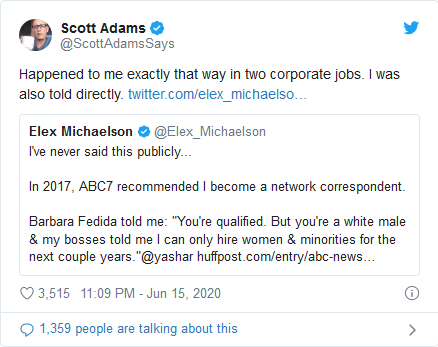
I believe it is essential that social media platforms emerge to challenge the left-wing censorship of Twitter, Facebook, Instagram and the rest. Since I am preparing to quit Twitter as a matter of principle, I attempted to register for the new service, Parler. It purports to allow free speech without censorship.
I failed. Why? The sign-up process is not only ridiculously complicated, it’s flawed. The process asked for my phone number…not my cell phone, just my phone. Then it sent the last stage of the process, my verification code, via SMS. But my office phone doesn’t receive SMS’s. The kids starting this service just assumed that everyone lives on cellphones. That’s arrogant and stupid. Do some market research.
One good thing about Twitter: a marmoset could sign up in less than five minutes. If Parler can’t even develop a user-friendly sign-up process, and worse, makes a tyro mistake like the phone botch, it can’t be trusted. Heaven knows what else they will screw up.
Parler won’t get a second chance with me.
There are few things worse than accepting an important challenge ahead of others, and blowing it by ineptitude and carelessness.
_________________________
One more point: it is already nearly impossible to contact the platform to address issues like this. This is a problem with too many tech firms, Facebook being among the worst. It’s possible to do better: WordPress will give you a live chat with an agent in minutes.
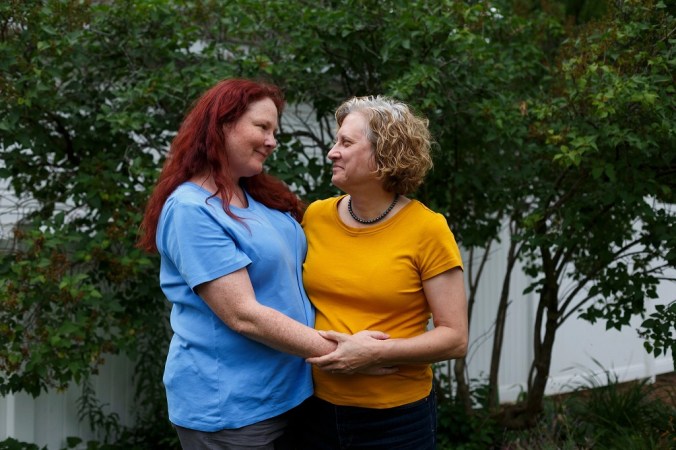
Terry Gonda has been a loyal member and supporter of the Catholic church for decades, serving as musical director of her parish for over twenty years. She is gay, but never hid the fact from her family, friends, church or pastors. She was also married, to another woman, naturally. This wasn’t a secret.
However, somehow the word got to the Detroit Archdiocese, where it was deemed that her same-sex marriage made her morally unfit to keep her job. On June 12 she received an email reading, “The Archdiocese is choosing to activate its morality clause to terminate your employment.”
Whether the ruling will apply to religious organizations is the subject of other cases before the Court, which heard oral arguments last month in Our Lady of Guadalupe School vs Morrissey-Berru, a case about whether teachers at private, religious schools are subject to the exception in the Civil Rights Act.
Gonda says that her Catholic mentors and employers always modeled Pope Francis’s compassionate and tolerant attitude toward homosexuality. She was never shunned for being gay, nor after her 2011 marriage to Kirsti Reeve, 51. (That’s Kristi on the left, Terry on the right.) Terry told an interviewer that she is certain the Church believes “they’re doing the right thing — they’re trying to protect the church.” Continue reading →
It was only in May that I had a quick note in a morning warm-up declaring the 2015 film “Trumbo” an ethics movie. That it is, but subsequent developments have made me realize it is much more, including frightening.
The film, starring Brian Cranston as the most famous member of the “Hollywood Ten,” now is a glass of ice water recieved full in the face, shocking viewers into the realization that the George Floyd Freakout is the catalyst for a second wave of McCarthyism. This one varies from the first in that the current version is being fueled by the Left rather than conservatives, and that it is far more violent, and potentially more dangerous.
After watching the film again and reviewing the history, for “Trumbo” is easily the best film about the blacklist, there is no question in my mind that this is true. Previously, I regarded the use of “McCarthyism” as a useful if over-used metaphor, like “witch-hunt.” (“McCarthyism” usually refers to the oppression and intimidation of the entire “Red Scare” period, including the blacklist, which was Fifties for “cancelled.” The “Hollywood Ten” were victims of the fascist House Un-American Activities Committee, which was separate from the vicious Wisconsin GOP Senator, but “House Un-American Activities Committee-ism” doesn’t roll off the tongue well.) Now it is evident that we are witnessing in the United States a mutated clone of what occurred across the country in the beginning of the 1950’s, with “racist” the current label being used to bully, silence, and ruin careers and lives, rather than “Communist.” Continue reading →
Update: I decided we needed a less pokey version, so now we have Leonard Bernstein’s, and the whole thing. THAT should cheer you up…
Boy, am I sick of everyone telling me how depressed they are.
1. Translation: “I’m an idiot.” Now Seattle Mayor Jenny Durkan is saying that the city will close the so-called “Capitol Hill Autonomous Zone.” It turned out to be exactly what anyone with any sense predicted it would be, with three shootings so far and a rape, along with a leader ( war lord?) who had the gall to complain when the Seattle EMTs didn’t immediately respond when shots rang out. The mayor had said that the anarchist outpost would lead to a “summer of love,” marking her as a Sixties-romanticizing dolt, but now she says she was obviously joking-–yes, the Joke Excuse. She never said it was “in jest” before the completely predictable violence broke out.
I apologize for not highlighting her as an Incompetent Elected Official of the Month, but she was competing with Bill De Blasio.
2. Fearmongering. It should be apparent by now that the news media does not want the country to re-open, does not want the economy to begin recovering before the election, and is pushing its anti-reopening goal through fearmongering, in part by focusing on isolated cases of individuals getting hit by the Wuhan virus particularly hard.
This morning HLN kept repeating a long feature about a thirtyish Broadway star who has been disabled by the virus for 80 days, and another man not in a high-risk group who has been suffering for 100 days. The Times and the Washington Post are full of apocalyptic reports about the number of cases rising. Another news outlet said, “The U.S. reported more than 33,000 new coronavirus cases on Saturday – the highest total since May 1 – while the surge of infections in several states is outpacing growth in coronavirus testing.” ARRRGH! We;re DOOOMED!
One commentator called this “needless” frightening the public. Wrong. It is needed because it is a part of the ongoing effort to defeat President Trump.
The Centers for Disease Control predicted that cases would increase as the country reopened, not that it has much credibility at this point. Remember? The lock down was never intended to stop the spread of the disease, but to slow it down, flatten the curve, stock up on supplies, fix the CDC’s testing botch, and find treatments. That was mostly accomplished. The nation cannot continue to let the economy deteriorate: depressions kill people too.
Meanwhile, the death rate is declining even as the number of cases spike, and there’s a reason for that. In all outbreaks, a disease claims the most vulnerable first. This is known as Farr’s Law, named after William Farr, a British epidemiologist and early statistician who recognized the importance of death statistics and identifying causation. Not only has the current epidemic claimed many of the most vulnerable in the U.S., thanks in great part to the catastrophic decision of states like New York to send infected seniors to nursing homes, millions of Americans have antibodies.
The combination means that even if there are lots of new cases going forward, the death toll is likely to be far less severe than it has been. Do not hold your breath waiting for the media to explain this.
Just for fun, check and see how many news organizations have mentioned Farr’s Law. Continue reading →
The “mission” appears to be to enforce conformity of thought.
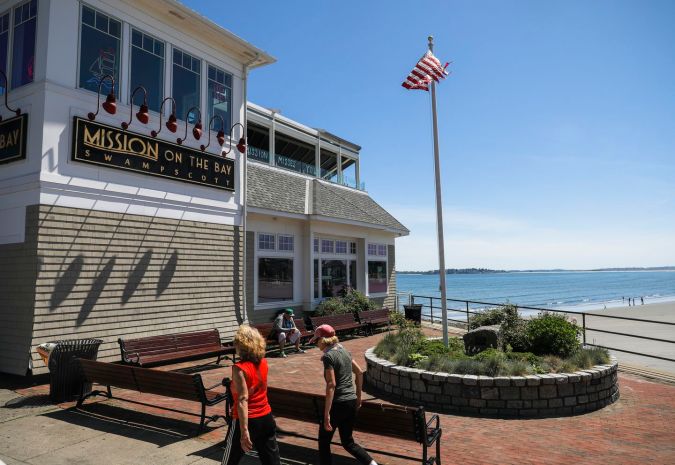
In my native state of Massachusetts, in the coastal town of Swampscott, home of Boston Red Sox tragic hero, the late Tony Conigliaro, comes a story where every element represents an ethics breach. The victim is being made the villain, the villain the hero. As I tell the tale, the faint refrain of “The World Turned Upside-Down,” the song the band played when General Cornwallis surrendered to General Washington, should echo in the background.
What is it about restaurants that generate so many ethics messes? This one occurred at Mission on the Bay, an upscale waterside eatery that serves food with a Brazilian and Asian influence. Selectman Donald Hause was dining with a friend in the outdoor dining area, and bartender Erik Heilman was eavesdropping, what people are doing when they say later, “I couldn’t help but overhear.” Heilman heard Hause criticize Black Lives Matter, allegedly saying that the group was “liberal bullshit,” and making the case that white privilege was a myth.
What the Selectman said, short of planning a crime, was none of Heilman’s business; nonetheless, the bartender says he was “distraught” at the comments, and so he posted what he heard or thought he heard to a local website, because he wanted to “inform” the community about the thoughts of an elected official. Hause disputes his account, but it doesn’t matter, and I don’t care what he said. Heilman’s conduct was unethical no matter what was said, or whether his post was accurate or not. Customers at a restaurant should, indeed must, be able to depend on the discretion and confidentiality of the staff. The bartender’s actions were a betrayal of his duties to the restaurant and its patrons.
We know Heilman’s rationalization for doing what he did springs from the totalitarian strain in what Commentary Magazine has called “the great unraveling.” Dissent from the Black Lives Matter and its supporters’ anti-American narrative will not be tolerated, and those resisting the mob, the movement’s mission dictates, must be exposed and destroyed. Continue reading →
“Across the United States, a great unraveling is in progress. A rolling crime wave, under the guise of social activism, has left city after American city shattered and smoldering. Armed anarchists seized territory inside Seattle with the blessing of local government. In Minneapolis and other cities, a campaign to enfeeble or eliminate the police has gained full legitimacy. In Kentucky, the governor has vowed to provide free health care only to one racial group. In the private sector, companies such as Uber Eats have pledged their commitment to a policy of race-conscious discrimination as well. And major media organs sanction all of the above as proper and good.
“The unraveling goes further still. Social-justice mobs have taken aim at freedom of expression, inventing new heresies daily and ruining the lives of those who unwittingly give voice to them. Forced confessions and language proscriptions are the order of the day. Poetry, fiction, movies, and television shows—including children’s cartoons—are canceled and excised from history. Indeed, all art and opinion are now subject to the chopping block lest they prove insufficiently propagandistic.
“To rewrite the present, the mob has rewritten the past. They have forced upon us a distorted and grotesque version of American history. With the support of corporations and education boards, school textbooks and curricula tell of an unredeemable America founded not on the promise of human liberty but human bondage. What’s more, this history discounts the transformative progress on racial equality for which Americans—black and white—have given their lives.
“Through the violent politicization of all aspects of American life, the mob aims to destroy the country as we know it and replace it with a new one—an anti-America that trades speech for violence, police for thought police, a free press for an indoctrination network, and the respect due the citizen for the obeisance owed the mob.
“There is one way to stop the unraveling: Refuse the mob. We have seen again and again that the mob comes only for those who hope to please it. And when it does, no amount of apology will save you. We stand against the mob and all its aims. We stand against the chaos and violence, the silencing of debate, the purging of heretics, the rewriting of history, and the destruction of the greatest country in the world. We will defend the most majestic achievement of humankind, the United States of America, against the most ignoble impulse in human history, to tear down that which is good….”
Read the rest, including the Commentary Magazine editors’ statement of what they stand for, and what the rest of us ought to, here.
I bet a really smart person wrote this. Maybe Chris Cuomo!
A group of studies reported today supposedly demonstrate that support free speech is strongly correlated with intelligence and “cognitive ability.”
Observations:
If true, there sure are a lot of unintelligent people taking control of society and the culture right now.
The study’s definition of intelligence is based on IQ scores, which are blunt measures of intelligence at best. Since it is well-known that the inventor of IQ scores violently objected to the test being used to measure above average intelligence when the device was designed to measure sub-normal cognitive ability, the fair definition of what the IQ test measures is that it measures what the IQ test measures. I spend much of every day reading allegedly brilliant people’s astounding opinions and analysis on every topic imaginable. They may have high IQ’s, but their reasoning is derailed by ideology, ego, bias and rationalizations. One of the many revelations I have come to accept over the years is that intelligence is an unfathomably complex concept, and I understand it less today than I thought I did when I was 18.
Worse than the dubious non-definition of “cognitive ability” is the vagueness of “free speech.” Is someone supportive of “free speech” when they support the punishment for someone daring to utter an opinion that doesn’t conform to mob cant as shunning, firing, and perpetual hostility? What about those cognitively gifted individuals who have decided that “hate speech,” as they define it, of course, isn’t covered by the freedom of speech? The smart people who run the Washington Post decided to doxx a woman who wore a politically incorrect Halloween costume at a private party two years ago . They claim that “democracy dies in darkness,” which is lip service to free speech. Do we judge them on their stated beliefs , or their actions? How does the study categorize those intelligent people who want to make it as difficult as possible for those they disagree with to have their opinions read and heard, by persuading social media to ban or block them, for example? How many people, because they are so darn smart, use lawyerly distinctions to justify non-government censorship as not offensive to “free speech” as defined in the Constitution?
At least the researchers have the integrity to state their bias up front: “We expected that people with higher cognitive abilities would be more inclined to embrace the open exchange of ideas, wherein viewpoints can be scrutinized and challenged in order to foster informed decision making and knowledge.” This is confirmation bias, and the foe of any reliable research. What a surprise: they expected their research to find that intelligence correlated with belief in “free speech,” and it did! Continue reading →
Last week Professor William Jacobson, a professor at Cornell Law School who writes a well-respected conservative blog, announced that there was a movement afoot among some faculty and students to get him fired. (Ethics Alarms discussed it here.) Here are Jacobson’s posts since then regarding the ongoing effort to have him dismissed for being critical of Black Lives Matter:
In a related development, the similarly politically incorrect (but so far anonymous) Berkeley history professor I criticized here is now being condemned by the university.
I saw this shortly after posting today’s potpourri, which ended with…
This is part of what appears to be the proposed answer tomy Question 13, “What is the “systemic reform regarding race in America” that the George Floyd protests purport to be seeking?” That answer: special accommodations and benefits for African Americans in all things. Affirmative action in employment, promotions, salaries and school admissions; preference in grading, contracting and hiring; elimination of any standards that African Americans continue to lag in meeting. Reparations, of course; race-based leniency in law-enforcement and sentencing; plus culture wide discrimination in favor of blacks and against whites in all things, all instituted by the intimidation, punishment and “cancelling” of anyone who dissents.
This happened to me, too, and it altered the course of my life. Continue reading →
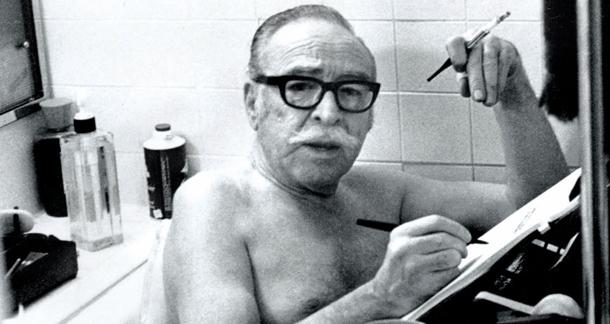
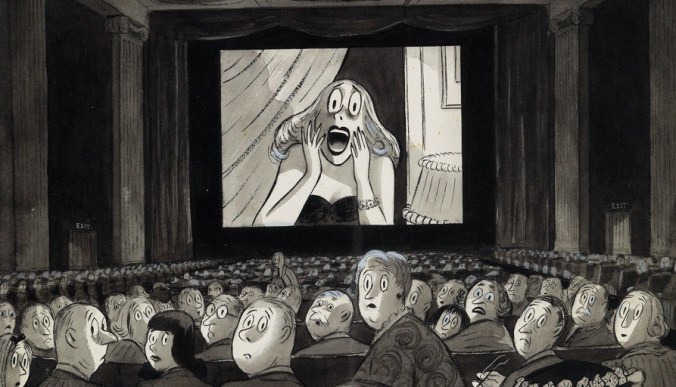
It’s Wednesday, Wednesday got me thinking about the Wednesday Addams, which got me thinking about Charles Addams, which reminded me of that Addams cartoon…
Yes, this is how my mind works, as if you didn’t know…
1. “You know: literate morons.” The National Book Critics Circle (NBCC), of all people, decided to give us an example of where the George Floyd Freakout can lead. The president of the NBCC drafted the obligatory institutional pander affirming Black Lives Matter and circulated it to the board for its approval. One contrarian and sane board member, a board president named Carlin Romano, said he disagreed with much of the letter, didn’t want to “distract the great majority of the Board from its mission,” but couldn’t resist explicating his objections, including describing the systemic racism premise as “absolute nonsense.” He did not, he wrote, believe that the publishing business operated with “the full benefits of white supremacy and institutional racism” and that “white gatekeeping had been working to stifle black voices at every level of our industry.” Such claims, he wrote, amounted to “calumnies on multiple generations of white publishers and editors” who had fought to publish authors of color. “I resent the idea that whites in the book publishing and literary world are an oppositional force that needs to be assigned to reeducation camps.”
In her reply,the current president told Romano that she’d always appreciate his perspective. It “shines unlike anyone else’s,” she wrote, adding, “your objections are all valid, of course.”
As a result of her respectful acceptance of a reasoned dissent, more than half of the 24-member board of NBCC resigned, including, of course, all of its non-white members. The president resigned too. Romano has not. In response to another member’s accusation that his criticism had displayed ” racism and anti-blackness,” he countered, “It did nothing of the sort. I’m not racist and I’m not anti-black. Quite the contrary. I just don’t check my mind at the door when people used to operating in echo chambers make false claims.”
Ethics Hero.
2. Pandering BLM Groveler of the Year? I’m pretty sure nobody will be able to top NFL Commissioner Roger Goodell. After dismissing Colin Kaepernick and his fellow NFL kneelers as a distraction to the game and an annoyance to fans, he is now not only encouraging the players to demonstrate on the field for “racial justice,”—if he thinks such workplace stunts will stop with mere kneeling, he really is a dolt—he is now encouraging NFL teams to sign Kaepernick, who hasn’t played for three years. He hasn’t been signed because the distractions his political grandstanding carried with him couldn’t begin to be justified by his declining quarterbacking skills, and that’s the case now more than ever. Does Goodell really think capitulating to the mob will keep him and his league safe? Is someone holding his family at gunpoint somewhere, or is he really this ignorant?
3. Wait, why haven’t I read all of this before?On Medium, Gavrillo David argues that there may be enough evidence to insulate Derek Chauvin from a murder conviction. he cites six facts in support of his theory: Continue reading →