On The Limitations Of Expertise

Guest Column by Sarah B.

[From your Host: This excellent essay arrived on an Open Forum, and as I sometimes do, has been elevated from Comment of the Day status to a Guest Column. I’ll even forgive Sarah for making me look bad in comparison to such thoughtful, eloquent and perceptive work.]

***

“The embarrassment is that chemistry was treated as a mere technicality rather than the foundation of the entire conclusion. The embarrassment is that skepticism—real skepticism, the disciplined refusal to accept claims without robust evidence—was framed as denial rather than diligence.”

This is, in my opinion, the money quote from The Brain, Microplastics, and the Collapse of Scientific Restraint. 

This particular article discusses the extraordinary claim that our brains contain a huge amount of microplastics.  The problem with this claim is that the study has a fatal methodological flaw.  The study relies on spectroscopy and detecting signatures of chemicals to determine a sample’s composition.  However, the fats in the brain break down into similar compounds as polyethylene, which means without further differentiation methods, there is no way to tell if the “microplastics” the study detected were actually just normal lipids found in the brain.  The whole article is worth reading, as it does an excellent job of explaining the issue. 

I recently saw a post on Facebook that decried the idea that experts could be challenged by some novice watching a few YouTube Videos and reading a few scientific papers.  This led to a long discussion in the comments, which was unfortunately extremely one-sided.  Most everyone agreed that trying to correct an expert in their field was utter hubris.

“Take something you are good at, like maybe changing transmissions.  Imagine someone who has watched a few YouTube videos comes up and tells you that you are doing it all wrong.  How would you respond?”

The main problem with this is that, in terms of changing a transmission, we can obviously see who is right and who is wrong.  The car will run, or the car will not.  Indeed, if you truly are an expert in changing transmissions, you can step up and, in simple terms, explain why your process is the correct one, what is wrong with the YouTube watcher’s process, and even perhaps teach your skeptic how to do it correctly. 

With any field of expertise, we have to remember that experts are people too, and all humans have flaws.  Experts can be tempted by money, power, prestige, and politics.  There are also limitations that even experts struggle to overcome.  For example, in many branches of research, there are serious problems (often ethical in nature) in creating a good control group. 

Bite Me, “Doomsday Clock”!

If anyone or anything ever deserved an Ethics Alarms “Bite Me!,” it’s the ridiculous Doomsday Clock and the pompous, biased, fear-mongering scientists who set it.

The Bulletin of the Atomic Scientists has set the clock each year since 1947, and to say it does not have a sterling record, whatever standards one uses, would be an understatement. Well, I’ll take that back: they have a sterling record for being wrong. Still, once again the thing is in the news. “The ‘”‘Doomsday Clock'”‘ — a symbolic clock that supposedly represents how close humanity is to global catastrophe according to “experts” — “has moved closer to midnight,” ABC News tells us. “The Bulletin of the Atomic Scientists announced Tuesday that the clock is now 85 seconds to midnight, with midnight representing the apocalypse.”

That’s the closest its ever been! AAAAIIIIIIIIII!!!

[Watch out now, you have to click on “2” below to keep reading…]

The First “The Unabomber Was Right” Post of 2026

Jason Fried is the Co-Founder and CEO at 37signals, the maker of Basecamp and HEY. His blog usually engages in discussing business, technology, design and product development, and his post earlier this month became especially interesting to me after last week, when it seemed like technology was out to get me personally. I experienced infuriating breakdowns or glitches from Verizon, American Express, Amazon Prime, my bank (Wells Fargo), Merrick Bank, Microsoft, and, of course, WordPress. Each breakdown involved frustrating interactions with chatbots and automated “customer service” lines, the oxymorons of the century. In total, I lost about four hours of otherwise billable time, and several of the problems have yet to be fully addressed.

Apparently, however, things will soon get worse, unless I hurl myself into that woodchipper, which seems to work just fine.

Fried writes in part regarding the recent experience of his parents when they rented a house near him to spend a few months. He had just come back from a vacation in Montana and had rented a house there. “[E]verything…was old school and clear. Physical up/down light switches in the right places. Appliances without the internet. Buttons with depth and physically-conformed to state change rather than surfaces that don’t obviously register your choice…traditional round rotating Honeywell thermostats that are just clear and obvious. No tours, no instructions, no questions, no fearing you’re going to do something wrong, no wondering how something works. Useful and universally clear. That’s human,” he concluded.

But not in the new, technologically advanced, “improved” house his parents ended up in. He writes in part (and in horror):

Confronting THEIR Biases: Yeah, Well, Bite Me, Whippersnappers…

This week Buzzfeed, which has long been on my blacklist, trolled Reddit for a list of “The “Old Person” Things Their Parents Do That Drive Their Kids Absolutely Bonkers.

Some of the things on the list of 25 are indeed genuinely stupid and annoying, like #7 on the list, “My mom still writes checks at the grocery store and stands there balancing her checkbook while everyone else stares impatiently at her, #15, “They use plastic cutlery so they don’t have to wash the real silverware, but then they wash and reuse the plastic ones to be thrifty!”, or #17, “Driving 10+ under the speed limit.”

Others, however, are the result of a whippersnapper’s unjust criticism of a different choice that is defensible, ignorance, or just plain snottiness.

“They own cell phones yet insist on keeping their landlines.”

Reaction: Bite me. I maintain a landline for business. It’s still more comfortable for long substantive conversations, and I prefer to keep my cell phone access limited.

“Turning the volume on the TV all the way down instead of pressing mute.”

Reaction: Why in the world would anyone care about this enough to be annoyed by it?

“My mom ALWAYS puts her phone on speaker phone. Even in public, she uses the speaker phone.”

Reaction: That’s not an old person thing; I see people of all ages, especially women, doing this.

Continue reading →

An Inquirer Asks, “How Can I Stop My Wife From Badgering Our Friends About Climate Change?” How About….

…showing her that her hysteria is based on lies, bad stats, politicized “science” and hooey?

I admit it, that headline sucked me in to reading “Social Q’s,” a Times advice column that puts wokeness over wisdom, causing me to put it on the EA blacklist.

“My wife has become an eco-warrior,” a married weenie writes. “She has strong feelings about the environment and other people’s carbon footprints. She challenges our friends repeatedly about their lifestyle choices. I agree with her in principle, but I can’t support her moral outrage. …Help!“

Predictably, the column’s proprietor, Phillip Galanes, begins by saying, “I would begin by praising her, rightfully, for her commitment to an important issue.” I’ll fix it for him: “an important issue that nobody really knows much about, especially indoctrinated progressives who are passionate about what their bubble-mates are passionate about regardless of facts.”

Much better.

Continue reading →

If A.I. Wrote a WAPO Op-Ed Piece to Set Us Up For a Take-Over By the Bots, This Is What It Would Be Like…

Oh , yeah, this is good advice.

The Washington Post (gift link, but don’t get excited, it’s a crummy gift) permitted a father-son team of faithful dupes to reassure us all that artificial intelligence is no different from any other machine, and can never compete with the human mind. Authors Andrew Klavan (a novelist) and Spencer Klavan, a classicist, are here to explain to us that artificial intelligence is like a wax writing tablet was to Plato (Spencer’s idea, I bet) or computers were to past generations, technological advances humans foolishly thought could match the human mind. “But by using machines as metaphors for our minds, we fall prey to the illusion that our minds are nothing more than machines. So it’s not surprising that now, when the possibilities of AI are enthralling Silicon Valley, those who think programs can become conscious are trying to tell us that consciousness is just a program,” they write.

Point? We have nothing to worry about! These things can’t really think or feel like we do! A.I. lacks “what ancient philosophers called “the inner logos” — the unique interior apparatus we have for structuring and understanding our experience of the world.”

Neither Klavan has anything in his biography to indicate they have more than the average landscaper’s understanding of technology, so what’s their authority for this verdict? Jesus, and Louis Armstrong. I kid you not. “The great Louis Armstrong, performing the George David Weiss and Bob Thiele song, “What a Wonderful World,” put it this way,” they write. “I see friends shaking hands, saying ‘How do you do?’ / They’re really saying: ‘I love you.’” Jesus put it similarly in Matthew 15: “The things that come out of a person’s mouth come from the heart.”

The two non-scientists have come to the dangerous and ignorant conclusion that A.I. bots are just “large language models” (LLMs) that are not capable of thought because, well, that’s what Louis sings. They tell us at the end,

Continue reading →

Comment of the Day: “Unethical Bank of the Month: Merrick Bank”

Diego Garcia entered an instructive description of an interaction with a bank on credit card matters that nicely illustrates a theme Ethics Alarms has been commenting on for quite a while. It is not exaggerated, because I have been enmeshed in dozens of these maddening experiences almost every month since my wife died last year. The practices are cruel, frustrating, time-consuming and hostile, and, I am convinced, often intentional. They are the product of multiple unethical conditions and practices, including incompetent management, needless technology complexity, sloth, poor hiring criteria, poor training, the public school system, lack of sufficient emphasis on English proficiency, corporate arrogance, outsourcing of jobs, inadequate staffing, and more. I also believe these systems and the factors creating them cause serious stress-related health problems among the public and even domestic and urban violence as well as mass shootings.

People have been conditioned to just shrug it all off as “how we live now.” We shouldn’t do that.

Here is Diego Garcia’s Comment of the Day on the post, “Unethical Bank of the Month: Merrick Bank”:

…I do have a recent BoA experience regarding account setups.

My sister has had a BoA credit card for something like 50 (!) years. She is very much not tech savvy, and is someone who always wants paper statements mailed to her.

On this card, she had made arrangements for her payment to be automatically drafted each month — the payment would be $150 or the statement balance, whichever was smaller. She had made this arrangement by phone as she never had set up an online account for this card. Well, a couple months ago they wrote her to say that they were cancelling this automatic payment and she would have to go online to set it back up.

Continue reading →

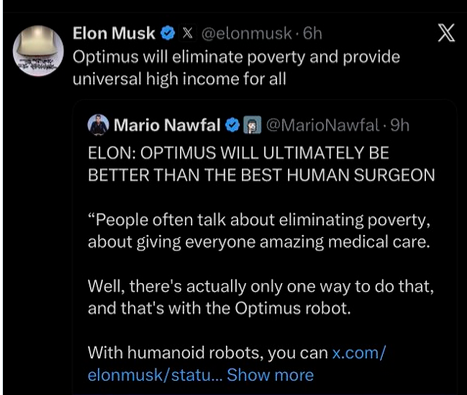
Elon Musk: “Delusional,” Huckster, or Credible Dreamer?

A twitter user I have never heard of (but who somehow has amassed over half a million followers posted that tweet above with the comment, “I don’t understand why people continue investing in a company whose CEO is self-evidently delusional and whose plans for the business have no basis in reality.” Another user quickly pointed out that the eccentric billionaire entrepreneur “reduced the cost of launch to orbit by ~90%, mainstreamed electric cars, and gave a paralyzed man the ability to control a computer with his mind.” Yes, that’s a complete rebuttal to the “influencer’s” snark. Why do investors trust Musk? Because he’s an out-of-the-box thinker with the resources to make impossible-seeming ideas reality, and has a track record that says, “Don’t bet against him.”

Regular readers here know that I detest John Lennon’s anthem for idiots, “Imagine.” John identifies himself as a “dreamer,” which he rationalizes “Everybody does it” style: He’s not the only one who thinks we can achieve his juvenile version of utopia (“Nothing to live or die for…”). But John was a minimally educated lifetime musician and poet: like the Everly Brothers, all he could do was dream (and they were silly dreams anyway). Elon Musk has shown that he is capable of making some previously impossible dreams possible. That deserves awe and respect.

Continue reading →

And Now…Here Comes A.I. Derangement Syndrome!

“Coca-Cola’s AI ad just ruined Christmas… again” rages tech blog CB (Creative Bloq) Wow. A Coca-Cola by-the-numbers holiday ad lasting a bit more than 60 seconds ruined Christmas just like the Grinch or Mr. Potter. How is that possible?

It isn’t, but apparently the new tool of artificial intelligence which can create things like the Coke ad faster and cheaper than CGI has some folks losing their jingle bells. What’s going on here?

This: the Marxists and progressives on social media and elsewhere are upset because AI puts actors out of work, or soon will. Of course, except for Santa, there are no humans in the ad to be put out of work, but the critics on X and elsewhere aren’t fooled. Coke used cute animals, see, so people would be fooled into thinking that AI wasn’t taking away human jobs. “Firstly, can you really put aside the issues of AI generated creative displacing artists simply by using animals instead of humans?,” Fergus McCallum, CEO at TBWA\MCR wonders. “Even if you can, there’s no getting away from the lack of joy and authenticity. As audiences start to turn away from the AI slop being served to them on a daily basis, Coca-Cola are in danger of becoming inauthentic too. Whatever happened to ‘I’d like to teach the world to sing’?!”

Continue reading →

The Duty To Remember: Jan Ernst Matzeliger, Inventor, (1852-1889)

This kind of thing drives me crazy, as regular and long-time readers here know. The culture and society lose so much when important events, figures and trailblazers are gradually lost—forgotten, ignored, erased by ignorance and apathy. That this remarkable and important inventor somehow fell into the memory hole of American history is particularly galling because he was black, and black activists have gone to extreme lengths, at times manufacturing significant black historical figures out of otherwise marginal accomplishments, to show the contributions of African Americans to U.S. society and culture. Jan Ernst Matzeliger was a big deal. We should know his name.

Continue reading →