Harvard researchers are on the way to perfecting brain-to-brain interfaces, permitting a human to control the behavior and eventually instincts and emotions of other creatures with thought alone. Continue reading
Harvard researchers are on the way to perfecting brain-to-brain interfaces, permitting a human to control the behavior and eventually instincts and emotions of other creatures with thought alone. Continue reading
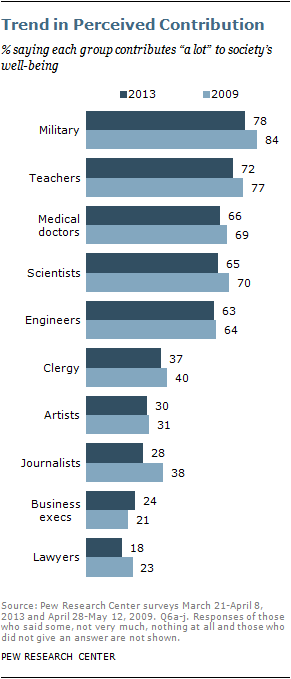
One reason why democracy doesn’t seem to be working very well is that the public is becoming increasingly ignorant about what makes it work at all. Evidence of this trend comes by way of a provocative study by the Pew Research Center, which polled the public regarding which professions it believes contribute the most to society.
The results can be found in this press release, this summary, and this article in The Careerist, but here is a snapshot:
“If his motives are as he has represented them-–“I understand that I will be made to suffer for my actions,” but “I will be satisfied if the federation of secret law, unequal pardon and irresistible executive powers that rule the world that I love are revealed even for an instant,” he wrote in a note accompanying his first set of leaked documents—-then he acted courageously and selflessly.”
—- Ethics Alarms, June 10, 2013, referring to the conduct and statements of Edward Snowden, NSA “whistleblower.”
That’s outrageous! They are collecting our phone records and our…hey, “The Fugitive!” I LOVED that show!!
Now we know that his motives are not as he represented them. From his statement that I quoted, I assumed that Snowden’s intent was to make himself available to U.S. authorities, and to prompt debate regarding the government’s widespread intrusions into the private communications of presumed-to-be-innocent citizens, as well as to ensure that the issue did not get drowned out, superseded and swept aside by distractions, as so many vital issues are. This was an indispensable second step, though I did not begrudge him some time to prepare for it. It would be the action of a one engaged in classic civil disobedience; it would demonstrate sincerity, public-mindedness and courage, and it would avoid his exploitation by the many around the world, and domestically, who wish the U.S. ill.
Instead, Snowden decided to run. Continue reading
…other than the fact that teaching your child to understand and enjoy baseball is one of the greatest gifts a parent can give, that is.
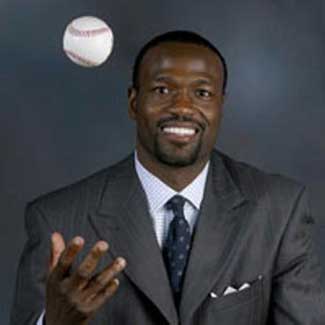
Don’t be like Harold, son.
No, the best reason to watch “MLB Now,” a program on the cable MLB channel, has nothing to do with baseball. It does have to do with preparing your child for life, showing him the danger of bias, and teaching her that remaining open to new ideas and information is essential, not only to ethical conduct, but to rational conduct as well.
The show features two commentators, Brian Kenny and Harold Reynolds, debating various baseball questions while coming from different disciplines and perspectives. Reynolds, a former player of some note with the Seattle Mariners, is “old school,” meaning that he belongs to that dwindling cadre of people, in the game and out of it, who rely on traditional wisdom, misconceptions, myths, false assumption and, most of all, their own gut level observations to interpret the deceptively complex game and evaluate its players. Thus he extolls doing the “little things that win,” like bunting and stealing bases, talks a lot about “protection” in the line-up, prattles on about clutch hitting and “pitching to the score,” and other similar thoroughly debunked nonsense that was regarded as cant back when John McGraw was managing but now is about as outdated as the assertion that women can’t drive. Kenny is thoroughly versed in the art of sabermetrics, the statistical measurements of baseball pioneered in the 1980’s by Bill James and others. Sabermetrics has transformed how baseball is watched, operated and played, greatly aided by the availability of computers. They can show how a pitcher with a losing record is both better and more valuable than one who wins twenty games, the traditional measure of excellence. They can prove that a batting champion is actually less of a positive offensive force than some obscure, .270 hitting player few have ever heard of. Sabermetrics can prove that managers with the reputation of being geniuses were really lucky dimwits. They can, that is, if you are willing to learn and pay attention. Continue reading

My current ethics observations on the unfolding NSA story:
 There may be good arguments to support that massive trolling of Verizon Business phone records by the NSA revealed yesterday, but so far, the justifications are either disingenuous, rationalizations, or leaps down the slippery slope. None exemplified this better than the Wall Street Journal, in its editorial defending the recently revealed surveillance. My favorite paragraph:
“The critics nonetheless say the NSA program is a violation of privacy, or illegal, or unconstitutional, or all of the above. But nobody’s civil liberties are violated by tech companies or banks that constantly run the same kinds of data analysis. We bow to no one in our desire to limit government power, but data-mining is less intrusive on individuals than routine airport security. The data sweep is worth it if it prevents terror attacks that would lead politicians to endorse far greater harm to civil liberties.”
Hmmm.
Which would be…you!

Don’t say I didn’t warn you!
A group of professors and graduate students from the University of Virginia, The University of California (Irvine), and the University of Southern California have announced that they are performing research on “how moral minds work” and inviting volunteers to be subjects in the study…
“Why do people disagree so passionately about what is right? Why, in particular, is there such hostility and incomprehension between members of different political parties? By filling out a few of our surveys, you’ll help us answer those questions We, in return, will give you an immediate report on how you scored on each study, quiz, or survey. We’ll show you how your responses compare to others and we’ll tell you what that might say about you.”
You are invited (by them) to register (you can do so anonymously if you choose) online and begin the process. The website is here, at Yourmorals.org.
If this turns out to be a secret government plot to identify those with insufficient “social justice” inclinations and send them to forced re-education camps where they’re required to listen to Lauryn Hill songs, Sandra Fluke speeches and Michael Moore rants all day, don’t blame me: I’m not endorsing the study, just letting you know about it. I have been singularly unimpressed with most scientific research in this field, and not just because it seems unusually vulnerable to the biases of the researchers.
I was recently listening to NPR interview a researcher in animal morality who informed the audience that “dogs are a species that don’t hold grudges.” Tell it to my Jack Russell, Rugby, a dog who loves everybody and everything except the two Belgian Shepherds that belong to my neighbor, which look sufficiently like the two dogs of the same breed that attacked Rugby when he was a puppy that he races to the window every day at the exact moment they walk past our house, whereupon he growls, barks and generally goes nuts in an orgy of fury, using his big-dog bark to say (this is a rough translation): “GET AWAY FROM HERE YOU STUPID CRAP-HEADS!!! JUST WAIT UNTIL I TRACK YOU DOWN!!! YOU’RE DEAD, DO YOU HEAR ME, DEAD! YOU THINK I’VE FORGOTTEN??? SOONER OR LATER, I’LL GET YOU, JUST YOU WAIT!!!!! IHATEYOUIHATEYOUIHATEYOUIHATEYOU!”
Anyway, good luck.
__________________
Pointer: Charles Green (Thanks, Charlie!)

I don’t know Albert T. Harrison, though he may well be a neighbor: we both live in Alexandria, Virginia. He is probably a good and decent man, in fact, I’m pretty certain of it, and it pains me to take him to task for what he wrote to, and was subsequently published in, the Washington Post’s weekly “Free for All” page. His letter is already on the web, however, and I’m sure other good, and, like Albert, willfully ignorant Americans are reading it and nodding their heads. His is an unethical, irresponsible, cowardly and dangerous position, and it has too many supporters already.
I’m sorry, Mr. Harrison, but you force my hand.
This week, scientists determined with near certainty that rumors of cannibalism in the colony at Jamestown, Virginia, were true. The remains of a 14-year-old girl from an excavation at the site of the settlement showed unmistakable signs of deliberate butchering. From the Post story: Continue reading

A bad day for Machiavelli is a good day for America.
Consequentialism rules supreme in Washington, D.C.; that is the tragedy of our political system. If unethical conduct is perceived as having a positive outcome, few in D.C. will continue to condemn the means whereby those beneficial and lauded were achieved. Worse, the results will be seen as validating the tactics, moving them from the category of ethically objectionable into standard practice, and for both political parties
Thus we should all reluctantly cheer the likely demise of the Senate’s gun control bill yesterday. The compromise background check provision that failed wasn’t perfect, but it would have been an improvement over the current system. Nevertheless, the post-Sandy Hook tactics of gun control advocates, including the President and most of the media, have been so misleading, cynical, manipulative and offensive that their tactics needed to be discouraged by the only thing that has real influence in the nation’s Capital: embarrassing failure.
The tainted enterprise begins with the fact that it should not have been a priority at this time at all. Newtown did not signal a crisis; it was one event, and that particular bloody horse had left the barn. The supposedly urgent need to “prevent more Sandy Hooks” was imaginary, but it apparently served the President’s purpose of distracting attention from more genuinely pressing matters, notably the stalled employment situation and the need to find common ground with Republican on deficit and debt reduction. Meanwhile, the conditions in Syria have been deteriorating and North Korea is threatening nuclear war: why, at this time, was the President of the United states acting as if gun control was at the top of his agenda? It was irresponsible, placing political grandstanding above governing. In this context, Obama’s angry words yesterday about the bill’s defeat being caused by “politics” were stunningly hypocritical. The whole effort by his party was about nothing other than politics. Continue reading
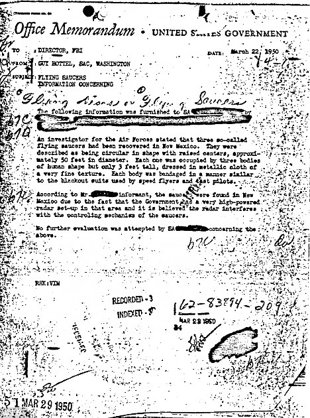 This is exactly the kind of thing that causes the American public to distrust its government, not to mention believing all sorts of bizarre conspiracy theories.
For reasons unknown, the FBI, apparently in need of fresh content for its website, decided to “explain” the remarkable memo in its files that has been cited as the “smoking gun” of a Roswell cover-up. The memo, send to FBI director J.Edgar Hoover in 1950, was not written by a crackpot but by Guy Hottel, then the head of the FBI field office in Washington, D.C. He wrote,
“An investigator for the Air Force stated that three so-called flying saucers had been recovered in New Mexico,” Hottel writes. “They were described as being circular in shape with raised centers, approximately 50 feet in diameter. Each one was occupied by three bodies of human shape but only 3 feet tall, dressed in metallic cloth of a very fine texture. Each body was bandaged in a manner similar to the blackout suits used by speed fliers and test pilots.”
Now, whatever this is, an explanation was and is in order. The memo was not made public until 2011, and to say it raises questions is a masterpiece of understatement. If this didn’t happen, why was the memo written? If it did happen, what was the government’s response? If Hottel and Hoover didn’t know whether it was true or not, what did they do about it? If the FBI investigated, what did it find out?
Instead of answering any of these questions, the FBI website this week posted this about the memo:
“A few facts to keep in mind:
“First, the Hottel memo isn’t new. It was first released publicly in the late 1970s and had been posted on the FBI website for several years prior to the launch of the Vault.
“Second, the Hottel memo is dated nearly three years after the infamous events in Roswell in July 1947. There is no reason to believe the two are connected. The FBI file on Roswell (another popular page) is posted elsewhere on the Vault.
“Third, as noted in an earlier story, the FBI has only occasionally been involved in investigating reports of UFOs and extraterrestrials. For a few years after the Roswell incident, Director Hoover did order his agents—at the request of the Air Force—to verify any UFO sightings. That practice ended in July 1950, four months after the Hottel memo, suggesting that our Washington Field Office didn’t think enough of that flying saucer story to look into it.
“Finally, the Hottel memo does not prove the existence of UFOs; it is simply a second- or third-hand claim that we never investigated. Some people believe the memo repeats a hoax that was circulating at that time, but the Bureau’s files have no information to verify that theory.
“Sorry, no smoking gun on UFOs. The mystery remains…”
What? Continue reading
 Ethics Alarms