Trevor Bauer Is Guilty Until Proven Innocent, And His Punishment Will Be Complete Before Such Proof Can Occur

Bauer

This is what #MeToo has wrought.

Dodgers pitcher Trevor Bauer, last year’s Cy Young winner as the best pitcher in the National League and currently the game’s highest paid player, hasn’t been able to pitch for his team since late June. The reason: he has been accused of domestic abuse. Accused.

Ethics Alarms first reported on his story here, writing,

“A restraining order was taken out against Dodgers pitcher Trevor Bauer, last year’s National League Cy Young winner. Bauer is a sportswriter favorite for his outspoken social media presence and progressive politics, so this will be a blow to the sportswriting woke. The woman making the allegations had what started as a consensual relationship with the pitcher, but in a 67-page document, alleges that Bauer assaulted her on two different occasions, punching her in the face, vagina, and buttocks, sticking his fingers down her throat, and strangling her to the point where she lost consciousness twice, an experience she said she did not consent to. After the second choking episode, the woman awoke to find Bauer punching her in the head and face, inflicting serious injuries. She contacted police, and there is now an active investigation of Bauer by the Pasadena, California police department. If any of her account is true, Bauer faces serious discipline from baseball, which has been (finally) cracking down on domestic abuse by players in recent years.”

I seriously miswrote, and should have known better. Baseball has a well-established tradition of taking action against players regardless of whether accusations have been proven. Indeed, the eight Chicago Black Sox who were accused of throwing the World Series in 1919 had been acquitted by a jury (They were guilty as sin, but then so was O.J.) were banned from baseball for life anyway. Pete Rose was banned for betting on baseball games before the evidence was definitive (Pete eventually confessed years later).

The next time I wrote about Bauer‘s case was a month later:

“Dodgers pitcher and reigning Cy Young winner Trevor Bauer, remains in limbo and under administrative, paid leave while baseball investigates the horrific allegations of abuse against him. Meanwhile, the Dodgers players have told reporters that they don’t want him back, though whether this is because he is an infamous pain in the neck or because he beats up women is unclear. Since the MLB policy appears to be based on “believe all women” and a “preponderance of the evidence” standard rather than “beyond a reasonable doubt,” I find it ethically troubling. (It resembles the way the Obama and Biden administrations want campus sexual abuse matters to be handled.) If, and I think this is doubtful, Bauer escapes charges and is still suspended, he is an excellent bet to challenge MLB’s “guilty until proven innocent” approach in the courts. Pains-in-the-necks have their uses.”

Last week, Major League Baseball and the MLB Players Association agreed to extend the Bauer’s administrative leave (he’s still being paid) through the end of the World Series, which the Dodgers still have a fighting chance to be part of should they make the play-offs. There has been no new evidence since June; the accusations against Bauer remain just that. He denies them, saying that the rough sex he had with his accuser was entirely consensual, and that he is the victim of a shakedown.


Continue reading →

A Baseball Ethics Quiz: Moral Luck And The Deflected Ball

BARTMAN-jumbo

I was surprised to find how often I have written about the Steve Bartman incident (shown above) here. For those of you who missed it (and if you are not a baseball fan, couldn’t care less) the episode is rife with ethics lessons.

Bartman was the hapless young Chicago Cubs fan in 2003 who unintentionally interfered with a foul ball that might have been catchable by Cubs outfielder Moises Alou in the decisive game of 2003 National League Championship Series. Bartman’s mistake (it didn’t help that he was wearing earphones and watching the ball rather than the action on the field) began a chain of random events that ended in a complete collapse by Chicago in that very same half-inning, sending the Miami Marlins and not the Cubs, who had seemed comfortably ahead, to the World Series.

Bartman issued a sincere and pitiful apology but it didn’t help. He was widely vilified by Chicago fans, who at that point had not seen a pennant-winning team in their lifetimes. Sportswriters joined in, and he was literally run out of town. Bartman’s name then became part of Cubs and baseball lore, one more chapter in the sad saga had been called “the Billy Goat Curse,” the uncanny inability of the Chicago National League team to win it all. The Cubs finally broke the imaginary curse in 2016, and in a show of kindness and remorse, privately awarded Bartman  an official Chicago Cubs 2016 World Series Championship ring.

That was nice, but Bartman’s life had already been, if not ruined, seriously degraded by the incident. I thought about poor Steve last night, when a foul ball nearing Fenway Park’s “Green Monster” left field wall wafted its way down the foul line. As Sox outfielder Danny Santana tracked it, so did several fans in the seats that look over the grandstand onto the field. Their eyes were on the ball, and as it moved way from foul territory into fair–maybe: in Fenway Park at that point, it is only a matter of a few feet’s difference—one fan lunged for the ball, deflecting it away from Santana’s glove.

Continue reading →

Post-Labor Day Ethics Laments, 9/7/21

weeping

You could yesterday, September 6, “Moral Luck Day.” On that date in 1901, President William McKinley was shaking hands at the Pan-American Exhibition in Buffalo when a 28-year-old anarchist named Leon Czolgosz approached him with a pistol in his hand wrapped in a handkerchief, and fired two bullets into the President’s chest. Touchingly, McKinley’s immediate thoughts were of his wife, Ida, who was in poor physical and emotional health. “Be careful how you tell her!” he whispered to an aide. Eight days later, McKinley was dead. But what Czolgosz intended as a strike to the heart of America’s government had the opposite effect, making Teddy Roosevelt, a Republican considered too independent, radical and uncontrollable (unlike McKinley) by his own party to be in the White House, exactly what GOP leaders never wanted him to be. Teddy made the United States a world power, greatly expanded the power of his office and the government itself, and was, in short, an anarchist’s nightmare.

1. Baseball ethics: The Boston Red Sox recently completed a disastrous collapse that dropped them from first place in the American League East to third. As they went into battle with the two teams now ahead of them, their hottest hitter, Alex Verdugo, vanished on a four game paternity leave. Shortly thereafter, another hot hitter, Hunter Renfroe, was lost for five days on bereavement leave after his father died of cancer. T’was not always thus: in the days before the Players’ Union bargained to add such mid-season leave as a new benefit, if a player’s wife was in labor or a loved on died, it was at the team’s discretion whether he would be permitted to leave the team. OK, I can appreciate the need for the benefit, but both players abused the right. These guys both earn millions of dollars a year. They both routinely talk about the team’s quest to win the World Series, yet when their team really needed them, they absented themselves for many days because they could. That’s a betrayal of the team, team mates, and fans. I’ve been there. My grandmother, a major influence in my life, died while I was in tech week for a major production I was directing. I flew to Boston for the wake, and flew back early the next morning. I couldn’t do anything for my grandmother. My family didn’t need me as much as the show did.And I wasn’t being paid a cent for directing that show, never mind millions of dollars.

2. Curtis Flowers is suing. Good! Curtis Flowers, whom I wrote about here, filed a lawsuit last week against Montgomery County District Attorney Doug Evans, who prosecuted him six times for the killings of four people at a small-town Mississippi furniture store. He was finally released in December 2019, about six months after the U.S. Supreme Court tossed out the conviction and death sentence from his sixth trial, which took place in 2010. Justices said prosecutors showed an unconstitutional pattern of excluding African American jurors in the Flowers’ six trials, which kept him in prison for 26 years despite never being found guilty in a fair trial. This wasn’t a prosecution, it was a vendetta. I would like to see a bar prosecution of Evans, who abused the ethical duties of a prosecutor.

Continue reading →

There Are More Important Ethics Stories On The Runway, But This One Gets Priority Because It’s Soooo Stupid…

Resolute-Athletic-Complex-Columbus-OH-Sports-Club-exterior

ESPN, which we can now safely conclude is incompetent as well as being unethical in that very special way the Great Stupid demands, released this statement:

“We regret that this happened and have discussed it with Paragon, which secured the matchup and handles the majority of our high school event scheduling. They have ensured us that they will take steps to prevent this kind of situation from happening moving forward.”

What was “this kind of situation”? Oh, just a national sports network televising a high school football game between one of the the top teams in the nation and a fake team fielded by a fake high school. That’s all.

On Sunday, ESPN broadcast a high school football game between featuring Florida’s IMG Academy, one of the top rated teams in the country, and Ohio’s Bishop Sycamore, an obscure high school with a team nobody has written about or paid much attention to. ESPN had been assured by Bishop Sycamore—schools get compensated when their teams’ games are televised– that its football squad was stacked with top players. Uh, no. This was a primetime match-up on ESPN, but nobody there did any due diligence to check on the juggernaut IMG Academy’s competition. IMG won by the heart-pounding score of 58-0. The broadcasters were reduced to telling funny stories and expressing concern that the Bishop Sycamore players were at risk of serious injury.

But wait! There’s more!

Continue reading →

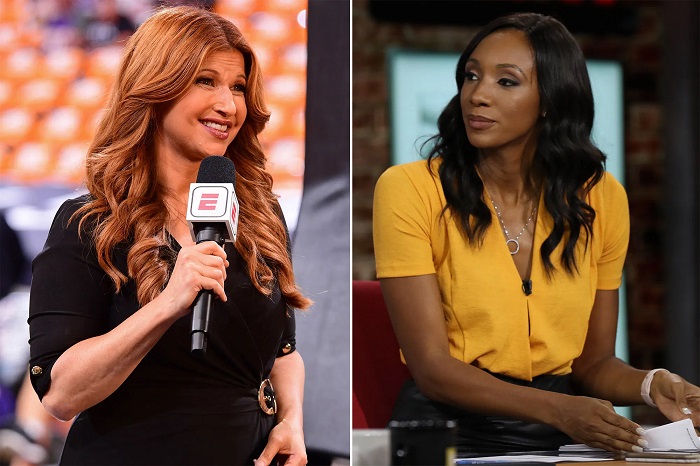
New Category! “Most Innocent And Fair Quote Of The Month That Gets Used To Tar The Speaker As A Racist And Destroy Her Career”: Former ESPN Rachel Nichols

rachel-nichols-maria-taylor-03

“I wish Maria Taylor all the success in the world — she covers football, she covers basketball. If you need to give her more things to do because you are feeling pressure about your crappy longtime record on diversity — which, by the way, I know personally from the female side of it — like, go for it. Just find it somewhere else. You are not going to find it from me or taking my thing away.”

—-ESPN sideline reporter Rachel Nichols in a phone conversation nearly a year ago after learning that she would not host coverage during the 2020 N.B.A. finals, as she had been expecting.

The phone call, unbeknownst to her, was being recorded, and someone leaked it to the ESPN brass and the public. The ethical issues raised by that conduct are clear and have been discussed here often: it is a dastardly thing to do, a breach of basic Golden Rule ethics, and indefensible because it creates harm to all involved. But that’s not the issue at hand.

After the video was leaked, many black ESPN employees told one another that it confirmed their suspicions that outwardly supportive white people talk differently behind closed doors. Nichols, seeing the ominous handwriting on the wall, tried to apologize to Taylor with texts and phone calls. Taylor did not respond. Meanwhile, ESPN employees turned against Nichols, whom they perceived as indulging in a “common criticism used by white workers in many workplaces to disparage nonwhite colleagues” when she suggested that “Taylor was offered the hosting job only because of her race, not because she was the best person for the job.”

Continue reading →

The FIFA Scandal’s Lesson: The U.S. Government Does Not Comprehend The Principle Of “A Culture Of Corruption”

jackheadexplosion

Why I am I not surp….oh, oh, there goes the head again. I guess I am surprised after all.

Since I regard soccer as about as entertaining as watching paint dry, I took only scant notice of the massive scandal in 2015 involving the Fédération Internationale de Football Association (FIFA), which oversees international soccer. More than 50 people and companies were charged in the case, and dozens have pleaded guilty. You can catch up here; I’ll wait.

All set? OK, then process this: six years after the massive criminal indictment exposed decades of corruption in global soccer, the U.S. government approved the payment of more than $200 million to….wait for it!—- to FIFA as well as its two member confederations also implicated in the scandal.

See, the theory is that the organization that was run by the individuals who stole all that money and engaged in bribery, money laundering and corruption, was really just another victim of it all. The repayment begins with an initial payment of $32.3 million in forfeited funds, the Justice Department announced, and prosecutors have approved a plan in which the soccer organizations could receive as much as $201 million.

Continue reading →

Monday Morning Ethics Warm-Up, 8/23/2021: Farewell Everly Brothers And Other Problems

Don Everly has died, and that’s the end of the Everly Brothers (Phil died years ago), one of the most influential and perhaps the most harmonious singing group of all time. The unique sympathetic vibrations that only sibling singers seem to be able to achieve is a marvelous metaphor for the ethical benefits of teamwork and trust.

This date also marks the demise of another famous duo: despite worldwide demonstrations in support of their alleged innocence, Italian-born anarchists Nicola Sacco and Bartolomeo Vanzetti were executed for murder in Massachusetts in 1921 .On April 15, 1920, a paymaster for a shoe company in South Braintree was shot and killed along with his guard. The murderers, who escaped with more than $15,000, were described by witnesses as two “swarthy Italian men.” Sacco and Vanzetti were arrested and charged with the crime. The men carried guns and lied to the police, but neither had a previous criminal record, and they definitely didn’t get a fair trial by modern standards. Prejudice against Italian-Americans was strong, and suspicion of anarchists was stronger. The pair was convicted on July 14, 1921, and sent to the electric chair on August 23.

A TV dramatization of their case, written by Reginald Rose (who authored “Twelve Angry Men”) made a huge impression on me as a child, and sparked the first stirrings of my interest in the law. In 1961, a test of Sacco’s gun using modern forensic techniques proved that it was his gun that killed the guard; he, at least, was guilty, but there was little evidence to implicate Vanzetti in the killing. To make this ethics train wreck complete, Massachusetts Governor Michael Dukakis ignored the evidence of Sacco’s guilt and issued a proclamation exonerating both Sacco and Vanzetti and proclaiming that no stigma should be associated with their names.

Typical of Dukakis.

1. Accountability? What accountability? “Sources”—and I stipulate that un-named “sources” are untrustworthy—tell various news outlets that “President Biden isn’t inclined to fire any senior national security officials over the chaos in Kabul unless the situation drastically deteriorates or there’s significant loss of American life.” That sounds as likely as it is depressing. The reluctance of American Presidents to fire subordinates for gross incompetence has become the norm rather than the exception, and the trend ensures that our government, whoever is the President and whatever party is power, will continue to decline in competence and trustworthiness. Consider President Bush’s refusal to fire any of those responsible for the botched intelligence regarding Iraq’s WMDs, and later Abu Ghraib, or my personal favorite, Barack Obama’s refusal to acknowledge the gross incompetence of Kathleen Sebelius, his Secretary of Health, after her inexcusable reliance on a flawed website to launch the Affordable Care Act.

Dumber still is the qualification “unless the situation drastically deteriorates or there’s significant loss of American life.” Morons. Morons! Whether the situation gets worse or not is pure moral luck; it doesn’t change the utter incompetence of the Afghanistan abandonment. Imagine a babysitter who gives a toddler knives to play with, and a parent whose reaction is, “Well, the kid wasn’t hurt, so there’s no reason to fire her.” That is literally what the reasoning at the White House is…if “sources” are accurate.

Continue reading →

Return To”Field Of Dreams”

Field of Dreams2

Baseball had a rare PR triumph earlier this month when it held a regular season game between the New York Yankees and the Chicago White Sox in the Iowa cornfield diamond that was the setting for the cult movie favorite “Field of Dreams.” The TV ratings were the best for any regular season broadcast in 16 years. That’s amazing, but maybe it shouldn’t be. Despite rumors of its demise, baseball still has a cultural bedrock of tradition, nostalgia and history unmatched by any other sport, professional or amateur. So many Americans would not tune in to a baseball game if they didn’t still have a flicker of affection for the sport, and if your argument is, “Yeah, but that’s just because of the movie,” the movie wouldn’t have become iconic if a lot of people didn’t care about baseball. As Terrence Mann said,

Now my confession: I’m not a wild fan of the film, nor that scene. The scene in particular is unforgivably stagey and artificial: it’s right out of the (much better) book, “Shoeless Joe,” and not even the great James Earl Jones could make it sound like anything but a recitation. I got annoyed, during the hype for the game broadcast, with “Field of Dreams” being repeatedly called “The greatest baseball movie.” I don’t regard it as that; I think it just barely makes the top five, and I could be talked out of ranking it that high.

For good reasons, many baseball writers, fans and bloggers have criticized the film over the years, and not just because it is shamelessly manipulative. But it is that. Baseball writer Craig Calcaterra, a vocal debunker of the film, writes,

“I will fully admit that a story about a father and son repairing a longstanding rift over a game of catch — with or without the magical realism elements — could form the basis of a MAJOR chills moment in an absolutely fantastic movie. The problem, as I’ve said in the past, is that “Field of Dreams” does not earn its chills moment. It is lazy in that it does not sketch out the dispute between Ray and his dad in anything approaching realistic terms — it’s dashed off in the rushed intro with almost no details — and it does nothing to explain why Ray’s moving the Earth and the Heavens to bring his dad back to that ball field is so important or why it serves as the “penance” Ray must pay for whatever reason. With no buildup or backstory, there’s no payoff.”

But worse, for me and others, is the slipshod handling of baseball history. “Shoeless Joe” Jackson was not innocent of taking a bribe to throw the 1919 World Series, he was guilty. He was not a thoughtful, wise-cracking Ray Liotta, he was just north of being a moron. He batted left-handed, and famously so, not right-handed like Liotta. When Frank Walley’s character, a magically reincarnated and youthened old ballplayer named Archie “Moonlight” Graham, whose single appearance in the major leagues was in 1905, is nearly beaned by a close pitch, he says “Hey ump, how about a warning?” Umpires didn’t warn pitchers for throwing at batters in 1905, and not for more than a half-century after that. Sloppy.

Continue reading →

Evening Ethics, 8/19/2021: Those Were The Days…

Ah, those heady days when the U.S. felt ethically justified in toppling governments it didn’t approve of, and “nation building” was still considered practical and virtuous. Today marks the anniversary of the U.S. overthrowing the government of Premier Mohammad Mosaddeq and reinstalling the Shah of Iran in 1953, The Shah was a torturing, oppressive autocrat, but he was our torturing, oppressive autocrat for 26 years, a dependable anti-Communist ally of the United States until a revolution ended his rule in 1979. You should know the rest. Wonder why Iranians aren’t crazy about the U.S.? Today is one big reason. Also on the ethics regrets list is the release of the West Memphis Three on this date in 2011. I wrote about that one here. An excerpt:

“In an ethical system, prosecutors would have made certain the wrongfully convicted men were freed, without any further adversary action. But this was not an ethical system. Instead, prosecutors insisted on a bizarre plea deal in which the Memphis Three agreed to take an Alford plea, a strange, dishonest and much criticized guilty plea in which a defendant essentially lies to avoid an otherwise unavoidable unjust punishment. With an Alford plea,  the prisoner or defendant asserts he or she is innocent, but acknowledges that the prosecution has sufficient evidence to prove guilt beyond a reasonable doubt, and thus acknowledges legal, though not actual, guilt.   Prosecutors insisted that all three men plead “guilty” in this fashion in order to agree to release them with time served. The judge accepted the deal. Now Echols, Baldwin and Misskelley are free, their lives all but ruined by 18 lost years, thanks to a rotten system. The news media for the most part didn’t bother to explain why the terms of their release was just one more gratuitous assault on their existence by Arkansas legal hacks.”

I’m sorry today reminded me of this case. It still upsets me to think about it.

1. Here’s evidence that the current complaints of antiracism propagandists is a crock: Denzel Washington. I’ve been watching a lot of his movies lately, and a comparison with Sidney Poitier is unavoidable. Poitier was the ground-breaker, the black man who became a genuine movie star in a majority white market, and more than that, did it by holding up the racism and discrimination in American culture for all to see. Nonetheless, he was limited by his race. Poitier always played character’s whose race was central to their roles in the plot. He never played a villain: like many stars, like John Wayne, Cary Grant and Clark Gable, he regarded his career as a continuous work exploring a particular archetype in all of its facets. For Poitier, it was that of the outstanding black man as an outsider in American society. In Poitier’s amazing year of 1967, he was in three hit movies: “In the Heat of the Night,” “Guess Who’s Coming to Dinner?,” and “To Sir, With Love.” All three featured Poitier as a black man thrust into a biased white environment, and gradually earning respect and some measure of equality. Today the #1 black star is Denzel, and he doesn’t have to play such sanctimonious roles. Race plays a part in many of his movies; he has even played black civil rights activists, like Malcolm X and Hurricane Carter. Washington, however, in part because of Poitier’s work, often plays parts that were written for white actors, and nobody cares. He isn’t afraid to play flawed characters and even brutal ones, like in “The Equalizer.” Washington’s success, and the versatility and range he is allowed to explore in his movies, would have been impossible in Poitier’s prime years. His body of work is proof of how far American attitudes toward race have advances and how unfair and dishonest the Black Lives Matter/ Critical Race Theory narrative is holding that the Jim Crow culture still rules America.

Denzel is also better than Poitier, although it is fair to say that Poitier never had the option of being as versatile as Washington. If Sidney Poitier is cinema’s Jackie Robinson, Denzel Washington is its Willie Mays.

Continue reading →

Noontime Ethics, 8/18/2021: The Segue Edition

Segue

1. Combine mental health with unaccountable female superstar athletes and you get.…another “How dare you expect me to answer questions like any other pro athlete, you sexists racist!” moment from Naomi Osaka. Ahead of the Western & Southern Open in Mason, Ohio, tennis’s reigning queen finally agreed to sit down for questions from the press on a Zoom call. You will recall that at the French Open in May, she said she would decline to do pretournament or post-match news conferences, even though they are required of all players. When Osaka was fined $15,000 for skipping her press commitments after her first-round victory, she withdrew before her second-round match in Paris, for the first time playing the mental health card., later used so effectively by Simone Biles at the Olympics. At the session in Mason, Paul Daugherty, a sports columnist for The Cincinnati Enquirer, asked ,“You are not crazy about dealing with us, especially in this format. Yet you have a lot of outside interests that are served by having a media platform. I guess my question is, How do you balance the two?” Osaka, after an attempt at an answer that wasn’t an answer, ran out of the room in tears. Her agent, Stuart Duguid, said via text message, “The bully at The Cincinnati Enquirer is the epitome of why player/media relations are so fraught right now. Everyone on that Zoom will agree that his tone was all wrong, and his sole purpose was to intimidate.”

Imagine that response from a male athlete to a legitimate if tough question. Imagine an agent for such a male athlete calling the questioner a “bully.” Female athletes cannot protest that they must be treated equally with male jocks and still reserve the right to revert to delicate flowers when it serves their purposes.

Continue reading →