Morning Ethics Warm-Up: 8/24/17 [UPDATED]

GOOD MORNING!

1. I’m moving this to the top from its original placement at the end. I warned that the mania for retroactive statue-toppling and historical air-brushing was a deadly slippery slope to cultural chaos from the moment Dylan Roof’s rampage primed the Confederate flag banning push. I said that there was no clear stop on that slope, and that this was a massive ethical error that would quickly spin out of control.

I am accepting apologies and “You were right, I was wrong” messages at jamproethics@verizon.net. I will reply gracefully.

2. It’s a good thing, in some ways, that President Trump has no ethics alarms, or has them but doesn’t understand what all the ringing means, because if he did, he might realize that he has put himself in ethics zugswang in the matter of former sheriff Joe Arpaio, the anti-illegal immigration zealot who is facing up to six months in jail for defying a federal judge’s order to stop targeting Latinos based solely on the suspicion of their legal status. Trump has been urged to pardon Arpaio. Let’s see:

  • Arpaio did defy a judicial order. Should a law enforcement official be treated especially harshly when he does this?

Yes.

  • The judicial order related to Arpaio’s practice of assuming that individuals of Hispanic descent were more likely to be violating the immigration laws in his jurisdiction than other citizens. Since his jurisdiction was rife with Hispanic illegals, was this an unreasonable assumption on his part? No. Was it still discriminatory? Sure. Is the balance between profiling, which in such situations is a valuable law-enforcement tool, and the importance of equal treatment under the law a difficult one legally and ethically? Yes. Does a sheriff have the right and authority to ignore the way this balance is decided one legal authorities define it?

No.

  • Is the determination of this balance often polluted by ideological biases, in this case, against enforcement of immigration laws?

Yes.

  • Do Donald Trump, and his supporters, and those Americans who may not be his supporters but who agree that allowing foreign citizens to breach our borders at will without legal penalties is certifiably insane, believe that Arpaio’s position on illegal immigration is essentially correct and just?

Yes.

  • Nonetheless, did his ham-handed methods give ammunition to open-borders, pro-illegal immigration, race-baiting activists like the one who told the New York Times,

“Trump is delivering a slap in the face to dignified, hard-working people whose lives were ripped apart by Arpaio. Arpaio belongs in jail, getting a taste of his own medicine. Trump wants to put Arpaio above the law, showing they are both about white supremacy.”

  • Is sending Arpaio to jail a political imprisonment?

Yes, although he made it easy to justify on non-political grounds.

  • Are political prisoners the ideal objects of Presidential pardons?

Yes.

  • Would pardoning him send dangerous messages (it’s OK to violate judicial orders you think are wrong; the ends justifies the means; Presidents should meddle in local law enforcement, “extremism in defense of liberty is no vice”) as well as defensible ones ( judges and elected official enabling illegal immigration are a threat to the rule of law; Joe is an old man with a long record of public service who deserves mercy even though he was wrong…)

Yes.

  • Will such a pardon, especially as the news media is again spinning to make the case that Trump is sympathetic with xenophobes and white nationalists, further inflame an overly emotional debate that needs to be calmed, not exacerbated?

God, yes.

  • Is the most responsible course for Trump to stay out of this mess?

YES!

  • Will he?

Of course not. Continue reading

Morning Ethics Warm-Up: 8/23/17

Good Morning!

(BOY, there are a lot of especially stupid ethics stories today…)

1. This:

That’s right: an Asian-American broadcaster who never fought for the South during the Civil War has been robbed of a job assignment because his virtue-signaling, grandstanding mega-corporation wants to side with the statute-toppling Left. ESPN regrets that the NAME of one of its broadcasters has become an issue? Who made it an issue? ESPN, that’s who.

Nah, there’s no slippery slope! Nah, this is just about Civil War generals! Nah, the people behind the historical purge or reasonable…they won’t just keep looking for more ways to claim they are being offended!

Can you tell I am losing patience with the defenders, enablers and rationalizes of this toxic nonsense?

2. Or is this dumber? From issue scout Neil, who writes, “Watch the video. [Trump] gestures for the crowd to look up at the sky, then makes a show of looking himself (though CLEARLY not actually trying to see the eclipse). I must have seen at least a dozen other  people yesterday scan the sky in a similar fashion before accidentally getting blinded by an eye-full of rays. The man is inept beyond belief, but he’s not wearing a bib. God this  irritates me.”

These are the ways that that the newsmedia signals to anyone with an open mind and not drooling, gnashing and recoiling at the sight of water from end-stages Anti-Trump Brain-Eating Virus infection that it cannot be trusted, and has traded of its integrity, honesty, fairness and objectivity to lead the “Destroy the Elected President of the United States” effort. No, the President did not actually look directly into the sun and blind himself. In fact, I did exactly the same thing he did when I glanced up at the sun sideways for a nanosecond wondering why so many idiots were lying on the ground wearing 3-D glasses. This is the epitome of fake news—fake, because the intent of the item is to mislead, and because it is no more news than “President uses wrong fork at State Dinner.” No other President, ever, under any scenario, would be covered this way, and no news publication would ever print anything so dumb unless it was certain that its readers were gullible, deranged, and even dumber.

Prof. Glenn Reynolds:If the press and the political opposition — but I repeat myself — were just sober, straightforward, and honest they could beat Trump easily. But then, if they were capable of that, we wouldn’t have gotten Trump to begin with.”

3. My wife reminded me that I have been flagging deception in obnoxious ways since long before ProEthics and Ethics Alarms.  When we were dating, she had a bowl of soup at a Georgetown campus hangout called The Tombs, and I had a cup of the same soup, for $1.50 less. I asked the waitress for a clean bowl and cup,  and poured water into the cup until it was at soup-level, and then poured that water into the empty bowl, which it filled. Then I asked her to get the manager, whom I asked to explain why a bowl cost more than a cup when the amount of soup was the same. he had no explanation of course.

You’ll be amazed how many restaurants do this. Continue reading

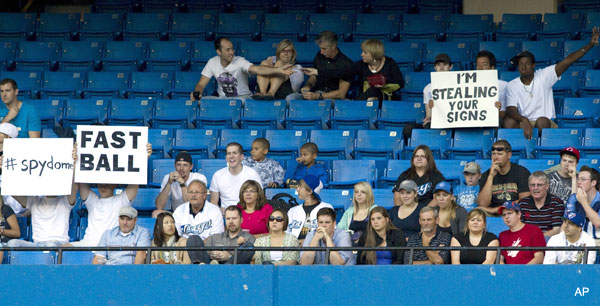
When “Ick!” Strikes Out Ethics: The Intensifying Robo-Umpire Controversy

[I see that I last wrote about this issue in April, and before that, in June of 2016, and in 2012 before that.Well, it’s worth writing about again, and again, until ethics and common sense prevails.]

This weekend Major League Umpires held a silent protest, wearing armbands in support of colleague Angel Hernandez, whose competence was publicly questioned by Detroit Tiger player Ian Kinsler. In fact, Angel Hernandez is a terrible umpire, and terrible, indeed, even mildly fallible umpires have a problem now that they never had to worry about in the good old days: their mistakes are obvious and recorded for all to see.

Yesterday Red Sox color man and former player Jerry Remy was reminiscing during the Red Sox -Yankee game broadcast about one of his few home runs. He said he had struck out, missing with his third swing by almost a foot, and was walking back to the dugout when the umpire called him back, saying he had foul-tipped the ball. “I know that was wrong, but I’m not going to argue I’m out when the ump says I’m not.” Remy said. He went back to the plate, and on the next pitch hit a home run. “Of course, they didn’t have replay them,” Jerry added.

Before every game was televised and before technology could show wear each pitch crossed the plate, balls and strikes were called definitively by umpires, many of whom proudly had their own strike zones. “As long as they are consistent with it ” was the rationalization you heard from players and managers. It was, however, a travesty. The strike zone isn’t a judgment call; it is defined, very specifically, in the rules. A pitch is either within the legal zone or it is not. A strike that is called a ball when it is not, or vice-versa, is simply a wrong call, and any time it happens can affect the outcome of the at-bat and the game. If you watch a lot of baseball, you know that we are not just talking about strikeouts and walks.  The on-base average when a batter is facing a 2 balls, one strike count as opposed to a 1-2 count is significantly higher. The wrongly called third pitch can change the result of the at bat dramatically.

Since the technology is available to call strikes correctly 100% of the time, why isn’t the technology being used? Actually it is being used, in TV broadcasts. The fan can see exactly when the umpire misses a call, and the broadcasters talk about it all the time. “Where was that?” “That was a gift!”  “Wow, the pitcher was squeezed on that one.” Once, a missed call in a game was virtually undetectable, because one could assume that the umpire had a better and closer view than any fan or broadcaster could have. Now, there is no doubt.

Yet the players, sportswriters and broadcasters still overwhelmingly argue against the use of computer technology to call balls and strikes. It’s amazing. They know, and admit, that  mistaken  ball and strike calls warp game results; they complain about it when it happens, point it out, run the graphics repeatedly to show how badly a crucial call was botched, and yet argue that a completely fixable problem with massive implications to the players, the games and the seasons, should be allowed to persist.

These are the rationalizations and desperate  arguments they advance: Continue reading

Morning Ethics Warm-Up: 8/21/17

GOOOOD morning!

Ready for an ethical week?

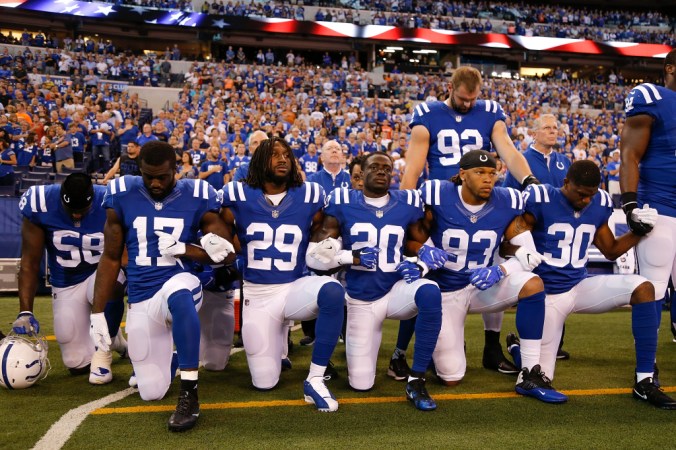
1.  I am beginning to wonder if aimless protesting and demonstrating has become a fad. Here is one piece of evidence: over the weekend, dozens of New York City police officers held a rally in support of getting quarterback Colin Kaepernick a job in the National Football League. Among the demonstrators was Frank Serpico, made famous by Al Pacino’s portrayal (Do not watch that movie now, as it has aged horribly), who must be bored or something.

What possible good can this rally do, other than to serve as some kind of perverse virtue-signaling by police (“I support the guy who said that when I’m falsely accused of murder, I should lose my salary before there’s an investigation or a fair determination of what really happened! Love me!”)? If the rally is supposed to tell NFL teams who they should hire to play based on talent alone, no team in its right mind will or should pay attention. “Hey, a bunch of cops in Brooklyn think that Colin’s better than we think he is. What the hell: lets give him a few million bucks!” If the rally is mostly about his National Anthem-dissing stunt,  all they are doing is guaranteeing that the borderline quarterback will stay unemployed. Kaepernick, by his own actions (and routinely inarticulate and simple-minded justification of them) irreversibly made linked his political stand to his football abilities. It’s like the dilemma Michael Sam created when he made a big deal about being openly gay. Was he being drafted because he was gay and the NFL didn’t want to appear bigoted, or because he was good enough to play? When he was cut, was it really because he was gay (Naturally Sam hinted it was) or because the team’s management thought it would have a better team on the field without him? The same was true of Tim Tebow: if a team cut him, it was suspected of hating God. Who needs a constant distraction like that?

If a protest can’t accomplish anything constructive, then it’s an unethical protest.

2. Popular culture in the Age of Trump is sending even more muddled and unethical messages that it used to. I’m trying to get though Marvel’s latest for Netflix, “The Defenders”, a series based on Marvel’s second-tier super-hero team that consisted of a rotating squad of hopeless mismatches, like Dr. Strange and the Submariner. It has been recast as a group of urban misfits (Bulletproof ghetto warrior Luke Cage, depressive and cynical strong girl Jessica Jones, blind super-nimble lawyer Matt Murdock (aka Daredevil) and boring young tycoon Eastern master Iron Fist, whose real name I can’t remember. Yesterday i watched, Luke, easily the most likable of the four, berate Iron Fist because we was white, rich, “privileged,” and had the cruelty and audacity to regard a young black kid who was being paid to spray acid on multiple murder victims of a sinister criminal enterprise as a criminal himself. “He just needs a job,” explains the huge, indignant, racist, classist, bullet-proof black guy.

Oh, well, that’s all right then! (Pssst! Luke! Don’t hurt me, but it’s called “accessory after the fact.”) Continue reading

Morning Ethics Warm-up: 8/19/17—-The St. Louis Rally Cat Edition

Good morning!

1. The still unfinished saga of the St. Louis Rally Cat illustrates nicely how the most innocent-seeming events can spin out of control when the participants don’t heed their ethics alarms, or lack the instruction manual to operate them competently. As an aside, this baseball season has yielded a bumper crop of ethics controversies, the most I have ever seen, and it is far from over. In general, Major League Baseball’s participants, including its sportswriters,  are not very good at ethics, and the simple-minded virtue-signaling in the Tom Yawkey controversy is a recent, and embarrassing example. As an aside to an aside, I used to provide baseball ethics commentary at little or no cost to a well-regarded stat-head website, until they made it clear that they neither appreciated the importance of ethics in the sport, nor were capable of practicing it. Too bad. Baseball ethics is a lot more valuable than knowing the exit velocity and launch angle of a home run.

But I digress. The Rally Cat…and let’s count the ethics breaches:

Last week, the St. Louis Cardinals, fighting to overtake the Cubs in the closely contested and mediocre National League Central, were trying to rally back from looming defeat. The bases were loaded with Cardinals at Busch Stadium when a juvenile cat raced onto the field and halted play. A groundskeeper captured the cat, which mauled him as he carried it off the field. This was shown on the video scoreboard, provoking laughter and applause from the crowd.

As soon as play finally resumed, Cardinals catcher Yadier Molina hit a grand slam, and the Cardinals won as a result. Baseball players are superstitious, as the game is an orgy of moral luck, and such incidents typically create unlikely and illogical totems. In Los Angeles, there is a video of a monkey going nuts, the Angels’ “Rally Monkey.” In Boston, it is the old Neil Diamond ear-worm “Sweet Caroline.” Last year, the Kansas City Royals had a good luck praying mantis-–I’m not making this up—dubbed “The Rally Mantis.”  Back in the politically incorrect Twenties, the New York Giants had a mentally-challenged man travel with club as a mascot, because the team won the day he arrived and told Manager John McGraw that he was a great pitcher. For laughs, McGraw told the poor man that he was starting the game, and he actually warmed up on the sidelines as the players guffawed. He didn’t pitch, but the Giants won, so McGraw had him warm up before every game, as the team went on a winning streak.

So, naturally, the St. Louis cat was given the name Rally Cat, and responsibility for the Cardinal’s fate this season was placed squarely on its fluffy shoulders.

Now came the ethics botches:

Ethics breach #1. Lucas Hackmann, the cat-grabbing groundskeeper, let go of the feline talisman to get his bites attended to. Foul. He works for a baseball club; he is obligated to be aware of the culture he serves. He had to know, or should have known, that the cat would be a media star, and that the team, if it won the game, would want to employ him, or her. It. He also should know that cats do not stay, like dogs. The cat ran away, endangering the Cardinals’ season/

Incompetence.

Ethics breach #2. The Rally Cat was picked up by a fan, Korie Harris, and she left the park with it. Cardinals security questioned her, and she said it was her cat. Again,  Incompetence. The cat now had potential value to the security personnel’s employers. Why did a fan have a cat? You can’t bring a cat into the ballpark.

Ethics breach #3 Of course, it wasn’t her cat.  She was lying.  Dishonesty.

Ethics breach #4, 5, 6 and 7. Then Lying Korie (I bet that’s what the President calls her) also lost the cat. Some animal lover she is. If she was going to take custody of the animal, she had accepted responsibility for its welfare. She could have adopted it. She could have advertised to find its owner. She could have returned it to the Cardinals. She could have given it to a shelter—anyone but PETA, which would have probably killed it. No, she just let it go. Feral cats live a fraction of the average life of a house cat. Four fouls: Lack of responsibility, incompetence, dishonesty, and lack of caring.

Ethics breach #8 The Cardinals released a statement hoping that the cat would be found so the team could “properly care for it.” Right. A traveling baseball team is the perfect place for a cat. The Kansas City Royals killed the Rally Mantis, and quietly replaced him, thinking nobody, including the Baseball Gods, would notice. Ha! They missed the play-offs.

Again, this is dishonesty. The Cardinals don’t care about cats; if the team did, it would be donating money to animal shelters. It cares about good luck charms that can be used to promote the team..

 Ethics breach #9 The cat was found and taken into custody by St. Louis Cat Outreach, a nonprofit organization. The Cardinals claimed ownership. “The St. Louis Feral Cat Outreach organization has assured us they will be returning our cat to us after a mandatory 10-day quarantine period,” Ron Watermon, the team’s vice president for communications, said in an email to The St. Louis Post-Dispatch. “Rally Cat will be cared for by our team, making the Cardinals clubhouse his home,” Watermon said. “Mike (Mike Matheny, the Cardinals manager) and our players are looking forward to loving and caring for him.” Outrageous Dishonesty!  The cat shelter denied the story, posting on its Facebook page: “It was a totally false statement that STLFCO has committed anything to the Cardinals. We have made no decisions about Rally’s long-term placement.” Moreover, anyone who thinks the baseball team was “looking forward to loving and caring for” a cat in the middle of a pennant race will believe anything.

2. That took longer than I expected. I assume you are sufficiently warmed up, though.

Here’s Lucas and the Rally Cat:

____________________________

Pointer and Facts: New York Times

From The “Grandstanding Ingratitude” Files…Ethics Dunce: Boston Red Sox Owner John Henry

Ah, Ethics Alarms heaven! The statue-toppling mania issue has collided with the Boston Red Sox, just two days after my pilgrimage to Fenway Park!

ESPN reported yesterday that Red Sox owner John Henry wants Boston to change the name of  the street that borders the legendary park, Yawkey Way, and he is trying to exploit the   current political correctness mania that has cities pulling down statues of war heroes in the dead of night to accomplish his goal.

That’s my characterization, of course, not ESPN’s.

Henry told the Boston Herald that he is “haunted” by the racist legacy of previous owner Tom Yawkey, who led the team from 1933 to 1976. Because he is haunted, he thinks that it is fair and right that the man who beyond question saved the team, ran it as a Boston institution and public utility, and is as responsible as anyone for the fact that Henry owns one of the prestige franchises in all of sports, should be dishonored and shunned because he wasn’t enlightened about civil rights long before Martin Luther King began marching.

Such disgraceful moral grandstanding and self-righteous ingratitude is seldom seen. But I guess if anyone should be able to grandstand, its someone who owns a baseball park.

For those who mock the idea that the desecration of Robert E. Lee’s statues leads directly to George Washington, now hear this; for the Boston Red Sox, Tom Yawkey is George Washington.

The only owner any one remembered before Tom Yawkee bought the team was Harry Frazee, consigned to Beantown Hell for selling Babe Ruth (and many other stars) to the New York Yankees in 1919. From that moment on, the team was a perennial loser, often in last place, while New York won pennant after pennant and sneered at its proud rival on the Bay. In 1933,

Tom Yawkey , a lumber tycoon and baseball enthusiast, bought the team and poured money and love into it, buying other team’s stars (Left Grove, Joe Cronin, Jimmy Foxx) and turning the team into worthy challenger to the Yankees.  From the beginning, Yawkey paid no  attention to the bottom line as he tried to build a champion out of the franchise, or as he put it, “to bring a championship back to the fans of Boston.” This was during a period when teams had permanent control over player contracts, and most owners used that leverage to pay players pathetic wages. Not Tom Yawkee. He was criticized for over-paying players–hilarious now, when we’re talking about his paying a utility infielder $15,000 when others of his ilk were making just $8,000, and current utility players make a couple million dollars a season. Sportswriters in Boston called the Red Sox a country club, and blamed Yawkee for “falling in love with his players.” In 1960, Ted Williams had to ask Yawkey to cut his salary, because he felt embarrassed after a bad year, his only one.

Was Yawkey a racist? He was born in 1903, and grew up during the Wilson Administration, when Jim Crow really took of. Sure he was a racist, along with about 95% of the whites in the nation.  Continue reading

Ethics Dunce: Anyone Who Ran This Story

On my way home from my seminar today, I saw that my cab’s in-ride video featured, along with three Jeopardy! questions from Alex Trebek, a Jimmy Kimmel feature (his “Pedestrian Belly-Flop” competition) and the weather, and a video from the ceremonies I had just returned from witnessing in person at Boston’s Fenway Park. The headline was-HAHAHAHA!—“First Pitch Goes Horribly Wrong!” and showed Mike Andrews, the ex-Red Sox second baseman from the 1967 “Impossible Dream Team,” receiving a pitch from the ceremonial first pitch tosser, who then heaved the ball far beyond Mike’s reach into a group of photographers, hitting one of them—it’s important to note that he is male–right in the crotch. The clip was attached to an ad for the local ABC affiliate here.

I thought that the mocking video was an ABC product, and it might be, since other ABC affiliates have distributed it. But the same video with similar mockery of the pitch in the commentary is elsewhere, and on its way to going viral. Here is the attached story used by ABC Channel 15 in Arizona:

A photographer and University of Arizona alum was the unfortunate victim of one of the worst first pitches in MLB history on Wednesday night.

Before the Boston Red Sox hosted the St. Louis Cardinals at Fenway Park, the gentleman who tossed out the first pitch threw it juuuuuust a bit outside — and right into a sensitive spot for Tony Capobianco, a photographer and page designer for The Eagle-Tribune who graduated from UA in 2013.

Fortunately, Tony reported he’s OK. Way to Bear Down, sir.

That “sir” is a triumphant cancer survival and success story by The Jimmy Fund, the Dana-Farber Cancer Institute’s ‘s research drive to cure cancer in children that the Red Sox  made the organization’s affiliated charity since Ted Williams became passionate involved with the project in the late 1940s. His pitch was the climax of the ceremonies honoring the 50th anniversary of  the storied pennant winning team, in part because that team became the first to ever award a full World Series share to cancer research, and in part because Andrews had followed his playing days with 25 years as the Jimmy Fund’s executive director. Continue reading

Morning Ethics Warm-up: 8/17/17

Good Morning!

1. I got back late last night from my pilgrimage to say thanks to the Impossible Dream team, and now I’m on my way out to teach an ethics seminar for D.C. government attorneys. I haven’t caught up with the comments yet; I’m sorry. Things should be back to normal hear by this afternoon. Here are the surviving members of that 1967 Red Sox team that changed my life:

Incredibly, the Red Sox barely promoted the event, and had no memorabilia, not even a T-shirt, available at the souvenir stands. I asked one of the sales people, who said the team had given them nothing, figuring that the typical fan was too young to remember or care.

And people wonder why I object to tearing down statues…

2. …which the unethical Mayor of Baltimore ordered to be done yesterday in the dead of night. From the Times:

It was “in the best interest of my city,” Mayor Catherine Pugh said Wednesday, as she explained why she ordered Confederate monuments removed under the cover of darkness, days after violence broke out during a rally against the removal of a similar monument in neighboring Virginia.

“I said with the climate of this nation,” Ms. Pugh said later, “that I think it’s very important that we move quickly and quietly.”

With no immediate public notice, no fund-raising, and no plan for a permanent location for the monuments once they had been excised — all things city officials once believed they would need — the mayor watched in the wee hours on Wednesday as contractors with cranes protected by a contingent of police officers lifted the monuments from their pedestals and rolled them away on flatbed trucks…

David Goldfield, a professor of history who studies Confederate symbols at the University of North Carolina at Charlotte, said the removal of the monuments in Baltimore was likely to be part of a “rolling cascade” of cities and states ridding themselves of, or at least relocating, similar statues.

”You’re going to see another wave of these removals.” Mr. Goldfield said. “The fact that it’s done fairly expeditiously is not surprising because if you do it quickly the opposition can’t build up, and the confrontations that we’ve had, not only in Charlottesville but elsewhere, will not materialize.”

By all means, move quickly and without notice or due process so lawful protests and expressions of public opinion “can’t build up.” “It was in the best interests” is such a versatile rationalization for unilateral government action.

Democracies don’t undertake controversial actions in the night. Dictatorships do. Pugh and others nascent fascist of the left are as responsible for “the climate of this nation” as much or more than anyone else, and now want to exploit the dangers of that climate to stifle dissent.

Perfect. Continue reading

Morning Ethics Warm-up: 8/16/17

GOOD MORNING!

1. I’m heading to Boston and Fenway Park in a few hours to meet with two of my high school classmates and together pay our respects to the 1967 Boston Red Sox, the spiritual beginning of Red Sox Nation, and a group of men, then barely more than boys, who had as profound an effect on my life and view of it as anything I have ever experienced.

It’s the 50th Anniversary of that amazing team and the heart-stopping pennant race it won against all odds, in a four team race that came down to the final game of the regular season. I mean heart-stopping literally: the team wasn’t called “The Cardiac Kids” for nothing. TWO of my father’s colleagues at the Boston Five Savings Bank died of heart attacks while attending Red Sox games, during one of the 9th inning desperation rallies for which the team was famous. The only reason I didn’t perish in like fashion is because I was just 16 years old.

Why was this team, and that summer 50 years ago, so important to me? I don’t have time or space to answer that question well, and you’d probably wonder what I was babbling on about anyway. A 2017 film by Major League Baseball called “The Impossible Dream” does a fair job of explaining it, but it’s too short to do the job right.

I had listened to, watched or attended every Boston Red Sox game for five years, as the team lost and lost. From those bad teams, followed weakly by the city in those days, in a crumbling old park that seemed destined to be abandoned and torn down, I learned that winning wasn’t everything, that loyalty wasn’t easy, that Hemingway was right, and that baseball was about courage, humility, perseverance, doing your job every day, sacrifice, and hope, as well as usually losing at the end. That summer of 1967 taught me that hope is worth the effort even though hope is usually dashed by the ice water of reality, that you should never give up, that miracles do happen, and that nothing is as wonderful as when a community is united in a single, inspirational goal, no matter what that goal might be…and that you should never be afraid to give everything you have in pursuit of a mission, even when it is likely that you will fail.

I learned difficult, discouraging lessons, too. When an errant pitch hit Red Sox right-fielder Tony Conigliaro in the face on August 18, 1967, it was the beginning of a lesson that revealed its tragic last chapter 23 years later. That one taught me that life is horribly, frightening unpredictable, and that we envy others at our peril. It taught me that we need to do what we can to accomplish as much good as we can as quickly as we can, because we may lose our chance forever at any moment.

Tony C, as he was and is known as, was a beautiful, charismatic, local kid, the idol of Boston’s huge Italian-American community,  in his fourth season with his home town team at the age of 22. He dated movie stars; he recorded pop songs; he had a natural flair of the dramatic, and was destined for the Hall of Fame. One pitch took it all away. Although he had two comebacks and played two full seasons facing major league fastballs with a hole in his retina and his field of vision, Tony was never the same. After his final attempt to keep playing failed at the age of 30, he became a broadcaster, and at 37 was seemingly on the way to stardom again in 1982 when he suffered a massive, inexplicable heart attack—Tony  did not smoke, and had no family history of heart problems– that left him brain damaged until his death in 1990.

As Henry Wiggin, the star pitcher protagonist of the novel, play and movie “Bang the Drum Slowly” observes as he  reflects on the death of his catcher and roommate, everyone is dying, and we have to remember to be good to each other. But it’s so hard. Ethics is hard. The ethics alarms ring faintly when we are about the task of living, or not at all…

At the end of the story, the narrator, the best friend of the catcher (but not really that close a friend) recalls how quickly everyone on the baseball team went back to their selfish ways after their teammate went home to die Even the narrator, who was the leader of the effort to make the catcher feel loved and appreciated in his last days, ruefully recalls his own failing. The catcher had asked him a favor, just to send him a World Series program (the team won the pennant after he had become too ill to play), and he had forgotten to mail it until it was too late. How hard would it have been, the narrator rebukes himself, to just put it in an envelope and mail it? Why are we like that, he wonders?

1967 was the beginning of my exploration of that mystery too.

So I am going to Boston for the 30 minute ceremony. I can’t even stay for the game; I have a seminar to teach tomorrow morning, and the last flight out of Logan is at 9 PM. There will probably be just a small contingent from the Cardiac Kids: most of them are dead now, or too infirm even to walk onto the field. But Yaz will be there, and Gentleman Jim Lonborg; Rico Petrocelli, Mike Andrews, and maybe even Hawk Harrelson  and Reggie Smith. I will be there to say thank-you, that’s all.

And to show that I remember. Continue reading

Morning Ethics Update: 8/10/17

Good Morning!

1. Less than two weeks after social justice bullies on social media chastised actor Mandy Patinkin for agreeing to take the place of a black actor in Broadway’s “Natasha, Pierre & The Great Comet of 1812,”  causing the politically impeccable Mandy to withdraw with humble mea culpas, and the “woke” creator of the  the Tony winning musical to humbly kowtow to the new show business principle that it is better for a show to close entirely, putting everyone out of work, than for a white actor to take over a role from a black actor who took over the role from a white actor in the first place, “The Great Comet’s” producers announced that the show will close in September.

Good job, everybody!

Morons.

2. First Amendment incursions are creeping in from all sides and all angles so fast it’s hard to slap them down. Cowboy Joe West, the major leagues’ longest-serving umpire,was just suspended for three days for comments he made a in an interview with USA Today published on June 20, to mark   the umpire’s 5,000th regular-season game. Asked which player beefed most frequently about his calls, West said “it’s got to be Adrian Beltre.” Beltre, who recently punched his own ticket into the Hall of Fame by getting his 3000th hit, is apparently something of a human Bermuda Triangle for ethics controversies.

“Every pitch you call that’s a strike, he says, ‘Whoa! Whoa! Whoa!,'” West was quoted as saying.  “I had a game with him recently and the pitch was right down the middle. He tells me, ”That ball is outside.’ I told him, ‘You may be a great ballplayer, but you’re the worst umpire in the league. You stink.'”

MLB suspended West for three days, telling the umpires union in a letter that the discipline was in response to an “appearance of lack of impartiality.” Beltre has said that he never assumed West was being anything but facetious. The umpires union is livid, and West is likely to file a grievance.

There are two theories about this strange episode in the Marshall household. I think it’s more evidence of slippage on the societal slope to speech suppression. My wife thinks baseball is laying the groundwork for replacing umpires on balls and strikes with robo-calls. After all, robots aren’t biased.

I hope she’s right, but I doubt it.

3. Why don’t Democrats want to clean up eligible voter rolls?the Justice Department filed a Supreme Court amicus brief  supporting the state of Ohio as it fights to defend its law that purges names from voter rolls if  those names aren’t attached to votes for a significant period. This reverses the Obama Administration’s position, which backed a lower court decision  that it ran afoul of the 1993 National Voter Registration Act.

Why does Ohio want to de-register voters who don’t vote for two years, then are sent notices asking that they confirm their voter registration, don’t respond to the notices ,and continue to not vote for another four years? I assume it is because the state doesn’t want dead people on the voter rolls. Why do Democrats want the names of dead people listed as eligible voters?

I’ll leave that to your imagination… Continue reading