Unethical Quote Of The Month: An NFL Wife, On The Private Facebook Fearful Spouses Of Future CTE Victims Support Group Page

“It’s scary to think about the future and the ‘what ifs’ … if it’s what he loves, I have to support it.”

What? No, you don’t!

The above anonymous quote from a feature about how 2,000 wives of past and current NFL players share their fears and console each other as the evidence mounts that their husbands are likely to spend their final years as tortured, brain-damaged victims of their sport and burdens on their families illustrates how delusional supporters of the NFL money machine have become.

It also shows, to depressing degree, how people will rationalize and justify conduct that cannot be rationally defended.

If an unmarried NFL player without family responsibilities chooses to shorten his life and cripple himself in exchange for a brief career in the limelight and a lot of money, that’s his stupid choice to make. Then the only other responsible parties are the cynical and corrupt sport that knowingly pays him to make that choice, the amoral and greedy corporations that make such cruelty worth the NFL’s while, and the ethics alarms deficient football fans who get their Sunday thrills watching young men slowly disable themselves. Continue reading

Ten Further Thoughts On The “The Taunting Girls Softball Team”

Well! I returned from my seminar to find an excellent discussion underway regarding this Morning’s Ethics Warm-up, wholly devoted to the Virginia girls softball team that was hammered mercilessly for the raised middle fingers of six teammates to send off their vanquished foes in the semi-finals. Here are some further thoughts after reading the comments:

1. There is no question that the conduct of the girls concerned the game, the sport, and the League. They were in uniform. The message directed the “up yours” gesture to the other team. This is not a case where personal expression via social media was punished by an outside authority. Ethics Alarms has been profuse in its rejections of efforts by schools to punish students for their language, ideas or other expression on platforms like Facebook and Snapchat. Those are clearly, in my view, abuses of power, parental authority and free expression. This is not like such cases in any way. If a cheerleader squad, wearing the uniforms, colors and emblems of a school, behaved like these girls, punishment by the school would be appropriate, right up to the “death sentence” of dissolving the squad.

2. Would the reaction to the photo be different if it were a boy’s team? I just don’t think so.

3. The comparison has been made to the earlier post about Matt Joyce, a major league player, being suspended by the league for a comment made to one fan during a game in a heated exchange. For the life of me, I cannot figure out what anyone would think is similar about the two episodes, the primary difference being the fact that in one case, an adult was disciplined for professional misconduct on the field of play, and in the other, children were disciplined for breaching conduct their sport and organization exists in part to teach, reinforce and convey. The punishment of the player was $60,000 in lost income for a single word, not broadcast via social media. The team was not punished except to have to play without his services for two games, but then it was not colorably a team offense by any stretch of the imagination. I don’t even want to think about what an MLB team would do to six players who, in uniform, made the same gesture the girls did to “our fans.” They might all get released. Continue reading

Morning Ethics Warm-Up: 8/8/2017: The Taunting Girl’s Softball Team

Good Morning!

I’m squeezed today like fresh orange juice!

I have an early morning ethics seminar in about 90 minutes, so one topic is all I have time for. But it is a good warm-up, reaching an ethics issue—the proper level of punishment for civility breaches in sports— recently discussed here, but with very different factors and ethical considerations involved.

Here and Virginia, many are steaming over the harsh punishment handed down to the victorious Atlee Little League girls’ softball team, which was kicked out of  the Junior League World Series,  featuring the best 12-to-15-year-old girls teams in the world, only hours before its players were about to take the field on national television. The team’s offense: an unsportsmanlike social media post, taunting its last opponent.

Atlee prevailed in a week long tournament in Kirkland, Washington, culminating in tense 1-0 victory in the semifinal game against the host team. Apparently resentment between the teams ran high, and the game featured a controversy over the Kirkland team stealing signs. (Stealing signs in a girls’ softball game? Wow. I didn’t even think there were signs in girls’ softball!)

After the victory, the carptain of the Atlee team used Snapchat to post a photo of showing six members of the team flipping the Fuck You Finger at the Kirkland team.

The Atlee manager Scott Currie heard about the post and had it deleted. Then he arranged for his team to deliver a formal apology in person  to the Kirkland players the same evening. Nonetheless, it was too little, too late. The next morning the head office of the Little League World Series disqualified Atlee from the tournament, and awarded Kirkland the berth in the title game.

The Junior League  issued the following statement:

“After discovering a recent inappropriate social media post involving members of Atlee Little League’s Junior League Softball tournament team, the Little League® International Tournament Committee has removed the Southeast Region from the 2017 Junior League Softball World Series for violation of Little League’s policies regarding unsportsmanlike conduct, inappropriate use of social media, and the high standard that Little League International holds for all its participants.”

Not surprisingly, supporters of the Atlee team, and the team itself, feel that the punishment is excessive.

Observations: Continue reading

More Speech Policing In The Service Of Political Correctness: The Matt Joyce Affair

“GET HIM! He used a bad word!!!”

An obnoxious fan was verbally abusing Oakland A’s player Matt Joyce during 8-6 loss to the Los Angeles Angels, and he responded in kind, or perhaps worse than in-kind, since what the fan was saying has not been reported. In his angry exchange with the fan, however, Joyce used what is only described as an “anti-gay slur,” which I assume to be “fag” or faggot.” If it was “cocksucker,” which I don’t believe is an anti-gay slur as used by athletes and others, then the description is misleading.

I have no problem with the fact that Joyce was disciplined for this. He’s a professional, and major league players have to put up with fans, even those who behave despicably. (Harassing a player with abusive verbiage is unethical, and the fan should have been ejected.) However, the player’s offense was a single word, and the punishment was two games suspension, which in Joyce’s case is about a $60,000 fine. $60,000 for a single word hurled in the midst of an argument is cruel and unusual punishment. Worse, Major League Baseball required that Joyce now participate in an outreach program with PFLAG, a “family and ally organization” supporting the LGBTQ community. That’s indoctrination, and an abuse of authority. The issue is incivility, not insufficient sensitivity to a minority group.

Joyce grovelled and apologized all over the place on Twitter, as if he had condemned the entire LGBT community. He needed to apologize to the fan he used the word on. That’s all. As we discussed in the case of a previous ballplayer, Kevin Pillar, disciplined this year for using the same term during play, this appears to be virtue-signalling by MLB, and unfair. Would Joyce have been suspended for, say, calling the fan “fuckhead”? Would he have to go to Fuckhead Sensitivity Training?

I wrote, Continue reading

Morning Ethics Warm-Up: 8/6/17 [UPDATED]


CORRECTION: somehow, and I have no idea why, this somehow was posted with “Comment of the Day” in the headline. And because today has been marred by illness and unexpected events, I didn’t see the mistake until 7:43 PM. I’m sorry for the confusion. I need a vacation.

1. Continuing my informal survey of the Trump Hate obsession at the New York Times,  the trend I noticed last week in the flagship for “the resistance” on the Times staff, the Sunday Times Review section, continued dramatically. Is this evidence that Times readers are finally getting sick of the paper’s unethical obsession? Time will tell. There was just one Trump Hate piece in the ten page section, out of 16 separate essays and op-eds. (A professor of anti-American studies has an essay that attacks all Trump voters and supporters as racists. Should this count? Nah. If you’re not a Democrat, you’re a racist, that’s all. It isn’t about Trump.) Oh, one of the editorials was questioning the Trump policy approach, but that’s within the normal range of newspaper editorials. The one hate essay was borderline, Maureen Dowd being snarky about the Russia investigation. She’s more of a humor writer than a true pundit, inclined to go where the most laughs lie, and her last paragraph was so, so dumb that it effectively discredited anything else she wrote, or will write, really. Dowd wrote,

“On Thursday, the president pout-tweeted that it was Congress’s fault that “our relationship with Russia is at an all-time & very dangerous low.” So he was blaming lawmakers who punished Russia for a cyberattack on our election rather than blaming Russia for sticking a saber in the heart of our democracy.”

Right, Maureen: Russia letting the American public know that the Democratic Party rigged its nomination, that Barack Obama knew about Hillary Clinton’s breaching her own department’s cyber-security requirements, that the Democratic Party’s candidate was running illegal pay-to-play shakedowns of foreign governments to fill the Clinton Foundation coffers (and her husband pockets), that reporters were colluding with her campaign to make certain she was elected, and that the DNC chair used her CNN position to help Hillary cheat in a debate stuck a saber in our democracy. In other words, Russia stuck a saber in our democracy by uncovering genuine evidence that the Democratic Party and Hillary Clinton had stuck multiple sabers in our democracy. I have actually described the “Russian interference” almost exactly this way to die-hard Hillary-ites, and they see nothing amiss with that analysis.

Or was Maureen just making another joke?

2. Some NFL players are now speaking up, protesting that free agent quarterback Colin Kaepernick is being “blackballed” by NFL owners because of his ridiculous anti-National Anthem stunt last season while playing for San Francisco. “Blackballed” implies something unethical and subterranean. We all know why Kaepernick hasn’t been hired: a) he’s not very good and b) he can’t be trusted not to embarrass his team and annoy fans by creating racially divisive (and incoherent) political theater on the field.

Does this “chill” his political speech? All of our political speech is “chilled” to the extent that when we speak out about controversial matters while representing our employers, we risk losing out jobs.  If the NFL put pressure on the teams not to hire this jerk, that would  raise ethical and legal issues, but why would they have to? He was a disruptive employee who wasn’t good enough to get the unethical benefits of the King’s Pass. No team in its right mind would pay millions to Kaepernick. Indeed, teams have an obligation not to. Their job is to win games, make money, and entertain fans. Keapernick undermines all three objectives. Continue reading

Al Luplow And The Duty To Remember


A culture is defined by what it chooses to remember and what it chooses to forget. Ideally, a culture would remember everything, because knowing the past, as Santayana famously observed, was insurance against repeating its mistakes.  But time is a huge eraser, as Shelley told us:

I met a traveller from an antique land,
Who said—“Two vast and trunkless legs of stone
Stand in the desert. . . . Near them, on the sand,
Half sunk a shattered visage lies, whose frown,
And wrinkled lip, and sneer of cold command,
Tell that its sculptor well those passions read
Which yet survive, stamped on these lifeless things,
The hand that mocked them, and the heart that fed;
And on the pedestal, these words appear:
My name is Ozymandias, King of Kings;
Look on my Works, ye Mighty, and despair!
Nothing beside remains. Round the decay
Of that colossal Wreck, boundless and bare
The lone and level sands stretch far away.”
This is why historians have such a crucial role to play in preserving our culture, by preserving stories, lives and memories along with the inspiration and wisdom they can provide.Sometimes a lost memory is rescued from neglect. Today we remember Colonel Joshua Chamberlain as one of the central heroes of the Battle of Gettysburg for his desperate stand with the 20th Maine Volunteer Infantry Regiment at Little Round Top, culminating in his using his knowledge of military history (he was a college professor) to improvise the bayonet charge that held his position and turned defeat into victory. That was not the case for almost a century, however, until the historical novel “The Killer Angels” retold the story so vividly that Chamberlain’s entire career became the object of new scholarship and admiration. This was truth emerging, but it was also justice. Chamberlain deserved to be remembered.

Unfortunately, Chamberlain is an exception. Once a life, a deed, a remarkable moment is forgotten, it is usually gone. That is a tragedy for the culture. The duty to remember, which I have discussed here before, is the duty to protect the culture and its riches. It is also based on the Golden Rule. We all would like our lives to be remembered as long as possible, especially when we accomplished something that future generations could and would appreciate or benefit from recalling.

This brings us to Al Luplow.

Two nights ago, in an outrageously antic and entertaining game between the Cleveland Indians and the Boston Red Sox, Indians outfielder Austin Jackson robbed Hanley Ramirez of a home run by leaping in the air at the right centerfield bullpen fence reaching over it mid-air to catch the ball, and tumbling over it. He still held on to the ball—he could have easily broken his neck—and the home run became an out.

Although outfielders have fallen over that fence from time to time, notably in the 2013 play-offs…

Continue reading

Ethics Hero: The Chicago Cubs Organization

This was a wonderful gesture of kindness and reconciliation. It won’t mean much to those who don’t follow baseball, and that is Reason #478,653,222 why it’s a mistake not to follow baseball.

I’ve written about the Steve Bartman fiasco several times.  I am not in the “Steve Bartman was an innocent victim of circumstance” camp, though he was a victim of moral luck. He was an  incompetent baseball fan, not paying sufficient attention to the game and interfering with it as a direct result. On the other hand, for members of the 2003 Cubs to use him as a scapegoat for their blowing a lead,  the game, and the play-offs, and for Chicago fans to hound him out of town and into hiding, was far worse than his negligence, the most disproportionate and vindictive treatment of a fan in sports history.

Here was my summary of the saga to date before the Cubs finally won the World Series after more than a century of failure:

Bartman, for those of you who have lived in a bank vault since 2003, was the hapless young Chicago Cubs fan who unintentionally interfered with a foul ball that might have been catchable by Cubs outfielder Moises Alou in the decisive game of 2003 National League Championship Series. In a perfect display of the dangers of moral luck, Bartman’s mistake—it didn’t help that he was wearing earphones and watching the ball rather than the action on the field—began a chain of random events  that constituted a complete collapse by Chicago in that very same half-inning, sending the Miami Marlins and not the Cubs, who had seemed comfortably ahead, to the Series. Bartman, who issued a sincere and pitiful apology, was widely vilified and literally run out of town. He then became part of Cubs and baseball lore, one more chapter in the sad saga has been called “the Billy Goat Curse,” the uncanny inability of this team to win it all.

Yesterday the Cubs announced that the team had privately awarded Bartman  an official Chicago Cubs 2016 World Series Championship ring as a special gift from the the Cubs organization. These things contain 214 diamonds at 5.5 karats, three karats of genuine red rubies and 2.5 karats of genuine sapphires, and are worth about $70,000. Even so,  the symbolism is worth far more.

Tom Ricketts, the Cubs owner, issued a statement: Continue reading

Morning Ethics Warm-Up: 8/1/17


Good Morning, World!

1. Follow-Up on the 7/28 morning post: Sometimes a popular public figure’s words and conduct so obviously show a deficit of character that I wonder if those who admire him or her are not paying attention, or are creeps themselves. “Harry Potter” author J.K. Rowling is officially in this category. First, I do not care for foreigners who obsessively bash our leaders, however bashable. They don’t have standing, in most cases, and their opinions are by definition uninformed if they don’t live here. Most obnoxious of all, however, in Rowling’s case, was her indefensible conduct regarding her recent infamous fake news tweet that circulated to her mob of followers a deceptively edited video showing President Trump cruelly ignoring a boy in a wheelchair, when he in fact stopped, crouched, and spoke to the child. She did this (“When someone shows you who they are, believe them.’ – Maya Angelou” was the snotty accompanying comment) on July 28, and the same day it was widely debunked, with the actual video being circulated on the web. No response came from Rowling, even as her tweet and libel continued to be liked and retweeted by “the resistance.”

On July 30, even CNN’s Brian Stelter, with extra time on his hands because his alleged news media ethics show avoids criticizing bias in the news media, flagged the bad tweet, and asked why Rowling hadn’t retracted it. Come on, Brian, you know why! It is for the same reason CNN continues to use unethical journalism to attack the President: they don’t believe he’s worthy of fairness or honesty.

Finally,  after various conservatives dredged up this year-old tweet from Rowling to show her hypocrisy and shame her with her own chosen words…

and after left-wing, fellow Brit Trump-basher Piers Morgan expressed frustration with her, and after PunditFact, a spin-off of PolitiFact, rated Rowling’s claim “Pants on Fire,” and after the boy’s mother herself denied that Rowling’s version occurred, the author finally retracted the tweet and took it down. She also tweeted this unethical apology:

Re: my tweets about the small boy in a wheelchair whose proferred hand the president appeared to ignore in press footage, multiple sources have informed me that that was not a full or accurate representation of their interaction. I very clearly projected my own sensitivities around the issue of disabled people being overlooked or ignored onto the images I saw and if that caused any distress to that boy or his family, I apologise unreservedly. These tweets will remain, but I will delete the previous ones on the subject.

This is a miserable apology, containing the stinking tell of the non-apology apology, “if anyone was offended” in this case the equivalent “if that caused any distress.”  The two people she non-apologizes to had no reason to be “distressed,’ since the tweet wasn’t an attack on them. This is not an apology at all, since it does not apologize ..

…to the person fraudulently attacked, President Trump, as well as his family and supporters

…to those deceived by her retweeted lie, and

…to the people who trusted her and became accessories in the false attack

…for taking four days to take down a lie that had been thoroughly exposes as one.

On the Ethics Alarms Apology Scale, it is a bottom of the barrel #10:

An insincere and dishonest apology designed to allow the wrongdoer to escape accountability cheaply, and to deceive his or her victims into forgiveness and trust, so they are vulnerable to future wrongdoing.

This rot is actually worse than a #10, as Rowling dares to ladle soppy virtue-signalling onto it. She only falsely attacked the President of the United States and spread a lie around the world because she is so, so sensitive and concerned about the treatment of handicapped people! Don’t you understand? It’s because she’s so compassionate and good that this happened!

It is my experience that good people can usually manage a sincere and remorseful apology to those harmed by their words or conduct.

2. This unethical lawsuit could sustain a stand-alone post, but I refuse to devote one to it as a matter of principle. Continue reading

Law vs. Ethics In Baseball: The Great On-Deck Circle Controversy!

What’s going on here?

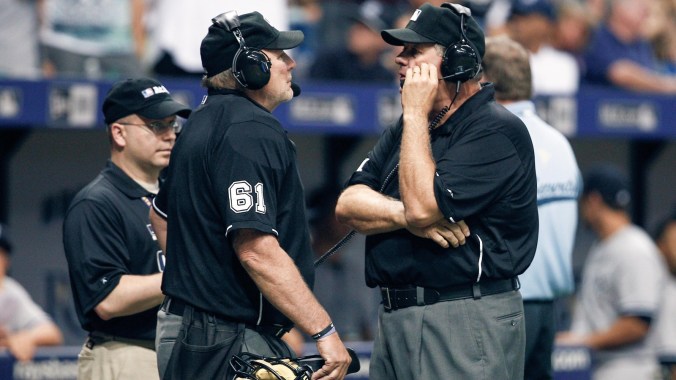
During last night’s Texas Rangers, in a crucial moment with the bases loaded, Rangers third baseman Adrian Beltre, waiting for his turn at bat,  suddenly turned up within a few of yards of home plate, watching a pitcher he wasn’t familiar with to give Beltre an edge when he got to the plate. Baseball’s rules, however, require that the next batter remains in the on-deck circle provided, which is closer to the dugout and not behind home plate. Reasons for this include making sure that on-deck batters don’t interfere with play, can’t relay stolen signs to the batter, and aren’t killed by foul balls.

The home plate umpire called time and told Beltre to get back in the on-deck circle. Beltre then moved the on-deck circle to where he had been standing.

The umpire threw him out of the game, and rightfully so. Continue reading

From The Law vs Ethics Files: The July 24, 1983 Pine Tar Incident, When Baseball Chose Ethics Over Law, And Was 100% Wrong

I have written on this topic before, but this is the famous incident’s anniversary, and I have come to believe that the lesson learned from  the pine tar incident is increasingly the wrong one, and the consequences of this extend well beyond baseball.

On July 24, 1983, the Kansas City Royals were battling the New York Yankees at Yankee Stadium. With  two outs and a runner on first in the top of the ninth inning,  Royals third baseman George Brett hit a two-run home run off  Yankee closer  Goose Gossage to give his team a 5-4 lead.  Yankee manager Billy Martin, however, had been waiting like a spider for this moment.

Long ago, he had noticed that perennial batting champ Brett used a bat that had pine tar (used to allow a batter to grip the bat better) on the handle beyond what the rules allowed. MLB Rule 1.10(c) stated: “The bat handle, for not more than 18 inches from the end, may be covered or treated with any material or substance to improve the grip. Any such material or substance, which extends past the 18-inch limitation, shall cause the bat to be removed from the game.” At the time, such a hit was defined in the rules as an illegally batted ball, and the penalty for hitting “an illegally batted ball” was that the batter was to be declared out, under the explicit terms of the then-existing provisions of Rule 6.06.

That made Brett’s bat illegal, and any hit made using the bat an out. But Billy Martin didn’t want the bat to cause just any out. He had waited for a hit that would make the difference between victory or defeat for his team, and finally, at long last, this was it. Martin came out of the dugout carrying a rule book, and arguing that the home run shouldn’t count.  After examining the rules and the bat, home-plate umpire Tim McLelland ruled that Brett used indeed used excessive pine tar and called him out, overturning the home run and ending the game.

Brett’s resulting charge from the dugout (above) is video for the ages. Continue reading