Nice, careful, professional work by the Federal Emergency Management Agency!
I’m kidding.
After a typhoon caused extensive damage to homes along Alaska’s western coast in September, FEMA’s job was to help residents repair property damage. Since most of the residents were native Alaskans, FEMA chose Accent on Languages, a Berkeley, California company, to translate its usual instructions on how to apply for aid.
They chose…poorly. The documents victims of the typhoon received would have been right at home in the Monty Python skit that featured translation book howlers like “My hovercraft is full of eels.” The Yup’ik and Inupiaq translations were nonsense. “Tomorrow he will go hunting very early, and will nothing,” read one mysterious passage. “Your husband is a polar bear, skinny,” another said. One document had bee translated into Inuktitut, an indigenous language that nobody uses in Alaska.
FEMA fired the translation company. It appears that the words in the “translated” documents were randomly lifted taken from Nikolai Vakhtin’s “Yupik Eskimo Texts from the 1940s.” “They clearly just grabbed the words from the document and then just put them in some random order and gave something that looked like Yup’ik but made no sense,” concluded an investigator.
The company’s CEO wrote, “We make no excuses for erroneous translations, and we deeply regret any inconvenience this has caused to the local community,” adding that FEMA would be getting a refund.
That video that I saw today on the Federalist site clinched two 2022 Worst of Ethics Awards for me, not that either was a tough call.
Unethical Rationalization of the Year:#64. Yoo’s Rationalization or “It isn’t what it is”
Frankly,Rationalization #64 would won this award in each of the past three years, which is pretty amazing for such a late addition to the list.
The reason, I think, is that the American public either has behaved so gullible and stpudly, or the political class and journalists have concluded that it is so gullible and stupid that the strategy of calling night day, day night,good bad, bad good and failure success has become too attractive to resist. 2022 was the zenith of this revolting development so far, but there is no reason to think 2023 won’t be worse. We’re hardly started, and there is Karine Jean-Pierre telling reporters that the White House is being transparent about Joe’s confidential documents stash while she refuses to answer questions about it. Last year, the administration line about the chaos at the border was that the border was secure. LGBTQ+ activists looked us right in our eyes and told us that a man became a woman simply by deciding he was, and sports leaders announced that biological men who were now trans women had no advantage over natural-born women in athletic competitions while it was obvious that they did. Meanwhile runaway inflation wasn’t runaway inflation, Twitter’s partisan censorship wasn’t partisan censorship. John Fetterman was not cognitively impaired by his stroke. The January 6 House inquiry was unbiased and fair, with no partisan objectives. And when Joe Biden gave his Reichstag, he sounded and looked like a Nazi while accusing Republicans of being Nazis. There’s lots more. I’ve never seen anything like it. Continue reading →
What possible justification could there be for Democrats to oppose releasing all of the footage of the January 6 riot for public viewing?
Last week, Speaker McCarthy said he will make public the thousands of hours of footage from January 6, 2021 riot at the Capitol as the “public should see what happened” that day, rather than rely on the report from the rigged and partisan House Select Committee that (sort of )investigated the event. Democrats don’t want the stuff released. Why?
Appearing o MSNBC, where outageous statements are treated as pearls, former Democrat rep Elaine Luria, now just another MSNBC Democratic Party mouthpiece, argued,
If you release all of the security tapes at the Capitol… every bit of information that would lay out a road map for someone who wants to come try to do something like this again, that is really dangerous for the future security of the Capitol… A large portion of the tapes have been released in different contexts.
Oh, well then..wait, what? A complete failure of a mob action might provide guidance to “someone ” who wants to do the same thing because it was such a roaring triumph?
I thought public information and transparency were always good things in a democracy. Why wouldn’t Democrats want the public to see all the horrors of what they have compared to the Civil War, Pearl Harbor and 9-11? Most of the approximately 14,000 hours of footage from that day has never been reviewed by the public or the media. Full transparency doesn’t cause conspiracy theories; it defeats them. It’s like the JFK assassination files and UFOs.
I wonder: which is more significant in U.S. ethics history? On this date in 1961, President Dwight D. Eisenhower sounded his famous warning about the malign influence of the growing perpetual military bureaucracy and the industrial interests dependent upon it, a “military-industrial complex” that benefited from war and was vulnerable to an abuse of power.. Eisenhower warned, “[while] we recognize the imperative need for this development…We must not fail to comprehend its grave implications we must guard against the acquisition of unwarranted influence…The potential for the disastrous rise of misplaced power exists and will persist.” Largely forgotten now was Ike’s other admonition: “As we peer into society’s future, we–you and I, and our government–must avoid the impulse to live only for today, plundering, for our own ease and convenience, the precious resources of tomorrow,” he said. “We cannot mortgage the material assets of our grandchildren without risking the loss also of their political and spiritual heritage.”
Then there was 1994, when on this date Paula Jones accused Bill Clinton of sexual harassment, leading to Clinton’s in-court perjury and, indirectly, his impeachment via the Monica Lewinsky mess. Clinton, I believe, corrupted the entire Democratic Party, made George W. Bush’s election possible, and began the decline of the respect and credibility the U.S. Presidency must have to be effective.
Or maybe, in some sense, this date in 1964 planted a truly insidious seed of ethics rot in our culture. On this date, NBC gave the go-ahead for the production of “The Monkeys,” a TV sitcom about a fake pop band modeled on the Beatles as they were portrayed in “A Hard Days Night.” Eventually assembled from struggling musicians and two has-been former child stars, the briefly successful development began the toxic trend of ersatz celebrity, even though, as it turned out, the fake band wasn’t much worse than a lot of the real bands the Sixties inflicted on us.
1. MLK pornographic sculpture update: In an op-ed in the Boston Herald, Rasheed Walters wrote in part of the fiasco,
The Boston Common’s illustrious history and Boston’s popularity as a tourist destination made this opportunity to honor the Kings that much more fitting. Furthermore, this statue will represent how far Boston has evolved in the last 50 years from a racist city to a world-class city inclusive of all people, reflecting Dr. King’s dream [but] the statue that was supposed to symbolize an embrace between Dr. King and Mrs. King was nothing more than two arms detached from a body. Depending on the angle, the statue appeared to be feces, sexual innuendo, or a “woke penis,” as described by the New York Post. The “Embrace Statue” is an utter insult to the honor and legacy of the Kings, an embarrassment to the city of Boston, and an aesthetically unpleasant addition to the country’s oldest park….This spectacular failure has been the subject of countless jokes around the country. However, Black Bostonians are not laughing; we are outraged, dissatisfied, and upset that this opportunity was squandered. We don’t see any statues depicting the severed arm of General George Washington brandishing a sword. So, why should we see statues of our African American heroes mutilated?
I watched “Bananas” for the first time in decades. It was influential on better comedies to come, notably the Zucker-Abrahams films, and Mel Brooks stole some of the gags (as have I, in some stage shows). I had forgotten that Marvin Hamlisch did the (annoying) score and that Sylvester Stallone appeared as a subway thug in an uncredited role. But it’s no use: I just can’t enjoy watching Woody Allen now that I know what a toxic creep he is. Cognitive dissonance strikes again!
I also watched an ethically provocative 2020 revenge drama called “Becky,” in which a bullied and depressed thirteen-year-old girl methodically and diabolically foils four escaped convicts who invade her father’s home and murder him. “Foils” is an understatement: she stalks, traps and kills all four in progressively more cruel and vicious attacks. I was about half-way through when I realized the story was basically “Home Alone” without the gags.
1. What hacks these people are...Ann Althouse flagged a ridiculously strained piece by Jonathan Chait in New York Magazine “explaining” why Joe Biden (as VP) keeping classified documents he wasn’t authorized to have is so much more innocent and forgivable than Donald Trump (as President). I have read so many of these, and they are useful reminders of just how partisan and foolish the mainstream media is. Chait is such a reliable Democratic spinmeister and rationalizer that this article was highly predictable: he was one of those who attributed Hillary’s loss to Trump to the fake historical “fact” that the same party seldom wins the White House for three straight terms—you know,except for 1920, ’24, and ’28, then 1932, ’36, ’40, ’44 and ’48, then 1980, ’84 and ’88, with only the Electoral College stopping a 1992, ’96, 2000 run, just like it stopped a 2008, ’12, ’16 string. (I know I’m unreasonably triggered by that false factoid, but I can’t help it.)
2. On ABC’s brain-rotting public events show “The View, meanwhile, co-host Joy Behar exclaimed, “Just as we’re this close to getting [Trump], somehow these documents appear.” Then slightly less stupid (but equally biased) co-host Sunny Hostin added, “Does it feel like the Republicans are behind it?”
Barbara Walters, who died this month to many accolades, really stained her legacy by inflicting “The View” on America
Some follow-up items before we get to the real stuff:
I have two more parking lots to report on as I seek evidence on why parking head-first is the most ethical procedure. In my Harris Teeter’s underground garage, notorious for its narrow spaces, the count yesterday was 73 straight in and just 8 back first. Yet the only space available for me involved getting into a tight spaces with a “Backie” on my left and a “Frontie” on my right. For some reason, debaters on this post didn’t seem to see why this is a problem. My answer: try it. If you get close enough to the properly parking car on the right to have room to get out on the left it is impossible to allow the obnoxious “Backie” driver on the left to have a shot at getting into his car if he weighs 280 pounds while not beating MY door full of dings—and I have to squeeze through a barely opened door to get out myself without dinging his car. In my wife’s doctor’s medical building parking lot this morning, it was much closer 22 back-ins to 42 straight ins. But 1) the lot was only half full and 2) it has much wider spaces.
I swear I’ll finish the count-down to determining Joe Biden’s competition for Worst President Ever. The last segment was issued in August. I think I can do it a single post; I’m sorry this has dragged out. Yesterday I heard an old stand-up routine by David Cross (who can be clever, but he’s a dick) arguing that George W. Bush was the worst President, and he began by saying that GII was even worse than “Millard Fillmore and James K. Polk.” That statement is a tell: he doesn’t know what he’s talking about. Millard wasn’t bad at all, especially for Vice-President who had to take over, and Polk was arguably a great President, and the best one term POTUS ever. If you think Polk was bad, I don’t really care what your Presidential ranking is. You’re ignorant, and so is anyone who laughs at your critiques. I bet 90% of his crowd couldn’t pick Polk out of a line-up.
My Trump-Deranged, Wuhanphobic but otherwise reasonable Democrat sister, expressing disgust with the Biden classified document scandal, said that she hoped somehow both Trump and Biden could be convicted of crimes sufficiently serious to make them ineligible to run in 2024. I told her that there is no such crime, but that I would gladly take that trade, and so would a lot of people in both parties.
1. I’m sure it’s just a coincidence. The interim superintendent of Loudoun County schools announced that at least three high schools, Potomac Falls, Freedom, and Loudoun County, did not tell students they had received the National Merit Scholarship awards.That is now a total of six Virginia high schools that prevented deserving students from notifying colleges of their honors in early-admission applications. The official line is that it was a one-time mistake….that just happened to occur in six Northern Virginia high schools at the same time, all overseen by an “equity consultant” whose stated objective is “equal outcomes” for all students regardless of performance. Glenn Reynolds’ rueful comment ends with a quote from “War Games:
You want to live in an area with the “best” public schools, but nowadays those schools are so woke that they sabotage your kids’ college chances in the name of “equity.” And then, even if those schools get your kid into a prestigious college, employerswon’t want to knowabout it, also in the name of equity? And diversity consultants say tohire people without degreesanyway to promote diversity. What a strange game. The only way to win is not to play.
2. Speaker McCarthy fails an integrity check. (Of course he does.) There are calls for Rep. George Santos–you know, the fake Congressman— to resign coming from the New York delegation of Republican members of Congress and state party officials. But at a news conference yesterday, McCarthy said that he had no intention of barring Santos from congressional committees or penalizing him for winning election under false pretenses. “The voters of his district have elected him,” Mr. McCarthy said. “He is seated. He is part of the Republican conference.”
I have to confess, this past week has me feeling overwhelmed. There may have been other weeks where the mendacity, corruption and hypocrisy were more apparent, and the prospects for a healthy nation and an ethical culture seemed dimmer, but I must have repressed those memories.
Yesterday, fraudulent GOP House member George Santos said that he had “led an honest life,” Joe Biden excused the latest discovery of classified documents in his garage by saying the garage was “locked,” and three more Virginia high schools admitted that they had withheld notice of National Merit Scholarship awards from students. The school superintendent, who is an DEI consultant and who pledged to seek “equal outcomes” for all students, swears these were independent, unrelated “mistakes.” All made by six high schools in her state. Coincidentally.
Dilemma: the warm-ups and their equivalents take more time to prepare and post than regular, single topic posts, and usually generate less traffic. Yet without them, EA would fall hopelessly short of covering as many interesting and relevant ethics topics as they arise. The suggestions from readers (that’s jamproethics@verizon.net, folks!) help a lot. Dribs and drabs to get ME warmed up…
Once again, a kamakazi jogger charged silently out of the darkness right at Spuds and me, requiring me to yank my dog back with all my weight to protect the fool from a lunge by a 70-pound pit bull mix. I initially said, “Sorry, didn’t see you,” thought better of it, and called after him, “LIGHTS, asshole!” It’s amazing how frank one can be with a large dog at the ready…
Speaking of pit bulls, Sadie Davila, 7, died after she was attacked by a neighbor’s pit bull in Baton Rouge last week. The articles have been, as usual, filled with the false stats about the “breed” (actually at least four distinct breeds) spread by the despicable and destructive Dogsbite.com. This time, at least, the dog really was an American Pit Bull Terrier based on the photo: I check these things, and often the alleged “pit bull” is something else, accounting for the inflated statistics. The owner is under arrest, because he let the dog roam free. I’m just guessing what kind of treatment, care and training this dog got from an owner that irresponsible: this is another factor in the large number of pit bull attacks. It’s the dog of choice for irresponsible people who should never be trusted with a Yorkie, never mind a larger breed,
Neil Dorr was kind enough to pass along this funny piece in the Hill. Now Biden and Co. are swearing that nobody ever, ever considered banning gas stoves. This is because to outpouring of anger from more than one side of the political spectrum was so vociferous after CPSC commissioner Richard Trumka Jr. said that a forthcoming information request from the committee might be “the first step in what could be a long journey toward regulating gas stoves,” as The Hill reported at the time and that said that an outright ban was “a real possibility.” An honest, trustworthy government would just say after the public reaction to this (lead) trial balloon, “Well, the public has spoken, so we will cease any efforts to limit the use of gas ovens.” But no. Instead, this administration acts as if the news media made the whole thing up.
1. See the Washington Post spin.Spin spin, Post! Ace of Spades has a rueful and deft take-down of the Washington Post’s Dervish-like coverage of a new study that concludes that “Russian influence operations on Twitter in the 2016 presidential election reached relatively few users, most of whom were highly partisan Republicans, and the Russian accounts had no measurable impact in changing minds or influencing voter behavior.” “But the study doesn’t go so far as to say that Russia had no influence on people who voted for President Donald Trump” writes the Post. Ace: “Oh, it doesn’t say there was zero influence, so let’s assume we’re still Basically Right.” The Post, as we all know, was one of the leaders of the “Trump had Russia steal the election from Hillary” narrative. The Post: “It doesn’t examine other social media, like the much-larger Facebook….” Ace: “Where Russian-affiliated companies spent a staggering One Hundred and Fifty Thousand Dollars on ads.” The Post: “Nor does it address Russian hack-and-leak operations….” Ace: “Like the Hunter Biden laptop…The article keeps bringing up “hack-and-leak operations.” Let’s be clear about what happened there: Hillary Clinton and the DNC rigged the primary against Bernie Sanders, and leakers exposed this fact. That wasn’t a lie. That wasn’t “Russian Disinformation.” That really happened. The leakers just revealed the truth which Hillary Clinton, the DNC, and her Media Mafia wished to conceal.” Continue reading →
(Let’s see if I can get WordPress to behave this time, unlike in the previous post...)
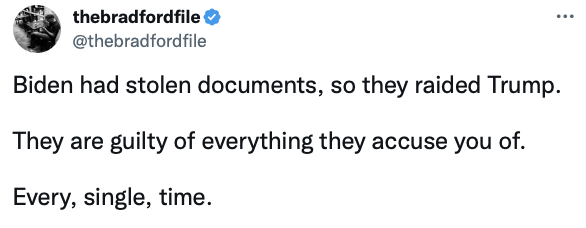
Double Standards Alert! Classified documents were found in a locked closet in an office used by Joe Biden at the Penn Biden Think Tank, formally known as Penn Biden Center for Diplomacy and Global Engagement at the University of Pennsylvania.
The fact that there is something akin to a “think tank” named after Joe Biden is itself hilarious, as it would be hard to imagine a public figure in US history whose intellectual abilities have been so frequently exposed as lacking over such a long career, even before he began slipping into dementia. This is like having an Orson Welles Fitness Institute. Baseball fans would find the Mario Mendoza Center for Batting Science similarly risible. The George Santos Integrity Academy. It’s another parlor game! I’d include Hillary Clinton endorsing #MeToo, but that’s real.
But let’s move on to the classified documents themselves. You know this is going to be reported as a “Republicans pounce!” story, but they should pounce. President Biden was recently asked on “Sixty Minutes” about the classified documents the FBI found in former President Trump’s home and he said he thought to himself, “How anyone could be that irresponsible?” In truth, a President has a much better defense to having classified documents in his possession after he leaves office than a Vice-President, because a President can declassify them. Here was a good pounce:
The stench of double standards pervades the entire Biden Presidency and the media’s coverage of it. Meanwhile, it is fun to watch the mainstream media hustle to minimize the damage. In this case, it perfectly explicates the rueful Ethics Alarms category, IIPTDXTTNMIAFB(“Imagine if President Trump did X that the news media is accepting from Biden.”)
“This was only a small number and we need to prop up Joe Biden and rules don’t apply to Democrats, they’re on our side. And the fact that we hid it until after the mid-terms means nothing, you smelly Walmart shopper.” That’s their story and they are sticking to it…You know what will happen, my fellow Deplorables. Abso-freaking-lutely nothing. Biden cooperated. It was a small number. It’s old news. Move on.






 Ethics Alarms