King refused to apply his usual ethics alarms to Obama, but continued to be a credible and objective analyst where the D.C. government was involved. He was an instant Donald Trump-hater, however. the second the 2016 results were known. I can understand reaction to the two-time runaway winner of the Ethics Alarms “Asshole of the Year” award. But King concluded Trump was a racist—his embrace of birther accusations against his beloved Obama was enough to guarantee that—and once Trump was elected, King became the Post’s counterpart to Trump-deranged Times columnist Charles M. Blow, except that King at his worst is usually more endurable than Blow at his best.
King’s latest anti-Trump screed, however, shows how far a smart pundit can fall when the cognitive dissonance scale and confirmation bias work in tandem, especially when old age marches on and one is mired in both work and personal bubbles where a single bias dominates.
I don’t think it is a good bet, though it is certainly possible. King assumes it is a good bet, as his column makes clear (along with all of his previous columns relating to Trump) because he thinks of the President as a corrupt racketeer. King’s once nimble mind is now incapable of imagining a justification for pardoning the “allies” in question, Roger Stone, Mike Flynn, and Paul Manafort. I can: arguably all three of them were indicted and convicted because of the “resistance”effort to try to drive Donald Trump from office, and to send a message to anyone who might be of value to his administration that they would instantly be in cross-hairs if they dared to try to support the President. President Trump might feel responsible for their plight, and use his absolute clemency power to relieve their burdens. If so, it would not be an unprecedented political or personal use of the pardon and clemency power. King reallywas just using this question as a pretense to vent about the President, whom he detests, shredding his own credibility in the process. For example, Continue reading →
As regular readers here know, I often criticize TV ads for sending unethical messages or endorsing unethical conduct. I have even been accused of being hypersensitive on the subject. With the controversial Peloton commercial above, I missed it, if there was an it to miss.
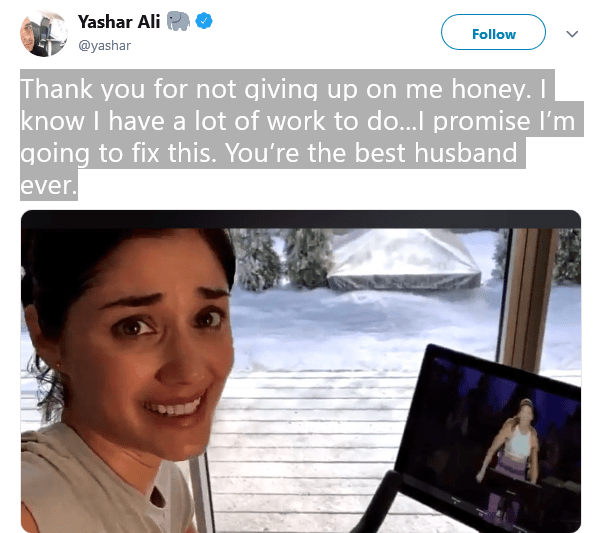
The surprising thing is that a lot of the objections to the ad are coming from the Right. If I had bothered to think about the Peloton commercial, I would have perhaps detected that it was sexist, with a critical husband demanding that his already apparent fit and lovely wife get in better shape, and she dutifully complying. Indeed the Left was annoyed: Yashir Ali, who writes for HuffPo and New York Magazine (and you know what THAT means) captured the spirit of the objections:
Another tweeter wrote, “So sweet. My husband was inspired by the Peloton ad to get me a pair of pants in a child’s medium and a handwritten note that says “Don’t fucking touch me till you can fit into these.”
The weird part is the … eagerness with which she shows her gratitude. It’s lovely to be grateful for an expensive gift, but she’s *really* grateful and *really, really* wants her husband to know it. It’s not just that she feels compelled to record herself using the bike repeatedly over a span of many months. She looks curiously anxious doing it, even when smiling into the camera. At the end of the clip, when she finally shows him the footage, her eyes are trained on his reaction, seemingly desperate for his approval. Is, um… How do I put this? Is everything okay between these two?
Towards the end of British author Douglas Murray’s latest book The Madness of Crowds is a call to find significance beyond politics:
“One of the ways to distance ourselves from the madness of our times is to retain an interest in politics but not to rely on it as a source of meaning. The call should be for people to simplify their lives and not mislead themselves by devoting their lives to a theory that answers no questions, makes no predictions and is easily falsifiable.Meaning can be found in all sorts of places.For most individuals it is found in the love of the people and places around them: in friends, family and loved ones, in culture, place and wonder.A sense of purpose is found in working out what is meaningful in our lives and then orienting ourselves over time as closely as possible to those centres of meaning. Using ourselves up on identity politics, social justice and intersectionality is a waste of a life.”
Murray ends his book arguing, “To assume that sex, sexuality, and skin colour mean nothing would be ridiculous. But to assume that they mean everything will be fatal.”
In the last year and a half my wife and I have lost six loved ones, including two grandmothers last month, only three weeks apart. Between us we have lost three grandparents, a cousin, an aunt, and my father. Ours has been a house of grieving that has prompted both of us to re-examine what has brought us a sense of purpose and what we need to focus our energies on in the future.After spending not just years but decades fighting for equality, it has become clear, with so much death, that such supposed noble efforts have only rendered a more broken heart in a more broken world.
At the age of fourteen I went to my first protest to express concern for the United States involvement in El Salvador. At the time, I didn’t really know what our country was doing wrong but I did know that the exhilaration of marching in the middle of the street, after the police told us through their bullhorns not to, while yelling various slogans repeatedly, was intoxicating.All my frustration with whatever complications life had thrown my way dissolved instantly.Suddenly I was a part of something bigger than myself while believing my actions and those of the other protesters were on “the right side of history” (see 1B. The Psychic Historian on the list of Unethical Rationalizations and Misconceptions). For a somewhat shy teenager, I was instantly transformed by that march into a powerful person. Continue reading →
Presidential Thanksgiving Addresses, which used to be a big deal but which have fallen by the wayside. Winston Churchill had a memorable one too, on November 23, 1944:
We have come here tonight to add our celebration to those which are going forward all over the world, wherever allied troops are fighting in bivouacs and dugouts, on battlefields, on the high seas, and the highest air. Always this annual festival has been dear to the hearts of the American people. Always there has been that desire for thanksgiving, and never, I think, has there been more justification, more compulsive need than now.
It is your Day of Thanksgiving, and when we feel the truth of the facts which are before us, that in three or four years the peaceful, peace-loving people of the United States, with all the variety and freedom of their life in such contrast to the iron discipline which has governed many other communities – when we see that in three or four years the United Sates has in sober fact become the greatest military, naval, and air power in the world – that, I say to you in this time of war, is itself a subject for profound thanksgiving.
We are moving forward in this struggle which spreads over all the lands and all the oceans; we are moving forward surely steadily, irresistibly, and perhaps with God’s aid, swiftly towards victorious peace.
There again is a fitting reason for thanksgiving, but I have spoken of American thanksgiving. Tonight here, representatives of vaster audiences and greater forces moving outside this hall, it is British and American thanksgiving that we may celebrate today. And why is that? It is because under the compulsion of mysterious and all-powerful destiny we are together.
We are joined together, shedding our blood side by side, struggling for the same ideals, and joined together until the triumph of the great causes which we serve has been made manifest.
“Now therefore I do recommend and assign Thursday the 26th day of November next to be devoted by the People of these States to the service of that great and glorious Being, who is the beneficent Author of all the good that was, that is, or that will be—That we may then all unite in rendering unto him our sincere and humble thanks—for his kind care and protection of the People of this Country previous to their becoming a Nation—for the signal and manifold mercies, and the favorable interpositions of his Providence which we experienced in the course and conclusion of the late war—for the great degree of tranquillity, union, and plenty, which we have since enjoyed—for the peaceable and rational manner, in which we have been enabled to establish constitutions of government for our safety and happiness, and particularly the national One now lately instituted—for the civil and religious liberty with which we are blessed; and the means we have of acquiring and diffusing useful knowledge; and in general for all the great and various favors which he hath been pleased to confer upon us.”
The first assertion I would make is that we now live in outcomes of the Civil conflict of the mid-1800s. Some historian, I forget who, said that the Civil War or War Between the States was the ‘defining event’ that frames everything. When I heard it, I didn’t understand. Now I think I understand better.
There are many aspects to this, of course, but the one that most strongly comes to my mind is this imperious (that is how I see it) declaration made by President Lincoln which is a rhetorical marvel but, in fact, a group of powerful lies. Did the ‘glorious being’ desire that a civil war divide a people? Did the glorious being ‘give thanks’ that 700,000 men were killed as a result of an internal war that fractured the Republic? Was the ‘glorious creator’ standing behind the North in its imperious claim to define a ‘nation’ whose identity it would control? The questions could go on & on & on… Continue reading →
There are many lessons, ethical and otherwise, to be learned from Charleston, West Virginia’s short-lived “Winter Parade.” I originally missed the story, which apparently took place over three days in October. Fox News, which has led the “War on Christmas” narratives since the days of Bill O’Reilly, covered it.
Even before Halloween, Charleston’s new mayor (and its first female occupant of the office) Amy Goodwin sent out a Facebook announcement that “The Charleston Winter Parade will begin at the corner of the Kanawha Boulevard and Capitol Street.” For years, the city has had an old-fashioned “Christmas Parade” (you know, like they show in “A Christmas Story” ?) with Christmas-themed floats, marching bands, fire trucks, Shriners in their tiny cars and Santa Claus. Suddenly it was officially a Druid-sounding “Winter Parade” because Mayor Goodwin wanted to signal that her city embraced all faiths and cultures. “I wanted to show that Charleston is a welcoming and inclusive city,” she said.
A large number of Charleston residents didn’t welcome her unilateral decision at all. “The new mayor needs to be voted out if she does away with the Christmas parade,” read an early comment on ther Facebook post. “Christmas is all about Christ, not some winter parade.” Columnists and radio shows weighed in, almost unanimously condemning her decision. The largely white and Christian city of 48,000 hadn’t exactly been racked with controversy over the Christmas parade, but now renaming the parade felt to many like a rejection of Christianity and tradition.
The New York Times quoted the president of the West Virginia Chamber of Commerce in Charleston, Steve Roberts: “The community reaction was a collective groan, It’s a cute little parade with cute little kids and can’t we just have a Christmas parade?”
The change threatened to start a chain reaction. The Times story says that Brandon Willard, a junior high band teacher, began to worry about his musical selection for his student band scheduled to march in the parade: Leroy Anderson’s “Sleigh Ride.”It’s a secular Christmas tune of long-standing (they always played it at my High School Christmas assembly), but Willard became worried that he would be accused of having the band take side. Maybe parents would pull their children from the parade in protest, maybe even preventing the band from having enough musicians to march. It would be a big disappointment to the students, who march every year in Santa hats and with decorated instruments, and this year, with new light-up necklaces he had ordered. The parade also counted toward their grade. Continue reading →
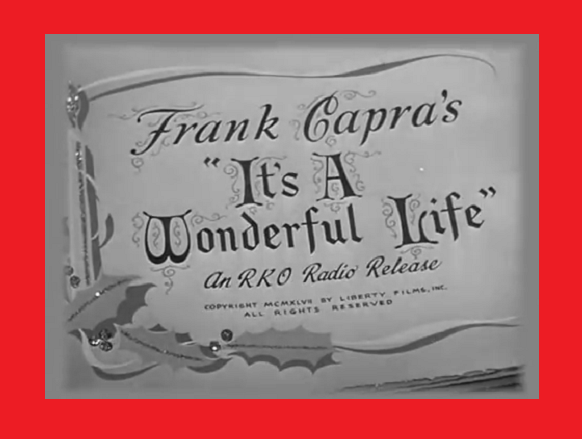
The Ethics Alarms Ethics Guide to Frank Capra’s 1946 masterpiece “It’s A Wonderful Life,”perhaps the greatest ethics movies of all time, has become this blog’s official welcome to the holiday season. Once again, I have reviewed the post after another viewing of the film. It is a mark of the movie’s vitality that I always find something else of interest from an ethics perspective.
The movie is an important shared cultural touch-point,and exemplifies the reasons why I harp on cultural literacy as so vital to maintaining our nation’s connective tissue. The film teaches about values, family, sacrifice and human failings unlike any other. I hope its power and uniqueness disproves the assertion, made in one online debate here this year, that new cultural creations inevitably and effectively supersede older ones, which, like copies of copies, eventually the cultural values conveyed get fainter and less influential.
Last year I wrote with confidence, “No, they really don’t,” but now I am not so sure. In , I learned that my druggist, about 35, married and with children, had never seen the movie. I gave him a DVD over the summer, and suggested that he watch it with his whole family, which he said he would: he moved on to another CVS branch, so I have no idea if he did or will. I used to be amazed at how many people haven’t seen the movie; now I am not. Last year I wrote that my son’s girlfriend admitted that she hadn’t; this year he has a new girlfriend, and she hasn’t either.
The movie is in black and white, and many Gen Xers and Millennials disdain uncolored films the way I once avoided silent movies. Will anyone be watching “It’s A Wonderful Life” 20 years from now? I wonder. The movie begins in heaven, and has a strong religious undercurrent. Religion is increasingly mocked and marginalized today, and I see no signs that the trend is reversing. Aside from the nauseating Hallmark Christmas movies, most of this century’s holiday fair is openly cynical about Christmas and everything connected to it.
Here’s an example of how rapidly cultural touchpoints vanish: I’m going to poll how many readers remember this:
Deck us all with Boston Charlie, Walla Walla, Wash., an’ Kalamazoo!
Nora’s freezin’ on the trolley, Swaller dollar cauliflower alley-garoo!
Don’t we know archaic barrel Lullaby Lilla Boy, Louisville Lou?
Trolley Molly don’t love Harold, Boola boola Pensacoola hullabaloo!
Bark us all bow-wows of folly, Polly wolly cracker ‘n’ too-da-loo!
Donkey Bonny brays a carol, Antelope Cantaloupe, ‘lope with you!
Hunky Dory’s pop is lolly, Gaggin’ on the wagon, Willy, folly go through!
Chollie’s collie barks at Barrow, Harum scarum five alarm bung-a-loo!
Dunk us all in bowls of barley, Hinky dinky dink an’ polly voo!
Chilly Filly’s name is Chollie, Chollie Filly’s jolly chilly view halloo!
Bark us all bow-wows of folly, Double-bubble, toyland trouble! Woof, woof, woof!
Tizzy seas on melon collie! Dibble-dabble, scribble-scrabble! Goof, goof, goof!
Now just answer the poll, don’t go giving away the answer. Nobody knows all the lyrics that I just posted, nobody but the author ever did. The first verse, however, was once familiar.
Maybe there is hope: it was recently announced that a new musical adaptation of the movie may be coming to Broadway as early as next year. The songs will be written by Sir Paul McCartney, and interest in The Beatles is surging.
“It’s A Wonderful Life” would be an excellent basis for a middle school ethics course. I haven’t seen a better, richer film for that purpose come along since, and I’ve been looking. Despite the many ethics complexities and nuances that the film glosses over or distorts, its basic, core message is crucial to all human beings, and needs to be hammered into our skulls at regular intervals, far more often than once a year.
What is this message? In an earlier posting of The Guide I described it like this:
Everyone’s life does touch many others, and everyone has played a part in the chaotic ordering of random occurrences for good. Think about the children who have been born because you somehow were involved in the chain of events that linked their parents. And if you can’t think of something in your life that has a positive impact on someone–although there has to have been one, and probably many—then do something now. It doesn’t take much; sometimes a smile and a kind word is enough. Remembering the lessons of “It’s a Wonderful Life” really can make life more wonderful, and not just for you
Finally, I hope you all have a terrific Thanksgiving, and that the holiday season is joyous for all.
1. More trivial ethics: Watching Season #2 (2015) of the excellent Stephen Bochco procedural “Murder One,” my wife and I were stunned to hear an expert witness in the trial of one of the teenage shooters in a school bus mass murder point out, while noting that most sociopaths don’t kill people, the Jack Kennedy and Bill Clinton were examples of very successful sociopaths. It’s very unusual to see favored progressive narratives challenged in television dramas. Of course, this would have been an opportunity for Trump-bashing had the show been filmed a couple of years later.
2. Ew. Matthew Lebsack, an 18-year employee of the Union Pacific Railroad Co., defecated on a train-car knuckle three years ago, threw feces-covered toilet paper out of the locomotive window, and informed his manager that he had left a “present” for him. Lebsack’s co-workers cleaned up his droppings using bottled water and paper towels.
At the investigation hearing, Lebsack admitted the specifics of the incident and apologized for his behavior. He claimed he was suffering from irritable bowel syndrome, and his wife had just left him at the time of the incident.
I wonder why?
Yeah, that justifies throwing one’s poop around the workplace. Lebsack was fired, shockingly. His union, the International Association of Sheet Metal Air, Rail, and Transportation Workers-Transportation Division, or SMART appealed and the matter was sent to an arbitration board.
The arbitration board found that firing “was too harsh.” That’s good to know, just in case a clueless ethics class frustrates me so much I decide to take a dump on the podium. Lebsack’s medical and psychological issues were deemed to be sufficient mitigation that board ordered Lebsack to be reinstated once he successfully completes a physical and a psychological evaluation. Union Pacific appealed to vacate the decision and SMART sought to enforce it.
U.S. District Judge Brian Buescher ruled that, under the Railway Labor Act, he was without authority to review the merits of the board’s interpretation of the collective bargaining agreement. Buescher said the arbitration board’s decision fell within its discretion, although he admitted that he didn’t understand its reasoning. Continue reading →
A lawyer for Utah’s chapter of the ACLU asked Utah Judge Kara Pettit to rule that the state’s lewdness law violates the Constitution by treating women differently than men and thus violating the Equal Protection Clause. The statute makes it a crime to expose “the female breast below the top of the areola” in the presence of a child in a private place “under circumstances the person should know will likely cause affront or alarm.”
Tilli Buchanan, 27, faces imprisonment, fines and the requirement to register as a sex offender for 10 years if convicted of violating the law, which she certainly did. Buchanan and her husband had been installing drywall in the garage, and they had taken off their shirts that had become scratchy from the fibers, she told reporters. When her stepchildren, aged 9, 10 and 13, walked in, she “explained she considers herself a feminist and wanted to make a point that everybody should be fine with walking around their house or elsewhere with skin showing,” her lawyers wrote in court documents. Here’s Tilli…
Just kidding.
Lawyer Leah Farrell of the ACLU says the law requires women to do a “mental calculation” about whether going topless would cause alarm. But men can go shirtless without violating the law and without making that calculation. “That really sets up an unequal and unfair dichotomy,” Farrell says.
Prosecutors say that Buchanan stripped in front of the children and was under the influence of alcohol at the time. They also claim she said she would put her shirt back on if her husband showed her his penis.
Or so it seems, anyway. Have people already started ignoring life for Thanksgiving? Or am I being punished for not being able to squeeze enough posts out while driving, flying, typing in crowds and moving in and out of various abodes while trying to work? To make it worse, there was a lot going on that required some time and solitude to research and analyze, and I just didn’t have it. I also managed to make myself sick. Tuesday and Wednesday had the worst non-holiday mid-week traffic of 2019, and Saturday had the lowest number of visits for that day in three years.
Well, as Andy Kinkaid, my late, cynic-philosopher college roommate, a ruined Vietnam veteran, used to respond several times each day to every argument, disappointment, tragedy, catastrophe, and piece of bad news as he smiled and retreated to his darkened room to get stoned, “Fuck it, right?“
1. Apparently there is a copyright battle over the obnoxious catch-phrase “OK, Boomer!,” the viral dismissive insult being hurled at Baby Boomers who dare to question the wisdom, passion, and hive-mind beliefs of Gen. Z-ers and Millenials. It looks like all such efforts to “own” the phrase are doomed, because it has rapidly become so ubiquitous as a put-down so quickly that nobody can prove it originated with them.
Has it occurred to any of the smug little snots brushing aside their elders that this is nothing but a personal ad hominem attack without substance, no more fair or valid, and just as rude and bigoted, as “Shut up, bitch,”“Go home to your mother, Pee-Wee,” or “Get a job, Pedro”? As a Baby Boomer, I think we ought to agree on a standard retort to “OK, Boomer” of equal substance and wit, and I hereby nominate “Keep flailing, Dumb-Ass!”
2. Speaking of Millennials, a New York Times social columnist informs me that they have decreed that on-line the term “OK” or “Okay” is now considered rude, and the proper term is “k-k,” which sound to me like a Klan chapter short of members, or someone with a stutter. Just because you want to create ugly and pointless new conventions to metaphorically mark your cyber-territory doesn’t mean I have to assent.
And no, I never have and never will use LOL or LMAO. They’ll have to shoot me first. Continue reading →
The Economist surveyed five different countries, asking respondents what kind of conduct they viewed as sexual harassment.
Some examples (such as requesting a sexual favor) were obviously inappropriate, and were classified as such across all countries. Asked if a compliment on a woman’s appearance could be classified as sexual harassment, U.S. were a different matter. roughly a third of those under 30 in the U.S. answered, “Yes.”
Here’s the survey….
Thus we see how #MeToo propaganda has succeeded in convincing a large proportion of Americans that the simple act of engaging in the long-standing, traditional social balm of being nice should be avoided and even punished. For them, an innocent compliment must be regarded with suspicion. Since whether an arguable sexually inspired comment makes the recipient “uncomfortable” and is therefore “unwelcome” is the necessary predicate to a sexual harassment complaint and law suit. Continue reading →






Presidential Thanksgiving Addresses, which used to be a big deal but which have fallen by the wayside. Winston Churchill had a memorable one too, on November 23, 1944:
In her Comment of the Day, on “Pre-Thanksgiving Day Ethics Wrap-Up, 11/27/2019,”Alizia points us to one of Abe Lincoln’s Thanksgiving speeches: