Good! A Spontaneous Memorial Day Weekend Outburst Of Patriotism…

…and it’s from California!

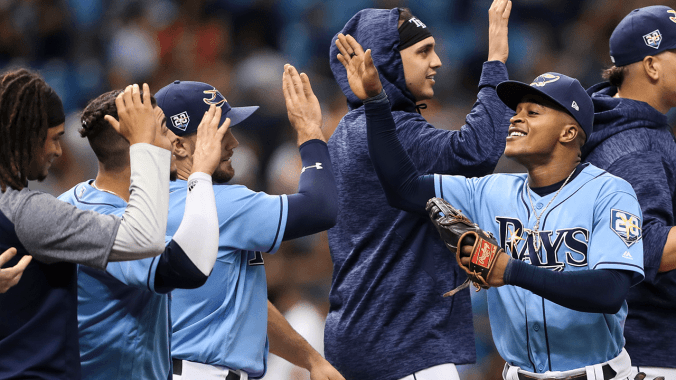
Before Clovis High played Buchanan for the Central Section Softball Championship being held at Fresno State’s Margie Wright Diamond, the announcer said,  ‘There will be no anthem, let’s just play softball!”

Many booed the announcement, then the crowd started singing the anthem anyway, a capella, as most in attendance removed their hats, put their hand over their hearts, and stood. The players stopped their pregame warmups to turn around and face the American flag that waved beyond the center-field wall; nobody knealt, apparently. When the anthem ended, the crowd burst into a round of applause.

THEN the two teams played softball.

More such spontaneous demonstrations of unity, community and patriotism would go a long way toward mitigating the divisions in this nation that so many are working so hard to exacerbate.

There is hope.

Comment Of The Day: “THAT’S The Concept I Was Looking For—’Cultural Vandalism’!”

Another perspective on the question  of how the personal and professional misconduct of artists should affect our regard for their art comes from Curmie, a drama teacher, director and blogger who has as deep credentials for this topic as anyone.

Here is his Comment of the Day on the post, THAT’S The Concept I Was Looking For—“Cultural Vandalism”!…

Back in graduate school, I worked as a teaching assistant to a brilliant professor, Ron Willis, in his Introduction to Theatre class. Seitz’s commentary intersects with two of the concepts Ron highlighted in his course. The first of those is what Ron called para-aesthetics: those elements which affect an audience’s reception of an aesthetic event without being the aesthetic event.

These can be entirely coincidental (it’s pouring rain) or created specifically by the production company (the poster). The company many have had some, but not complete, control over the influence (there’s insufficient parking, in part because of another event in the area). The para-aesthetic influence could apply to the entire audience (the leading actor is a big star, the auditorium is freezing) or to an individual (the leading actor is your best friend, the person next to you thinks that showers are for other people, you’ve had a couple glasses of wine before the show).

The fact that a Bill Cosby’s off-camera life has been considerably short of exemplary matters in a para-aesthetic way. But each individual spectator will respond differently to each impulse. That leading actor—my best friend—is someone else’s ex. Facebook tells me that a year and a day ago I saw a play in London with a young movie star in the title role. His presence mattered to me not a bit, but there were dozens if not hundreds of his fans in the house: people who were there specifically to see him. That play was an adaptation of a script I adore and indeed directed a few years ago. The fact that the play as presented bore little if any resemblance to the original bothered me a lot; those who didn’t know the 19th-century version were far more able to accept the 21st-century revision on its own terms. Continue reading

Morning Ethics Warm-Up, 5/22/2018: Blemishes

Goooood Morning!

1. What is so hard to understand about the concept of Freedom of Speech and Freedom of Assembly? The Daily Beast negligently covers a story about how some alt-right groups are planning some kind of anniversary/reunion event in Charlottesville. (Funny, I thought we celebrated anniversaries of good things) and how some activists are plotting to block them. I especially like this sentence:

“Activists warned Charlottesville last year that the Unite the Right rally could turn violent. Now they’re determined to keep neo-Nazis out of their city for the anniversary.”

The rally turned violent because the counter-demonstrators turned it violent with help from authorities, who couldn’t, couldn’t, or didn’t want to keep the alt-right and the antifa demonstrations away from each other. This is the Berkeley trick: “Your speech will incite violence from us, so its irresponsible for you to speak. This issue was supposedly settled when the ACLU fought to allow Nazis to march in Skokie, Illinois 40 years ago.  In the end, the Nazis didn’t march but the principle that they couldn’t be blocked because of their message was made clear. I wonder if the self-righteous, speech-restriction fans represented by Black Lives Matter activist Lisa Woolfork even know about that case, given such ignorant quotes as,

“[Charlottesville authorities] seem to have gotten the message that white supremacist ideology is dangerous, but they are not willing to take, I believe, the truly moral step to say Kessler’s rally is a white supremacist Nazi rally, and therefore is inimical to our values and that we can ban that.”

No Lisa, you can’t ban that. You can’t ban ideas, no matter how dangerous you think they are, or how dangerous they in fact may be. The theory that the government should ban speech based on morality is infinitely more dangerous than anything these alt-right jerks say, but you still have the guaranteed right to promote such democracy-rotting garbage. Another Lisa quote:

“We did not ignore the white supremacists and let them proceed to go about their business undisturbed without any censure. These ideas are harmful, and they lead to horrible consequences in the real world.”

And I repeat: What is so hard to understand about the concept of Freedom of Speech and Freedom of Assembly? It sure seems to be especially hard to understand for the Left recently. Continue reading

Comment Of The Day: “Morning Ethics Warm-Up Overstock, 5/15/ 2018: It’s Use Them Or Lose them…”

Good things can even come out of really dumb ethics episodes, like the effort to silence critics of illegal immigration by pointing out that they had legal immigrants in their lineage, a non sequitur if there ever was one.

This good thing is Greg’s Comment of the Day, on Morning Ethics Warm-Up Overstock, 5/15/ 2018: It’s Use Them Or Lose them…:

The notion that immigrants in the 19th and early 20th centuries assimilated much more quickly than today is largely untrue. In fact, most Americans in the early part of the 20th century believed that the failure to assimilate by Lahren’s ancestors and millions of others like them was a matter for grave concern. These days, we read over and over again that the laws passed in the 1910’s and 1920’s restricting immigration were motivated primarily by racism. But that is a gross distortion. If you read political commentary at the time when those laws were debated, you will certainly find discussion of race (usually referring to what we would now call “nationality,” not to what we now call “race”), some of it quite offensive to modern sensibilities.

But the most important concern expressed by immigration restrictionists was that too many immigrants were failing to assimilate. Most immigrants were not becoming citizens. Consulting my grandfather’s trusty, albeit brittle and yellow, 1924 World Almanac, I see that in 1914, the last year before the first restrictive immigration act was enacted, the Census Bureau reported that there were 1.2 million immigrants to the United States but only 0.1 million naturalizations.

The vast majority of immigrants moved to a few large cities in the North. Census figures in 1910 revealed that in most major northern cities, Americans born of parents who had been born in America (as shorthand, in order to avoid wordy repetition, I’ll call them “American-Americans”) were outnumbered by immigrants and their children. In many cities, the number of immigrants was more than twice the number of American-Americans, and the number of immigrants and their children (about two-thirds of them born to two immigrant parents) was often three to four times the number of American-Americans.

Moreover, most immigrants clustered in insular ethnic neighborhoods where they continued to speak their native languages and follow their native customs, standing largely outside the broader American society. In the 1910 census, the population of the United States was 92 million, of which 33 million were immigrants and their American-born children. Of those 33 million, 23 million told the census that English was not their primary language, with 3 million admitting that they did not speak English at all (although the actual number was generally believed to be much larger). Those heart-warming Italian, Irish, Jewish and other ethnic neighborhoods that you see in countless movies and books? There was a widespread conviction that those neighborhoods were a serious social problem. They were viewed, not unfairly, as encouraging their inhabitants to maintain dual loyalties or primary loyalty to their native countries, perpetuating European ethnic hatreds that imported from their native countries, breeding ethnic criminal gangs (Irish, Italian, Jewish and others), fomenting anti-democratic political tendencies, and most of all, undermining America’s sense of itself as a people joined by common values and purposes. Most Americans believed that something should be done to induce people in those neighborhoods to assimilate into the mainstream of American society; and that this necessary assimilation would never happen if immigration were not curtailed. Continue reading

On The Santa Fe School Shooting

  • That the latest school shooting, this one in Sante Fe, Texas that left ten dead, came so soon after the last one, barely three months ago, is meaningless. It is moral luck. Never mind, though: the timing, like everything else in the incident, will be politicized and used for political agendas.

Well, maybe not completely moral luck. A case can be made that the increasingly hysterical and long-running news coverage these tragedies receive—the last one dominated the news for more than a month—increases the likelihood that some sick kid who wants to go out in a blaze of infamy chooses this guaranteed route. No, you can’t blame CNN, much as I would like to. Nor is there any way to limit news reports and publicity, especially when it also becomes entertainment programming, and that is what the last school shooting’s emotional finger-pointing exercises became. The publicity, however, is more “to blame” than, say, the NRA.

  • I checked developments just before I was going to write this bullet point: sure enough, the guns used and the shooter’s method of obtaining them had absolutely nothing to do with all of the “sensible” gun-control measures that have been shouted at us since Parkland. The shooter took his father’s guns, which were legal. The guns used didn’t include an “assault-type weapon.”

Indeed, this school shooting had nothing to do with gun regulations at all. Do you think that little detail will stop the anti-gun zealots from using it to advance their agenda anyway? Of course not; facts have always been irrelevant when gun-banning is the topic.

  • And, sure enough, the first elected politician to intone about the matter lied, pandered, and made the job of anti-Second Amendment advocates easier. Said Texas Governor Abbott: “We need to do more than just pray for the victims and their families. It’s time in Texas that we take action to step up and make sure this tragedy is never repeated ever again.”

How, governor? How do you make “sure” this kind of tragedy never happens again? Confiscate guns? Ban schools? Ban children? I know the idea is to say comforting things, but the idea, repeated constantly after the Parkland shooting, that such shooting can be prevented (“easily” claim the student scolds) is foolish, dishonest, and invites bad policy. Continue reading

Morning Ethics Warm-Up, 5/18/18: George Sanders Memorial Edition

Good morning….

1. Why George, you ask? “Dear World,” famed actor George Sanders wrote in his suicide note in 1972, ”I am leaving because I am bored.”

I can relate. I am so bored with the unchanging patters of the news media’s irresponsible obsession with “getting” Donald Trump, the unethical and obsessed Ahab-like mania of his foes, and the depressing–I’m really ashamed of all of you—conduct of my many left-wing friends who still, after all this time, erupt in unseemly barking and seal-flipper applause over any Trump-hating pundit’s warped analysis. I’m bored, and I don’t understand why everyone else isn’t bored. How can Saturday Night Live fans still pretend to think Alec Baldwin’s amateurish, fury-sweating, repetitive Trump mockery is interesting? We’re at the point now where everything is being repeated from months ago: the resistance is running through the alphabet AGAIN.  A few days ago an ex-Obama official went all the way back to the Resistance’s Plan C, the arcane Constitutional dead letter known as the Emoluments Clause, and like the lapdogs they are, the Democrats’ impeachment lynch mob and anti-Trump news media predictably followed suit. This was widely interpreted by cooler heads as a sign of Trump Derangement Desperation, and maybe so, but this is like “Groundhog Day.” I never dreamed that I would still have to write about this 18 months after the initial post-election freak-out—“He’s a Nazi!” “He’s insane!” He’s a racist!” “He stole the election!” “He’s a Russian puppet!” —which was embarrassing enough. And I do have to write about it, because it is, in the end, an ongoing story of Americans acting horribly toward their own institutions, and professionals, who are supposed to be trained to be better, leading the way while in many cases acting worse.

It just kills the blog, as well as the fun of writing it, which has always been the eclectic and broad influence of ethics in our lives. The issue has just gutted traffic here: the anti-Trump virus-infected  can’t bear to read any objective commentary that doesn’t drip with hatred of the President, so they retreat to the warm second-hand lies of social media, rapid Trump supporters don’t want to frequent a periodic defender who won’t ignore his flaws, and serious ethics followers who view the whole episode as a bad dream that they would rather not think about while pondering the nuances of utilitarianism find the essays on the topic of the Trump Wars repetitive—which, inevitably, they are.

2. “Animals.” Look at yesterday’s ridiculous effort by journalists and pundits to intentionally misinterpret the President’s off-the-cuff comments in response to a comment about the violent MS-13 gangs at a White House roundtable discussion on the subject of immigration and so-called “sanctuary cities.” Fresno County Sheriff Margaret Mims raised the problem of  Mara Salvatrucha gangs, better known as MS-13. “There could be an MS-13 member I know about — if they don’t have a certain threshold, I cannot tell [Immigration and Customs Enforcement] about it,” Mims said, thus triggering a typical Trump word cloud in which he described the gang members as “animals.” Never mind: multiple news sources deliberately omitted the context of Trump’s remarks to advance the “Trump is a racist and hates all immigrants” narrative. Incredibly, this was so blatant that CNN, of all people, decided to weigh in on the President’s side—all the better to allow them to claim objectivity when they smear him later. Continue reading

Comment Of The Day: “Unethical Quote Of The Month: New Mexico Congressional Candidate Pat Davis (Guess What Party!)”

This is one of the times I am grateful for a backlog of worthy Comments of the Day. I have several posts pending requiring a lot of thought, research and writing, and I’m exhausted as well as swamped. It’s nice to have some excellent ethics commentary from the regulars here to keep new content flowing. I am very grateful to all of the authors.

This time it’s Still Spartan, a mother, a lawyer, a self-described liberal (though on today’s spectrum I’d call her a left of center moderate) with an interesting back-story. In fairness, I should note that she protested later that if she knew this would be a COTD she would have been more circumspect regarding her choice of words. With the exception of “sucks,” which I believe now is an acceptable rhetorical device for emphasis (though my father would still object if I used it), I made some minor edits to address those concerns. I hope she approves.

As is often the case here, this Comment of the Day came out of a thread inspired by the post but pretty much irrelevant to it. Although the post concerned the gratuitous vulgarity of an anti-NRA House candidate, much of the discussion was about illegal immigration, or as it’s known around the Marshall house, The Amazing Controversy For Which  There Is No Logical Or Defensible Justification For The Pro- Position, But That Roils Politics Anyway (TACFWTINLODJFTPPBTRPA, for short). Another prolific commenter, Slickwilly, had written in part this response to a comment defending illegal immigrants and discarding claims that they are a burden on citizens,

I have been poor… I worked my way up just a bit, but still sit in the lower middle class, if not the upper poor….I STILL pay taxes, and the illegals suck that money down. While the legal poor may sometimes use those tactics, it is NOT the norm, as THEY HAVE ROOTS HERE. You know, like family, friends, jobs, or at a minimum welfare payments. All of those make it harder to just up and leave, especially in this day and age of computer tracking. Illegal Aliens have none of those ties. I have lived with them my entire life, and know more on a bad day than you ever will. Most are good people, if you ignore that they are criminals. They run up bills and change addresses, change names, change jobs, as a matter of course. They do not pay any type of insurance. They cause car wrecks and abandon the scene, running to Mexico until the heat is off. They clog emergency rooms with minor, minor ailments, BECAUSE IT IS FREE. They steal identities causing citizens hundreds of miles away tax problems, when they bother to pay taxes at all (and those that hire them should be in jail).

Here is Still Spartan’s response to that comment, and her Comment of the Day on the post, “Unethical Quote Of The Month: New Mexico Congressional Candidate Pat Davis (Guess What Party!)”:

Actually, I think Slick’s comment is indicative of many people’s thinking right now (and I am not writing this with any snark at all). We have a large population of white, rural, poor people in this country. And it sucks. I was one of those people. Good jobs have become scarce, especially with blue collar jobs virtually disappearing overseas. And the jobs that are left don’t pay the bills. These people also don’t have the money to move elsewhere — or tend to not have the education needed to get a good paying job in the information age anyway.

Now, we have poor black populations and poor Latino populations as well of course, but what makes the white rural poor unique is that they tend to be isolated in the country and do not have the freedom of movement that predominantly urban poor have. The white rural poor do still have some advantages: 1) they are white (so they don’t face discrimination); 2) food scarcity isn’t as big of a problem. Many supplement with gardens, hunting, and even farms if they have the space; 3) because people are spread out, crime isn’t as big of a problem. But these people still want jobs. And they see, for the most part, that they are struggling even more than their parents did. It is scary. Liberals are not doing enough to appeal to them. Continue reading

The 90th Rationalization: #67 The Herd’s Excuse, Or “We’re All In This Together”


In Philip Zimbardo’s writings about avoiding corruption in organizations, he warns, “Be aware of the roots of compliance and persuasion: reciprocity, commitment, majority conduct, authority, liking, and perceived scarcity/need. Know why you are being persuaded.”  Rationalization #67 on the list, reaching the landmark of ninety rationalizations in total, addresses the commitment and majority conduct arguments for following the crowd even when the crowd is wrong.

The Herd’s Excuse is an inverted #1, “Everybody Does It.” That most popular of all rationalizations holds that what everyone does is ethical because “everyone” does it. The Herd’s Excuse argues that what would normally be wrong becomes right when the group endorses it uniformly. This is sinister.  A protesting group member gets extorted into following a group course of action that he or she had legitimately identified as wrong by being told that withholding participation, endorsement and approval is not only a betrayal, but conduct that sabotages what would become rightful as long as the group is united and of one mind.

The use of this peer pressure as emotional blackmail to keep followers in line is a weaponized tool of unscrupulous leaders, ethics corrupters, cultists and  authoritarians.  It is the false and sometimes deadly logic that has led to some of history’s worst disasters, closely related to magical thinking. If we all commit to this, we cannot fail. The group cannot be denied.

In such situations, it is essential that those who know that the planned or proposed action is wrong form a different group. Togetherness, in such situations, is no longer a virtue.

Here Is Why Baseball Fans, And Almost Everyone Else, Are Ignorant Of How The Law Works…

Last night, while I was watching a lousy Red Sox loss to the Oakland A’s, the Boston broadcasters announced their mid-game poll: “Do you agree with the Supreme Court decision on sports betting?” Viewers were supposed to text one number for yes, another for no. It was quite clear that the Sox announcers themselves had no clue what the decision was, however, as Jerry Remy and Dave O’Brien began debating the pros and cons of legalizing sports betting. The debate was edifying, but had nothing to do with the Court’s decision in Murphy v. National Collegiate Athletic Association whatsoever.

They and thousands of Red Sox fans had no clue what the decision was, and their ignorance didn’t stop them from voting on what they thought it was. What they thought it was came from second and third hand social media posts, and misleading headlines (“Supreme Court Strikes Down Anti-Sports Betting Law”) as well as brain-dead reports on the meaning of the majority ruling. (“Today the Supreme Court opened the door to legalized sports betting by declaring the federal law banning it unconstitutional…”). On a local news channel in the D.C. area, a reporter was dispatched to “investigate” if the reporting on the decision was accurate. “We began by reading the decision itself,” he said,

Wow! What a concept! Read the opinion rather than depend on ignorant reporters who don’t know the Constitution from “Hiawatha” to explain it based on what they think they know, which is not remotely like knowing anything!

Quoting again from ScotusBlog, here’s what “the decision on sports betting” was…

The 10th Amendment provides that, if the Constitution does not either give a power to the federal government or take that power away from the states, that power is reserved for the states or the people themselves. The Supreme Court has long interpreted this provision to bar the federal government from “commandeering” the states to enforce federal laws or policies. [The] justices ruled that a federal law that bars states from legalizing sports betting violates the anti-commandeering doctrine…

…In a decision by Justice Samuel Alito, the court began by explaining that the “anticommandeering doctrine may sound arcane, but it is simply the expression of a fundamental structural decision incorporated into the Constitution” – “the decision to withhold from Congress the power to issue orders directly to the States.” And that, the majority continued, is exactly the problem with the provision of PASPA that the state challenged, which bars states from authorizing sports gambling: It “unequivocally dictates what a state legislature may and may not do.” “It is as if,” the majority suggested, “federal officers were installed in state legislative chambers and were armed with the authority to stop legislators from voting on any offending proposals. A more direct affront to state sovereignty,” Alito concluded, “is not easy to imagine.”

Later on, Alito makes it clear that the decision isn’t pro-sports betting or anti-sports betting. The decision is anti-the federal government telling the states that they can’t pass certain kinds of laws, and the subject matter of those laws are irrelevant to that principle. The decision in Murphy v. National Collegiate Athletic Association  no more approves legalized sports betting than it approves speed limits over 90 or letting felons vote in state elections. The decision says that while the federal government can pass its own laws, it can’t order the states not to pass laws.

Never mind! Thousands of Red Sox fans had opinions based on misunderstanding the decision, just as many bloggers and online commenters worked themselves into a frenzy about the evils or benefits of sports betting, aided by journalists who literally, not figuratively, didn’t know what they were writing about, and didn’t have the integrity or common sense to find out.

Good job, everybody!


Morning Ethics Warm-Up, 5/16/ 2018: The Fake Moussaka Edition

Gooood morning Pyongyang!

…and everyone else too, of course.

1. ” Winning.” How many in “the resistance” and the news media are rooting, secretly or openly, for the North Korean talks to fail? Based on the tone of some premature gloating on social media and news reports after North Korea threatened to pull out of talks, I think “many” is the fair answer. Other recent headlines and news stories also point in this direction, like “Improving Economy A Problem For Democrats.” (No, an improving economy is not a problem for any Americans, unless they care about their own power more than their country.)

This is especially revolting ( and hypocritical) from the same people who 1)  falsely attributed Rush Limbaugh’s indefensible statement in 2008 that he wanted Obama to fail to the entire Republican Party (I condemned Limbaugh’s statement at the time) and 2) used it to feed the narrative that conservatives who opposed that Presidents left-ward policies were doing so out of personal and racial antipathy.

A President’s success–as in “being proved correct” or “getting lucky,” it doesn’t matter which— makes it more likely that policies you don’t like will be continued? Suck it up and cheer like the good citizen you are. His accomplishments make it less likely that your favorite politician will get elected? Cry me a river: your duty is to care about your nation and fellow citizens first. That you are on record that—okay, still think that—this Presdent has crap for brains and you wouldn’t shake his hand without gloves makes you look less wise and prescient than you would have if he fell flat on his face? Cue the world’s smallest violin, have some integrity, and grow the hell up.

2. Ken Burns ethics, and FDR. In this post earlier this year, I scored documentary whiz Ken Burns for the hagiography of Franklin Roosevelt that marred his otherwise superb “The Roosevelts.”  “The smoking gun for me,” I wrote, “is that despite ten and half hours, Burns somehow never found time to highlight FDR’s internment of American citizens solely because they were of Japanese ancestry. The civil rights outrage is only alluded to in passing, as part of a list from a biographer preceding the nostrum, ‘All great leaders make mistakes.’” That critique stands, but it is slightly unfair, I subsequently discovered. Burns covered the internment of Japanese Americans extensively in an earlier, also excellent, PBS series, 2007′ s “The War.”  Even that section, however, avoided laying proper accountability for the debacle at President Roosevelt’s feet.  I watched the documentary over the past two days, and the deceit is really extraordinary.  The narration keeps referring to Executive Order 9066, without specifically saying whose order it was, like the thing appeared on its own. Here, Ken, let me fix this for you:

President Franklin D. Roosevelt ordered the imprisonment of tens of thousands of American citizens of Japanese ancestry and resident aliens from Japan in concentration camps (“internment” is a euphemism and a cover word, like “pro-choice”) with towers and guards with loaded rifles. Though some German-Americans and Italian-Americans were imprisoned as well, far fewer were taken. The risk they posed was not considered as great, because they were white.’

Executive Order 9066 wasn’t rescinded, incredibly, until February 19, 1976, by President Ford. The Supreme Court decision upholding the order, Korematsu v. United States, 323 U.S. 214 (1944),has never been overturned. In that case’s 6–3 decision approving the abrogation of American citizen rights with fear as the justification, six of FDR’s eight appointees—you know, the liberals—  sided with Roosevelt, and against the Bill of Rights. Continue reading