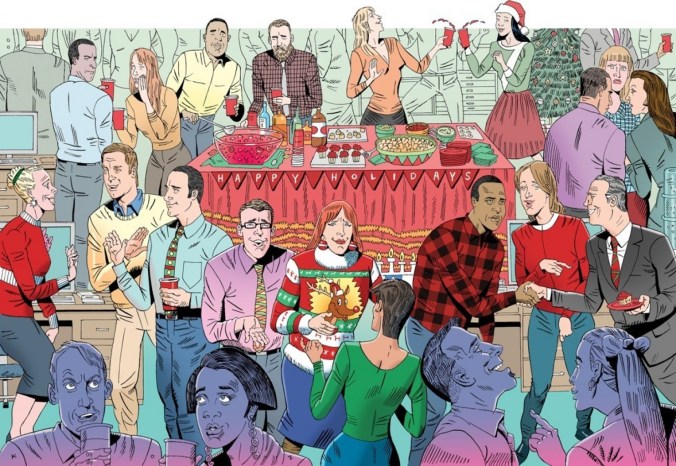
Dear Linda: There Is Nothing Racist, Biased, Disrespectful, Harmful, Wrong Or Unethical About This Drawing. Get Help. Quickly. And Not To Lay A Guilt Trip On You Or Anything, But It’s People Like You Who Make Donald Trump Popular

office party

The Washington Post recently accompanied a feature about office Christmas parties with the above illustration. Sharp-eyed reader Linda Franklin thuse felt that she had to lambaste the paper for its diversity blindness in today’s “Free For All” extension to the usual Letters to the Editor section. Admittedly, “Free For All” is where the Post stows its pedants and cranks. There was a letter today complaining that a penguin story had a photo of the wrong species of penguin. Another guy, who just missed having a post written here about him, chided the Post for letting “global-warming deniers” off as  being called mere “skeptics,” because according to Skeptical Inquirer magazine,  “skeptic is an honored term that should be reserved for those who are guided by scientific evidence,” and the Associated Press “will no longer use the term skeptics for those who reject the findings of climate science.” That’s right, you ass, tar with the equivalent of Holocaust denial those who reasonably and properly cry foul at those who claim certainty in the notoriously speculative climate science field and who don’t believe current research on the subject justifies such nonsensical and self-destructive policy decisions as blocking the Keystone Pipeline.

But I digress. Franklin’s letter is a societal warning that the obsession with group identification, quotas and diversity can lead to societal insanity. in other words, Linda is contagious.

“There was a significant fault in the illustration accompanying “Significant bother,” Linda began.

Having seen the drawing and immediately gone to work with her abacus, she determined that that 20 people who have some skin color indicated (on their faces, hands or back of their necks) and four in the foreground who are bluish. (“That’s funny, they don’t look Bluish!” I thought that joke was funny when I saw “Yellow Submarine,” and I still do. No, I never grew up. Linda, I’m sure, thinks this means I’m an anti-Semite.) Of the 24 people who are meant to be at an office party, she calculated, “only two men are obviously African American, one blue woman might be African-American, one woman is probably Asian and one person has gray hair.”

Linda is outraged, and probably wrote her missive with tears streaming down her cheeks. “Is this really a fair way to depict the employees of an office?” she cries. Continue reading

Christmas Music Blues

Who are those guys?

Who are those guys?

At the rate things are going, I am certain that before long no pop vocal interpretations of traditional Christmas music will be easily accessible on the radio. This is a cultural loss—it’s a large body of beautiful and evocative music—and someone should have, one would think, the obligation of preventing it. But I have no idea who.

I realized this when I felt myself getting nostalgic and sad as I listened to a series of “Christmas classics.” For one thing, they all reminded me of my parents, whose absence beginning in 2011 permanently kicked my enjoyment of the season in the groin. For another, all the artists were dead. Bing: dead. Frank: dead. Andy Williams, Nat King Cole, Dean Martin, Judy Garland, Burl Ives, Gene Autry, The Andrews Sisters, Perry Como, Elvis, John Denver–dead. Long dead, in most cases. Christmas has become a serenade of dead artists. Except for the narrow range of country music stars for those who enjoy “O Holy Night” with a twang, living pop artists don’t sing these songs. OK, Mariah Carey and Michael Buble. Not many others. Sirius-AM was desperate to find living artists that it has been playing the Seth McFarland Christmas album. Seth can sing, but I’m sorry, but it’s hard to enjoy “Silent Night” while picturing “The Family Guy.”

Current pop stars are, understandably, looking for new Christmas hits that will be identified with them, and those have always been hard to come by. Bing Crosby made annual recordings of terrible entries in the Christmas song market—I just heard a station play a few of them. Gene Autry too: many of his efforts were bombs, though I rather like this weird one:

Continue reading

“The Affair” Smears An American War Hero

The General and friend.

                             The General and friend.

“The Affair,” Showtime’s much lauded soap opera, wrapped up its season yesterday, without me. There are some things I won’t forgive, and sliming the legacy and reputation of long dead individuals of character and accomplishment is one of them.”The Affair” was guilty of that the previous week. It is dead to me.

The background: General Omar Bradley is increasingly accorded credit for planning D-Day, and thus is owed a large share of the world’s gratitude for winning World War II. He was not flamboyant like Patton or MacArthur, and had no political aspirations, so despite his remarkable life in service of the United States, Omar Bradley is an undeservedly obscure historical figure. He is, also, beyond any controversy, an American hero.

He also was an especially ethical one, as indicated by three of his better known quotes:

“It is time that we steered by the stars, not by the lights of each passing ship.”

“We have grasped the mystery of the atom and rejected the Sermon on the Mount. The world has achieved brilliance without conscience. Ours is a world of nuclear giants and ethical infants. We know more about war than we know about peace, more about killing than we know about living.”

“Dependability, integrity, the characteristic of never knowingly doing anything wrong, that you would never cheat anyone, that you would give everybody a fair deal. Character is a sort of an all-inclusive thing. If a man has character, everyone has confidence in him. Soldiers must have confidence in their leader.”

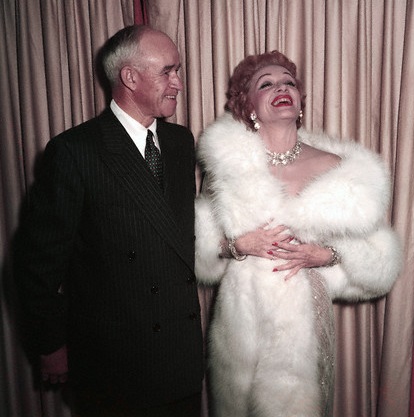
Why the writers of “The Affair” decided smear Bradley, I cannot fathom. Nonetheless, any viewers of the show that watched the penultimate episode and who didn’t know who Bradley was, and many who did, left it with the belief that Bradley, a who by all accounts was faithfully and lovingly married to the his first wife throughout the war and until her death, had an affair with actress Marlene Dietrich, who traveled with the U.S. Army for nearly two years at the end of the war. “The Affair’s” self-obsessed and perpetually horny protagonist, a successful novelist, told his therapist—and boy, does he need one–that his new book would be a historical novel about Omar Bradley. Then he said that he was tempted to skip the affair with Marlene Dietrich, but then that was the most interesting thing about Bradley to him. Continue reading

Over 30% Of Republicans Apparently Have No Problem With America’s Representative To The World And The Role Model For Their Children Using Words Like “Schlonged” In Public

Well, I do.

I have previously opined, confidently, that Donald Trump supporters, every single one of them, are stupid. This I have pointed out, is the only possible explanation for supporting an obvious narcissist who utters no substantive or serious policy ideas, believes rationalizations are legitimate arguments, is vulgar and insulting without shame or hesitation, and has the essential character of a pimp.

I was wrong.

They aren’t stupid.

They are very stupid.

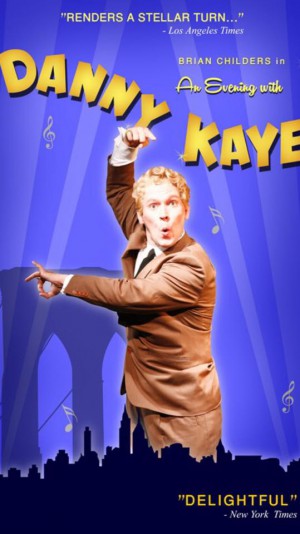
An Act Of Kindness, Danny Kaye And Me : An Ethics Case Study

Brian Childers

This isn’t a Christmas tale exactly, but it is a deeply personal one that will always make a big difference in how I make decisions in my life. It is episode that taught me, once and for all, that when you do the right thing, the amount of good that can come from it is unpredictable and sometimes unimaginable.

Maybe it will inspire you too.

In 2001, my friend Bob McElwaine handed me a script and a CD of a musical he had been working on about his long-time friends and clients, entertainer Danny Kaye and his wife, song writer Sylvia Fine. Bob was in his 70s, retired, a former Hollywood publicist and later an association executive who had taken up writing musicals with his childhood buddy, legendary movie score bassist Bob Bain (that’s Bain you hear playing the famous bass instrumental on the “Bonanza” theme, and the melody line in “The Munsters” intro too.)

McElwaine knew I was a long-time Danny Kaye admirer. He had been a wealth of information for me about Kaye when I was directing “Lady in the Dark,” the Broadway show that had made Danny a star in 1941, for the American Century Theater years before. One day, Bob asked me, as a favor, if I would agree to workshop the new piece, direct it, and see how it turned out in front of an audience.

I was not enthusiastic about the project, not at all. I had my ethics business as well as the theater to oversee; I had just finished directing a show, requiring me to be out of the house every weekday night and all day Saturday, and I thought the piece itself was too old-fashioned and formulaic to work. Mostly, however, I didn’t see how anyone could be a credible Danny Kaye, since Kaye was a unique performer—he wasn’t exactly a comedian, or a singer, or a dancer, yet  all of these and more—that has never had a close equivalent since. I was trying to find a way to turn Bob down nicely when I watched a performance of the show I had just gotten up and running. A young man named Brian Childers who was only in his second professional role played the romantic lead, and that night, for some reason, he handled a scene differently than I had ever seen him do it before—and for maybe three seconds, probably because Bob had just put the late performer’s image in my short term memory, reminded me of Danny Kaye.

After the performance I asked Brian if he would be interested in playing Kaye in this new musical, and he enthusiastically agreed, saying he was a huge Danny Kaye fan. (Later I learned that he barely knew who he was). Continue reading

Comment of the Day: “Comment of the Day: ‘On the Importance Of Christmas To The Culture And Our Nation : An Ethics Alarms Guide'”

Scrooge9

Nesting Comments of the Day again, as Belle’s reflections on how the cultural celebrations of Christmas made her feel “othered” as a child was met with many excellent responses and a lively thread. Pennagain’s (that is to say, the Commenter Previously Known As Penn) comment, however, surpassed tough competition, and thus we have the Comment of the Day on the post, Comment of the Day: “On the Importance Of Christmas To The Culture And Our Nation : An Ethics Alarms Guide”:

First impressions aren’t that easy to shrug off. Belle’s comment that she “was always sure that Ebenezer Scrooge was a commentary on the Jews” reawakened a long dormant spectre of mine. So, Google to the rescue, I went searching for the 65-year-old source and damned if I didn’t find it: My oldest Scrooge image is not from Dickens; it’s from the Rackham illustration of Shylock from Charles and Mary Lamb’s incomparable childrens’ (anyone’s!) introduction to Tales from Shakespeare:

ShylockFiction abounds with misers, a sub-category of villains (often semi-comical: to jeer at), a stock character from Medieval times, especially in children’s stories, who are often more memorable — and way more fun to act out — than are heroes. Miserly villains tend to have the same features and characteristics: mean, suspicious, hoarding good will as well as gold, stooped, narrow-shouldered, and “clay-faced” life-denying penny-pinchers … as is another “Ebenezer” in Stevenson’s “Kidnapped” whose miserliness is ethically and morally beyond villainhood (he changes sides in the middle of a battle), or a father-and-son pair of Chuzzlewits in another Dicken’s classic, or Shylock himself — who has by the end of Scene 1, before he lends the money and (jokingly) adds the “interest” that is the basis of the tragedy, chosen love of money over love of his daughter.

Continue reading

Mistrial In The First Freddie Gray Trial: There’s No Way Out Of This Ethics Train Wreck

Judge Declares Mistrial In First Freddie Gray Trial

In Baltimore this week, a judge declared a mistrial in the case of Baltimore Police Officer William G. Porter after jurors said they were deadlocked regarding all of the charges against him in the death of Freddie Gray. Porter, 26 and an African American, is the first of six police officers to be tried in Gray’s death. He has been charged with with involuntary manslaughter, second-degree assault, reckless endangerment and misconduct in office. Street protests began almost immediately.

Let’s review this disaster so far, shall we? Continue reading

The Lesson Of The Pete Rose Saga: It’s Hard Being Ethical When You’re Stupid

Rose rejected

Pete Rose’s final appeal to have his ban from Major League Baseball lifted was rejected, as Commissioner Rob Manfred delivered a stinging rebuke. (You can read his letter here.) The very first ethics post I ever wrote was about Pete, and I have posted about his character and plight several times since. Rose, the all-time leader in hits and undeniably a great player, was banned from the game in 1989. An investigation concluded that he had bet on baseball games while a manager of the Cincinnati Reds, a violation of MLB’s famous “third rail” no-gambling rule, which makes it an automatic expulsion from the profession to place bets on baseball games as a manager, coach or player. This is regarded as an existential rule for baseball, which was nearly ruined when gamblers fixed the 1919 World Series.

Rose maintained his innocence of the allegations for decades, then admitted(to sell a book) that he had been lying, and did gamble. Just a few months ago, evidence surfaced that he had also bet on baseball while a player, which Rose has always denied.

In his letter rejecting Rose’s appeal, Commissioner Manfred noted that one of the conditions that had long been set for Rose to have any chance of reinstatement—though Rule 21 has no exceptions, MLB was willing to do almost anything not to have the holder of the record for lifetime hits on its blacklist—Rose would have to earn a pardon by showing he had turned his life around, meaning that Pete was no longer a sleazeball.

Manfred wrote that Rose, who had, among other black marks, served time in prison for tax evasion, asserted in his latest appeal that he indeed was a new and better man. Nevertheless, Rose…

1. Refused to admit that he had bet on baseball as a player, when the evidence was incontrovertible, and

2. Revealed that he still gambles on horse racing and professional sports, including baseball.

Manfred came to the obvious conclusion that “Charlie Hustle,” who pretty clearly has a gambling addiction, has taken no positive steps toward addressing it, is still a risk to gamble on baseball games or get himself in debt to gamblers if he returned to the sport, and  can’t be trusted.

All of the above could be more concisely summarized by six words: Pete Rose is a stupid man. As comedian Ron White says, “You can’t fix stupid.” Manfred, in his letter telling Pete that he can forget about any future employment in baseball, noted more than once that Rose does not appear to understand the import and purpose of the rule he violated, which exists  to protect the integrity of the game. Indeed,  Pete Rose wouldn’t know what integrity was if it sat on his face. Continue reading

The US’s Existential Ethics Dilemma

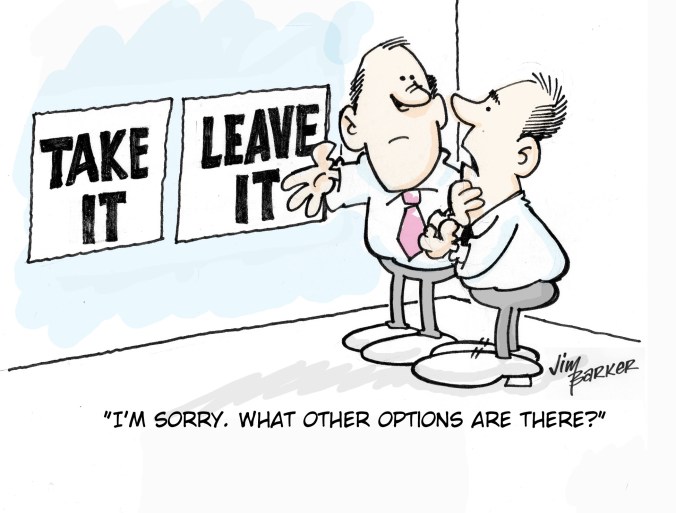
take-it-or-leave-it1No, I don’t mean how to hold on to our core values while taking responsible measures to prevent a fatal cultural infestation by radical Islam, though that’s a tough one too.

The U’S.’s existential dilemma is how to prevent a 2016 Presidential election between Hillary Clinton and Donald Trump. Such a race would represent a holistic failure of the assumptions of American democracy, including the belief that ordinary Americans can be trusted with responsible self-governance.

I just forced myself to watch an entire Donald Trump campaign appearance in Iowa. Unbelievable. Just unbelievable.

He is a pathological narcissism case study. He’s having a ball, just being in front of a beaming crowd. Not a word of genuine substance came out of his mouth. Mostly, he talked about himself—how popular he is (He’s ahead in the polls! He’s ahead in the polls!), how nice he is, how he gets along with everybody, how he’s always right. Good God. Get the hook. If a high school candidate gave that kind of preening, hubris-gagging, “I’m the greatest thing since string cheese” speech running for student body president, he’d be jumped by the football team after the assembly. People who act like Trump are not well: this is about him being desperate for affection, not leading the country. Why do so many people fail to see that?

Well… Continue reading

Race-Baiting Scalia (For Doing His Job)

Ignore them, Nino.

Ignore them, Nino.

As is often the case with topics here, I heard about the uproar over Justice Antonin Scalia’s controversial question during oral argument on the latest challenge to affirmative action accidentally, when a Facebook friend re-posted a furious message from his friend calling Scalia a moron and a racist. Even reading a second hand account of what somebody read that Scalia said (the transcript hadn’t been released, but never mind: that was enough for my friend’s African-American friend to call a Supreme Court Justice a racist and for my friend, who is a liberal-minded professor, to endorse it), I could tell that the attack was unfair and worse, outright race-baiting.

What Scalia was alleged to have asked a lawyer was whether affirmative action actually hurt blacks by putting them in “more advanced” institutions, that they “don’t belong” in elite schools. I knew, no matter what Justice Scalia really said, that he was talking about some blacks, not all blacks. That’s obvious: if an African American student can be admitted to an elite school without the “thumb on the scale” of affirmative action, obviously he or she is qualified and belongs there. But more importantly, I knew from personal experience that being admitted to a top school when the student’s credentials wouldn’t normally warrant it could be disastrous.

I worked in the administration of Georgetown Law Center in the late seventies and early eighties, as the school was trying to increase its percentage of black students. I was involved in the process sometimes, and was stunned by its unfortunate revelations: for example, some of the black students we accepted from elite colleges lacked basic reading, writing and critical thinking skills. I remember one Yale grad in particular who could not write a comprehensible sentence.

Georgetown Law set up a special class for these minority students (and a couple of  white “legacy” admits who were sons of wealthy alums, one of which I had specifically told his father could not possibly graduate, based on his college grades and test scores.) Then the school was sued by one of the affirmative action students, who claimed that making him take the remedial class was demeaning and racist. Of course he would have been better off in a less demanding law school. Affirmative action did none of these students any favors. In my opinion then and now, their welfare, confidence and self-esteem was  sacrificed so Georgetown could look progressive, and to the dubious objective of diversity for diversity’s sake.

It wasn’t just my Facebook friend’s friend that was bashing Scalia as a racist. It was much of the news media. “Justice Scalia Suggests Blacks Belong at ‘Slower’ Colleges” reported Mother Jones. “Scalia: Maybe black students belong at ‘less-advanced’ schools” reported The Hill. MSNBC’s slur was Justice Antonin Scalia floats ‘lesser schools’ for black students.  A New York Times editorial—the paper has, it appears, lost its mind– said that Scalia raised an “offensive premise which has not gotten such a full airing at the Supreme Court since the 1950s.” The New York’s Daily News  headlined“SUPREME DOPE” over a photo of Nino. Continue reading