Ethics Quiz: Is It Ethical For The President To Cut In Line?

"I'm more important than you are, so I'm cutting in line."

“I’m more important than you are, so I’m cutting in line.”

[Fred, who sent me this one, prefaced it by writing, “You’ll love this.” He was right. I do. I also hate it.]

News Item ( Austin 360):

“Following his speech at the Paramount, President Obama’s motorcade traveled to Franklin Barbecue on East 11th Street. The restaurant is well known for its great brisket and extremely long waits, but the president circumvented that using the powers of his office. “I know this is a long line. I feel real bad, but – I’m gonna cut,” Obama said, according to a pool report from the Statesman’s Chuck Lindell. [Owner] Aaron Franklin told the Statesman’s Ciara O’Rourke that nobody cuts the line at Franklin … except Obama.”

Your Ethics Alarms Ethics Quiz of the Day:

Is it ethical for the President of the United States to cut into a line for goods or services?

Can you guess my answer?

It’s not just “no,” but “Hell, no!”

Talk about the Imperial Presidency! There is no basis, justification or excuse whatsoever for the President to cut into line under these circumstances, especially by saying, “I’m gonna cut.” The proper answer to that, my friends, is “No, you’re not, Mister President. Why don’t you ask politely, and maybe everyone ahead of you will be magnanimous and agree?” Continue reading →

Judges At Work

Supreme Court protests

In the threads here stemming from Judge Kopf’s impolite and unprofessional verbiage directed at the Supreme Court, some members of the Nebraska federal jurist’s fan club have sought to justify his incivility by asserting that the judicial system itself is “broken,” and that, more specifically, judges ought to just concern themselves with judicial errors of their lower court colleagues and eschew political controversies, such as, I must presume based on the context of the judge’s compliant, when the other branches of the government break laws and violate constitutional principles.

To say that I’m cynical about this argument understates the case.What it means, I believe, is that members of one partisan orientation believe that the system is broken as long as judges who do not share their progressive biases are in a position to rule on various controversies where judicial intervention is necessary and appropriate, but will no longer be considered “broken” once progressive-minded jurists are in a position to do the intervening, whereupon the critics like Judge Kopf will drop their objections.

The fact that the system is not “broken” and that judges are doing their jobs when called upon to protect the public from abuse of power was illustrated by two events this week: Continue reading →

Comment of the Day: “The Obama Outhouse Float: Not Racist, Just Wrong”

Obama float

Rick Jones, a drama professor, deep thinker and superb writer, weighed in on the controversy over the tasteless Independence Day float in Norfolk, Nebraska. (As an aside: did my trip to Nebraska last week unleash something in the Ethics Cosmos? First this story, then the Nebraska judge telling the Supremes to “stfu”?) Rick courageously wades into the messy and contentious area, often discussed here, of racial motivations behind criticism of Barack Obama. Here is his Comment of the Day on the post, The Obama Outhouse Float: Not Racist, Just Wrong:

I’ve written about this incident, as well, and we generally but don’t totally agree.

I’m intrigued by the discussion of racism. Certainly I agree that nothing in the events described qualifies as inherently racist… but I think the word “inherently” matters here. The fact that there is not an obvious racial motivation for what is clearly an intentionally offensive float, one which displays its creator’s “disgust,” does not mean that it is intrinsically devoid of such volition. Even the little boy who cried “wolf” was right once. Similarly, whereas there are those who reflexively scream “racism” at every criticism of the current President, that doesn’t mean that there aren’t expressions of anti-Obama sentiment which really are grounded in the fact that he has a little more melanin than you or I do.

In this case, Ms. Kathurima and her daughter have experienced racism—or believe they have—and you say that you “don’t blame her” for perceiving it in this instance. Nor do I. That Mr. Remmich intended to insult the POTUS, I think goes without saying. Why, specifically, he set out to do so is an open question. Maybe it’s racial. Maybe it’s political. Maybe he knows his neighbors and pandered to their predilections. I certainly don’t know, and I wouldn’t be surprised if he doesn’t, really, either.

I grapple with a variation on this theme constantly in my professional work, especially in the area of communication theory as it applies to aesthetics. Oversimplified a little, the modernist/positivist view is that the sender of a message creates and encodes meaning, and the receiver’s job is to “find” the meaning through a process of decoding. The post-positivist view, however, is to argue that the sender catalyzes rather than creates meaning, that meaning is in fact created by the receiver of the message. To me, the two positions are equally valid.

One of my standard approaches to this dilemma is to suggest to students that “somewhere in this room is someone who has had a major fight with a loved one because what one of you thought you said was not what the other thought he/she heard.” Moreover, whether the “blame” for a misinterpretation should be placed with the sender or the receiver is likely to be influenced in your mind not so much by philosophical or theoretical concerns as by which of those positions you happened to occupy on the occasion in question.

We are left, then, with two significant questions, neither or which I am prepared to answer with confidence. 1). Is the meaning of a communication determined by the sender, the receiver, or by some presumably objective external agent? 2). At what point does a particular reaction pass from confirmation bias into, well, experience?

_______________________

Continue reading →

Emmy’s Transgender Nomination: Important, Inspiring, and a Breach of Integrity

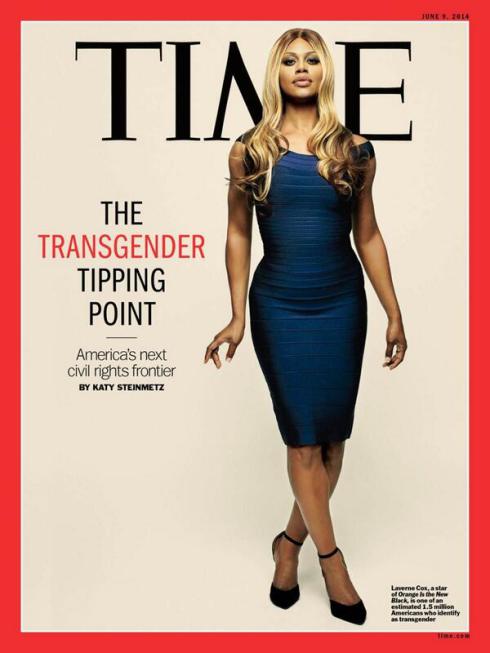
laverne-cox-timeThe Emmys made cultural history yesterday, nominating Netflix’s “Orange Is the New Black” actress Laverne Cox, who plays Sophia Burset in the prison drama, in the category of outstanding guest actress in a comedy series. It is the first time an openly transgendered actress has been nominated for an Emmy.

She joined several of her colleagues  on the show who were also recognized in various acting categories: stars Taylor Schilling, Kate Mulgrew, Uzo Aduba and Natasha Lyonne.

The problem is that Cox received the nomination for political and social reasons unrelated to her performing skills. This will be denied, of course, and since all awards are subjective, no one will be able to prove this is the case. It is, however. In the large, uniformly superb ensemble cast, Cox’s role is relatively minor, and I have a difficult time believing that anyone would objectively identify her as a standout in the show based on her acting. (In the current season, which I have seen in its entirety, her character is almost invisible). This isn’t intended to diminish Cox in any way, for in the role she plays, I cannot imagine it being played better. Nevertheless, there are many un-nominated actresses in that show—as well as other shows— whose characters are more vivid, who have to show more range, and who are more deserving of a nomination once the process is stripped of irrelevant political baggage. Among them: Taryn Manning, whose transformation into the complex religious fanatic Tiffany “Pennsatucky” Doggett is frightening; Yael Stone, as the heartbreaking stalker Lorna Morello; Samara Wiley, as te alcoholic moralist Poussey Washington, and several others.

Everyone is thrilled for Cox, with Cox, reasonably, leading the way. “I’m on cloud nine. I’m through the roof,” said the actress, whose path to an award was  paved when she was featured on the cover of Time magazine.“What a wonderful, wonderful day for “Orange” and for black trans-women,” she said.

Undoubtedly. It’s not such a great day for the acting profession generally, the Emmys, or the principle that awards based on merit should be decided based on merit, and not social and political agendas. I would say, “But that’s Hollywood,” except that it isn’t just Hollywood. Continue reading →

Is There An Ethical Obligation Not To Shock, Nauseate, Or Blind Your Neighbors? Of Obese Joggers and #FreetheNipple

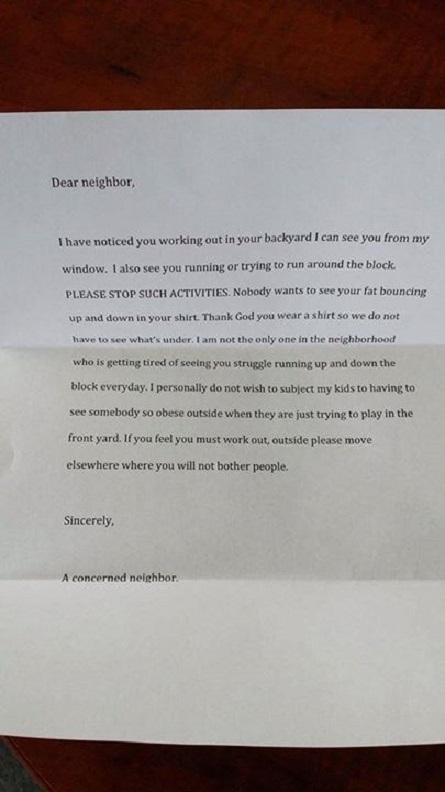
A Facebook friend posted the following letter, posted by one of her friends, and supposedly passed along by the target of the letter. The individual subjected to the complaint is reputedly trying to overcome obesity and various health issues. The letter:

Mean letter

I have my doubts regarding the authenticity of this, but it doesn’t matter to this post. I assume we can all agree that the letter itself, if genuine, is cruel, mean-spirited, cowardly (it is anonymous), hurtful, and indefensible. It does raise an valid ethics question, though, which is this: Do we have any ethical obligation any more to exhibit modesty and a degree of public decorum out of doors, when we are likely to come under the gaze of others? If so, what are that obligation’s parameters? Continue reading →

Comment of The Day (Public Service Message Division): “Wanetta Gibson Is Even Worse Than We Thought”

Wait a second...I'm getting my rifle...

Wait a second…I’m getting my rifle…

We haven’t had one of these in a while, and I’m feeling like having a good fish-shoot in the ol’ barrel, so here we go….

Apparently there has been another development in the Wanetta Gibson saga—I know this because the last post about this horrible woman is suddenly getting traffic again—and this has moved one Terrance Skerrette—I sure hope there’s just one— to enter one of those periodic comments I receive here that serves as a public service announcement for the ethically-challenged. You know the kind—Saturday Night Live parodies of such spots used to be a staple:

“Hello. I’m Jack Marshall, and this is Terrance. Terrance was raised in an environment that left him with an inability to understand ethics. That’s right–he will go through life justifying horrendous conduct by using rationalizations, hideous logic, and warped values. Will you help Terrance? No, he can’t be helped by treatment, but perhaps, if you give generously, we can provide him with a comfortable shack in the forest and plenty of food, so he can live comfortably without infecting anyone else with his hopeless ethical ignorance and dangerous excuses for terrible conduct. Please send your generous contributions to “Help Terrance,” care of Ethics Alarms. Thank you. Terrance would thank you too, but he probably thinks you are evil.”

Continue reading →

The Obama Outhouse Float: Not Racist, Just Wrong

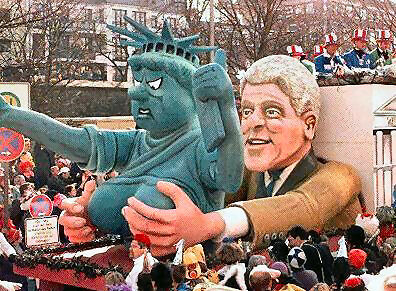
Racist float? Why not? Well, a) Bill Clinton's not black b) it's not a 4th of July parade, c) this is in Germany and d) it's not Obama.

Racist float? Why not? Well, a) Bill Clinton’s not black b) it’s not a 4th of July parade, c) the parade is in Germany and d) most important of all, it’s not President Obama.

It was almost a year ago that a rodeo clown donned an Obama mask, and the NAACP demanded that the Secret Service investigate him, and the clown lost his job. It is considered acceptable that in the nation’s capital, five people in  big-headed costumes depicting the Mt. Rushmore Presidents (and William Howard Taft) race around a baseball stadium as the crowd laughs at their antics, but any mockery of the current President of the United States will be immediately attacked as “racist.”

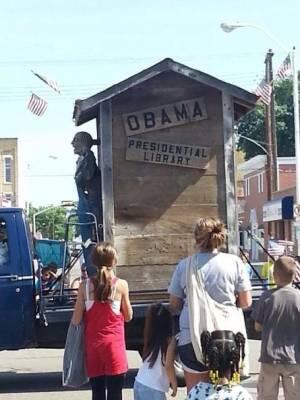
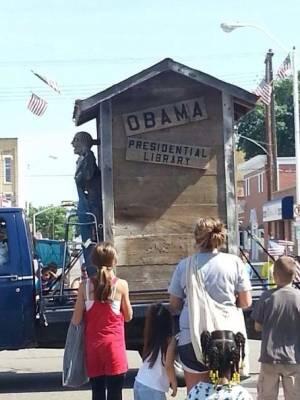
Thus an appallingly stupid, tasteless and inappropriate float in a Norfolk, Nebraska Independence Day parade is further straining already damaged race relations in this country, because it depicted a distressed man coming out of an outhouse labelled the  “Obama Presidential Library.” The Norfolk Odd Fellows Lodge, which coordinates the annual parade, is defending the float, which was entered as political satire (it even won an award). Others, however, have condemned it as, you guessed it, racist.  Here it is:

Obama float

It isn’t racist. Although many media reports have described the zombie-like figure exiting the outhouse as a representation of the President, it clearly isn’t. Does President Obama use a walker for support? The float’s designer, Dale Remmich, who does use a walker and dresses like the figure on the float, explained that the figure was meant to be Remmich himself, tinged green out of disgust for, among other things, the Veterans Administration fiasco. As for portraying Obama’s future library as an outhouse, that’s not racial imagery, though it is obviously a statement communicating criticism and disrespect. The same imagery would not have puzzled anyone if it had been used to criticize any other recent President; nobody would have looked at the exact same float except with the label “George W. Bush Presidential Library” on the outhouse and said, “I don’t get it. Bush isn’t black.” That’s because it isn’t the design of the float that makes it racist, just as it wasn’t the use of a mask that made the rodeo clown’s act racist, in the eyes of those making the accusation. What makes it racist is the criticism and the mockery, its target. Criticism and mockery of other Presidents went with the territory. Criticism of the first black President is by definition racist. Continue reading →

Ethics Quote Of The Week: Bill Bigelow

FireworksHistory5

“The pretend war of celebratory fireworks thus becomes part of a propaganda campaign that inures us—especially the children among us—to current and future wars half a world away.”

—Former teacher and current Howard Zinn disciple Bill Bigelow, in a jaw-dropping screed titled “Rethinking the Fourth of July”

Revolting and hateful right wing radio host Michale Savage authored an appropriately revolting and hateful book titled “Liberalism is a Mental Disorder.” That kind of marginalization of dissenting opinions apes the tactic of recent totalitarian regimes, which often subjected political enemies to forced hospitalization as “insane.” Extreme ideological zealotry that refuses to acknowledge either the good faith or the possible virtues of opposing views is anathema to a functioning democracy, and the fact that we have a toxic amount of such zealotry right now is one of the reason our government isn’t working very well.  Nonetheless, when I read a statement like the quote above, I cannot help but ponder how any rational individual reaches the point where he would think such a sentiment was worth publicizing. I think it is a form of ideology-sparked derangement. That doesn’t mean that liberalism is a mental disorder. It may mean that intense indoctrination in leftist (or conservative) cant leads to progressive derangement.

How does someone come to see the colorful spectacle of fireworks as “pretend war”? The invention of fireworks predated the use of bombs as weapons. They are an art form, and nothing more nor less. All right, they are also fun. (Can’t have that.) Seeing celebratory firework displays as indoctrination requires a paranoid view of one’s country and the world.  Continue reading →

Ten Movies For Independence Day Weekend

fireworks

I wasn’t going to do this until I ran across a few lists of “Most Patriotic  Films” that made me fear for the taste and the values of my fellow citizens. “Independence Day” ? “Armageddon”? “Rocky IV”?  When did “patriotic” start meaning “crappy”? “Born on the Fourth of July”? If Oliver Stone is your idea of patriotic fare, you and I are going to have a problem.

Here is my very personal list of ten favorite films that bring a patriotic lump to my throat and a remind me of how lucky I am to be born and raised in the U.S.A. Don’t mind the order: it was hard enough narrowing the list down to ten.

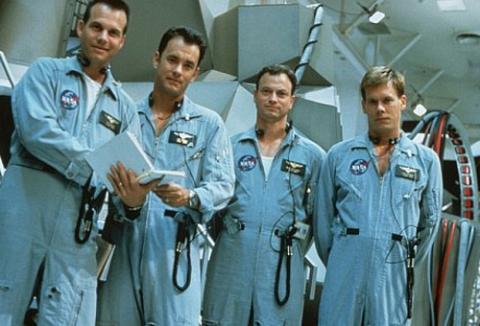
1. Apollo 13  (1995)

The only one of the movies on my list that I saw on the others today. Like many of the films here, it makes me wistful for American boldness and confidence that seem to be in retreat today. When the  Apollo re-emerges from radio silence, and Tom Hanks says, with perfect inflection, “Hello, Houston. This is Odyssey. It’s good to see you again,” I lose it, every time.

2. Mr. Smith Goes to Washington (1939)

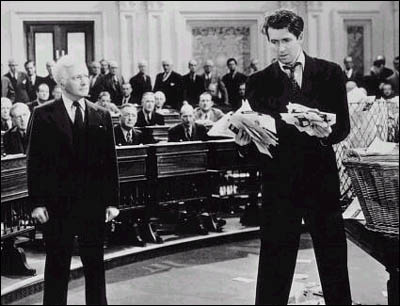
Yes, this is Capra-corn at its corniest, but from Harry Carey Sr.’s sage and heroic Vice -President, to the power of the people triumphing, to the press trying to expose corruption rather than abet it,  this film reminds us of the best ideals of our government. When we get too cynical to enjoy Jefferson Smith’s struggle to make Washington work the way its supposed to, it will be time to pack it in.

3. The Longest Day (1962)

Longest Helm

Yes, it’s not just about Americans, but it is a great film about one of our country’s  finest achievements, all true, and inspiring without a lot of flag waving and sentiment. Best war movie ever—and my Dad’s favorite. Continue reading →

Independence Day Ethics: Historian Hype, Liberal Bias, And The Great Punctuation Mystery

founding-fathers-declaration-of-independence

First, a little background…

I have often found it depressing that historians so often lack the ethical integrity necessary to do their jobs. If there was any profession in which avoiding bias would seem to be paramount, historical research and analysis would seem to be it, but that just isn’t the case. Because historians are academics and scholars, and because academia has become almost exclusively a hot-house of left-ward ideology for more than half a century, too many historians view their duty as using the past to manipulate the present and future.

My introduction to this came early, when I was a fifth grader suddenly fascinated with the U.S. Presidency as the first national election that I could follow approached. I read various assessments of who the greatest of our past POTUSes were, and there was near consensus, it seemed. Washington and Lincoln, naturally, were “the berries,” and they were joined as “greats” by Jefferson, Jackson, Wilson, FDR, and Truman, Democrats all. Teddy Roosevelt was “near great”; Eisenhower was a dud. What a great party this Democratic Party must be! Of course, Jefferson’s racial hypocrisy, Jackson’s lawlessness and persecution of Native Americans, Wilson’s racism and bungling of the peace after World War I and FDR’s complicity in locking loyal Japanese-Americans in prison camps was never mentioned. Over time, I learned that even the most respected American historians were likely to be pursuing partisan agendas. The classic example, of course, was Arthur Schlesinger, Jr., who carefully and unforgivably culled the facts he deemed worthy of revelation in order to add John Fitzgerald Kennedy to that list of brilliant Democratic Presidents. Was I surprised when a large number of prominent American historians signed a petition opposing the impeachment of President Clinton, a Democrat, thus asserting that a degree of dishonesty and lack of trustworthiness that was sufficient in every state in the union to mark a lawyer as unfit to practice was nonetheless not sufficient cause to remove a President from office?

I was not.

This brings us to the Case of the Missing Comma, brought to us by Danielle Allen, a professor at the Institute for Advanced Study in Princeton, N.J., aided and abetted by her left-leaning allies. Allen (who by the purest coincidence has a book out!) claims a major discovery. The iconic sentence in the Declaration of Independence—“We hold these truths to be self-evident, that all men are created equal, that they are endowed by their Creator with certain unalienable Rights, that among these are Life, Liberty and the pursuit of Happiness.–”—was not intended to end in a period, as all current quotations and reproductions show, and the official transcript produced by the National Archives and Records Administration indicates.  Allen claims that her extensive research indicates that the period at the end of that phrase almost certainly did not appear on the original parchment version of the Declaration, and was mistakenly included in later versions. Just in time for July 4th (when Allen’s publicist calculated that her “Eureka!” would get maximum exposure) Allen explained to the New York Times that the extra period contributes to a “routine but serious misunderstanding” of the famous document signed by the Second Continental Congress in 1776. Continue reading →