The Deadliest Rationalization Of All?

woodys excuse

All rationalizations can be deadly and have been. History and human nature teach us, however, that “Woody’s Excuse,” #22 on the Ethics Alarms Rationalization list, can hold its own with any of them when it comes to tallying up pain, ruined lives, and death. This is “The heart wants what the heart wants,” the comedian, actor and acclaimed director’s personal pass for his seducing and marrying a girl who was, in essence, his adopted daughter.

Today the Washington Post carries the grim final act of a story so terrible that it crosses into the realm of black humor. A veteran Labor Department lawyer, married, with an impeccable record, was found dead in his cell after being arrested and charged with violently attacking a co-worker with whom he had become infatuated. The story is full of weird U-turns of phrase; for example, the judge called the lawyer, charged last week with first-degree burglary while armed and third-degree sexual assault relating to the June 5 attack, a “wonderful person in most respects”—-that is, “most respects” beside the implications of his breaking into a woman’s home, punching her in the face (or spraying her with mace,) then trying to incapacitate  her with a stun gun, handcuffing her hands behind her back and knocking her to the floor. The victim was so badly injured that a plate had to be surgically implanted in her face.

Other than that, Judge, you’re right: he was a hell of a guy. Continue reading

Hold On, Taylor Bigler: First Get Into A Bikini And Answer The Question, THEN We’ll Discuss Whether It’s Fair To Mock Miss Utah

By all means, her views on social policy should determine her place in the MIss USA competition...

By all means, Miss Utah’s views on social policy should determine her place in the Miss USA competition…

Every year some columnist or internet wag attempts to perpetuate the dumb bimbo stereotype and get cheap laughs in the process by calling attention to a beauty pageant contestant’s incoherent or fatuous answer to a question in the interview round. On rare occasions, the ridiculed response is jaw-dropping and genuinely funny, appropriately triggering fears that “Idiocracy” is upon us. However, the nonsensical curvy-contestent answer flagged by Daily Caller entertainment editor Taylor Bigler had a perfectly good excuse: the question was impossible to answer. Continue reading

Of Teenage Tweets, Politics, Fairness, and Acorns

How about scrutinizing the trees, and not the acorns?

How about scrutinizing the trees, and not the acorns?

Two GOP Congressmen are apologizing for the offensive tweets of their teenage sons, as well they should. But to what extent do the homophobic, racist and otherwise vile social network comment of a couple of high school students with famous fathers tell us anything about their legislator parents? Are such communications newsworthy? Should the kids be exposed to “Gotchas!” as if they were the elected officials, not their dads, and are their indiscretions legitimate clubs for political and journalistic foes to beat their fathers with?

I think these are difficult ethics questions, and I don’t much care for any of them.  Let’s examine the ethical conduct of some of the participants in this icky drama: Continue reading

“Rubbish” and Ethics

That's me!

That’s me!

Cognitive scientist and philosopher Daniel Dennett has a brilliant and original mind. One of the seven tools he advocates (in his most recent book) for those of us who want to think more clearly and make better use of our time caused me to reflect on one of the most persistent criticism I receive about Ethics Alarms. one of America’s foremost thinkers. Here are the seven, with a sample of Dennett’s comments about them:

1. USE YOUR MISTAKES

“Try to acquire the weird practice of savoring your mistakes, delighting in uncovering the strange quirks that led you astray. Then, once you have sucked out all the goodness to be gained from having made them, you can cheerfully set them behind you and go on to the next big opportunity. But that is not enough: you should actively seek out opportunities just so you can then recover from them.”

2. RESPECT YOUR OPPONENT

“Just how charitable are you supposed to be when criticizing the views of an opponent? If there are obvious contradictions in the opponent’s case, then you should point them out, forcefully. If there are somewhat hidden contradictions, you should carefully expose them to view – and then dump on them. But the search for hidden contradictions often crosses the line into nitpicking, sea-lawyering and outright parody. The thrill of the chase and the conviction that your opponent has to be harboring a confusion somewhere encourages uncharitable interpretation, which gives you an easy target to attack….” Continue reading

Ethics Quiz: Grade The Misbehaving Celebrities!

Our subjects:

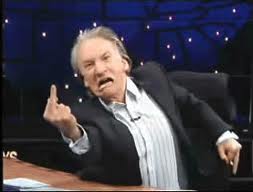
Oh, Bill...you're such a scream!

Oh, Bill…you’re such a scream!

Bill Maher, bad boy comic, political satirist and host of HBO’s “Real Time”

Maher’s fans

Ron Futrelle, former sportscaster and Las Vegas media personality

Sarah Palin, former governor, VP candidate, Fox commentator and conservative icon

All clashed over a joke made by Maher during a stand-up gig, and your challenge is to decide who gets the lowest ethics grade. Here’s what happened: Futrelle was in the audience for Maher’s show in  Las Vegas. Maher made a joke about Palin’s son, Trig, who has Down Syndrome. According to Futrelle, the joke  upset him, as well as the fact that the audience appeared to enjoy Maher’s using Palin’s innocent and mentally challenged child as a comedy topic, and laughed heartily. Futrelle began heckling Maher, eventually prompting an annoyed audience member to remind him that he was not the attraction, and suggest that he shut his gob. Futrelle persisted, and when confronted by security, left.

Through Futrelle’s blog’s account of his experience, Brietbart and the miracle of social media, Mama Grizzly Palin learned that her young son had been (again) converted into joke-fodder, and tweeted her reaction to Maher:

“Hey bully, on behalf of all kids whom you hatefully mock in order to make yourself feel big, I hope one flattens your lily white wimpy a#*.”

Our grading scale:

Exemplary ethical conduct.

Ethical and appropriate conduct that could have been better executed.

C  Acceptable conduct according to reasonable social norms

D Unethical conduct

Despicable conduct

Your Ethics Alarms Ethics Quiz is, therefore, to accept this challenge:

Give Maher, Maher’s audience, Futrelle and Palin their ethics grades. Continue reading

Anti-Terror Surveillance Flip-Flops, Fools, Converts and Heroes

Flag peek

There has been much ink and pixels spilled about the supposed hypocrisy of Republicans and Democrats in their disparate reactions to the revaluation of far more extensive phone and internet data-gathering by the government than those of us not wearing tin-foil on out heads ever suspected. For example, a recent Pew survey shows this...

Pew survey

Naturally, Republicans and Democrats are calling each other hypocrites, suggesting dishonesty and lack of integrity. There are surely some hypocrites in there, but for the most part, the flip-flopping is neither dishonest nor theoretically unreasonable. Even if we assume that the level of NSA intrusion under Bush and Obama administrations are the same (and to be fair, it appears that the current gathering of all domestic phone records goes well beyond what we understood to be the limited surveillance permitted under the Patriot Act), they are materially different in one key aspect, from the perspective of partisan citizens.

Think about it this way: Let’s say on successive days you discover your best friend and your business rival, both of whom visited your home for various reasons, looking through bills and financial papers on your desk. They did the same thing, but while you might be peeved at your friend, if he had a credible explanation like “I think I can save you some taxes,” you would not view his actions as sinister, and might even be grateful for it. When you found your rival looking over the same private papers, however, you would be furious, suspicious, and justly so. The difference is a matter of trust. You trust your friend, his motives and loyalty; you don’t trust your rival. Continue reading

Supreme Court Justice Powell’s Ethical Dilemmas

Supreme Court Justice Lewis Powell

Supreme Court Justice Lewis Powell

The New York Times, anticipating next year’s Supreme Court consideration of the gay marriage problem, tells a fascinating story about the late Justice Lewis Powell, who was the swing vote in the 1986 case of  Bowers v. Hardwick, which was overturned in 2003, upholding a Georgia law outlawing sodomy.

During the consideration of the case, Powell told his colleagues that he had never met a homosexual, though in reality he had more than one gay law clerk during his tenure, and according to at least one of the former clerks, knew it.  (Powell even quizzed one of them about the mechanics of gay sex.) The reason he told his fellow Justices an untruth, the theory goes, is that he knew there was a stigma in the legal profession and in Washington connected to being gay, and he wanted to protect his law clerks.

Yet Powell, after flip-flopping on Bowers, finally came down on the side of a state’s right to make homosexual sex a crime. Continue reading

Ethics Quiz: Butt Slap In Court!

skd250141sdc

Once again the issue at hand is judicial restraint, as another unfortunate individual incurred judge’s anger with inappropriate courtroom conduct and paid a heavy price. The question is, was it too heavy?

The object of robed wrath this time  was the former NFL star Chad Johnson, better known as Chad Ochocinco,  in court for violating his parole arising from a domestic abuse conviction (he head-butted his wife—nice), which also ended his NFL career.  His lawyers had worked out a plea deal giving Johnson community service and requiring him to attend  counseling sessions, and the judge had approved it.  But then Broward County Circuit Judge Kathleen McHugh asked the athlete if he was satisfied with his lawyer’s performance,  and in response, Ochocinco slapped his lawyer on the butt. The entire courtroom laughed.

Judges don’t usually like to hear laughter in their courtrooms, unless they’re telling the jokes.

Judge McHugh proved to be no exception. “‘I don’t know that you’re taking this whole thing seriously,” she said. “I just saw you slap your attorney on the backside. Is there something funny about this? ‘The whole courtroom was laughing. I’m not going to accept these plea negotiations. This isn’t a joke.’’ Johnson tried to pacify her, but it didn’t work. She ordered him jailed, and the deal cancelled.

Thus, your Ethics Alarms Ethics Quiz is:

Was Judge McHugh unfair?

I think so. This was the worst possible combination for Johnson: domestic abuse conviction, a female judge, physical contact, though obviously playful, and laughter from spectators. Remove any of those factors, and I think the ex-player gets his deal. The judge over-reacted.

I’m betting she lets him cool in the cooler while she cools off herself, and reinstates the deal.

Or do you think levity when domestic violence is involved is especially obnoxious, and deserves what Chad O got?

__________________________________

Facts: The Inquisitor

Graphic: Adriatique

Ethics Observations On The NSA Surveillance Revelations….

NSA

My current ethics observations on the unfolding NSA story:

  • I do not have enough facts to conclude that what NSA whistleblower Edward Snowden did was truly heroic, but if one is going to be a whistleblower, Snowden did it the ethical way. Snowden decided not to hide his identity, and accepted responsibility for his actions. If his motives are as he has represented them-“I understand that I will be made to suffer for my actions,” but “I will be satisfied if the federation of secret law, unequal pardon and irresistible executive powers that rule the world that I love are revealed even for an instant,” he wrote in a note accompanying his first set of leaked documents—-then he acted courageously and selflessly. Whether or not he also acted responsibly depends on whether he correctly weighed the possible harm of his leak against its benefits. Since its benefits include exposing what may well be ruled to be an unconstitutional and overly broad violation of citizens’ rights, I’m not certain any harm would sufficiently outweigh them in ethical balancing.
  • If it is true, as he says, that Snowden himself had the power to examine private communications of citizens who were not suspected of any crime, then the representations of Sen. Feinstein, the President and others that the NSA program was reasonable and not an abuse of power is not only untrue, but a lie. Snowden is a high school dropout, a consultant, about whose judgment, reliability and trustworthiness the NSA knew next to nothing, and what they thought they knew was obviously wrong, since he betrayed the agency. If such massive power to invade private communications and thoughts is casually placed in the hands of such an individual by a security agency, what other faceless future power-abusers have been similarly armed? Continue reading

Unethical Quote Of The Week: Strobridge Elementary Principal Charles Hill

“If we want older kids to not think guns are cool, we need to start early.”

-Charles Hill, Principal of the Strobridge Elementary School in Hayward, California, advocating his school’s toy gun buy-back program.

Cool!

Cool!

I would also nominate this as the most chilling quote of the week, the month, and perhaps the year. It is an admission that this principal, and this school—and, like cockroaches, there is never just one rogue school—are interested not in education and the conveyance of knowledge, but indoctrination, compelling children how to think and what to believe, regardless of the desires of their parents and the values of the nation. Continue reading