Web Ethics Complaint File: Rotten Etiquette in “Etiquette Hell”

The topic: rude behavior in public dining

There is nothing quite as exquisitely frustrating as having one’s commentary misrepresented elsewhere by a sloppy blogger, and then watching the nasty comments pile up by posters who never bother to read the original post. That is what is happening to Ethics Alarms, and thus me, over at an otherwise virtuous site called Etiquette Hell.

The site, or blog, or forum, or whatever the hell it is commented on the Starbucks post, with the inept headline: “Hogging all the tables in a crowded establishment.” That’s not what the post was about. That is a misrepresentation. The post was specifically about coffee shops that provide free wi-fi, and how customers abuse the privilege and benefit by camping out with their laptops for unreasonable amounts of time,  forcing patrons who need to use the tables for the primary purpose they exist to provide—allowing someone to eat and drink comfortably—to go elsewhere, or to stand. Continue reading →

The Starbucks Principles

Hey you squatters! I'm coming over!

The First Starbucks Principle: If you create a free and open public benefit, the use of which is contingent on mutually understood conditions of fairness and reasonableness, eventually the utility of the benefit will be destroyed by individuals who refuse to be either fair or reasonable.

The Second Starbucks Principle: Once this occurs, there will necessarily  be rules and enforcement, conflict leading to consensus and a new social norm, or the elimination of the benefit.

Starbucks is in the midst of the First Starbucks Principle, but the Second is on the way. The nice, absurdly expensive coffee shops that created a culture where coffee-lovers could drink their lattes at leisure while working at their laptops or perusing  books and newspapers, are being choked to death by arrogant and cheapskate squatters who stake out the tables and remain for hours on end, often driving out customers who just want to sit down briefly and sip.

I had read about Starbucks’ New York City shops covering up outlets at the store, limiting the squatters to the battery storage limits of their laptops, a pretty mild reform. Then, last week, I saw the problem up close: a companion and I purchased coffee at a Starbucks clone, Caribou Coffee, and found that every table was occupied by one squatter with a laptop. Out of eight tables, only one had a cup or food of any kind. We had to go outside and find a bench; I guarantee that Caribou lost some business, because I would have purchased another drink. Continue reading →

American Lessons from the English Riots

I am going to refrain from joining the ranks of amateur psychologists trying to identify the “root cause” of the English riots. People of any age or economic status who riot are, it is fair to say, assholes, like lesser social miscreants such as vandals, computer virus inventors, Leroy Fick and Pastor Terry Jones. If I were convinced that these riots were in response to necessary government cutbacks in social programs, I would have something arguably useful to say, but that doesn’t seem to be the case.

There is no question, however, that in allowing the riots to go on so long and harm so many citizens, businesses and homes, the British government has failed one of its most basic duties. Great Britain has been the anti-gun zealot’s Nirvana for a long time: not only can’t citizens own guns for their personal protection, neither can the police. That can work, if the culture is reliably non-violent, and if social and community institutions do a good job making sure that the culture of non-violence is strong, self-reenforced, and deep.

Well, it isn’t, is it?

Continue reading →

Ethics Quiz: Is It Wrong For A Rescuer To Sue The Victim He Rescued?

"OK, Princess, you'll get my bill for this rescue in five to seven business days."

On March 11, 2009, Mark Kinkaid and David Kelley were riding in Kinkaid’s truck when they saw a detached bumper, headlights and all, lying in the middle of Rt. 23.  Smoke was rising up from the highway embankment,  and the two men concluded that someone was in trouble. The truck stopped, and they got out, hopped a barbed-wire fence, made their way down the steep highway embankment, where they saw a flaming Hummer. Theresa Tanner was trapped inside, screaming for help. They forced their way into the vehicle, pried a door open and pulled Tanner out. She was injured and burned, but after weeks in intensive care, survived.

Now Kinkaid and David Kelley are suing Tanner, claiming that the crash was her fault and that she is liable for the injuries they sustained in rescuing her. They have filed a lawsuit asking for damages of at least $25,000 each. “All I know is that I am not the same man I used to be,” says Kelley, a 39-year-old truck driver and father of five, who says the heavy smoke and fire that day damaged his lungs so that he can’t carry a laundry basket up the three flights of stairs in his home.

The law provides a rationale for such a lawsuit. “The precedent is clear: danger invites rescue … and if you’ve acted recklessly or negligently and someone gets hurt rescuing you, you could be in trouble,” says Stan Darling, a tort law specialist. A well-established principle known as “the Rescue Doctrine” holds that if someone is in peril because of their own negligence or recklessness, an injured rescuer can recover damages if he acted reasonably and can prove that his injuries were caused by the rescue attempt.

That’s the law, however. This is ethics, and your Ethics Quiz today is:

Is it ethical for a rescuer to sue the person he rescued? Continue reading →

Ethics Quote of the Day: Ken, of Popehat

“Listen to me: a law school calculated to make students feel good about themselves is as ridiculous as a Marine boot camp designed to make enlistees feel good about themselves. Law students, God help us, will one day be lawyers. When they are, nobody will care about their self-esteem. The prosecutors seeking to jail their clients will not be seeking to foster a sense of community. The opposing civil lawyers seeking to bankrupt their clients will not be promoting a culture of dignity and respect. Most law practice is about conflict. It’s a bloody, ugly street fight. Self-esteem borne of law-should-be-harmony is useless to clients. The only self-esteem useful to clients is self-esteem earned by hard work, determination, command of the subject matter, and the willingness to stand up to adversity. People who object to law professors being wickedly Socratic, and classmates being cutthroat, are missing the point. If you’re put off by a Socratic professor, Mr. Fluffy Bunny, a run-of-the-mill judge is going to make you soil yourself. If nasty, backstabbing classmates upset you, the first time you get into a nasty letter-writing campaign with an opposing counsel you’re going to have a breakdown. Law school is not a fucking spa day. It’s training to stand between your client and whatever the world throws at him.”

—– Ken, the astute lawyer/sage/Don Rickles of the libertarian social commentary website Popehat, excoriating the University of St. Thomas Law School for, among other things, extolling the values of self-esteem, collaboration, harmony and community among their students.

What Ken is really talking about is zealous representation, that once universally accepted bedrock of the  lawyer’s duty that has gradually fallen into disfavor with many academics and lawyers. Continue reading →

Comment of the Day: “The Provocative T-Shirt Problem:

"Oh yeah? Well, your good manners and dignity offend ME!"

Sometimes I receive terrific comments to posts via e-mail, and sometimes I decide to make them Comments of the Day. And sometimes I decide to do that and forget, like I did with this comment, from Neil Penny, in response to my July 26 post about Dollywood forcing a patron to cover the mild political message on her T-shirt that “might offend some.” Neil’s comment was about the anecdote included in my post, relating how the dress code at my college was brought down by a concerted effort to comply with its letter rather than its spirit, and how the subsequent loss of decorum in the dining hall was regarded my many students, including me, as a diminishment of the experience.  Here is that lost “Comment of the Day”—my apologies to Neil for the delay: Continue reading →

Dear Newsweek: We Can Figure Out That Michele Bachmann Is A Little Off Without The Crazy Photos, But Thanks For Your Concern.

Holy Crap!

When I put up yesterday’s post about Nancy Pelosi’s excessive and uncivil accusations about Republicans, I went searching for an appropriate photo. I found one that I came this close to using, because it was angry, like the quote, and just a little bit deranged-looking. (Pelosi has a lot of photos out there that make her look quite mad.) I didn’t use it. I decided it wasn’t fair.

Of course, I have to try to be fair; I’m an ethicist, and this is an ethics blog. Journalists, however, don’t…wait, aren’t they supposed to be fair too?

Not in Tina Brown’s book, or rather magazine. Newsweek made the choice to be the MSNBC of pulp even before Brown took over, and now it is officially shameless. Because Newsweek, like its almost as moribund rival Time, once was a respected journalistic enterprise, some of Newsweek’s now non-operable reputation for integrity remains. It can still do damage with its cheap tricks. That’s why its wild-eyed cover photo of Michele Bachman is so despicable. Continue reading →

Major League Baseball, Forgivability, and List Ethics

Unforgivable?*

Bleacher Reports is an enjoyable sports website, and it gives opportunities to aspiring writers and bloggers, some of whom are quite talented.  In addition to typical opinion pieces and reporting, the site has a fondness for lists, often trivial to the extreme, like “The 50 Ugliest Athletes of All Time.” The titles are all misnomers, because there is almost never any criteria given for the choices or their relative ranking. An accurate title would be, “The Fifty Athletes I Think Are The Ugliest.”  And of course, who cares? (Don Mossi, by the way, was the ugliest athlete ever, no matter what anybody says.)

A recent list, however did bother me. It is called “The Fifty Most Unforgivable Acts in Baseball History,“ and much of the problem with it lies in the title itself. If you are going to write about history, there is a duty perform diligent research, even for a silly online list. Misrepresentations online have a large probability of misleading people.  The title is a misrepresentation, like “The 50 Ugliest Athletes,” but unlike that list, there is some harm done. The list isn’t close to complete; it isn’t consistent; it isn’t well-researched. I’d bet that the author, Robert Knapel, wrote it off the top of his head.  Anyone who looked at the list and assumed, as the author represents, that these are truly the low points—“the dark side,” as the author puts it—of major league baseball would be seriously misinformed.

There are unequivocally, probably universally recognized incidents and events that are infinitely worse that most of the items on the list.  Just a  few samples: Continue reading →

Ethics Dunce, Ethics Hero: Name Calling and One-Way Civility On the Left

John Boehner was just like this during debt ceiling negotiations. Well, sort-of. OK, he really wasn't like this at all, but I don't like him, so it's not uncivil for me to say he was.

The popular Democratic, progressive, liberal and news media (I know I’m being redundant here) slur for the Republican House and its Tea Party warriors during and after the budget ceiling debate was “terrorists,” suggesting an analogy between the GOP insisting on major expenditure cuts in the budget as a condition for raising the debt ceiling, and political and religious extremists who threaten to kill people if they don’t get their way. Needless to say, it’s a disgraceful, dishonest, illogical and slanderous comparison. Whether the GOP’s negotiating stance was fair, reasonable or right can be debated; that the intent of the strategy was to strengthen the nation’s financial health is not.

To many of the Republicans involved, incurring more debt without a guarantee of serious deficit and debt reduction in the future was more dangerous than allowing the nation to default on its obligations. Add to that the fact that many in the Tea Party  leadership believe that the consequences of not raising the debt ceiling was overblown, and it is clear: the Republicans were using their control over the immediate fate of something progressives  wanted more than conservatives as a bargaining chip in a political disagreement. It may have been irresponsible; it may have been a risk; it may have been a bluff. But it was not terrorism. It was politics. Hardball politics no doubt, but well within accepted standards

Oh, I forgot: there is another reason the Republicans weren’t acting like terrorists. They weren’t threatening to kill anybody, and they didn’t kill anybody. Continue reading →

The Tricky Ethics of Trading Sex For Tuition


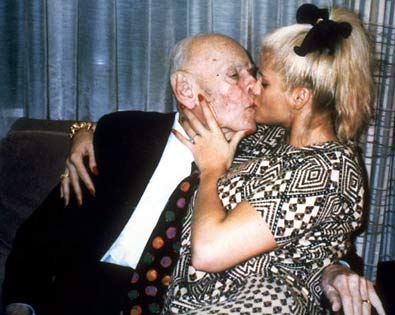
It's not generally known, but Anna Nicole Smith initially hooked up with billionaire husband J. Herbert Marshall so he could pay her tuition at MIT.*

Seekingarrangement.com is undoubtedly an unethical website. The question is how unethical, and that is why I’ve taken longer than usual to write about it, and the social phenomenon it and other websites are fostering.

The site is per se unethical because it facilitates adultery, infidelity and improper workplace conduct, by definition and unequivocally, convicted by its own words:

“Rich and successful. Single or married, you have no time for games. You are looking to mentor or spoil someone special — perhaps a “personal secretary”? secret lover? student? or a mistress for an extra-marital affair?”

Based on this alone, Seekingarrangement.com is Ashley Madison (the adultery website) all over again. Case closed, no appeal. A website is unethical when it endorses, encourages, and assists in dishonest conduct that is guaranteed to cause harm to third parties. The “consenting adults” argument doesn’t work, and doesn’t apply, when the adults are consenting to something that violates commitments, agreements and promises made to other parties who don’t have the option of consenting.

Seekingarrangement.com, however, became the topic of much debate this month for another reason: its use by desperate students, aspiring students or indebted graduates to pay their college tuition. In this it is like the more specialized Seektuition.com, which is solely devoted to matching horny, rich, developmentally retarded and presumably repulsive older men who can’t find real relationships to hot, poor, young women willing to exchange their bodies and dignity to  “help sponsor” their “ dorm rent, books, or provide assistance for tuition.” (“Perhaps even take you shopping for those new clothes you want to impress your sorority sisters!”). The Huntington Post broke the story, telling the tales of both students who “hook up” with wealthy, older men over the internet using Seekingarrangement.com and similar sites, have sex with them, and get tuition money or tuition loan repayment funds in return, while the wealthy men gladly pay big bucks to have an evening of passion with a co-ed and some Viagra. Continue reading →