Why I Hate Hate Crime Laws

Just do it with love, and they'll be lenient...

I did it to myself, I confess: reminding myself of the nation’s offensive hate crime laws while writing about the McDonald’s beating, pausing in the middle of the main theme of the post to note the foolishness of investigating whether or not an unprovoked attack qualifies as a hate crime. Hate crime laws infuriate me every time I think about them, because they represent the lowest and most cynical form of cultural values-setting by lawmaking, an important governmental task that is increasingly a lost art, because today’s lawmakers care more about posturing and power than values.

Two unidentified men beat Bryan Stow, a 42-year-old paramedic, senseless in the parking lot outside Dodger Stadium on opening day. Why? He was wearing a San Francisco Giant jersey, and it was Dodger territory. Continue reading →

Comment of the Day: “Fake Pregnancy, Real Deception, Real Harm

Commenter Karl Penny expands on the original post with reflections on trust:

“…Ms. Rodriguez’s actions were just plain wrong. Society, a civilized one anyway, depends on trust if it is to function. I buy foods that I trust were processed in such a manner that they are still wholesome, for example. Not so long ago, my wife and I went to see a movie and, while still some distance from the ticket booths, noticed that a number of people had turned and started walking away from the line they’d been in. We asked a couple who’d headed off in our direction what the matter was. They said a particular movie (forgot which one, now), the one we had planned to see, was sold out. We thanked them and left. We believed them. We didn’t wonder if it was a stunt or practical joke of some kind. We didn’t think a competing theater chain was trying to undermine a competitor’s business in that way. We certainly didn’t wonder if some local students were conducting a study on the behavior of disappointed theater patrons. I don’t want to have to live in a society where it would have been necessary to check whether the theater was really out of tickets for that show. We have enough people already who have worked at undermining public trust, to the detriment of us all. Any more of them, we don’t need.”

Flashback: “Ethics Test at McDonald’s”

Background: The McDonald’s beating and video story reminded me of another ethics essay arising out of a McDonald’s incident, one that I was personally involved in. This post first appeared on The Ethics Scoreboard in 2006, and reading it again, I realized it was one of the first times that I used the ethics alarms imagery that became the basis for this blog. The incident that inspired the essay still troubles me. I wish I could blame McDonald’s for the callousness that my 2006 experience and last week’s incident in Maryland exposed, but unfortunately, our problem relates to the Golden Rule, not the Golden Arches. Here is “Ethics Test at McDonald’s”:

Life gives ethics tests like pop quizzes. You often get no warning, and if you’re thinking about something else, you might not even realize the test is going on. Continue reading →

The MacDonald’s Beating Video, Another Dead Canary in The Ethics Mine

Vernon Hacket: videographer, violence afficianado, shameless bystander

Last week, In the early hours of  April 18,two teenaged patrons at a Rosedale, Maryland MacDonald’s brutally beat Chrissy Lee Polis, 22, into a seizure. The attack was captured on a video recorded by Vernon Hackett, one of the MacDonald’s workers, on a cellphone camera. Other employees can be heard laughing on the video, and Hackett apparently is heard warning the attackers that the police are coming. He has been fired by the restaurant’s proprietor.  (More on this here.)

His firing was well-deserved, but it doesn’t begin to address the disturbing implications of the incident. Continue reading →

The ACLU Gives Us a Lesson in Principles

Paul Scofield as Sir Thomas More

“What would you do? Cut a great road through the law to get after the Devil?…And when the last law was down, and the Devil turned ’round on you, where would you hide…the laws all being flat? This country is planted thick with laws, from coast to coast, Man’s laws, not God’s! And if you cut them down…do you really think you could stand upright in the winds that would blow then? Yes, I’d give the Devil benefit of law, for my own safety’s sake!”—- Sir Thomas More [Played by Paul Scofield, scripted by Robert Bolt (in a speech adapted from More’s writings) in the film of “A Man for All Seasons” (1966)]

My opinion of Rev. Terry Jones is a matter of record; to summarize, I think he is well beneath Charlie Sheen, Donald Trump, Tom DeLay, Goldman Sachs, Nancy Pelosi, Eliot Spitzer, AIG, Charlie Rangel , Mark Sanford, Barry Bonds, “Ronbo” and most of the other members in bad standing on the Ethics Alarms Bottom 100. Determined as he is to sully the First Amendment with his disgraceful and hate-soaked use of it, however, he is an American, and he has rights. A Dearborn, Michigan jury, prompted by the city, has taken away those rights by preventing him and another fool from protesting outside a local mosque. Continue reading →

Fake Pregnancy, Real Deception, Real Harm

"How exciting! It's fake, isn't it?"

Gaby Rodriguez, a Yakima (Washington) High School senior, faked a pregnancy for six months as a school-approved senior project. She told no one about the charade, which the school has called a “social experiment,” except her mother, boyfriend and principal. Others, like her siblings, her boyfriend’s family, fellow students, friends and teachers, were led to believe the pregnancy was real.

Thanks to hidden camera shows like ABC’s “What Would You Do?” and various reality shows, too many people have the impression that everyone they meet is a potential guinea pig. On the contrary: using decent, disguise, deception and lies to “see how people react” is no better than lying for any other reason, and often more harmful. Continue reading →

No-Hit Piñatas and the Killers of Childhood

This is a no-hit piñata. Send it to Hell.

The latest device invented by childhood-fearing adults is the “no-hit piñata,”a new invention designed to make the ancient traditional child’s game less violent. Instead of hitting the colorful paper container with sticks to get at the candy and toys inside, the children pull strings, and the piñata opens non-violently.

What fun.

This is just another sally from the growing number of whimsy-challenged and anti-violence-addled parents and psychologists, who won’t rest until no child ever again picks up a stick to use as an imaginary gun, plays soldier, watches the Roadrunner push Wile E. Coyote off a cliff, or participates in a dodge ball game. Continue reading →

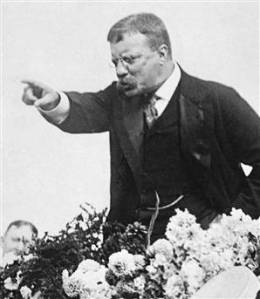
Quote of the Day: Theodore Roosevelt

On this date in 1910, former President Theodore Roosevelt made his famous “Man in the Arena” speech, one of the most inspiring calls to courage and personal character ever spoken. Its most quoted passage is this:

“It is not the critic who counts; not the man who points out how the strong man stumbles, or where the doer of deeds could have done them better. The credit belongs to the man who is actually in the arena, whose face is marred by dust and sweat and blood; who strives valiantly; who errs, who comes short again and again, because there is no effort without error and shortcoming; but who does actually strive to do the deeds; who knows great enthusiasms, the great devotions; who spends himself in a worthy cause; who at the best knows in the end the triumph of high achievement, and who at the worst, if he fails, at least fails while daring greatly, so that his place shall never be with those cold and timid souls who neither know victory nor defeat.“

It’s an important quote, and not only because it carries the essence of a great man and leader. Teddy’s words should be revisited regularly by all those, including me, who stand on the sidelines passing judgment on the words and deeds of men and women who devote themselves to public service and elected office. It is not that we should not hold them to high standards and subject them to just criticism, for we should. We must always remember, however, that they have had the courage to undertake great responsibility and personal risk to accomplish what they believe is right, and though they may be misguided, mistaken, flawed or unsuccessful, they deserve our respect for that.

[Many thanks to my friend, Tom Vesper, a great trial lawyer and legal ethics specialist, for reminding me of the date and the speech.]

If President Obama Is So Smart, Why Does He Keep Doing the Same Dumb, Unethical Thing?

I have written before, more than once, about President Obama’s astonishingly flat learning curve regarding what is and is not appropriate subject matter for the nation’s Chief Executive to render public opinions about. Without knowing the facts, he has denigrated a local policeman’s handling of a difficult and racially charged situation; he has rendered opinions on state governance matters that are not the federal government’s proper concern; he has warped public opinion by condemning a state law while misrepresenting its provisions. He has criticized citizen critics and media figures by name, something that is almost unprecedented for a president. He has declared corporations negligent or guilty in matters that had not been fully investigated, before any lawsuits or charges had been filed.  He took sides in a purely local dispute over the location of an Islamic center near the 9/11 scene, and he even injected himself into NBA star Lebron James’ free agency, suggesting that he should consider Obama’s home town Chicago Bulls.

Flat, flat, flat. Continue reading →

The Hazing Abuse of Michael Warren

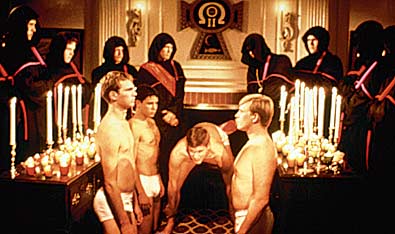
Michael Warren should have consulted Kevin Bacon...

A fraternity hazing story—yes, amazing as it seems, there are still hazings—raises the persistent ethical issue of whether a victim is responsible for his own mistreatment if he consents to it. Even if he shares responsibility, however, his consent does nothing to reduce the ethical failings of the abusers, or those of the irresponsible authorities who presided over a sick campus culture.

Michael Warren is an African American who was the only black pledge of the Alpha Delta Omega fraternity at Hartwick College (in Oneonta, New York). His potential “brothers” locked him in a bathroom with other pledges for hours, where they were subjected to ear-splitting music and strobe lights; he was forced, he says, to dress like a pimp, a humiliating bit of racial stereotyping; and, shades of the evil Omega Theta Phi fraternity in “Animal House,” was paddled so hard that he needed medical treatment (“Thank you, sir, may I have another?”). Warren complained, and found himself a pariah on campus, making him so uncomfortable that he gave up his scholarship to transfer to Hofstra. Now he is suing Hartwick, and his lawyer is arguing that his mistreatment by the fraternity “may have ruined his life.” Continue reading →