Ethics Quote Of The Week: Gary Sinise

gary-sinise

“With all due respect, what the hell are you talking about?”

—Actor and Wounded Warrior ally Gary Senise, in an open letter responding to Howard Dean’s statement that the audience for “American Sniper” consisted of “angry people.”

Good question. What are the vicious and anti-military critics of Clint Eastwood’s box-office busting bio-pic about Navy Seal Chris Kyle talking about?

I saw the film yesterday. It’s not pro-war, pro-Iraq invasion, or political in any way. The various critics of the film out themselves as hateful and so biased against combat, the military and, I don’t know—life? Reality?—that they can’t even keep their minds open a crack for a thought-provoking piece of popular art. Dean had said, turning his review (I’ll bet anything that he hasn’t seen the film) into a gratuitous attack on tea party supporters:

“There’s a lot of anger in this country, and the people who go see this movie are people who are very angry. And this guy basically says ‘I’m going to fight on your side.’ … I bet you if you looked at a cross-section of the Tea Party and the people who go to see this movie, there’s a lot of intersection.”

In the same forum–his weekly HBO conservative-bashing fest–Bill Maher called Kyle a “psychopath patriot” (there is nothing whatsoever in the film that supports that diagnosis). Seth Rogen compared “American Sniper” to a Nazi propaganda film. Michael Moore used the film–which he couldn’t possibly have seen–to make the ridiculous observation that snipers were “cowards.” Kyle, the most effective sniper in U.S. military history, was wounded repeatedly and awarded two Silver Stars and five Bronze stars. For him to be smeared as a coward by the likes of Michael Moore is grotesque.

The film, among other things, shows just what kind of horror our service men and women endured in Iraq, how they suffered (and suffer still), what it did to them and their families, and accords them well-deserved compassion and respect. How sad, bitter and rotten inside someone must be to resent that. As I watched the film, it occurred to me that this was probably exactly what John Wayne wanted “The Green Berets” to be during Vietnam, but had neither the discipline to avoid agitprop and sentimentality, nor Clint’s directing skills to pull it off.

After expressing his disgust at Dean’s outburst in a tweet, the stage and screen star, whose foundation works to help and recognize the soldiers and veterans he calls our “defenders,” wrote,

To Howard Dean,

I saw American Sniper and would not consider myself to be an angry person. You certainly have a right to make stupid blanket statements, suggesting that all people who see this film are angry, but how is that helpful sir? Do you also suggest that everyone at Warner Brothers is angry because they released the film? That Clint Eastwood, Jason Hall, Bradley Cooper, Sienna Miller and the rest of the cast and crew are angry because they made the film? Chris Kyle’s story deserved to be told. It tells a story of the stress that multiple deployments have on one military family, a family representative of thousands of military families. It helps to communicate the toll that the war on terror has taken on our defenders. Defenders and families who need our support. I will admit that perhaps somewhere among the masses of people who are going to see the film there may be a few that might have some anger or have been angry at some point in their lives, but, with all due respect, what the hell are you talking about?

My guess is that Dean is talking about his own estrangement from basic American values, its history, and its essential role in the world, including all the sacrifices, risks and difficult choices that role demands. He’s the angry one.
 

Ethics Alarms Encore: “Aesop’s Unethical and Misleading Fable: The North Wind and the Sun”

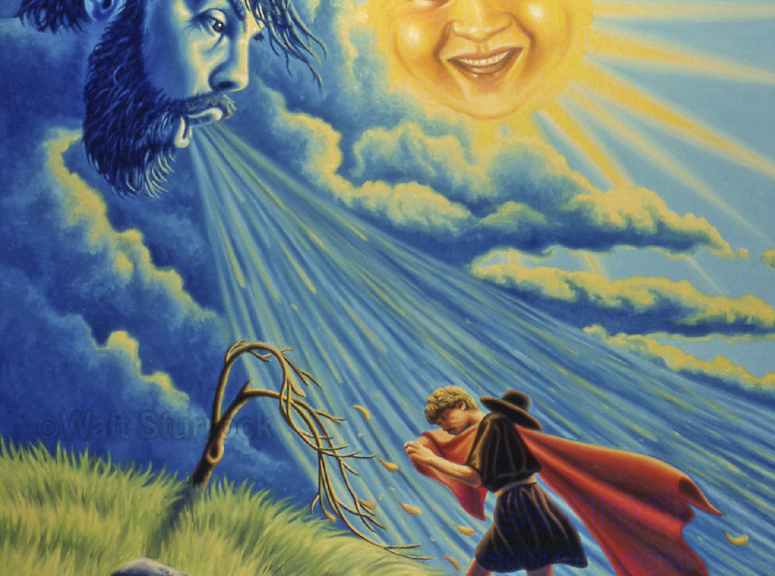
north-wind-and-the-sun-story-oil-painting

[ I vowed that the next time I got a comment on this post, I would publish it again. It hails from four years ago, when  Ethics Alarms got a quarter of the traffic it gets now. I confess that I wrote it on a whim, having been talking with my wife about how Aesop’s Fables were joining Mother Goose stories,  Edward Lear limericks and American folks song in the Discarded Bin of our culture and then stumbling upon a fable I had either never read before or forgotten about.  To my surprise the post attracted intense criticism from fans of the story—I even had to ban a commenter who got hysterical about it—and the post joined a very eclectic group of early essays here that get considerable and consistent readership every week. Apparently there are a lot of Sun-worshipers out there. Anyway, since you probably missed it the first time, here it is.]

Today, by happenstance, I heard an Aesop’s Fable that I had never encountered before recited on the radio. Like all Aesop’s Fables, at least in its modern re-telling, this one had a moral attached , and is also a statement of ethical values. Unlike most of the fables, however, it doesn’t make its case. It is, in fact, an intellectually dishonest, indeed an unethical, fable.

It is called “The North Wind and the Sun,” and in most sources reads like this:

“The North Wind and the Sun disputed as to which was the most powerful, and agreed that he should be declared the victor who could first strip a wayfaring man of his clothes. The North Wind first tried his power and blew with all his might, but the keener his blasts, the closer the Traveler wrapped his cloak around him, until at last, resigning all hope of victory, the Wind called upon the Sun to see what he could do. The Sun suddenly shone out with all his warmth. The Traveler no sooner felt his genial rays than he took off one garment after another, and at last, fairly overcome with heat, undressed and bathed in a stream that lay in his path.”

The moral of the fable is variously stated as “Persuasion is better than Force” , or “Gentleness and kind persuasion win where force and bluster fail.”

The fable proves neither. In reality, it is a vivid example of dishonest argument, using euphemisms and false characterizations to “prove” a proposition that an advocate is biased toward from the outset. Continue reading

Comment of the Day: “Unethical Quote of the Month: Patriots Quarterback Tom Brady”

"Is this a deflated ball I see before me?"

“Is this a deflated ball I see before me?”

“Inflategate”—-the developing NFL scandal about the New England Patriots’ under-inflated, more easily thrown footballs in the team’s last play-off win and perhaps others—is a big deal to 1) people who hate the Patriots; 2) football fans who care about whether their game has any integrity and 3) people like me, who think there is no justification for cheating, in sports, in business, or in life. Those who argue that it’s “much ado about nothing,” usually without being able to quote a line or explain a plot turn from the Shakespeare comedy they’re alluding to, do so because 1) they are Barry Bonds fans; 2) they don’t know the difference between a football and a plantain, and don’t care. except that they wouldn’t want to eat a football by mistake; 3) they are typical NFL football fans and want to “oh, pshaw!”  anything that reflects badly on the sport that gives their brutal lives meaning, 4) they are John Edwards, or 5) they are members of the New England Patriots organization, and perhaps were involved in the ball deflation.

Pats quarterback Tom Brady (that’s how you know I’m from Boston: I call the team the “Pats”) gave a highly unconvincing press conference yesterday in which he maintained that he would never notice that the tool of his trade that he has plied approximately since he exited the womb felt different than usual, and, like his coach, the brilliant and soulless Bill Belichick, has no idea how the team’s balls got deflated. The credibility of that claim was severely undermined for me by Brady’s use (“This isn’t ISIS…”) of my least favorite rationalization of them all on the Ethics Alarms compendium, the infuriating #22:

The Comparative Virtue Excuse: “There are worse things” : If “Everybody does it” is the Golden Rationalization, this is the bottom of the barrel. Yet amazingly, this excuse is popular in high places: witness the “Abu Ghraib was bad, but our soldiers would never cut off Nick Berg’s head” argument that was common during the height of the Iraq prisoner abuse scandal. It is true that for most ethical misconduct, there are indeed “worse things.” Lying to your boss in order to goof off at the golf course isn’t as bad as stealing a ham, and stealing a ham is nothing compared selling military secrets to North Korea. So what? We judge human conduct against ideals of good behavior that we aspire to, not by the bad behavior of others. We should each aspire to be the best human being that we can be, not to just avoid being the worst rotter anyone has ever met.

Behavior has to be assessed on its own terms, not according to some imaginary comparative scale. The fact that someone’s act is more or less ethical than yours has no effect on the ethical nature of your conduct. “There are worse things” is not an argument; it’s the desperate cry of someone who has run out of rationalizations.

(Or someone whose coach had the equipment guy deflate the footballs.)

Now comes blogger Windypundit to expand on my derision of Brady’s embrace of #22 from a different and useful perspective. Here is his Comment of the Day on the post, “Unethical Quote of the Month: Patriots Quarterback Tom Brady”:

In a way, Brady has a point, but it’s not what he thinks it is, and it doesn’t cut in his favor. In the grand scheme of things, nothing that happens on the field of play is very important. In fact, most of the rules of sports are arbitrary — the location of the free throw line, the number of bases the runners have to tag, the pressure in the football. The rules don’t have any higher meaning. And that’s precisely why there’s no excuse for not following them.

The big issues — when you can disconnect the life support, when a cop can shoot an unarmed person, when the President can order a drone strike — are full of complications and nuance. It’s hard to come up with a clear set of rules that will apply in every possible situation. You may think you have it all figured out, and then a scenario arises that you never thought of, and your simple set of rules, if followed blindly to the letter, would produce a terrible result. So maybe after you think through all the consequences, you decide that you’ve found a valid exception, and you change the rules. Or maybe, if the matter is important enough and you believe the rules are immoral, you break the rules as an act of conscience.

But I can’t see that happening much in sports. There is no greater good that could be used to justify breaking the rules. What terrible result could arise from blindly following the rules of football to the letter? A team loses a game? That might cost the team a bit of money, and I can see where crazed fans would get upset, but you know what? Nobody dies if the Patriots don’t make the playoff. This isn’t ISIS after all.


Ethics Hero Emeritus: Irena Sendler (1910-2008)

Sendler

I missed learning about the death of Irena Sendler (Irena Sendlerowa) in 2008, and this occurred because the mass news media barely took note of it. Lots of celebrities died that year whose passing prompted extended mourning in the press and examinations of their legacies: Paul Newman, Heath Ledger, Sir Edmund Hillary (a member of the Ethics Alarms Heroes Hall of Honor), Charlton Heston, Aleksandr Solzhenitsyn, and many others. There was no room for a final appreciation of the life of Irena Sendler, apparently. Today, the website Bio.com doesn’t list her among the notable deaths of that year, though it finds room for Fifties stunt singer Yma Sumac—remember her? She had a four octave range! And Arthur Showcross: he murdered 11 women from 1988 to 1990 in upstate New York, earning the nickname “The Genessee River Killer.”

All Irena Sendler did was save 2500 children from the Treblinka death camp. Continue reading

Unethical Quote of the Week: Dick Cheney

Hello, I'll be your torturer today. Now, if you are innocent, please understand, on balance this works.

Hello, my name is Skug, and I’ll be your torturer today. Now, if you are innocent, please understand, on balance this works.

“I’m more concerned with bad guys who got out and released than I am with a few that, in fact, were innocent.”

—Former V.P. Dick Cheney, giving his reactions on “Meet the Press” regarding the Senate’s critique of the Bush Administration and the CIA’s interrogation methods.

I try to be fair to Dick Cheney, whose character has been distorted beyond all recognition by his partisan foes. Sunday, however, he was apparently attempting to validate all the most terrible things anyone has said about him, as well as providing future students of ethics real life examples of ethical fallacies.

The one quoted above is the pip: so much for the jurisprudential principle that It is better that ten guilty persons escape, than that one innocent suffer.”   Chuck Todd reminded Cheney that 25% of those detained were apparently innocent. The Cheney variation: “It is OK if some innocent persons are unjustly punished as long as the bad guys get what they deserve.”

It is hard to pick the most unethical assertion, however; there are so many horrible statements to choose from. Such as: Continue reading

On Its 100th Anniversary: Remembering The Great War’s Christmas Truce Of 1914

christmas-truce-1914-H

On December 7, 1914, as the horrible, pointless, world-disrupting “War to End All Wars”  was only five months old, Pope Benedict XV suggested a truce for the celebration of Christmas. The governments of the battling nations rejected the idea, but in the days leading up to  Christmas and after, many of  the soldiers in the trenches of this ugly conflict took the Pope’s advice.

On December 20, Germans soldiers in some areas took in British wounded from the no man’s land between the warring armies. A German soldier reported on December 22 that both sides had been heard singing Christmas Carols in the trenches. German troops arriving into the lines had begun bringing Christmas trees, and some men placed them on the parapets of the fire trenches. Then, on Christmas Eve, many German and British troops serenaded each other across the lines. Allied soldiers reported that sometimes their singing was accompanied by German brass bands. Then, Christmas Day, 1914, some of the German soldiers left their trenches and  carefully approached Allied lines, shouting“Merry Christmas” in French and English. Allied soldiers climbed out of their trenches, and shook hands with the men who had only recently been trying to kill them. Some even exchanged exchanged gifts of cigarettes and and food. There were even instances where soldiers from opposing sides played soccer: in England, one organization is holding a match next week against a German team to commemorate such contests. Continue reading

Ethics Quote Of The Month: Aaron Sorkin

“You want the truth? Well, you can’t have the truth because I’ve decided that it isn’t newsworthy!”

“I understand that news outlets routinely use stolen information. That’s how we got the Pentagon Papers, to use an oft-used argument. But there is nothing in these documents remotely rising to the level of public interest of the information found in the Pentagon Papers. Do the emails contain any information about Sony breaking the law? No. Misleading the public? No. Acting in direct harm to customers, the way the tobacco companies or Enron did? No. Is there even one sentence in one private email that was stolen that even hints at wrongdoing of any kind? Anything that can help, inform or protect anyone? The co-editor in chief of Variety tells us he decided that the leaks were — to use his word — “newsworthy.” I’m dying to ask him what part of the studio’s post-production notes on Cameron Crowe’s new project is newsworthy. So newsworthy that it’s worth carrying out the wishes of people who’ve said they’re going to murder families and who have so far done everything they’ve threatened to do. Newsworthy. As the character Inigo Montoya said in “The Princess Bride,” I do not think it means what you think it means.”

—-Acclaimed screenwriter, playwright and Hollywood liberal Aaron Sorkin, reprimanding the news media  for publishing material from the Sony computer hacks in an Op-Ed in the New York Times.

There are many other titles for this post I considered, like “Jaw-dropping Hypocrisy of the Month,” “Self-serving Delusion of the Month,” and “This Is The Tragedy of Partisan Delusion: Won’t You Give Generously To Help Aaron”?

I’ve got to give the man credit: it takes world class gall for to write something like this self-serving for international consumption. Self-righteous, Freedom of the Press-promoting (Sorkin is the creator and writer of “The Newsroom” series on cable) Hollywood liberals applauded and screamed for blood when a near-senile billionaire’s private comments made in his own bedroom were surreptitiously recorded by his paid female mistress and plastered all over the media, because the private, private, private words suggested that he held racist attitudes, and no matter what he actually did (which was sufficient to be named an NAACP “man of the Year,” a distinction Aaron Sorkin has never earned),  that meant that he had to be publicly humiliated, fined millions and stripped of his business. We didn’t hear Sorkin protesting that this wasn’t newsworthy. Nor did the Sorkins of an earlier generation protest when the very same newspaper carrying his essay published criminally stolen Defense Department documents that, whatever was contained in them, were part of a sincere effort to win a war. Continue reading

Vice President Biden May Be A Boob, A Hypocrite And An Ethics Dunce, But He Understands The American Culture Better Than Most Of His Party

I’m late to the blog today, because I spent it giving a special program for the Smithsonian Associates called  “From Stagecoach to Django Unchained: The Hollywood Western and Its Influence on American Values, Aspirations and Culture.” It consisted of me talking, a terrific Powerpoint presentation by the gifted Grace Marshall, and almost three hours of clips from classic Westerns—the whole session was five hours. My primary message is that anyone who is not literate  regarding the Hollywood Western really doesn’t understand the myths and archetypes that powerfully influence U.S. culture to this day. Within that “anyone” are the majority of pundits and journalists, a large percentage of citizens under 50, and the vast majority of women and minorities. This is a problem.

For example, no one can consider the vast influence of the Western genre on American culture and be the least bit surprised that gun control has an uphill battle with the American public. No other culture has as its primary source of heroes, legends and lore figures and events so dependent on firearms as a means to right wrongs, protect the innocent, and punish evil. Frankly, if a pundit doesn’t understand why John Wayne (who died in 1979) just set a Harris poll record by being included in its annual list of top ten most popular movie actors for twenty consecutive years, from 1994 to 2014, I don’t think they can comprehend the nation sufficiently to opine on it.

Joe Biden, however, understands. I have been critical of Joe, as he is frequently an embarrassment, and there was a lot wrong with his comments today as he was honored with the “Voice of Solidarity” award by Vital Voices, a women’s rights charity, at their event celebrating “men who combat violence against women.” Still, Biden proved that whether he knows it or not, he is more atuned to U.S. culture than most of his colleagues. He deserves credit for that, if nothing else.

You see, Biden told a fascinating personal anecdote from his childhood. He related:

“I remember coming back from Mass on Sunday Always the big treat was, we’d stop at the donut shop…We’d get donuts, and my dad would wait in the car. As I was coming out, my sister tugged on me and said, ‘That’s the boy who kicked me off my bicycle.’ So I went home—we only lived about a quarter mile away—and I got on my bicycle and rode back, and he was in the donut shop.”

Biden said the the boy was in a physically vulnerable position,“leaning down on one of those slanted counters,” so he took immediate advantage:

“I walked up behind him and smashed his head next to the counter.His father grabbed me, and I looked at his son and said, ‘If you ever touch my sister again, I’ll come back here again and I’ll kill your son.’ Now, that was a euphemism. I thought I was really, really in trouble… My father never once raised his hand to any one of his children—never once—and I thought I was in trouble. He pulled me aside and said, ‘Joey, you shouldn’t do that, but I’m proud of you, son.’”

The lesson, Biden said, was that one should to “speak up and speak out” to correct wrongdoings. Like much of what come out of Biden’s mouth, this was nonsense in the context of his own story, and was not what the lesson was at all. The lesson was that force, punishment, violence and intimidation is sometimes necessary to stop bullying, discourage misconduct, protect the innocent and vulnerable,  set standards, and give more than lip service to core values. Little Joey Biden didn’t “speak up”: he bashed a bully’s head and threatened to kill him. Apparently it worked, too. America, Americans, the culture and our history—as well as the Duke–have long believed that sometimes violence is necessary to stop violence, and send important messages, and can therefore be virtuous and ethical.  Biden understood that when he was ten, and somewhere deep in that mess of mush he calls a mind, he understands that now. Continue reading

Ethics Hero: Sen. John McCain

waterboard1

While other Republicans are attacking the Senate report on torture as a political hit piece by Democrats—which, in part, it is, but that doesn’t diminish its significance—the one Senator who has experienced torture is supporting the report’s conclusions and criticism, saying…

I know from personal experience that the abuse of prisoners will produce more bad than good. Most of all, I know the use of torture compromises that which most distinguished us from our enemies.”

Exactly.

My position on this topic is unchanged from what I wrote in 2006, which you can read here.

Comment of the Day on “Comment of the Day on ‘The Perils Of Over-Regulating The Police: A Case Study'”

Robocop

Stephen Mark Pilling contributes the second consecutive Comment of the Day providing perspective on the issue of police militarization, in response to the first. Here is his Comment of the Day to the post (by dragin_dragon, which you should read first if you haven’t yet), Comment of the Day on “The Perils Of Over-Regulating The Police: A Case Study”

When critics speak of the “militarization” of the police, not all are looking at it from the same viewpoint. Some are, of course, sociopathic or are conspiracy theorists. Some have swallowed the loudly flaunted concept that policemen are evil racists, corrupt ward healers in uniform or just about anything heinous, as they represent law as an absolute, not a relative.

There is a rational based distrust, however. Many of us grew up in a time where the police still walked a beat or patrolled his neighborhood in a squad car, armed with nothing more than a revolver. We’re also the product of an old tradition of law enforcement that stems from the British mold. Unlike the continental European system of paramilitary gendarmes, we adapted a system of localized lawmen, run by an elected county sheriff. The metropolitan police department is still a relatively new phenomenon, started in late 19th Century London.

To many citizens, police who are unaccountable to a directly elected chief and who sport automatic weapons strike a sour note. But recently, people have been seeing them acquiring armored vehicles, military assault training and a tendency to wearing black uniforms. They’ve also noted an increased likelihood of these tactics and weapons being utilized and the increased incidence of “no knock entries”. Likewise, citizens have been imaging police making arrogant idiots out of themselves and caused other cops to become ever more touchy about cell phones, whether they’re right or wrong.

These and other factors have been serving to create a gap between the citizens and the police. That’s never a good thing, of course, because that trust is vital in a free society. Citizen distrust only deepens when they perceive policemen in whom this sense of civil mastery is full blown. As a former military cop, as a private citizen and as a friend or relative of a lot of civilian cops, I’ve seen all this from different angles. I’ve also seen the divide deepen in recent days.

One small note. The funding of police units on all levels directly from federal sources coincides with the worry by many that state and local police units may be more or less within the pocket of federal departments. The actual militarization of once innocuous federal police units and the memory of Obama’s projected National Civilian Defense Force has resulted in fear that this is an intentional part of a program to create an instrument of oppression. For myself, I highly doubt that any street cops would lend themselves to some “martial law” based takeover of the homeland of America. What I’m not sure of, though, is how many in higher authority have not conceived of the notion and would execute it if they could.

Again; it’s vital that the bonds of trust be strengthened between the police departments and those law abiding citizens whom they “serve and protect”. They must never- ever- be heard to make disparaging remarks about “civilians”, as that only deepens the gulf. In the Army Military Police Corps, the official motto is “Of the troops and for the troops”. It’s a good motto. It should also carry over to every local police or sheriff’s department in America. “Of the citizens and for the citizens”. Policemen who embrace that attitude will seldom go wrong. Both they and the communities they serve will benefit.

Continue reading