As the Cancer of Corruption Spreads, a Diagnosis and Treatment

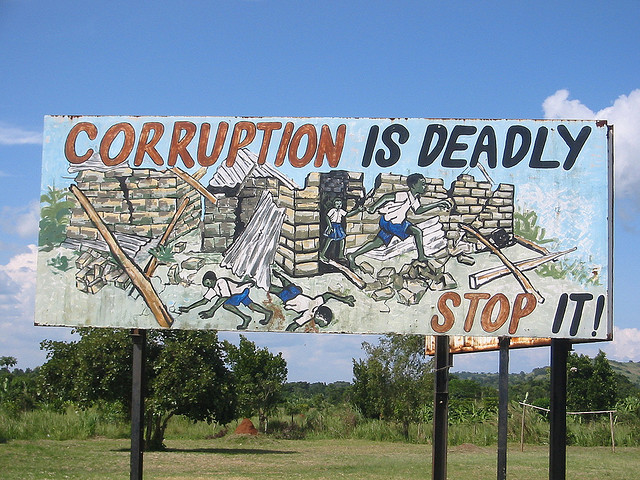
A sign in Africa, which corruption continues to ravage. We ignore its warning at our peril.

Last week, three more disheartening cheating scandals were in the spotlight, in completely separate areas of our society: legal education, the military, and college sports. The signs that the cancer of corruption is spreading through America’s culture with increasing speed are frightening, but being frightened isn’t constructive. Working to eradicate the cancer is. Last week’s revelations:

  • The American Bar Association publicly admonished Villanova Law School for a pattern of misrepresenting—inflating—GPAs and LSATs of its applicants and admitted students in order to receive a higher ranking, which in turn would attract more and better applicants. The scandal broke in June, and the ABA was lenient, stating that the school had reported its own misconduct (the responsible parties had been discovered and dismissed). Is Villanova alone, or is it just the first law school in this increasingly competitive environment to get caught? If a law school cheats, what kind of lawyers will it produce? Continue reading
American Lessons from the English Riots

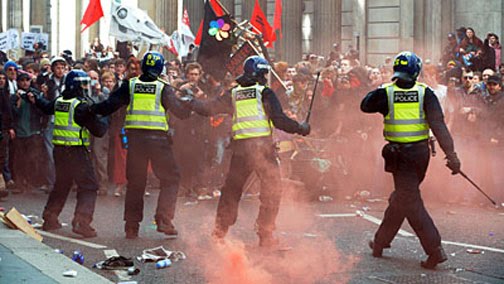
I am going to refrain from joining the ranks of amateur psychologists trying to identify the “root cause” of the English riots. People of any age or economic status who riot are, it is fair to say, assholes, like lesser social miscreants such as vandals, computer virus inventors, Leroy Fick and Pastor Terry Jones. If I were convinced that these riots were in response to necessary government cutbacks in social programs, I would have something arguably useful to say, but that doesn’t seem to be the case.

There is no question, however, that in allowing the riots to go on so long and harm so many citizens, businesses and homes, the British government has failed one of its most basic duties. Great Britain has been the anti-gun zealot’s Nirvana for a long time: not only can’t citizens own guns for their personal protection, neither can the police. That can work, if the culture is reliably non-violent, and if social and community institutions do a good job making sure that the culture of non-violence is strong, self-reenforced, and deep.

Well, it isn’t, is it?

Continue reading

Ethics Dunce, Ethics Hero: Name Calling and One-Way Civility On the Left

John Boehner was just like this during debt ceiling negotiations. Well, sort-of. OK, he really wasn't like this at all, but I don't like him, so it's not uncivil for me to say he was.

The popular Democratic, progressive, liberal and news media (I know I’m being redundant here) slur for the Republican House and its Tea Party warriors during and after the budget ceiling debate was “terrorists,” suggesting an analogy between the GOP insisting on major expenditure cuts in the budget as a condition for raising the debt ceiling, and political and religious extremists who threaten to kill people if they don’t get their way. Needless to say, it’s a disgraceful, dishonest, illogical and slanderous comparison. Whether the GOP’s negotiating stance was fair, reasonable or right can be debated; that the intent of the strategy was to strengthen the nation’s financial health is not.

To many of the Republicans involved, incurring more debt without a guarantee of serious deficit and debt reduction in the future was more dangerous than allowing the nation to default on its obligations. Add to that the fact that many in the Tea Party  leadership believe that the consequences of not raising the debt ceiling was overblown, and it is clear: the Republicans were using their control over the immediate fate of something progressives  wanted more than conservatives as a bargaining chip in a political disagreement. It may have been irresponsible; it may have been a risk; it may have been a bluff. But it was not terrorism. It was politics. Hardball politics no doubt, but well within accepted standards

Oh, I forgot: there is another reason the Republicans weren’t acting like terrorists. They weren’t threatening to kill anybody, and they didn’t kill anybody. Continue reading

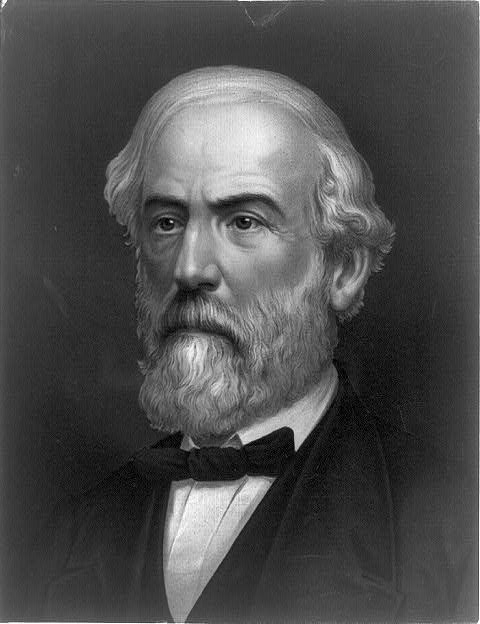
Robert E. Lee and the Abuse of Principle

Lee: Use his life as a warning, not an inspiration.

As both political parties and the President of the United States seem to be determined to subject the American people, economy and standing in the world to disaster in the defense of principles, it might be a good time to reflect on the fact that principles detached from reality have little value, and that rigidly adhering to principles to the detriment of the community and civilization is not a virtue.

In the current issue of Humanities, historian James Cobb makes these points vividly, if tangentially, while reflecting on the odd reverence with which Americans, and not just Southerners, regard Robert E. Lee. I am proud to say that the lionization of Lee never made sense to me, not even when I was a small boy. But he is the epitome of someone who is revered as a role model and hero for his supposed character and values rather than what he actually did with them.*

Cobb begins his essay with this anecdote:  Continue reading

Unethical Quote of the Week: WSJ Blogger James Taranto

This werewolf attack on Nazi soldiers doesn't weaken the case that Sen. Kerry didn't deserve his medals.

Alternate title:  “Smearing John Kerry”, Part II. The quote:

“The Swift Boat Veterans for Truth disputed whether John Kerry deserved some of his five medals. A large part of Kerry’s defense was an appeal to the authority of veterans who supported him–one of whom has now been revealed to have received a medal he doesn’t deserve. This doesn’t prove the Kerry detractors were right, but it certainly doesn’t weaken their case.”

—James Taranto, the usually astute and witty author of the conservative Wall Street Journal blog, “Best of the Web.” He is referring to the child porn conviction and retraction of the Silver Star of  Wade Sanders, who rose to Sen. Kerry’s defense during his 2004 race against President Bush, when The Swiftboat Veterans for Truth claimed that Kerry had lied about his war record.

A pure slime-job, this…well beneath Taranto’s standards, though he does dip low now and then, and as reprehensible an example of attack by unfair innuendo as you are likely to find, from McCarthy to Olbermann to Beck.

“It certainly doesn’t weaken their case.” No, because it has absolutely nothing to do with their case (which was weak and unfair to begin with), and since Taranto is undoubtedly smart enough to know that, this sentence, and the post containing it, was only written to suggest otherwise. Let’s see…what else “doesn’t weaken” the case of those who claim that the honors bestowed on Kerry for wartime valor by the United States of America were undeserved? Hmmm. We have… Continue reading

Smearing John Kerry

Quick---Who is this man, and why should his problems be news?

Guilt by association isn’t always an unethical suggestion. If all of your closest companions are members of the Mafia, I think it’s fair for me to question your values and taste in friends, if not to assume that you might leave a horse head in my bed. More often than not, however, guilt by association is unethically used for character assassination by applying the unfair presumption that an adversary’s associates’ misdeeds can reasonably be attributed to the adversary as well.

You will seldom see as pure and despicable an example of this than the current effort by some on the political Right to smear Sen. John Kerry based on recent revelations about Wade Sanders, like Kerry a Silver Star awardee, who introduced the Massachusetts Senator at the 2004 Democratic Convention.  Sanders knew Kerry when they both were Swiftboat commanders in Vietnam, and  when the Swiftboat Veterans for Truth questioned the legitimacy of Kerry’s record of heroism during that war in their infamous series of attack ads, Sanders led the counterattack. Now Wade Sanders is in Federal prison, serving a 37-month sentence for possessing child pornography, and the Navy Times reports that Secretary of the Navy has revoked Sanders’ Silver Star due to “subsequently determined facts and evidence surrounding both the incident for which the award was made and the processing of the award itself.”

What does any of this tell us about John Kerry? Absolutely nothing. Continue reading

Haboob By Any Other Name

"The haboobs are coming! The haboobs are coming!"

The line between national pride and patriotism on one side and small-mindedness and bigotry on the other can be perilously thin. Some Arizonans, however, have stumbled over the line where it is thicker than the annotated Federal tax regs,

The Arizona natives are objecting to local weathermen adopting the Middle Eastern term haboob to describe the small dust storms that have bedeviled Arizona this summer.  Haboob is a wonderful word, considerably more colorful than its Arizona equivalent, which is—-wait for it—“dust storm.” Nonetheless, the newspapers and local talk shows have been been awash recently with complaints like this letter to the editors of the Arizona Republic: Continue reading

Deadly Incompetence in Seattle….Luckily, It Was Just a Game

I know about the ADA, but still...hiring blind umpires who can't count just isn't working out...

It is rare that an ethics outrage repeats itself so closely that I could recycle a previous essay and just change the names. This occurred, however, in Seattle this past Saturday, in the baseball game between the Mariners and the San Diego Padres. San Diego’s Cameron Maybin walked on a 3-2 count (four balls are required by the rules) and eventually scored the only run of the game on Antonio Gonzalez’s fifth-inning single, allowing the Padres to defeat the Mariners 1-0 on Saturday night.

With one out in the fifth, Maybin walked when a pitch was called high by home plate umpire Phil Cuzzi. A video review of the at-bat by official scorer Dan Peterson confirmed the count should have been 3-2 when Maybin trotted to first base, meaning that his turn at the plate wasn’t completed. But Cuzzi, who like all umpires carries a pitch counter, saw that the stadium scoreboard showed a three-ball count before the pitch, and since 1) technology is always right 2) he wasn’t paying attention 3) he can’t count to “4” and 4) (or is it 3?) it isn’t like calling balls and strikes is his job or anything, he decided that the player had earned a base on balls. Continue reading

Custer, Gettysburg, and the Seven Enabling Virtues

Sometimes the Enabling Virtues will save an army, and sometimes they’ll get you killed.

July 3, 1863 was the date of Pickett’s Charge, when Confederate General Robert E. Lee ordered a desperate Napoleonic advance against the Union line at Gettysburg in what has come to be a cautionary tale in human bravery and military hubris. The same day marked the zenith of the career of George Armstrong Custer, the head-strong, dashing cavalry officer who would later achieve both martyrdom and infamy as the unwitting architect of the massacre known as Custer’s Last Stand.

Custer’s heroics on the decisive final day of the Battle of Gettysburg teach their own lessons, historical and ethical. Since the East Calvary Field battle has been thoroughly overshadowed by the tragedy of Pickett’s Charge, it is little known and seldom mentioned. Yet the truth is that the battle, the war, and the United States as we know it may well have been saved that day by none other than undisciplined, reckless George Armstrong Custer. Continue reading

July 2: A Good Day to Thank Minnesota For Saving The Country

If you know anyone from Minnesota, today would be a good day to say “thank you.”

July 2 was the second day of the decisive Civil War battle at Gettysburg, Pennsylvania, and the most complicated and wide-ranging day in the conflict. So much was going on at Seminary Ridge and Cemetery Ridge, on Little Round Top, the Peach Orchard, Devil’s Den and a half dozen other key features on the battle field that whether an instance of heroism was recorded or forgotten is as much a matter of chance as anything else. Even determining what was the turning point in the day’s conflict, which ultimately was won by the forces of the North, is an exercise in searching for order in chaos.

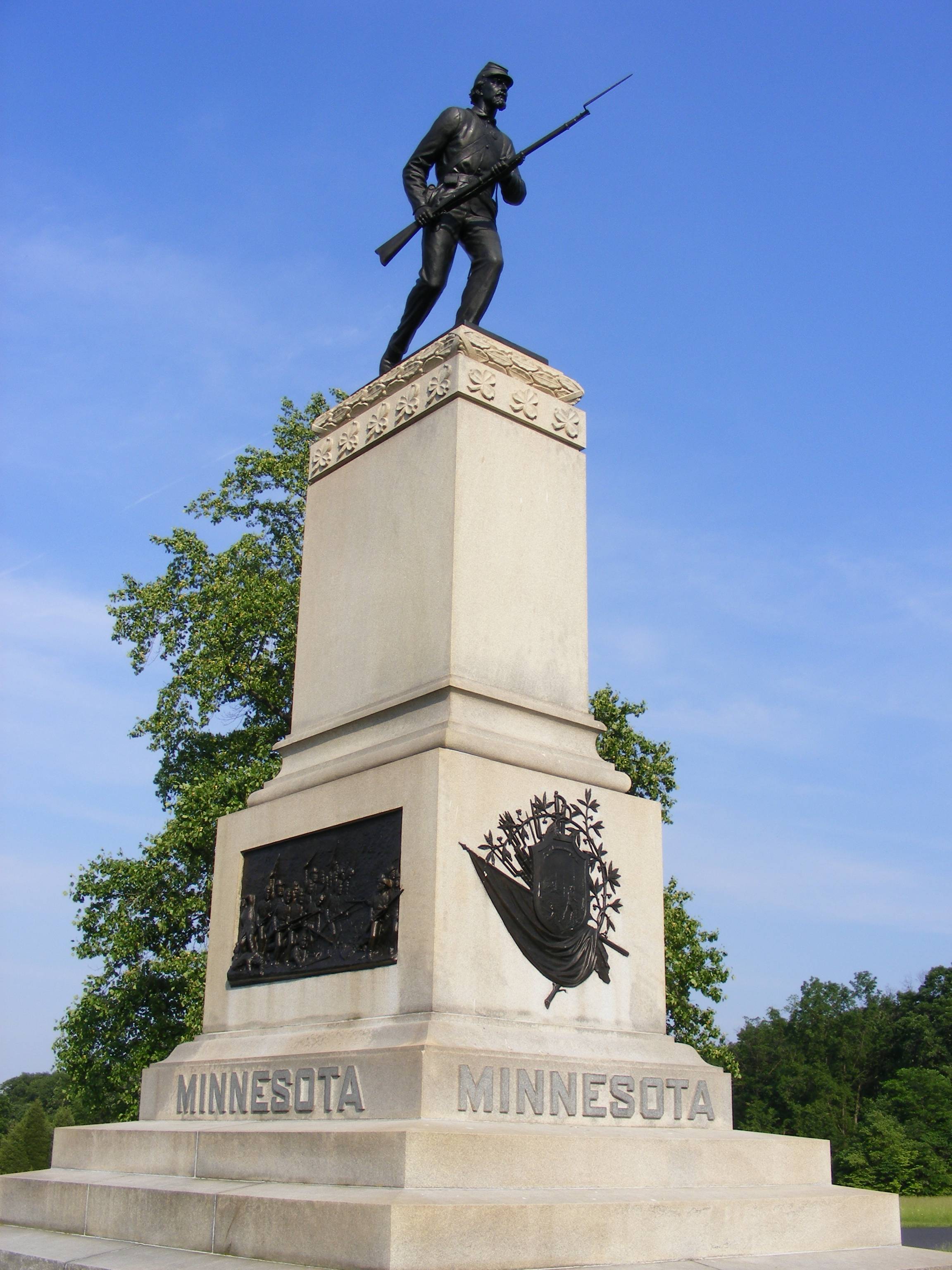
There is no question, however, that the First Minnesota Volunteer Regiment’s astonishing heroics stand out even among the many other examples of gallantry on that day. The battlefield monument to the First Minnesota is the one of the largest erected to any Union regiment, and yet it has not guaranteed our cultural memory of the epic sacrifice those soldiers made. Other second day exploits, due to sometimes arbitrary choices made by historians and film makers, have taken up the limited space available in the public’s attention to the details of the Civil War.

This is an injustice. As the battle raged for Cemetery Ridge, crucial high ground occupied by Union forces, General Winfield Hancock saw a serious breach in the Union line, and realized that Wilcox’s Alabama Brigade had to be opposed and stopped in their advance until he could round up reinforcements. He ordered the First Minnesota to charge the brigade and hold the position, even though its 262 men would be outnumbered by a force of more than 1200.  Continue reading