The Unabomber, The Red Light, And Me [UPDATED!]

I ran a red light last night, and I’m feeling bad about it. Ted Kaczynski made me do it.

It was after midnight, and I was returning home after seeing the pre-Broadway production of the musical “Mean Girls,” based on the cult Lindsay Lohan comedy. I was late, my phone was dead, I knew my wife would be worried, and I was stopped at an intersection where I could see for many football fields in all directions. There were no cars to be seen anywhere.

Ted, , aka “The Unabomber” or “Snookums” to his friends, cited my exact situation as an example of how we have become slaves to our technology. Why do we waste moments of our limited lifespan because of a red light, when there is no reason to be stopped other than because the signal says to. Admittedly, this had bothered me before I read Ted’s complaint. Stop lights should start blinking by midnight, allowing a motorist to proceed with caution, as with a stop sign.  If one isn’t blinking, we should be allowed to treat it as if it is.

Last night, I ran the light. With my luck, there was a camera at the intersection, and I’ll get a ticket in the mail. But..

…whether I do or not doesn’t change the ethical or unethical character of my conduct. That’s just moral luck.

…it was still against the law to run the light, even it I was treating it as a blinking light, because it wasn’t

…breaking the law is unethical, even when the law is stupid, and

…there was no legitimate emergency that could justify my running the light as a utilitarian act.

So I feel guilty. Not guilty enough to turn myself in, but still guilty, since I am guilty.

But Ted wasn’t wrong.

Update: Let me add this; I was thinking in the shower.

On several occasions in the past, I have found myself stopped by a malfunctioning light that appeared to be determined to stay red forever. Is it ethical to go through the light then? The alternative is theoretically being stuck for the rest of my life. So we run such lights, on the theory the frozen stop light is not meeting the intent of the law or the authorities who placed it there, and to remain servile to the light under such circumstances is unreasonable. Yet running it is still breaking the law, and isn’t stopping for a light in the dead of night with no cars to be seen also not consistent with the intent of the law and the light? What’s the distinction?

Morning Ethics Warm-Up, 11/29/2017: Featuring Vital Questions Such As: Will Women Now Try To Look Unattractive? Should A Hospital Employ A Nurse Who Hates White People? Is That Man Trying To Rape A Manniquin With An Ice Dildo?

Good Morning!

1  Documented insanity. The New York Times has been on an extended binge of highlighting the suffering of deported illegal residents. I could probably post several more episodes of the Ethics Alarms “Good Illegal Immigrant ” series every week. The intellectual dishonesty of almost all of these Times stories, like the pro-illegal immigrant movement itself, is impressive. Essentially, they all can be reduced to, “Isn’t it terrible that these lawbreakers have to endure the consequences of their own actions?”

Complementing these stories are periodic opinion pieces like “ICE’s Courthouse Arrests Undercut Democracy,”‘ by César Cuauhtémoc García Hernández, an associate professor of law at the University of Denver. He writes a pro-illegal immigration blog, identifiable in motive by its habitual use of the cover word “migrant” to mean “illegal immigrants” and the deliberately misleading word “Immigration” to mean “illegal immigration.” Hernández’s op-ed’s argument follows as the night follows day:

“In El Paso, ICE arrested a woman moments after she requested a court’s help keeping away an abusive partner. Fear and uncertainty caused by this type of courthouse arrest are already keeping people away from the halls of justice. In Denver, the city prosecutor gave up on four domestic violence cases because the victims said they were too afraid of ICE to appear in court. In a nationwide survey conducted in April by the nonprofit Tahirih Justice Center, four out of 10 social service providers working with immigrant survivors of abuse said they had clients who had abandoned legal claims because of fear of what will happen if they call the police or go to court.”

Wait: why were these people afraid of ICE? By immigrant survivors, doesn’t Hernandez mean illegal immigrant survivors? If he does, why doesn’t he say so? His favorite terms are “unauthorized” immigrants, and here and there “undocumented” immigrants, poor things. Whatever happened to their documents?

It’s not a threat to democracy if illegal immigrants are afraid to come to court. They should be afraid to come to court. They should be afraid to take advantage of any aspect of  our government or American society. Underlying the professor’s claimed concern for democratic institutions is his contempt for the rule of law. He wants to blur the distinction between illegal and legal immigration to the vanishing point. He quotes the California chief justice as she writes that “the vast majority” of “undocumented immigrants” “pose no risk to public safety.” Is that the desired standard for law enforcement now? As long as a known law-breaker poses no risk to public safety, he or she should be immune from arrest when they turn up in court?

The Times is apparently committed to bombarding its readers with this unconscionable position in perpetuity: our monstrous government has decided to enforce its immigration laws, and the very fabric of our democracy is threatened as a result.

2. CNN Tales.   On a related note, this morning I saw a slick TV ad on CNN supporting “Dreamer” legislation. The terms “illegal,” and even the cover words “undocumented” or “unauthorized” were never used, as various Presidents were shown extolling “immigrants.” “Dreamers” were described as “immigrants” who came here as children.

An ethical broadcast news organization should not accept money to run ads that intentionally misinform its viewers.

But THIS is CNN!…and so is this:  A CNN spokesperson told Politico…
Continue reading →

The Three Circles, Prime Directives, And President Trump [With Addendum]

I can’t believe I have never written about this diagram before, but apparently I haven’t. That’s my fault, and a major one.

The diagram, the creation of my friend, attorney John May, shows the inter-relationship of the three ethical systems professionals must employ when they face ethics problems. For although we tend to think about making decisions in one context, there are several, and which sphere—these are circles after all—we choose will often determine what balance of values, principles and outcomes dictates the ultimate course.

Here are what the circles represent:

The Big Circle, in yellow, includes the ethics culture that we all live in. It includes our nation, society, community, family, and friends, and is a messy, inconsistent, multi-faceted, often contradictory melange of traditions, religion, customs, literature, history, heroes, fables, family influences, teachers, peers, laws, and more. This the largest system of all, the sun to the planet-sized influence of the other two systems. within it are not only the often competing ethics theories of Reciprocity, Absolutism, and Utilitarianism, but also all the variations in between and beyond–Ayn Rand, Nietzsche, Marx, and many others. In his invaluable book “The Science of Good and Evil,” Michael Shermer posits that despite all the internal inconsistencies, the Big Circle is remarkably functional, agreeing on what is right and wrong perhaps 97% of the time. The disagreements are in the realm Shermer calls provisional ethics,  akin to what Ethics Alarms is referring to when it cites The Ethics Incompleteness Principle. These are the troublesome problems where the usual principles don’t always work.


The Core Circle, in green, represents the values, principles, beliefs and the priority of these for an individual–you. It comprises all of those, plus such core qualities as conscience, self-esteem and courage. It’s location in the Big Circle varies with the individual. A section of it even may protrude outside Big Circle, representing the degree to which a person does not embrace the values of his or her community or culture.

Finally, there is the Compliance Circle, in red. That circle defines the special ethics of a profession, and includes ethics codes, traditions, aspirational values and professional obligations and duties.

Notice that part of the Red Circle is outside the Yellow one. These are the values about which a profession is bound to adhere to at all costs, even though the society at large often and even usually does not have the same ethical priorities. Quoting Star Trek, this is Prime Directive territory. In Gene Roddenberry’s fictional Star Fleet, it was forbidden to use the immense power a starship could muster to interfere with a planet’s inhabitants and their conduct, even to prevent what appeared to be a horrible wrong.  This principle would be repugnant to the the public at large. For example, if a starship had an opportunity to stop a genocidal race from wiping out another race on its planet, the Prime Directive would make it a crime to do so. The Big Circle would certainly view this as monstrous, but the Prime Directive wisely holds that interference must be avoided. Continue reading →

An Ethics Hero Epic: Johnny Bobbitt, Jr, Kate McClure, And Americans

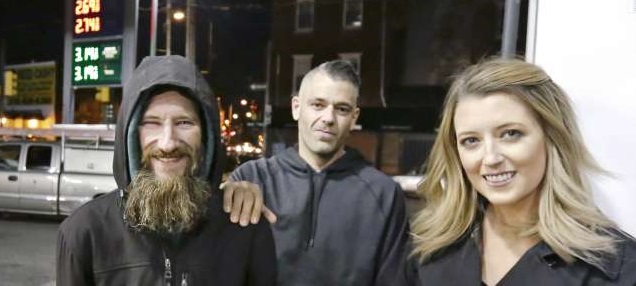
Kate, Johnny, and Kate’s boyfriend. I bet you can tell which is which…

I learned about this story days ago, and got so distracted by all the nauseating ethics news that I neglected to write it up. I apologize. This kind of story should always be the top priority.

Kate McClure of Bordentown, New Jersey, was driving through Philadelphia to visit a friend when her car ran out of gas in a tough section of the city. McClure pulled over, got out of her vehicle and began to walk to the nearest gas station. But Johnny Bobbitt, Jr, an ex-Marine who lives on the streets, saw her plight and immediately took charge. The neighborhood was a dangerous place for a woman to walk alone, he told her, and suggested that she get back in her car, lock the doors, and leave matters to him.

A few minutes later, Bobbitt was back with a full gas can, and gave Kate  20 dollars, the only money he had to his name,  to make sure she could get home safely.

McClure said she did not have money to pay Bobbitt back that night, but she returned several times to the spot where he sits, offering him a few dollars and useful items.. Then McClure started a GoFundMe for her rescuer. She wrote,

I would like to get him first and last month’s rent at an apartment, a reliable vehicle, and 4-6 months worth of expenses. He is very interested in finding a job, and I believe that with a place to be able to clean up every night and get a good night’s rest, his life can get back to being normal.

So far, her campaign has attracted donations totalling almost $380,000 for Bobbitt.

The veteran has been homeless for over a year because of real problems. He has battled drugs, bad choices and probably emotional issues as well. I hope this story has a happy ending. So far so good, though. Johnny demonstrated exemplary ethics, sacrificing his own well-being for a stranger. Kate demonstrated genuine gratitude, empathy and concern, and took affirmative action to try to pay him back. And the American public, as it usually does, showed that when sufficiently alert, it knows how to reward good and selfless deeds.

Paul Krugman, The Anti-Haidt

I don’t bother with New York Times op-ed columnist Paul Krugman here, for the most part. He constantly discredits himself by intentionally misleading his gullible readers, hiding the ball, engaging in deceit as an advocacy tool, over-stating and hyping and generally bolstering his progressive opinions with a nauseating combination of intellectual dishonesty, hypocrisy and condescension. I have no patience with such columnists, or any publication that inflicts them on its readers.

A parallel in the sportswriting field is the much lionized Thomas Boswell, a Pulitzer Prize-winning columnist who writes for the Washington Post. Boswell has written several books, and is regarded by many as a deep thinker about baseball. (My wife and I once were friends with a couple that socialized with the Boswells, and invited us to join the four of them for an evening. I told them that I could not stomach being in the same room with the guy.)  Many years ago, Boswell was writing about the individual talents of the Boston Red Sox, a topic I know at least as much about as he does. In assessing then-Sox catcher Jason Varitek, Boswell noted that “Tek” led the league in passed balls, leaving the impression that this demonstrated a serious flaw in his catching abilities. But I knew, and more importantly Boswell knew, that the Red Sox  had a regular rotation starting pitcher, Tim Wakefield, who was a knuckleballer, and was the only starting pitcher in the league who threw that confounding pitch.  If a catcher regularly catches a knuckleball pitcher, he leads the league in passed balls, usually by a large margin. Always. It has nothing to do with how good a catcher he is, and Varitek was a very good catcher. Yet Boswell deliberately cited the statistic without explaining to his readers what it meant in Vartitek’s case. He did this because he was trying to argue that Boston had defensive problems. This is unethical advocacy, and unethical journalism.

After that, I only read Boswell’s columns to document his dishonesty. I was never disappointed. He’s a cheat, relying on the ignorance of his audience to deceive them.

Paul Krugman is like that. After I posted the quote from Jonathan Haidt’s speech in which the professor perfectly described the ideology-driven betrayal of the culture and our democracy by institutions of higher education, I recalled a recent Krugman piece in the Times that I had instantly dismissed as classic deceit. One passage was literally the anti-matter version of Haidt’s hard truth regarding the rot in our colleges, a deliberate lie that denied the existence of the problem in order to further Krugman’s perpetual attack on Republicans and conservatives.

Behold: Continue reading →

Morning Ethics Warm-Up, 11/28/2017: The Worst Defense Of Roy Moore Ever!

Good Morning!

1 The Dumbest Moore Defense Ever Told! Debating with Chris Cuomo on CNN yesterday morning, Breitbart senior editor Joel Pollak made the following argument in defense of  Alabama GOP Senate candidate Roy Moore:

“You know, in 1973 Ringo Starr hit number one on the Billboard charts with the song, ‘You’re 16, you’re beautiful, and you’re mine,. He was 30-something at the time singing about a 16-year-old — you want to take away Ringo Starr’s achievement?”

He really did.

2. Sally Yates and James Comey are happy, anyway. Leandra English, the deputy director of the Consumer Financial Protection Bureau, argues that the Dodd-Frank Act makes her the lawful the acting director of the agency in a lawsuit she has filed  against President Trump, who also has the law on his side. He appointed Mick Mulvaney, currently Trump’s director of the Office of Management and Budget, as acting director to replace Richard Cordray, who appears to have resigned explicitly to foil the President’s ability to appoint his own choice to head the CFBP. Now there is mess triggered by a rare, genuine example of two statutes with authority over the same situation.

The Justice Department’s Office of Legal Counsel issued a legal opinion that says the Dodd-Frank Act does not displace the President’s authority to appoint under the Vacancies Reform Act. Either statute can be invoked. “We cannot view either statute as more mandatory than the other,” the opinion says. “Rather, they should be construed in parallel.”

Of course, employees of the Executive Branch are ethically obligated to defer to the President of the United States, but this President is handicapped by a thick muck of arrogant holdovers from the Obama Administration, who think it is appropriate to sabotage and undermine a leader whom they do not approve of. This is indefensible.

The lack of the basic deference and respect all elected Presidents should be able to depend upon that so many of the previous administration’s personnel have displayed is an indictment of the Democratic Party’s principles, integrity, fairness, patriotism and respect for process. This is how this story should be reported, too, and would be, by a competent and ethical news media. Continue reading →

Ethics Quote Of The Month: Professor Jonathan Haidt

This is longer than the typical featured ethics quote. It comes from NYU Professor of Social Psychology Jonathan Haidt’s 2017 Wriston Lecture to the Manhattan Institute on Nov. 15 , excerpted by the Wall Street Journal.

Today’s identity politics . . . teaches the exact opposite of what we think a liberal arts education should be. When I was at Yale in the 1980s, I was given so many tools for understanding the world. By the time I graduated, I could think about things as a utilitarian or as a Kantian, as a Freudian or a behaviorist, as a computer scientist or as a humanist. I was given many lenses to apply to any given question or problem.

But what do we do now? Many students are given just one lens–power. Here’s your lens, kid. Look at everything through this lens. Everything is about power. Every situation is analyzed in terms of the bad people acting to preserve their power and privilege over the good people. This is not an education. This is induction into a cult. It’s a fundamentalist religion. It’s a paranoid worldview that separates people from each other and sends them down the road to alienation, anxiety and intellectual impotence. . . . Continue reading →

Dear Regan Chastain And Her 9,670 Anti-Fat Shaming Hysterics: 1) It’s Satire and 2) Stop Trying To Censor Expression You Don’t Like

Nice, Regan. You can dance. Now get a sense of humor…

There was  an unanticipated side benefit of visiting Alas! A Blog, cartoonist Barry Deutsch’s home for the furious left-addled, as I researched the previous post. I also caught Barry giving space to fat-activist (not fat activist, for that would be rude) Regan Chastain as she fulminates against an Esquire U.K. feature by writer Giles Coren called ““I Don’t Care What My Son Becomes… As Long As He Isn’t Overweight.” Chastain is furious, and apparently Barry agrees. I presume he’s signed her Change.Org petition that demands that Esquire pull the post as “hate speech” (sigh!) and fire Coren.

For in her petition Chastain says that Coren…

Calls his 4-year-old son a “fat little bastard” and a “chubby fucker”

Says that “to bring forth upon the world a fat son is indeed a shame before God”

Says that he would rather his son be a “crackhead” than be fat.

Says about fat people: “I’d kill them all and render them down for candles.”

He ends the piece by saying that he “tries to look at the positive” but “other times I think, “I’d best get the chubby fucker’s jaw wired before he’s old enough to stop me.”

Read the article. Is there anyone out there who can’t tell that the article is satire, and intended to chide parents who obsess over their kids’ weight? How about the photo he posted with the article, showing his “fat” son? This…

Does that not constitute a sufficient clue? Continue reading →

Unethical Political Cartoon Of The Month: Barry Deutsch


To be fair, the Justice wasn’t much of a cartoonist…

In today’s warm-up, I briefly discussed the acquittal earlier this moth of NYPD officer Wayne Isaacs in the shooting an unarmed black motorist.  It was a weird case. Isaacs was off duty, and prompted a driver to apparent road rage by cutting him off in traffic. The motorist, according to Isaacs, walked up to his car and  struck him, and fearing that his assailant was armed, the officer drew his pistol and fired.

I don’t know if it was a coincidence or by design, but on the day of the acquittal progressive cartoonist Barry Deutsch, who once did battle (and well) at Ethics Alarms, posted this cartoon at his blog:

In the same post, he also called the late Justice Rehnquist a racist, which he was not, and made the demonstrably false statement that most police shootings involve blacks, but never mind that.

You have to really detest police and the principle of guilt beyond a reasonable doubt to regard such a cartoon as fair or enlightening. (Ethics Alarms is on record as declaring political cartoons an inherently unethical form of punditry.) No cop has been acquitted of shooting an unarmed  9-year-old kid in self-defense, and the cartoon is factually wrong that such a claim by a police officer would get him acquitted. Moreover, the case Barry is apparently referring to, Graham v. Connor, does not involve a shooting, and Rehnquist’s opinion for the majority doesn’t say what the cartoon says it does. In addition, the opinion in the case primarily relied upon by the majority in Graham, Tennessee v. Garner,  wasn’t written by the Rehnquist, but by Justice Byron White. It also specifically involved police shooting at fleeing suspects.

Thus the cartoonist a) doesn’t know what he’s talking about b) misleads his readers ( the blog is an echo chamber if there ever was one), and c) smears Justice Rehnquist. Continue reading →

Morning Ethics Warm-Up, 11/27/2017: Gibberish From Congress, Race-Blindness in the UK, Cruel Law Enforcement In Atlanta, And More

Mornin’!

1 “Rarrit!!” You will seldom see or hear as excellent an example of Authentic Frontier Gibberish than this word salad belched out by the leader of House Democrats on “Meet the Press” yesterday. Nancy Pelosi attracted so much negative attention with her “Rep. Conyers is too much of an icon to hold accountable” blather that this masterpiece was relatively ignored. Pelosi was asked by Chuck Todd whether she would support releasing to the public the full information behind heretofore secret settlements of sexual harassment accusations against Congressmen, even indispensable, virtuous icons like John Conyers. She said…

“Well, here’s the thing. It’s really important. Because there is a question as to whether the Ethics Committee can get testimony if you have signed a nondisclosure agreement. We’re saying we think the Ethics Committee can, but if you don’t agree, we’ll pass a law that says the Ethics Committee can, a resolution in Congress that the Ethics Committee can…. But there’s no– I don’t want anybody thinking there’s any challenge here to our changing the law and see how people– when we know more about the individual cases. Well, because you know what our biggest strength is? Due process that protects the rights of the victim, so that, whatever the outcome is, everybody knows that there was due process….”

http://www.youtube.com/watch?v=0_2Npp-euLU

If Chuck Todd wasn’t a partisan hack, he would have recognized his journalistic obligation to say, “That made no sense at all, Congresswoman. Please try again.”

Public pressure is increasing to force Congress to release the names of the members of Congress who paid taxpayer funds to settle with their accusers. Good. Democrats are obviously terrified, and presumably Republicans are as well.

2. That mean Trump Administration insists on enforcing the law. The New York Times had a front page story Sunday about the plight of illegal immigrants in Atlanta. The story, entirely sympathetic to the arrested, deported, and those afraid of being arrested and deported, saying in one headline that “immigrants” (that’s illegal immigrants, NYT editors, a material distinction) fear “even driving.”

“Even driving” without a license.

Here’s a quote to make any rational American’s head explode, about a local journalist who uses social media to warn illegal immigrants when ICE is lurking,

“Asked whether he had any reservations about helping readers evade immigration law, he said he preferred to think he was helping people with no criminal records stay in the country. “Honestly, I believe it’s an honor as a journalist if the people can use your information for protecting their own families,” he said.”

Translation: “I prefer to think of what I am doing as something other than what I am really doing.”

It’s kind of like a newspaper calling illegal immigrants “immigrants.” Continue reading →