Does The Naked Teacher Principle Apply To A Porn Star Teacher Whose Students Don’t Know What Porn Is?

The Ethics Alarms Naked Teacher Principle states:

A secondary school teacher or administrator (or other role model for children) who allows pictures of himself or herself to be widely publicized, as on the web, showing the teacher naked or engaging in sexually provocative poses, cannot complain when he or she is dismissed by the school as a result.

Various discussions  f the NTP can be found here. [The original post on the topic is on the old Ethics Scoreboard, which is down at the moment thanks to an incompetent web hosting operation. It will be back soon, or there will be blood….]

Now we have the borderline case of a kindergarten teacher—that’s primary school, not secondary school—who is a proud porn performer as a second occupation.

Nina Skye is a preschool teacher at a religious school in Los Angeles and decided to go public—with Fox News, of all places—with her secret double life moonlighting in the adult film industry.

“I love teaching. I love sex. If I can get away with doing both, then I will,” Nina says. “I know what I’m doing when it comes to teaching, I’m a really good teacher.”  On the other hand, “It’s easy money. For my very first scene, I just did a regular boy on girl and I got paid $2,500 on the spot.”

Skye’s explanation about why she is revealing her passion at the risk of her teaching? “I guess some people are really tied by that moral code, ” she says.  “There’s a really big stigma associated with it, and how our society views it, but that’s not how I am… I’m really open-minded. Super open-minded and not judgemental.” Continue reading →

Morning Ethics Warm-Up: 6/28/17 (Yes, It’s The CNN Sting Video)

1. What weight should we place on the latest James O’Keefe Project Veritas sting video? I detest O’Keefe, whose methods are unethical and whose bias is manifest. Nonetheless, what he catches he catches: like the Wikileaks leaks showing Donna Brazile cheating for Hillary, we can’t pretend that damning evidence doesn’t exist because it has been obtained and released unethically.

To track O’Keefe’s latest, I had to search through multiple websites that I don’t trust, like (yuck! pooie!) Breitbart, because the liberal-biased sources either aren’t covering the story or aren’t covering it thoroughly, because, I assume, “There but for the grace of God go we!”, and everything the stung CNN producer said might have been said by someone in their shops as well.

And, of course, since they are not happy about the #1 Get Trump plot by the Democrats and the news media flopping like a dying mackerel on the deck, they want to hide the story from the public as much as they can.

2. Here is the most publicized part of the surreptitiously shot video’s text, which occurs after CNN producer John Bonifield is asked about the Trump-Russia story and the investigation.

“Could be bullshit. I mean, it’s mostly bullshit right now. Like, we don’t have any giant proof. Then they say, well there’s still an investigation going on. And you’re like, yeah, I don’t know. If they were finding something we would know about it. The way these leaks happen, they would leak it. They’d leak. If it was something really good, it would leak…. The leaks keep leaking and there’s so many great leaks, and it’s amazing. I just refuse to believe that if they had something really good like that that wouldn’t leak because we’ve been getting all these other leaks. So, I just feel like they don’t really have it but they want to keep digging. And so I think the president is probably right to say, like, look you are witch hunting me. You have no smoking gun. You have no real proof.”

If any of this surprises you, then you really have to get your ethics alarms checked and your IQ-lowering biases treated, because all this has been obvious except to logic and fairness-deprived members of “the resistance,” Hillary bitter-enders, and people who think CNN and MSNBC are trustworthy. Like most Project Veritas videos, this one only confirms what progressives have denied for political reasons, thus rendering themselves untrustworthy.

3. I was more interested in another quote caught on the video, one which was harder to find because most reporters and bloggers don’t think ethics is newsworthy. After describing a CNN meeting in which reporters were told by CNN brass to stop covering the climate accords with the directive, “Let’s get back to Russia!”, Bonifield says,
Continue reading →

The New York Times’ Lies About “Trump’s Lies”

In a grandstanding stunt that was even beneath the fallen role model of U.S. journalism, The New York Times printed what it claimed to be “the definitive list of Donald Trump’s lies” since his inauguration. To say the the list was itself full of lies, and that the over-all assertion that these were “Trump’s lies” was a misrepresentation, is not in any way to excuse the President’s lazy, careless, incompetent use of language, impulsive habits of communication, shockingly inept reasoning and  reckless tweeting. Almost all of the statements quoted by the Times contain misinformation, irresponsible opinions  or unwarranted conclusions, and it is dangerous and disruptive for any leader, indeed anyone, to express themselves this way. Nevertheless, the statements are not all lies. Most of them, in fact, are not lies.

Does it matter? It does. When the New York Times call a list “definitive,’ that list should at a minimum meet the definition of what the New York Times claims to be exposing. It does not. The definition of a lie is a “a deliberately false statement designed to deceive.”

If we assume that the New York Times knows what a lie is, and if the Times does not then it should have no credibility at all, since a journalist’s mission is to report the truth, then the list proves that the New York Times deliberately set out to deceive its readers.

At one point, the Times says,

“We are using the word “lie” deliberately. Not every falsehood is deliberate on Trump’s part. But it would be the height of naïveté to imagine he is merely making honest mistakes. He is lying.”

This is a self-contradictory statement. If a falsehood isn’t deliberate, then it isn’t a lie.

In presenting this unethical project, the Times took unethical advantage of its readers’ confirmation bias. When the “Lie” list was printed, the Times made certain that it would require super-human dedication and extraordinary eyesight to read it, through the devices of listing every item and the Times commentary in horizontal sequence and in half the usual size type-face. (See above) This ensured that almost no readers would make the Herculean effort to read the whole thing , especially since the well-trained Times readers already “knows” that Donald Trump is a liar. In addition, the explosion of tiny words created the visceral response of “Wow! Look at all those lies!” which is exactly the effect the Times editors wanted.

But that isn’t reporting, and it isn’t journalism. The “list” was a page-size, visual, ad hominem attack. The Times wasn’t seeking close scrutiny of its list, nor was it interested in making any rebuttal easy or likely.

We have learned that the Times list was largely assembled from various fact-checker columns. That is a red flag, and explains many of the most embarrassing inclusions on the list. None of the fact-checkers are trustworthy. All of them are biased, Snopes and PolitiFact worst of all, and they consistently register opinions that the writer disagrees with as “false.” Many, many of the items on the Times list are in this category.

I’m not going to go over the entire list here and distinguish between the lies and non-lies, though I have done the analysis. My template for an undisputed Presidential lie would be Bill Clinton’s “I did not have sexual relations with that woman”—he did, and he said this deliberately to deceive; and Barack Obama’s “If you like your plan, you can keep your plan” declaration that he made repeatedly to sell Obamacare to the American people in 2009. The “women make 77 cents for every dollar a man makes for the same job” is a fake statistic that both Clinton  and Obama (and Hillary and Bernie) used, but that would not qualify as a lie on my scale.  I think they believe it, or believe that it’s close enough to true that they aren’t lying when they refer to it. Many of the “lies” on the list fall into this gray area. Of course, the Times never set out to list all of Obama’s lies, or Clinton’s, because they never wanted to suggest either of them were untrustworthy, though a good argument could be made that Clinton was, and Obama regularly engaged in deceit and misrepresentation. To its credit, the Post’s Factchecker did create a list of outgoing President Obama’s “Top Ten Whoppers.”

Many statements that Obama made that were much like dozens of the items on the Trump list were never called “lies” in the mainstream media, as when he attacked the Supreme Court and the Citizens United ruling in a State of the Union address by saying that the decision “will open the floodgates for special interests”…“ including foreign corporations”…” to spend without limit in our elections.” (Justice Alito was seen mouthing “not true” and shaking his head.”)

Unfortunately for the Times, listing “Trump’s lies” chronologically exposed the dishonest and biased nature of the exercise from the start. The first three “lies” are not lies.: Continue reading →


Over At “The Ethicist,” An Off-The-Wall Ethics Question Gets An Even More Off-The-Wall Answer

I don’t have many opportunities to take issue with the current writer of The New York Times Magazine’s “The Ethicist” column, because he, unlike his predecessors, really is one, and doesn’t come up with whoppers like they used. Professor Appiah had some “Bonus Advice” this week, however, from a Judge John Hodgman. The judge reminded me of those halcyon days when “The Ethicist” was good for a couple of Ethics Alarms attacks a month. Good times!

First, the question:

My roommate takes long, casual phone calls while on the toilet. I have tried explaining why this behavior is creepy and rude to the person he is talking to, as they do not know they are talking to someone who is going to the bathroom. He thinks it’s actually rude when people don’t answer phone calls simply because they’re in the bathroom.

Wait…what? WHAT?

It is impossible to be secretly rude. It has no effect on the person on the other end of the line if you are naked, making faces, or writing “I hate this idiot!” in the mirror in blood. Nor is it “creepy” to have a phone conversation on the toilet. I’m typing this while I’m on the toilet and wearing a duck on my head, and it’s nobody’s business but mine.

Nor is it rude to refuse to answer phone calls when one is in the bathroom. In fact, it is almost never rude to decline a phone call.  That bell is an  invitation to have a conversation, not a command. I don’t answer calls when I’m taking a nap, a shower, having a live, face-to-face conversation, writing an Ethics Alarms post, cooking, eating a meal, enjoying an orgy, or chopping up my victim after a murder. It’s my option, my time, and my schedule.

These two roommates are made for each other.

Now the judge’s response:

“Your roommate is quite wrong: What’s actually rude is people making phone calls in the first place. We have so many better ways to communicate now that do not involve repeating yourself constantly, saying the wrong thing under the gun and then realizing you’ve been talking for five minutes to a dropped call. Even the ringing of a good old landline is the intrusive announcement that either a) someone thinks you don’t deserve to choose how to spend your time, or b) someone you know has been killed or injured. If only to protect the meditative solitude of the bathroom act, your roommate should stop this habit, never mind the fact that it is just plain gross.”

Think about it: someone with this level of judgment is a judge.

1. We have better ways of communicating than talking to each other?

2. If someone doesn’t want to talk on the phone, they can turn the phone off.  They can have an unlisted number, or a cell phone number they only share with people they won’t think are rude when they call.  They can not have a phone at all. If you make it possible for people to call you when you don’t have to do so, people reasonably assume that you don’t mind being called. Calling too late or too early is inconsiderate, unless there is an emergency.  Robocalls and solicitor calls are intrusions. But a friend or relative “reaching out to touch someone” as the old Bell  long-distance ad sang? That’s rude? What’s the matter with this guy?

3. Let me rephrase that: What the HELL is the matter with this guy? We have to obey his rules for what we do in the bathroom? I read my baseball books in the bathroom…is that a violation of “meditative solitude’? How about having long discussions with my wife through the bathroom door—not sufficiently meditative? What’s happening on the toilet isn’t gross, but talking to someone who has no idea where you are and what you are doing is gross? I can be as gross as we want when the only witness is me, and there is absolutely nothing rude, inappropriate or unethical about it.

As long as I clean up afterward.

Morning Ethics Warm-Up: 6/27/17 [Updated]

1. Since I don’t want to have too many posts at once showing how untrustworthy CNN has become, let’s put this one in the short form: on Sunday, CNN’s alleged show about journalism ethics, “Reliable Sources,” hosted by “watchdog” (stifling a guffaw here) Brian Stelter, conveniently skipped the single biggest broadcast journalism scandal in years.

Thomas Frank, a reporter for “CNN Investigates, announced that “the Senate Intelligence Committee  was investigating a Russian investment fund”, the Direct Investment Fund — “whose chief executive met with a member of President Donald Trump’s transition team four days before Trump’s inauguration.” The CNN “exclusive ” was based on a single  unnamed source, and quickly attacked as fake news—which it appears to have been. CNN, of course, has pushed the Trump-Russia collusion hypothesis as if it were a missing Malaysian airplane. The network pulled the story, retracted it, and three reporters involved in the fiasco “resigned.”

If one were depending on Stelter to get a weekly briefing on how reliable and ethical news media sources were in the week past, one would have been thoroughly deceived. “Reliable Sources,” under the oversight of Stelter, itself isn’t reliable or ethical. It is a house mouthpiece, masquerading as an ethics show. This is res ipsa loquitur, an episode that speaks so loudly by itself that no further evidence is required. If the host of a broadcast ethics watchdog cannot and will not report on serious ethics breaches by his own employer, which is also one of the most visible and significant broadcast news outlets in the journalism, then the show isn’t really dedicated to journalism ethics. It is a biased tool of competition and propaganda, with conflicts of interest that it neither admits nor tries to avoid.

Stelter devoted most of his show to attacking President Trump for not according proper respect to the news media. The President has labelled CNN as “fake news.” This episode vividly demonstrated why.

2. Watching HLN’s Robin Meade this morning to avoid “Fox and Friends” (the CNN outgrowth also has thus far  neglected to mention the network’s fake news episode,) the Cheerful Earful began, “The minimum wage might actually hurt workers????” while making a shocked face that would be appropriate if she was saying that the moon was made of cheese. Thus do those constantly marinated in progressive/ Bernie-style fantasies set themselves up for amazement by the obvious.

Yes, Robin, it has been well-known for about a century that raising the minimum wages causes unemployment for workers whose negligible skills just are not worth the new mandated wage, eliminates whole job categories (summer jobs for teens being the most harmful to society), and puts many small businesses out of business. But never mind! “Living wage” sounds so kind and  good, and the rising minimum wage is always a tool to help unions  argue for increases in their much more than minimum wages, which is why the Democratic Party keeps promoting the lie that raising the minimum wage ever higher makes sense.

Robin was shocked at a new study of the results of Seattle’s huge minimum wage increase, enacted in the heat of mindless progressive faith. Conducted by a group of economists at the University of Washington who were commissioned by the city, the study indicates that far from benefiting low-wage employees, the costs to low-wage workers in Seattle outweighed the benefits by a ratio of three to one. This is the study found that  some employers have not been able to afford the mandated minimums, so they are cutting payrolls, delaying new hiring, reducing hours or firing workers. Gee, who could have predicted that?  The news media is reporting this as if it is a surprise. It’s not. I oversaw a study at the U.S. Chamber of Commerce decades ago that indicted this would happen, because it has happened before. Frankly, it’s obvious; so obvious that I have long believed that Democratic Party advocates for the minimum wage are lying to their gullible supporters.  Both Bernie Sanders and Hillary Clinton made raising the minimum wage a rallying cry, which is one of many reasons why I found it impossible to trust Bernie Sanders or Hillary Clinton.

In the meantime, having seen the writing on the wall, restaurants are increasingly moving to replace waiters, waitresses, and cashiers with automated systems, because they are cheaper…thanks to the minimum wage. If humans were cheaper, humans would keep those jobs, and restaurants would be more pleasant, unless you prefer dealing with computers than human beings. I don’t.

Lies have consequences. Or as Robin would say, “Lies have consequences???” Continue reading →

( PSSST! The Supreme Court Just Unanimously Pointed Out That The Courts Blocking The Trump Temporary Travel Ban Were Playing Partisan Politics, Not Objectively And Ethically Doing Their Jobs)

As many predicted (including me), the Supreme Court unanimously slappped down the lower court injunctions based on claims that the Trump temporary travel restrictions on six Muslim countries were unconstitutional, writing,

But the injunctions reach much further than that: They also bar enforcement of §2(c) against foreign nationals abroad who have no connection to the United States at all. The equities relied on by the lower courts do not balance the same way in that context. Denying entry to such a foreign national does not burden any American party by reason of that party’s relationship with the foreign national. And the courts below did not conclude that exclusion in such circumstances would impose any legally relevant hardship on the foreign national himself. See id., at 762 (“[A]n unadmitted and nonresident alien . . . ha[s] no constitutional right of entry to this country”). So whatever burdens may result from enforcement of §2(c) against a foreign national who lacks any connection to this country,they are, at a minimum, a good deal less concrete than the hardships identified by the courts below.
At the same time, the Government’s interest in enforcing §2(c), and the Executive’s authority to do so, are undoubtedly at their peak when there is no tie between the foreign national and the United States. Indeed, EO–2 itself distinguishes between foreign nationals who have some connection to this country, and foreign nationals who do not, by establishing a case-by-case waiver system primarily for the benefit of individuals in the former category. See, e.g., §§3(c)(i)–(vi). The interest in preserving national security is “an urgent objective of the highest order.” Holder v. Humanitarian Law Project, 561 U. S. 1, 28 (2010). To prevent the Government from pursuing that objective by enforcing §2(c) against foreign nationals unconnected to the United States would appreciably injure its interests, without alleviating obvious hardship to anyone else.

…The Government’s application to stay the injunction with respect to §§6(a) and (b) is accordingly granted in part. Section 6(a) may not be enforced against an individual seeking admission as a refugee who can credibly claim a bona fide relationship with a person or entity in the United States. Nor may §6(b); that is, such a person may not be excluded pursuant to §6(b), even if the 50,000 person cap has been reached or exceeded. As applied to all other individuals, the provisions may take effect.

Got that?

“To prevent the Government from pursuing that objective by enforcing §2(c) against foreign nationals unconnected to the United States would appreciably injure its interests, without alleviating obvious hardship to anyone else.” Continue reading →

Salon Asks: “When Is A Leak Ethical?” NEVER. That’s When.

Ethically challenged left-wing website Salon somehow found an ethically challenged law professor, Cassandra Burke Robertson, to justify the leaks in the Trump Administration. Robertson,  despite being a Distinguished Research Scholar and the Director of the Center for Professional Ethics at Case Western Reserve Law School, advocates unethical and sanctionable conduct in a jaw-dropping post, “When is a leak ethical?”

Here, professor, I’ll fix your misleading and dishonest article for you: It’s NEVER ethical to leak.

Never.

She begins by noting “I am a scholar of legal ethics who has studied ethical decision-making in the political sphere.” Wow, that’s amazing….since she apparently is hopelessly confused about both, or just pandering to Salon’s pro-“resistance” readers.

Robertson writes:

“Undoubtedly, leaking classified information violates the law. For some individuals, such as lawyers, leaking unclassified but still confidential information may also violate the rules of professional conduct.”

1. It is always unethical to break the law, unless one is engaging in civil disobedience and willing to accept the consequences of that legal breach. By definition, leakers do not do this, but act anonymously. Thus leakers of classified information, lawyers or not, are always unethical, as well as criminal.

2. Lawyers may not reveal confidences of their clients, except in specified circumstances.  Here is D.C. ‘s rule (my bolding): Continue reading →

Morning Ethics Warm-Up: 6/26/17

1. I am puzzled that no respected journalism source—assuming arguendo that there is one—hasn’t taken on the New York Times’ alleged list of President Trump’s “lies,” which was in my Sunday Times and released on-line earlier. I will do it today, but it shouldn’t fall to me, or other similarly obscure analysts. Why, for example, hasn’t the Washington Post taken this golden opportunity to prove how biased, dishonest and incompetent its rival is? Because, you see, the list is disgraceful, and smoking gun evidence of the Times’ abdication of its duty to its readers, except its own perceived duty to give them around the clock Trump-bashing.

The other thing I’m puzzled about is why I continue to subscribe to the New York Times.

2. One possible reason: The Sunday Times is now a weekly collage of the various derangements, false narratives and  obsessions of the Left, and worth reading just to witness how 1) bias makes you stupid and 2) how unmoored to reality one can be and still be judged worthy of op-ed space. Here, for example, is “Black Deaths, American Lies” (the print title), a screed by Ibram X. Kendi, a professor of history at American University in Washington, D.C. (Disclosure: I was also a professor at American University. But I was an honest and apolitical one.)

The first line is, “Why are police officers rarely charged for taking black lives, and when they are, why do juries rarely convict?” This is deceit: an honest scholar wouldn’t have written it, and an ethical editor wouldn’t have allowed it to get into print. The sentence implies that officers are less rarely charged and convicted when they take white lives, and this is not true. In the print version, the article is headed by a touching photo of a street memorial to Mike Brown, whom we now know got himself shot. The Black Lives Matter narrative that Brown was murdered is still carried on by racist activists, ignorant members of the public, cynical politicians  and unethical figures like Kendi, who lend their authority to divisive falsehoods.  Kendi then focuses on the Philandro Castile shooting, as if its facts support his thesis. They don’t. First, the officer was charged, though he shouldn’t have been. Second, we have now seen the video, which clearly shows that after telling the officer that he had a gun, Castile reached into his pocket and began pulling out his wallet as the obviously panicked officer shouted at him not to pull out his gun. Just as the video proves that the officer was unfit to be a cop, it shows that he was in fear of his life and why. He could not be convicted of murder on that evidence. Never mind: The professor writes, Continue reading →

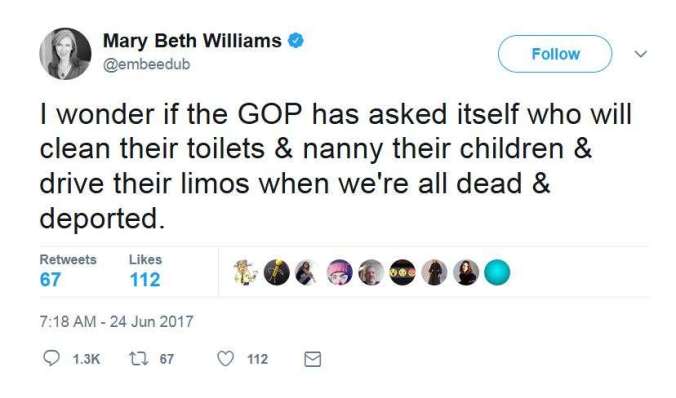
Now THAT’S An Unethical Tweet!

Let me count the ways…

1. The tweeter, a veteran Salon writer, assumes that nobody rationally supports enforcing the law unless they personally benefit from it. In other words, “Integrity? What’s that?”

2. Williams adopts the stereotype that Hispanics are all nannies, drivers and gardeners, and that this is their sole value to U.S. society.

Nice. Boy, if we didn’t have African Americans, where would we get our NBA stars, tap-dancers and banjo players?

3. Who’s advocating killing illegal immigrants?

4. And my favorite: Williams, who is as Hispanic as I am….

….refers to the group risking deportation as “we” to cover her condescension, or try to. Dishonest and cowardly. Also stupid.

The tweet is, however, accurately representative of the quality of thought being used by open-border advocates to justify the unjustifiable.

_______________

Pointer: Instapundit

Ethical Quote Of The Month: Harvard Law Professor Jeannie Suk Gersen

“We chose to set up our system to be stacked in favor of the defendant in all cases.So, in areas where most of the defendants are male, and most of the accusers are female, it’s a structural bias in favor of males. Even if we were to get rid of sexism, it would still be very hard to win these cases. I think this is what we have to live with on the criminal side, because we’ve made the calculation that this is the right balance of values.”

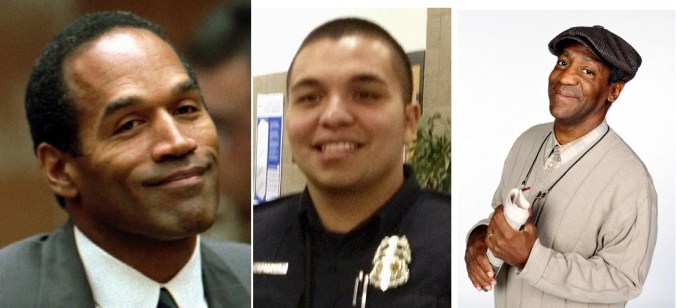
—-Jeannie Suk Gersen, Harvard Law School professor, explaining why the failure of a jury to convict Bill Cosby has little to do with sexism and everything to do with our standard of guilt in criminal cases.

The Professor could also have said, just as accurately,

‘We chose to set up our system to be stacked in favor of the defendant in all cases. So, in areas where the defendants are police officers, and most of the victims are black, it’s a structural bias in favor of cops. Even if we were to get rid of racism, it would still be very hard to win these cases. I think this is what we have to live with on the criminal side, because we’ve made the calculation that this is the right balance of values.’

It’s the exact same problem. The confusion comes when the public or a portion of it is  certain that particular defendant is guilty, and thus regards the failure of the system to find him so as proof of a malfunctioning justice system. It isn’t. It is proof that the system functions as it is supposed to, was designed to do and must do.  We do not take citizens’ freedom away unless guilt can be proven beyond a reasonable doubt under the evidence rules of the law. This is what Colin Kaepernick doesn’t understand. This is what Black Lives Matters refuses to understand. This is what feminists and the Obama Education Department, which commanded that universities give the benefit of the doubt to accusers in allegations of sexual assault rather than the accused, either refuse to understand or do understand but argue against anyway to pander to the ignorant.

Americans, however, must understand this principle, and not just understand but fight for it, because it is the foundation of the Rule of Law as well as our individual rights.

Before I am done I will probably have posted this scene from “A Man For All Seasons” more than a hundred times. Maybe I should post it every day. Those who casually advocate forging short-cuts and detours through our laws and rights as the remedy for what they perceive as intolerable wrongs need to see it, read the words, memorize them, and maybe be quizzed on the scene’s lesson as a condition predicate to being respected in any policy debate: