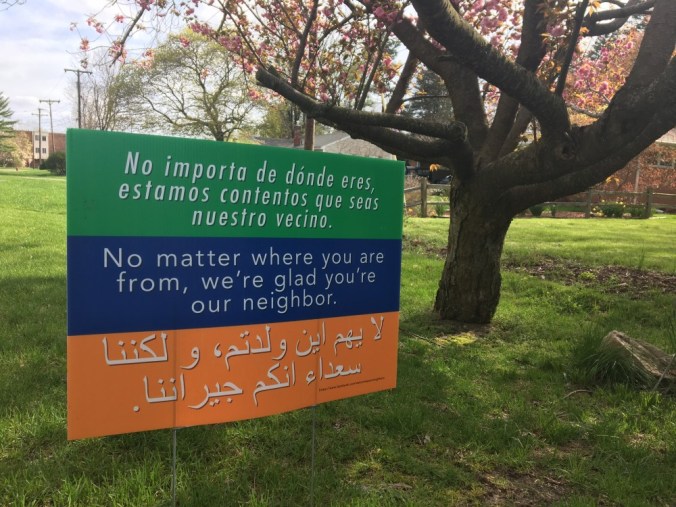
NPR claims that people get teary-eyed viewing this supposedly viral sign in front of houses across the country. I’ve only seen two in my neighborhood, thank goodness, and they irritate me no end. Why? The sign is dishonest, unfair and divisive. It is also political, while pretending not to be.
First, the sign is not what it represents itself as being. It is not written for an actual neighbor. If it were, the sign would be remote and rude. I welcome new neighbors personally, not by putting garish signs on my lawn. The sign is blatant virtue-signalling, telling the neighborhood that this household is in favor of diversity, love, and immigration…as if lots of other people are not. If it is not a public sign designed to rebuke those people, whoever they are, then why the sign? If everyone in the neighborhood welcomes Americans of all colors and origins—and I know of no Klan chapter in Northern Virginia—then the sign is a straw man. I’m sure, however, that Hispanic-Americans or Muslim-Americans who see these signs on lawns might be moved to think: Wait, does this mean that many people in this community DON’T welcome us as neighbors? How are we to recognize them?
That’s not a healthy or welcoming message, but hey, if it makes the homeowner seem enlightened and virtuous, it’s a net win. Continue reading →
I have finally read the transcript, which you should do as well. By now I have also seen a lot of video clips. (James Comey really says, “Lordy!” Wow.)
First, some general observations, with more detailed comments to come in a subsequent post.
1. My earlier expressed opinion of James Comey when I defended him against conservative accusations that he was giving Hillary Clinton an undeserved break by not indicting her were revealed as too generous yesterday. I still believe he is honest and non-partisan. More than ever, I believe that he is untrustworthy. He was obviously in a difficult position—many, in fact—that he was not able to successfully manage, if anyone could have. However, his oft-repeated insistence that he (and his FBI) did not play politics was exposed as false, if not dishonest (a gracious interpretation of the sort that Comey denied the President in his bitter testimony.)
2. The fake Russia collusion narrative pushed by Hillary, Democrats and the news media to simultaneously excuse her loss and undermine the Trump Presidency was killed yesterday, but will wander around like a zombie for months if not years because Trump-haters will not have the integrity to admit they were wrong. Chris Matthews, a once astute and courageous liberal Democrat reporter who morphed into a partisan, knee-jerk progressive shill and anti-Republican scold as soon as he started getting paid by MSNBC, had a sudden flashback to his days of integrity when he pronounced yesterday,
“But the big story has always beenthe assumption of the critics of the president, of his pursuers, you might say, is that somewhere along the line in the last year, the president had something to do with colluding with the Russians. Something to do, a helping hand, encouraging them,feeding their desire, to affect the election in some way, some role they played, some conversation he had with Michael Flynn, or Paul Manafort, or somewhere. And yet what came apart this morning, was that theory, because in two regards the president said according to the written testimony of Mr. Comey, ‘go ahead and get anybody satellite to my operation and nail them, I’m with you on that,’ so that would mean Manafort, Carter Page, someone like that. And then he also came across today what was fascinating, Comey said that basically Flynn wasn’t central to the Russian investigation, that he was touching on it. That there was, of course, Flynn had an honest, we assume, wasn’t honest in his answer on the official forms that he had to fill out to become a national security head.”
But it only touched on that, it wasn’t really related to that. But he could be flipped for that, but in other words, they could flip him because they had him caught on something he dishonestly answered but he wasn’t central to the Russian thing, and I always assumed that Trump was afraid of was that he had said something to Flynn, and Flynn could be flipped on that. And Flynn would testify against the president that he had had some conversation with Flynn in terms of dealing with the Russians affirmatively. And if that’s the case, where’s the there there?”
There is no there there, and never has been. Thus the anti-Trump hysterics are left with what they have always believed was proof enough: Hillary lost, leaked hacks of e-mails that led the public to realize how sleazy the Democrats were should have never been seen by voters, Trump was the beneficiary of the leaks, he had said nice things about Putin, he’s an unethical creep, and a lot of his associates had business contacts with Russia, and besides, they just know Trump is guilty.
That’s not enough; in fact, it’s nothing at all. Matthews as both a lifetime Democrat and a romantic regarding the Presidency and democracy detests Trump to his Irish-American Boston liberal core, but he knows when to get off a bandwagon that will embarrass him if he stays on board, or make it impossible for Chris to look in the mirror.
3. For a lawyer, Comey’s loose use of the term “liar” and his stated belief that he assumed that Trump was a liar early on in their relationship shows a troubling inattentiveness to his own biases, as well as a classic misunderstanding of what it means to lie. Comey said Trump lied about why Comey was fired, for example. Comey has no way of knowing which of the many legitimate reasons for firing him played the biggest role in his firing. He does not know what Trump was thinking, so he cannot assert that Trump lied. He can say that he believes Trump lied, but that is only his opinion: it does not make Trump a liar, and it is not evidence. Last ditch bitter-enders among the Impeach Trump Lynch Mob will be arguing that Comey’s various opinions and reactions prove misconduct by Trump. But lying and obstruction of justice are not like sexual harassment, where a second party, by his or her reactions, determines whether misconduct has taken place. Comey stated that he took Trump’s words that he “hoped” that the FBI would drop the Flynn investigation as a “direction.” He also could have taken it as a marmoset, but that wouldn’t mean that the President meant it as one.
Any time a supervisor says “I hope you do this,” it is a statement of what will make that supervisor happy. (Did Obama ever say to his Treasury Secretary, “I hope the IRS is tough on those tea party groups: they are about as non-partisan as I am!”?) Nevertheless, it leaves the decision in the hands of the subordinate.
4. Comey came off like a classic disgruntled former employee, and I’ve interviewed many of them, angry that he was fired and determined to do as much damage to his former supervisor as possible on the way out the door.
1. News Item: “More than 130 imams and Muslim religious leaders in the United Kingdom have said they will refuse to perform funeral prayersfor the Manchester and London terrorists as a rebuke to the “dastardly cowardice” of the “vile murderers.” Notes Ethics Alarms issue scout Fred, “This time it’s religious institutions refusing [to provide a service based on religious/political beliefs and conduct], and it’s based on the actions of the people they’re refusing to pray for or bury. On the other hand, anyone born in Scotland is entitled to the government’s services even if he’s No True Scotsman. By analogy, is it right for them to deny funerals to Muslims, even the most egregiously sinful?
I’d have to do more research on Islam than I have time for right now to address that question, but it’s an interesting one.
2. As a follow-up to New Orleans’ lamentable decision to remove statues honoring Confederate figures (discussed on Ethics Alarms here), The Atlantic published an exhaustive brief against the “myth” that Robert E. Lee was worthy of his reputation as a noble human being who fought for Virginia out of loyalty to his “country,” but who deplored slavery. I have criticized the hero-worship of Lee as well, but much of what is in Adam Serwer’s article was completely unknown to me. If accurate, it is horrifying. Just one example:
“Lee’s cruelty as a slavemaster was not confined to physical punishment. In Reading the Man, the historian Elizabeth Brown Pryor’s portrait of Lee through his writings, Pryor writes that “Lee ruptured the Washington and Custis tradition of respecting slave families,” by hiring them off to other plantations, and that “by 1860 he had broken up every family but one on the estate, some of whom had been together since Mount Vernon days.” The separation of slave families was one of the most unfathomably devastating aspects of slavery, and Pryor wrote that Lee’s slaves regarded him as “the worst man I ever see.”
3. I’ll discuss the Comey testimony in detail later, but I came close to writing about the unseemly and self-indicting display of gleeful anticipation by much of the news media (and “the resistance,” of course) over what they were just certain would be the smoking gun to get President Trump impeached. CNN had a countdown, second by second, on-screen the whole previous day, like Christmas was coming. Ann Althouse nicely summed up how foolish and ugly this was:Continue reading →
Colleen Campbell, a local Philadelphia television reporter, got herself fired for an obscenity-packed rant berating a cop outside a Philadelphia comedy club. What she didn’t know was that the whole, ugly thing was filmed. You know that rule that says “ethics is what you do when nobody’s looking except your embarrassed companion and a policeman who you have no respect for anyway because he’s just a cop? That’s the one Colleen whiffed on.
Campbell ae was kicked out of the club for “loud whispering” throughout the show. Once outside, she denied being disruptive to an officer who removed her. The officer replied that Campbell and her male friend needed to just leave the scene. The reporter replied, charmingly,
“Or what? Or what, motherfucker? Lick my asshole. How about that? Fucking piece of shit. That’s why nobody likes fucking police … idiots in this fucking town.”
Campbell, 28, didn’t know her act was caught on camera and posted to Facebook until after she received word from the station that she had been fired. Now she says…
“That’s not me or how I talk or act or anything at all…I don’t know what to do. I feel ruined and embarrassed for me and my family….I feel awful…That’s not me or how I speak or how I talk or how I was raised. I had to delete all my social media, because I’m getting threats….I wanna apologize to the officer. I don’t remember the whole altercation at all. I remember feeling attacked. I would never talk like that. It was like watching a whole different me.”
The Kathy Griffin episode sparked several of those currently popular blog posts and web essays about how social media destroys people who make “one mistake” and if it could happen to them, it can happen to you. Ethics Alarms has had several of these posts in the past, always about regular citizens who had an ugly e-mail distributed to the universe by an angry girl friend, or a tasteless or misunderstood tweet to a friend gone viral. No question: these web lynchings are out of proportion to the offense. Continue reading →
On a thread about the hysterical doom-sayers in response to the US’s exit from the Paris accords on climate change, one dedicated defender of progressive orthodoxy, lacking a genuine rebuttal for the proposition that the social media and pundit panic was nonsense (for there is none), defaulted to the argument that the withdrawal was unethical because the President’s stated motives for it were untrue. This raised two issues, one centuries old, and the other, an irritating one, of more recent vintage.
In order to sanctify many of the Obama administration’s policy botches, many people have adapted aggressive versions of three prime rationalizations on the Ethics Alarms List: #13. The Saint’s Excuse: “It’s for a good cause”; #13A The Road To Hell, or “I meant well” (“I didn’t mean any harm!”) and #14. Self-validating Virtue. To refresh your memory:
13. The Saint’s Excuse: “It’s for a good cause”
This rationalization has probably caused more death and human suffering than any other. The words “it’s for a good cause” have been used to justify all sorts of lies, scams and mayhem. It is the downfall of the zealot, the true believer, and the passionate advocate that almost any action that supports “the Cause,’ whether it be liberty, religion, charity, or curing a plague, is seen as being justified by the inherent rightness of the ultimate goal. Thus Catholic Bishops protected child-molesting priests to protect the Church, and the American Red Cross used deceptive promotions to swell its blood supplies after the September 11, 2001 attacks. The Saint’s Excuse allows charities to strong-arm contributors, and advocacy groups to use lies and innuendo to savage ideological opponents. The Saint’s Excuse is that the ends justify the means, because the “saint” has decided that the ends are worth any price—especially when that price will have to be paid by someone else.
13A The Road To Hell, or “I meant well” (“I didn’t mean any harm!”)
This sub-rationalization to the Saint’s Excuse is related to its parent but arguably worse. Rationalization 13 is one of the really deadly rationalizations, the closest on the list to “The ends justified the means”:
The Saint’s Excuse is that the ends justify the means, because the “saint” has decided that the ends are worth any price—especially when that price will have to be paid by someone else.
But while the wielder of the Saint’s Excuse typically at least has a beneficial or valuable result to claim as justification for unethical and inexcusable acts, the desperate employers of 13A only have their alleged good intentions, which may be the product of emotion, misunderstanding, ignorance or stupidity. How a bad actor intended his unethical conduct to turn out is no mitigation at all. The underlying logic is that the wrongdoer isn’t a bad person, so the wrongful act shouldn’t be held against him or her as harshly as if he was. The logic is flawed (it is the same logic as in The King’s Pass, #11, which holds that societal valuable people would be held to lower standards of conduct than everyone else) and dangerous, encouraging the reckless not to consider the substance of a course of action, but only its motivations.
The Saint’s Excuse attempts to justify unethical actions that accomplish worthy goals The Road to Hell attempts to justify unethical conduct even when it does undeniable harm, just because it was undertaken with admirable intent.
14. Self-validating Virtue
A corollary of the Saint’s Excuse is “Self-validating Virtue,” in which the act is judged by the perceived goodness the person doing it, rather than the other way around. This is applied by the doer, who reasons, “I am a good and ethical person. I have decided to do this; therefore this must be an ethical thing to do, since I would never do anything unethical.” Effective, seductive, and dangerous, this rationalization short-circuits ethical decision-making, and is among the reasons good people do bad things, and keep doing them, even when the critics point out their obvious unethical nature. Good people sometimes do bad things because they are good people, and because of complacency and self-esteem they begin with a conviction, often well supported by their experience, that they are incapable of doing something terribly wrong. But all of us are capable of that, if our ethics alarms freeze due to our environment, emotions, peer pressure, and corrupting leadership, among many possible causes. At the end of the movie “Falling Down,” the rampaging vigilante played by Michael Douglas, once a submissive, law-abiding citizen, suddenly realizes what he has done. “I’m the bad guy?” he asks incredulously. Indeed he is. Any of us, no matter how virtuous, are capable of becoming “the bad guy”…especially when we are convinced that we are not.
This has led to the seeming absurdity of recent arguments, some accepted in court, that the same conduct can be right or wrong, depending on whether the conduct is based on “good” motives, and who is the actor. Since, to take one random example, Barack Obama is obviously good and means well, even inept, poorly planned and irresponsible policies are ethical. Because President Trump is a villain, the same conduct emanating from his dastardly motives would make the same conduct unethical. I have dealt with this biased approach before and will again, but not today.
It is the second, older question that concerns me at the moment, and that is whether human motives should be used in the analysis of whether conduct is ethical or not. The conundrum come up repeatedly in one of my favorite ethics books, “The Pig That Wants To Be Eaten.” Continue reading →
[I have been pondering doing this for some time now. Literally every day there are issues and stories that arise that are either too minor for a full post, or crowded out by other issues. Often I never get to them. Also my various issue scouts (especially Fred) have been burying me with excellent candidates for discussion and analysis, and I never get to most of them, frustrating all of us. So I am going to see if I can begin every day with a set of short notes about these topics, reserving the right to expand some of them into full posts later.]
1. Stacy Lockett, a teacher at Anthony Aguirre Junior High, has been firedafter she gave out facetious awards to students such as “Most likely to become a terrorist” and “Most likely to blend in with white people.” Good, I think. These are too sensitive issues to expect middle-schoolers to laugh at, and the ‘awards” show terrible judgment. Still, I am thinking back to comments made in class by some of my favorite 7th and 8th grade teachers, some targeting me. I thought they were funny, and the teachers knew I would think so. All of them would have been fired today, according to the Lockett Standard (Pointer from Fred)
2. By not disciplining Reza Aslan, the host of its “Believer” program who called President Trump a “piece of shit,” “an embarrassment to humankind” and a “man-baby” CNN has made it clear that it has abandoned any vestiges of professionalism or regard for journalism ethics. Well, perhaps “even more clear” is more accurate. CNN allowed Carol Costello to gleefully mock Bristol Palin for getting emotional over being battered; it has allowed Don Lemon to get smashed on the air two New Year’s Eves in a row, and shrugged off Anderson Cooper speculating about the President taking “a dump on his desk,” to give just three examples. Its excuse for Aslan was especially weird, claiming in a statement that he was a host but not an employee. Aslan apologized, but it was a dishonest apology, claiming that the tweets were impulsive and “not like me,” but in another tweet on May 9, he wrote,
“Oh the joy when this lying conniving scumbag narcissistic sociopath piece of shit fake president finally gets what’s coming to him.”
It’s sad to see what CNN has become since Trump’s election. I am embarrassed for the network. but more than that, I am in sorrow for the public. It is not being served by this kind of amateurish, biased and unprofessional journalism.
3. I finally decided that this law suit was too stupid to write about: a ridiculous woman named Holly O’Reilly has found some lawyers—not just any lawyers, either, but the First Amendment Institute at Columbia University—-willing to file a lawsuit claiming that President Trump cannot block her on his Twitter account because doing so is a First Amendment violation of her rights of free speech. The institute’s executive director, Jameel Jaffer, said in a statement that Mr. Trump did not have a right to exclude his critics from engaging with his posts. Does anyone think this is anything but nonsense? Anyone but the New York Times, that is, which wrote, ” The request raises novel legal issues stemming from Mr. Trump’s use of his Twitter account, @realDonaldTrump, to make statements about public policy,” and the Washington Post, which published the woman’s silly op-ed .
When did “novel” come to mean “absurd”? The President blocking a Twitter user on the social media platform isn’t “government action” any more than not taking her phone calls or not reading her letters. She can still say anything she wants on Twitter. Next she’ll sue because she isn’t allowed to ask question at White House press briefings. Columbia University should be embarrassed, but when the anti-Trump hate virus melts your brain, embarrassment is often the first casualty. Continue reading →
Growing up in Casper, WY, the expectation among my peers was that after graduating high school, you either went to college our you stayed in your home community to work low-wage, service industry jobs. On very rare occasions, there was mention of going to WyoTech, if you really liked working on cars and could pay the tuition, which was quite a bit more than tuition at the University of Wyoming. I can’t say I ever heard anything promoted at my high school about apprenticeships in a craft, or any other kind of traditional skilled labor.
At the University of Wyoming, a great many people I met, a portion of which never made it past their freshman year, only went to college because it was expected, not because it was what they wanted to do or were interested in. I can understand going to college when you are searching for what you want to do with your life, and I think most people going to college either know what they want to do or want to find what they want to do at college. But for so many people that I saw, a trade school or an apprenticeship would have been worlds of improvement over drifting through campus, failing classes, drinking, partying, and essentially wasting thousands of dollars to go nowhere. Continue reading →
The post on Facebook hysteria over the U.S.’s decision to withdraw from the largely symbolic Paris climate change accords has drawn perplexing commentary. The post did not assert a position on climate change, nor did it defend the reasons given for the withdrawal. The post simply stated that it was irresponsible and dishonest to claim dire consequences of the decision when the accord itself is almost entirely symbolic, requires nothing, in the sense that there are no enforcement mechanisms, and can’t possibly carry the existential weight that social media, politicians, pundits and activists are claiming. It is all appeal to emotion and ignorance.
And it is. Especially since most of the social media hysterics haven’t read the accord and are illiterate regarding climate science.
And they are.
I guess I knew that both climate change flacks and those suspicious of them would shift gears into the messy issue itself and its controversial research and models. The dreaded (and misleading) “97% of all scientists” stat even made its appearance, although, again, it was irrelevant to the post.
Finally, Zoltar Speaks!, Popeye-like, declared that “I ain’t gonna take it, ’cause I can’t take no more!” after a side debate over whether the infamous hacked e-mails among climate-change researchers “proved” that there was a conspiracy to distort the science on climate change (no, they prove that the scholarly research community members are not as objective and independent as they are professionally obligated to be, and that this makes their conclusions inherently untrustworthy). He produced an epic essay in response, so long and detailed that he posted it on a satellite blog. With his permission, I am posting it in it’s entirety here.
Through June 3, 2017, there have been 296 no-hitters officially recognized by Major League Baseball, 252 of them in the modern era starting in 1901. Seeing one in person is a joy and a treat for any baseball fan, and even the close-but-no cigar games are memorable, as every out, every great play and every batter creates excitement, anticipation, and dread. No sport has anything like no-hitters.
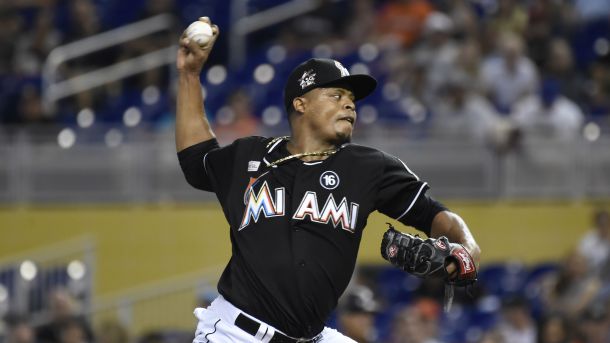
On that June 3 date, four days ago, Edinson Volquez tossed the first no-no ( as they are colloquially called) this season, and the sixth no-hitter in Miami Marlins history, defeating the Arizona Diamondbacks. It was an unusual version of the breed because Volquez, a journeyman starter, had two baserunners who reached on walks and saw them erased by double plays. He needed only 98 pitches to complete the masterpiece.
This comes at a good time for the sad-sack Marlins, who have attendance problems, trust issues (the team twice dismantled a championship team to save money), bad luck (rising superstar pitching ace Jose Fernandez died in a boating accident at the end of last season), hero problems (Fernandez was driving the boat, he was drunk and on coke, and he killed two of his friends) and ownership uncertainty, for the team is for sale.
A friend living in Florida writes,
“The Miami Marlins selling tickets to a game that’s already been played? I suppose so you can frame them and claim you were at the no-hitter a Marlins’ pitcher threw on June 3rd. From the email they sent me, since I live in Florida and do attend three or four Marlins games a season:
“For those of you who missed attending the game but want to own a souvenir piece of history, unsold tickets from the game are still available by clicking here. Online purchases will be printed and mailed. Fans can also purchase tickets in-person at the Marlins Park Ticket Office.”
Freshmen and seniors at about 200 colleges across the U.S. take a little-known test every year to measure how much better they get at learning to think. The results are discouraging.
At more than half of schools, at least a third of seniors were unable to make a cohesive argument, assess the quality of evidence in a document or interpret data in a table, The Wall Street Journal found after reviewing the latest results from dozens of public colleges and universities that gave the exam between 2013 and 2016. …At some of the most prestigious flagship universities, test results indicate the average graduate shows little or no improvement in critical thinking over four years. . . .
Some academic experts, education researchers and employers say the Journal’s findings are a sign of the failure of America’s higher-education system to arm graduates with analytical reasoning and problem-solving skills needed to thrive in a fast-changing, increasingly global job market. In addition, rising tuition, student debt and loan defaults are putting colleges and universities under pressure to prove their value.
Some?
What’s the other side saying, that the results are cooked? That critical thinking is over-rated or a sexist, racist, xenophobic construct? How can any objective individual who has followed the news, listened to activists babble incoherently on campuses like Dartmouth, Yale, Columbia, University of Missouri and hundreds of others, been aware of higher ed apocalypse stories like this one , or notice that the overwhelming majority of college students enthusiastically supported the fact-, math-, economics-, foreign policy-, history-and Constitution- challenged candidacy of Bernie Sanders be surprised at these findings? They aren’t even new.
The scam that is U.S. higher education poisons the American dream in too many ways to count. 50% of employers say that college graduates they hire aren’t ready for the workplace because of inadequate critical-reasoning skills. Yet virtually every institution cites this as the prime benefit of paying it a king’s ransom for four years, with brochure proclamations like…
“The university seeks to foster in all its students lifelong habits of careful observation, critical thinking, creativity, moral reflection and articulate expression.”
and
“… University fosters intellectual inquiry and critical thinking, preparing graduates who will serve as effective, ethical leaders and engaged citizens.”
and
“The college provides students with the knowledge, critical-thinking skills and creative experience they need to navigate in a complex global environment.”
“At most schools in this country, students basically spend four years in college, and they don’t necessarily become better thinkers and problem solvers,” said Josipa Roksa, a University of Virginia sociology professor who co-wrote a book in 2011 about the CLA+ test, that littel-known test the Wall street Journal referred to. . “Employers are going to hire the best they can get, and if we don’t have that, then what is at stake in the long run is our ability to compete.”
Even the arguments used to defend college lack evidence of critical thinking. Today’s New York Times special Higher Ed section highlights this quote: Continue reading →