This was a test of integrity for the mainstream news media, and they, most predictably, flunked it, and outed themselves as the shamelessly unethical propaganda-spewing hacks they are. Depressing, but good to know, as if we didn’t know already.
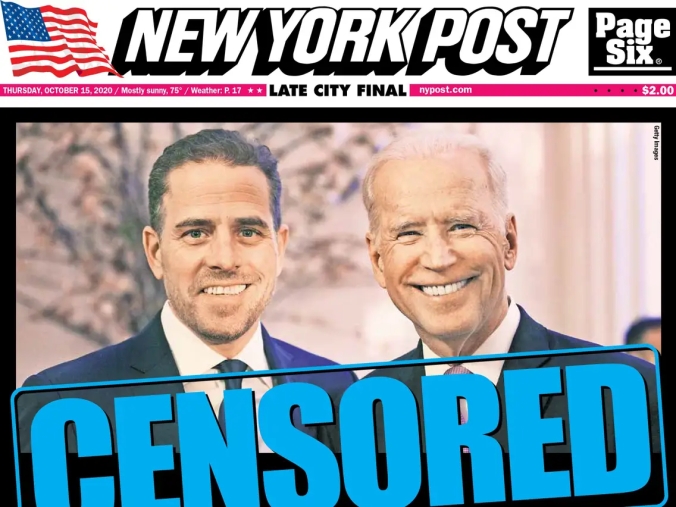
As an exemplar of the whole, ugly, revolting effort to dismiss evidence that a biased and partisan Twitter staff deliberately buried a news story that might have harmed Joe Biden’s prospects of winning the 2016 election, Phillip Bump’s “analysis” in the Washington Post could hardly be more damning. Its very headline is an unethical rationalization and an appeal to consequentialism: “No, limiting the Hunter Biden laptop story didn’t cost Trump the election.”
Brittney Griner, the U.S.-hating WNBA star who was sentenced to nine years in a Russian prison for violating Russian drug laws charges was traded to the U.S for international arms dealer Viktor Bout, an international criminal who was serving a 25 year sentence. Meanwhile, retired U.S. Marine Paul Whelan, also imprisoned in Russia and for nearly four years, remains there. He was convicted on espionage charges that the U.S. has called false, which doesn’t mean they are false, of course.
Observations:
You knew this was going to be the result, didn’t you? It was as certain as anything in foreign relations could be. Griner is black, a female and a lesbian as well as a sports celebrity who parrots progressive anti-American ideology. Biden might appoint her to the Supreme Court: she ticks all the right boxes.
The Biden Administration wasn’t wrong to seek her release. Russia had deliberately throw its metaphorical book at her; bu U.S. standards, her sentence was cruel and unusual. Our government is duty bound to try to rescue its citizens when foreign governments abuse them.
In baseball terms, this trade was like a team trading a superstar pitcher to its major divisional rival for a third-string catcher and a bag of stale peanuts. Griner has no national security or diplomatic use whatsoever; her sole value is political, as the Democrats will apparently do anything to pander to the three constituent groups Griner belongs to. Here’s a description of Bout, in contrast:
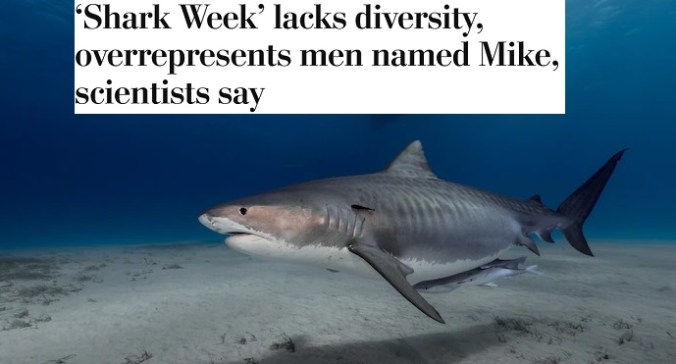
I couldn’t resist a post in “The American Thinker” which listed 12 “headlines you never would have seen just a few short years ago,” because 10 of 12 had appeared on my birthday, December 1. That explains why my favorite recent Great Stupid headline didn’t make the list, “Shark Week Lacks Diversity, Overrepresents Men Named Mike, Scientists Say,” which sparked two Ethics Alarms posts yesterday, here and here. Eric Utter writes that taken together, the list “looks like a harbinger of chaos and disaster.” I won’t argue with that, especially since I see worse headlines than these every day and have time and gorge to write about only some of them. Here are nine of the twelve:
Jennifer Lawrence is a charismatic, versatile, talented movie star, but someone misled her into believing that everything that pops into her head is worth saying, and it isn’t. In this case, it wasn’t just banal or gratuitous progressive blather points, but a wildly false and disrespectful over-praising of her own significance at the expense of actresses that she ought to be honoring rather than insulting.
In a recent interview with Variety magazine, the star of the “Hunger Games” movies (beginning in 2012), “Silver Lining Playbook” and other films said,
“I remember when I was doing ‘Hunger Games,’ nobody had ever put a woman in the lead of an action movie because it wouldn’t work. We were told … girls and boys can both identify with a male lead, but boys cannot identify with a female lead.”
If you don’t know your film history, don’t make statements about film history. It makes one look like a conceited fool, as the social media mob rushed to inform Lawrence. Continue reading →
In her Comment of the Day on the lament by female shark researchers that they are under-represented in their field (without any supporting evidence of how many aspiring but unfulfilled female shark researchers there are), Sarah B. neatly expresses how “diversity-equity-inclusion” based arguments for hiring create justifications for bias while supposedly addressing the problem of bias.
Women do have trouble in the hard sciences. This is true. HOWEVER if we act like whiny little bitches, no one will take us seriously when we need to be taken seriously. Do these DIE-obsessed women not understand that not only are they shooting themselves in the feet, but they are making it harder for all the rest of us?
Employer-Employee relations suffer. If I were hiring researchers, it would be hard to WANT to hire women given the current rules. As a woman I also have confidence issues, as I am uncertain if I was hired as anything more than a diversity hire. Am I really the best for a job, especially if I’m finding something about it very challenging? Is this simply a case of needing to step up and improve myself professionally, or am I just a check-box who is under-qualified and never expected or even capable of performing?
Finally the relationship with coworkers suffers. If my coworker is a diversity hire, they get paid about what I do, but I have to do their work which has me put in hours of unpaid overtime to keep my job while they float. This leads to hate and discontent. And as a potentially qualified person seen as a diversity hire, we need to work much harder than our coworkers with more results than our coworkers to get the basic respect because we start so far in negative territory on the Cognitive Dissonance scale.
As a further note, even if DIE had a point, trans and BIPOC rules have essentially neutered it because who can tell if Mike on “Shark Week” doesn’t identify as Michaela in its personal life and is 1/1024 BIPOC?
Women need to stand up against DIE hiring (yes I’m aware of the real acronym) and work to get jobs due to our qualifications, not our box-checking.
The New York Times has an article about the competition to create a new Christmas music standard, or at least a hit song for streaming. The piece’s “Rules of the Game:
No. 1: The public prefers the old classics, and isn’t too interested in new songs.
No. 2: Singers shouldn’t wander too far from the melody.
No. 3: “You can’t be too corny at Christmas. You totally get a free pass.”
Corny is fine, but what about creepy?
D. Dark Christmas Songs
1. Traditional Carols
The problem with “The Carol of the Bells” isn’t the lyrics, it’s the music. The thing is affirmatively creepy; my mother hated it, and compared the tune to “The Hall of the Mountain King.” No other Christmas music has been so frequently used darkly. It came, then, as no surprise when the TV horror mini-series “Nos4A2,” based on a novel by Stephen King’s son, used the carol as its theme music. The show is the tale of a damned man who kidnaps children and takes them to “Christmasland” where they are kids forever, and also become little vampires. The music, which is by a Ukrainian composer, is unquestionably ominous. Why it has remained in the Christmas canon is a mystery to me.
Another carol in a minor key is “We Three Kings,” which contains this cheerful lyric in Verse 4, sung by Balthazar:
Myrrh is mine; its bitter perfume Breathes a life of gathering gloom;— Sorrowing, sighing, Bleeding, dying, Sealed in the stone-cold tomb
Merry Christmas!
And why would you give that stuff to a baby?
I’m going to call “I Heard the Bells on Christmas Day” a traditional carol since its lyrics are more than a century old. It’s not creepy, but it is a sad song, and sadder still when one knows its origins.
Henry Wadsworth Longfellow wrote a poem titled “Christmas Bells” on Christmas Day, December 25, 1863. He was in despair: his son had been wounded fighting for the Union the month before, and the poet feared he would die. The author of “Paul Revere’s Ride,” “Evangeline” and other famous poems also was still mourning his second wife, who had died horribly in a fire two years earlier. He was not in a good state of mind when he wrote,
…unless, of course, we should have compassion and empathy for unapologetic, self-destructive idiots like Anaya Peterson.
Peterson is a mother of five and—KABOOM!—a law student, but nonetheless thought it would be a good idea to get her eyes tattooed. After all, Australian model Amber Luke tattooed her eyes a vivid blue and only went blind for three weeks! That was good enough for Peterson, whose seven-year-old daughter cautioned her that the procedure was too risky. “What if you go blind?” the kid asked? Oh pshaw, Mom answered; adults know best.
Now it looks as if Mother may go blind after all. “I don’t have 20/20 vision anymore. From a distance, I can’t see features on faces,” Peterson told the media. “If I didn’t have my eyeballs tattooed, I wouldn’t be having this problem. Even today I woke up with more floaters in my eyes. And that is dangerous.” Continue reading →
I read something about the ridiculous recommendations forthcoming from California’s “Task Force to Study and Recommend Reparations Proposals for African Americans” a while back, and decided that it was just one more indicator of how the entire state had lost its collective mind, that The Great Stupid knows no bounds, and that some things are even too silly for me to write about. Now I think some attention should be paid. Because…
The task force reportedly will recommend giving $223,200 each to all descendants of slaves in California, on the theory that it will be a just remedy for housing discrimination against blacks between 1933 and 1977. The cost to California taxpayers would be about $559 billion, which is more than California’s entire annual budget, and that doesn’t include the massive cost of administrating the hand-outs and dealing with all the law suits it is bound to generate. Obviously, the recommendation is absurd for that reason alone, which makes it pure virtue signaling. The task forces is unethical by definition: spending public money to study an issue and issuing a recommendation that is politically and financially impossible to follow is irresponsible in the extreme.
As I write this, I have no idea who will win Georgia’s run-off for the U.S. Senate. Ethically, it doesn’t matter: the prospect of either result—Sen. Warnock’s re-election, or a victory for Republican Hershel Walker—is horrible. This is an even worse ethics zugszwang election than Hillary vs. Trump in 2016, except that the Presidency is obviously more important than the Senate, and an incompetent, dishonest, untrustworthy occupant can do far more damage there.
Ethics Alarms has discussed the awful choice offered Georgians many times over the past few months, mostly focusing on Walker, who is the most unqualified candidate for the U.S. Senate offered by a major party in my lifetime, and possibly ever. Warnock, however, is only slightly better, and he’s representing the political party that is slightly more unethical and incompetent than Walker’s party. Walker’s scandals are marginally more numerous and worse; his lies are more outrageous, his hypocrisy more stunning. But then Warnock says stuff like his ridiculous explanation (on MSNBC, naturally, with Joy Reid, of course) of why he is a radical abortion supporter:
“I have been studying the Scriptures my whole life. I’m committed to the faith. And, as a pastor, I have a profound reverence for life. And, as a pastor and a person of faith, I have a deep respect for choice. If we care about life, black women are dying three to four times the rate of white women in childbirth, as a result of childbirth. And so, if you care about life, we ought to find a way and address the obvious bias in our health care system….I think it’s exactly what Jesus would do,”
Warnock isn’t just unfit to be in the Senate, he’s unfit to be in the clergy.
Not only has the Left’s obsession with group identification, quotas and “diversity, equity and inclusion” reached peak madness, but the purveyors of this cult, including the mainstream media, are no longer capable of perceiving its excesses.
The article in yesterday’s Post was not a parody. The headline was not supposed to be funny. The tragically biased Post reporter responsible for this insanity is Daniel Wu, a reporting intern in the Post’s Metro section. Stanford University made him this way. And the editors who agreed to insult Post readers with it? Who knows what made them impervious to common sense? Well, let me take that back: “It’s the Great Stupid, Charlie Brown!”
The piece begins by describing the tragic circumstances of LisaWhitenack, now a biology professor at Allegheny College, a shark researcher who was tormented as a child she didn’t see many shark researchers on the Discovery Channel’s “Shark Week” that looked like her. So she decided to study this dire and under-recognized phenomenon “Was “Shark Week” feeding audiences the wrong messages about sharks — and who studies them?” The Post continues,





Women do have trouble in the hard sciences. This is true. HOWEVER if we act like whiny little bitches, no one will take us seriously when we need to be taken seriously. Do these DIE-obsessed women not understand that not only are they shooting themselves in the feet, but they are making it harder for all the rest of us?
Employer-Employee relations suffer. If I were hiring researchers, it would be hard to WANT to hire women given the current rules. As a woman I also have confidence issues, as I am uncertain if I was hired as anything more than a diversity hire. Am I really the best for a job, especially if I’m finding something about it very challenging? Is this simply a case of needing to step up and improve myself professionally, or am I just a check-box who is under-qualified and never expected or even capable of performing?
Finally the relationship with coworkers suffers. If my coworker is a diversity hire, they get paid about what I do, but I have to do their work which has me put in hours of unpaid overtime to keep my job while they float. This leads to hate and discontent. And as a potentially qualified person seen as a diversity hire, we need to work much harder than our coworkers with more results than our coworkers to get the basic respect because we start so far in negative territory on the Cognitive Dissonance scale.
As a further note, even if DIE had a point, trans and BIPOC rules have essentially neutered it because who can tell if Mike on “Shark Week” doesn’t identify as Michaela in its personal life and is 1/1024 BIPOC?
Women need to stand up against DIE hiring (yes I’m aware of the real acronym) and work to get jobs due to our qualifications, not our box-checking.