Ethics Observations On Trump’s Dinner With Kanye (And Nick)

Last week Donald  Trump  had dinner at Mar-a-Largo with Kanye West—I’ll start calling him by his new name, Ye, once I’m convinced that it’s not just another gimmick, or in other words, “never”—as well as Nick Fuentes, a 24-year-old leader of an annual white-supremacist event called the America First Political Action Conference, and Karen Giorno,  a veteran political operative who worked on Trump’s 2016 Presidential campaign. Never in my memory has the identity of dinner companions ever been used by the media as a supposed smoking gun against the dinner’s host. West, you may recall, had a much publicized meeting with Trump when he was President; he has recently been “cancelled” for making what seemed like anti-Semitic comments. (Kanye, it is fair to say, is mentally unstable and a publicity addict, and is likely to say anything at any time.) Fuentes dining with Trump, however, has been the focus of most of the criticism from the media, political figures, and others. The Times’ house anti-Trump specialist, Maggie Haberman wrote,

Even taking at face value Mr. Trump’s protestation that he knew nothing of Mr. Fuentes, the apparent ease with which Mr. Fuentes arrived at the home of a former president who is under multiple investigations — including one related to keeping classified documents at Mar-a-Lago long after he left office — underscores the undisciplined, uncontrolled nature of Mr. Trump’s post-presidency just 10 days into his third campaign for the White House.

She (and her co-reporter Alan Feuer) also quoted several figures who condemned Trump’s guest list:

  • “To my friend Donald Trump, you are better than this,” David M. Friedman, who was Mr. Trump’s longtime bankruptcy lawyer and then his appointee as ambassador to Israel, wrote on Twitter. “Even a social visit from an antisemite like Kanye West and human scum like Nick Fuentes is unacceptable. I urge you to throw those bums out, disavow them and relegate them to the dustbin of history where they belong.”
  • “This is just another example of an awful lack of judgment from Donald Trump, which, combined with his past poor judgments, make him an untenable general election candidate for the Republican Party in 2024,” said Chris Christie, a former governor of New Jersey who is considering a candidacy of his own.
  • “Matt Brooks, chief executive of the Republican Jewish Coalition, said, ‘We strongly condemn the virulent antisemitism of Kanye West and Nick Fuentes, and call on all political leaders to reject their messages of hate and refuse to meet with them.’”
  • Jonathan Greenblatt, the C.E.O. of the Anti-Defamation League, condemned Mr. Trump’s meeting with Mr. Fuentes, [saying], “Nick Fuentes is among the most prominent and unapologetic antisemites in the country…He’s a vicious bigot and known Holocaust denier who has been condemned by leading figures from both political parties here, including the R.J.C….[that  Trump ]“or any serious contender for higher office would meet with him and validate him by sharing a meal and spending time is appalling. And really, you can’t say that you oppose hate and break bread with haters. It’s that simple.”

Observations:

Continue reading

Comment Of The Day: “The Ethics Alarms 2022 ‘It’s A Wonderful Life’ Ethics Guide”

Here, a Comment of the Day by John Paul, is a story about a real life “Bailey Bros. Savings and Loan.” Enough said.

***

Every year it seems like you post this and every year I find it inspirational. Last year was the first time I ever watched the movie. I think, it was a little fitting, because I found myself being a lot more sympatric to George and the Elder Bailey based on another project I started then. I would like to share a little bit about that and perhaps offer a different prospective on why George decided to stick around.

I serve as the president of the board for the local Fuller Center for Housing. We are a non-profit group whose goal is to provide affordable housing for low income people in the name of Christ and in the name of our founder Millard Fuller. For those of you who aren’t familiar with the man, I highly suggest you check out his story. It’s a good one.

By 29 he was a self-made millionaire, but his money and his commitment to his practice (lawyer) were tearing his family apart. His wife, thinking it was the end of their relationship, took his children and his kids to New York. He followed them, and after a long talk, they agreed to get their lives together and give away most of the money. In the following years they ended up on Koinonia Farm (another good story), Zaire (now the Congo), then came back to start one of the most successful housing movements in the United States: Habitat for Humanity. As of 2013, Habitat was the largest non-profit builder in the world and has helped more than 35 million people construct, rehabilitate, or preserve homes since 1976. Fuller Center, while different in name, has a similar mandate and purpose.

Well, what do we do? In some ways, we are a little bit like the Bailey Building and Loan. We act like the bank in the normal transaction between the people in need of housing and the builders who will build the housing. However, the biggest difference is we not only charge 0% interest on our loan, but we only charge for cost of the materials and contracted labor (we also do 80% of building). We have smaller projects we do as well; they might be home repairs such as roofs, bathrooms, ramps, or anything a person might need costing less than $5,000. Our motto is “Hand up, not hand out.” We are going to do everything we can to get you what you need, but in the end, we still expect you to pay for it. More than that, we expect you do put in a number of hours of what we call “Sweat equity” where you must help out with the home or other projects related to the program.

Continue reading

In This Law Vs. Ethics Clash, Choosing Law Over Ethics Is The Ethical Course [Link Added]

Clear?

Probably not. Let me explain.

On July 5, 2005 in Kirkwood, Missouri, police were executing a search warrant. While they were in his home, twelve-year old Joseph Long suffered a seizure and collapsed. Police, maybe thinking he was faking, maybe worrying about being distracted from their jobs, maybe because they were just cold-hearted bastards, did nothing to help him, and wouldn’t let his mother intervene either. The child died. Two hours later, the same officers responded to the same neighborhood after getting reports of illegal fireworks being set off. Kevin Johnson, the dead child’s older brother, spotted officer William McEntee, one of the police who had been at his home earlier that evening. “You killed my brother,” he said, and fired a gun at the officer multiple times, killing him.

Johnson was tried, sentenced to death, and now, 17 years later, has run out of appeals. He’s going to be executed. His daughter, Korry, just two when he murdered the police officer, is now 19 and wants to be among the limited number of attendees at her father’s death. Missouri has a statute, Revised Code Section 546.740 that determines who is eligible to watch an execution: Continue reading

Historical Ignorance Is Dangerous: This Isn’t The Low Point In American Political History

I’ve been meaning to mention this for a while now.

I’ve been reviewing some Presidential history as I prepare to continue the Ethics Alarms search for the Worst President Ever, as more evidence of Joe Biden’s proper ranking accumulates. what has stood out is now much worse things have been in the past than they are now by any objective measure. The pundits and other hysterics currently opining daily that the nation is on the verge of unraveling either don’t know our turbulent history, or are deliberately trying to stir up fear and unrest.

They are underestimating the United States of America, and the intrinsic strength of its mission and values.

Take the 15 year period immediately after the Civil War—“Please,” as Henny Youngman would say:

  • Following a catastrophic conflict that left 2% of the population dead, the nation shattered, a whole region’s economy and society destroyed and the nation faced with somehow dealing with more than four million newly freed black slaves, President Lincoln, the one individual who had the brilliance and political skill to—maybe—navigate this confluence of crises was assassinated in a conspiracy that may have included powerful members of the government itself, or so it seemed.
  • The Vice-President who took over as President, Andrew Johnson, was a Southern Democrat who was distrusted and disrespected by the overwhelmingly Republican Congress. Worse, he was stubborn and averse to compromise. The nation’s work, at a critical time, with the nation divided and struggling,  quickly deteriorated into all-out political war between the Executive and the Legislative Branches, with Congress passing laws, some of which were unconstitutional, Johnson vetoing them, and Congress over-riding the vetoes. Members of Johnson’s own Cabinet, actually Lincoln’s Cabinet, were working with Johnson’s enemies in Congress and against him—talk about the “Deep State” !  Congress finally contrived reasons to impeach the President, who had no defenders in the press either, basing the action mostly on one of those unconstitutional laws. Johnson refused to follow it or obey it (the law prevented a President from firing a Cabinet member without Congressional approval, a clear breach of the Separation of Powers), and there it was: “High Crimes and Misdemeanors”! The Senate failed to convict Johnson by a single vote, with many believing that the pro-Johnson votes had been bought (and they might have been!).

Continue reading

The Worst Sequel To “Home Alone” Yet

Here I was, all ready to shut down Ethics Alarms posting for the day, and I ran across this awful story, which I honestly don’t understand at all. There have to be some basic equipment ethics alarms that have to work in everyone, right?

Charleston, South Carolina police were called to investigate the home of 24-year-old Donald Gekonge when an apartment manager reported that he had found a child alone in the apartment yesterday. They discovered the child sleeping in a bed in the living room. When they walked into the room, the child “immediately reached for an empty water bottle.” The child seemed to be in good condition. Police then spoke to an unnamed person who said Gekonge had sent a message that he was in New York City. Eventually police reached him, and he said that someone was caring for his son, he just wasn’t certain who.

This is always a bad sign.

Continue reading

Friday Open Forum, “But It Feels Like Sunday” Edition

I apologize: I didn’t focus on the fact that this was Friday until just now. Even at ProEthics, which never rests or takes a vacation, it has been so quiet that I was lulled into weekend mode. All the l-tryptophan didn’t help either. But there is still time to…

Ethics away!

(Ugh. I hate that fad Madison Avenue use of nouns, as in “Let’s movie!” I had to try it once to be sure just how much I hated it. Sorry.)

Ethics Hero: Florida Catholic School Principal Tonya Peters, No Weenie She

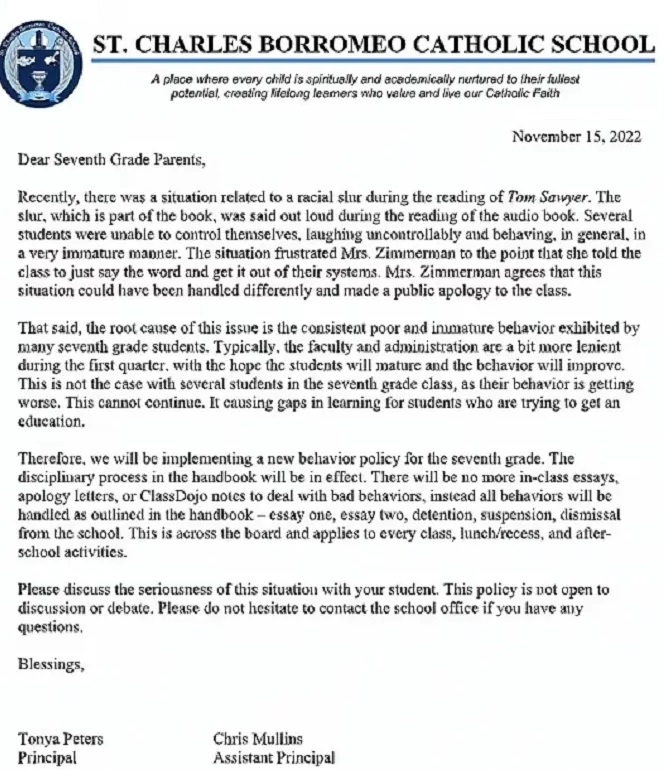
In a seventh grade English class at St. Charles Borromeo Catholic School in Port Charlotte, Florida, the teacher was presenting Mark Twain’s “Tom Sawyer,” using an uncensored version, which is to say, “Tom Sawyer.” The classic novel, like its larger, more ambitious cousin “Huckleberry Finn,” uses the now taboo “n-word” in a society today that should be too sophisticated and wise by now not to know that declaring words taboo is ethically and intellectually indefensible. One African-American community website’s news report on the incident states, “Anyone who has read an unedited version of those books know how racially insensitive they were.” Well:

  • Any one who has only read an “unedited”, meaning bowldlerized, version of “Tom Sawyer” hasn’t read “Tom Sawyer,” and
  • Great literature isn’t supposed to be “racially sensitive”; it’s supposed to be enlightening.
  • The issue of watering down language that some may find offensive in literature is well-considered in this essay.

As described in the letter above, when members of the class read the book out loud and the word “nigger” was uttered, the students began “acting up,” laughing, making comments, and generally acting like undisciplined 7th graders, which they were. When the teacher could not calm them down, she improvised a creative but risky solution: having the children repeat the word over and over again. The idea, obviously (though not sufficiently obvious for any of the media reports to figure out) was to rob the “taboo” word of power by repetition. It’s an old linguistic trick that kids should be familiar with (i know I was): when any word is repeated enough, it becomes just a sound, which is all any word is. (This device becomes the climax of the excellent horror film “Pontypool,” in which something causes the English language to become deadly, destroying everyone’s brains.) Continue reading

‘HA! You Fell For The Trap, White Boy!’

I almost made this an Ethics Quiz, but then decided that there is only one ethical answer.

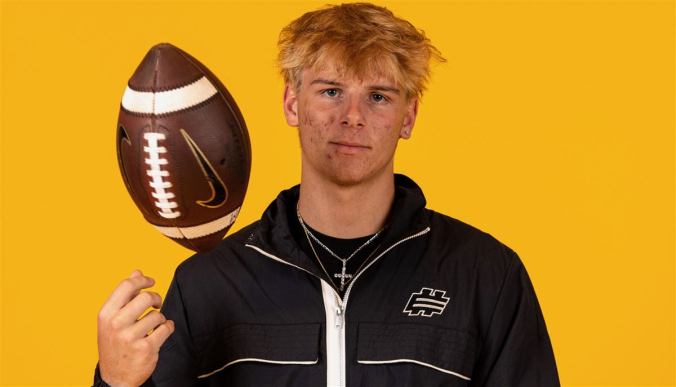
Star high school quarterback Marcus Stokes posted a video of himself in a car singing a rap song that used the term “niggas.” Or maybe it was “niggers.” We can’t find out, you see, because our infantile, unethical news media will only write  that he said the “N-word,” and the video has been deleted. Journalism!

Stokes’ video caused the University of Florida to rescind its scholarship offer. Stokes is white; there is little question that if he were the right color, singing the song and posting it would not have raised any issues at all. But as Yahoo!’s observes, “Saying the N-word as a white person goes into another territory,” at least in the hypocritical, race-obsessed worlds of sports and academia. Continue reading

Ethics Leftovers, 11/25/22: Macy’s, Police Brutality, Giving Thanks For Genghis Khan, And More

I have now seen three gags online using that introduction above. All of them were really mean; one made me laugh out loud, and I was sorely tempted to use it. However to do so would be neither ethical nor in the spirit of the season, so I’ll just encourage readers to use their imaginations.

I was especially tempted after hearing President Biden and the First Lady call into the NBC broadcast of the Macy’s Thanksgiving Day Parade—I wasn’t watching at the time, but someone sent me the video yesterday. First, it was an intrusion into what is supposed to be a completely non-political holiday event  for the President to try to exploit it. If Biden had even attempted to be the unifying leader he claimed to be while campaigning in 2020, I’d give it a pass, but at this point anything he does or says has to be taken as purely partisan, not to mention calculated and managed by his “handlers,” as in puppeteers. The phone call also went as you might expect: there were about 20 seconds of dead air time, which is an eternity on TV, as the Bidens could be faintly heard speaking incomprehensibly while NBC weather reporter Dylan Dreyer, smiling like a zany, went through a classic “Can you hear me? I can’t hear you…” routine. Finally, after Joe told  Dreyer that she was doing a “good job” and giving  credit to her for the good weather—she’s the weather girl, see; I think that bit was old by 1964—the First Couple replied  to Dreyer’s invitation to say something of substance to the audience,

Mrs. Biden: “We just want to say we’re so grateful for the people, for this opportunity, for the health that we have now in America, and Joe, what do you want to say?”

Joe: “I want to say thanks to the firefighters and police officers, first responders. They never take a break.”

Mrs. Biden:  “And God bless our troops for sure.”

Joe:  “And by the way, we’re going to be talking to some of our troops later in the day, both here and abroad. I hope everybody remembers. We remember them every single day. God bless our troops for real.”

1. More Macy’s Thanksgiving Day Parade ethics.…On the one parade broadcast I did watch for a while, the commentators used the buzz-word “diversity” three times in less than fifteen minutes, explaining at one point that a marching band was wonderful because it was “diverse.” Bands are good when they look and sound good; it shouldn’t matter what colors it is or whether there is a nonbinary flute player. Then I remembered that Macy’s had just dropped the Salvation Army and will no longer allow its Santas and bell-ringers to solicit seasonal charity contributions, because the conservative religious organization isn’t sufficiently all-in with Macy’s political and social pandering mission to “grant funding to advance human rights, racial justice, workforce development and economic opportunity.” This despite last year’s embarrassing attempt by the Army to jump on the Critical Race Theory bandwagon. The government/media/corporate alliance to mandate beliefs and opinions and punish dissenters brooks no deviation.

The last metaphorical straw was when some female pop star I had never seen, heard or heard of before serenaded the viewers with the brain-numbing Christmas song, “What Christmas Means to Me”:

Continue reading

The Ethics Alarms 2022 “It’s A Wonderful Life” Ethics Guide, Revised And Updated

2022 Preface

I had this year’s introduction all written in my head—that’s how I write, you know—and then discovered hat it was what I wrote last year. No wonder it seemed so obvious. Well, never mind: there are still plenty of new matters to consider.

The main one is that “It’s a Wonderful Life” is a Thanksgiving film as much as it is a Christmas story. In the end, it is all about being thankful and grateful for life, family, friends, being lucky enough to live in the United States, and avoiding bitterness and regret. George Bailey is a good man who is nearly destroyed by bitterness, anger, frustration and regret, and Frank Capra, who directed and partly wrote the screenplay, is telling us that this is no way to live, or even survive. It’s a tough lesson: I have been tempted many times to fall into that trap. Regular readers here have seen me do it. Like George, I often feel like I didn’t achieve and experience what I could have, that my choices too often didn’t pan out, that I barely missed the breaks that I needed when I most needed them. I feel this way even though my father constantly lectured me, really all the way through our relationship, never to fall into George’s pit of despond. As long as you’re breathing, he said, there is always opportunity and hope. Reflecting on what might have been is foolish, depressing and paralyzing.

Ironically, Capra’s fable shows a man for whom revelations of what might have been are decisive evidence that his life, however disappointing to him, nonetheless had meaning. “It’s A Wonderful Life” is perhaps the first screen time travel parable, a forerunner of “Back to the Future,” and anticipated chaos theory long before Edward Lorenz figured out how chaos works. Harry’s toast at the finale, as I wrote last year,

states a life truth that too many of us go through our own lives missing. What makes our lives successful (or not), and what makes makes our existence meaningful is not how much money we accumulate, or how much power we wield, or how famous we are. What matters is how we affect the lives of those who share our lives, and whether we leave our neighborhood, communities, associations and nation better or worse than it would have been “if we had never been born.” It’s a tough lesson, and some of us, perhaps most, never learn it.

I’m not sure I have learned it yet, to be honest with myself. Intellectually, perhaps, but not emotionally.

I just watched the film again today; every time I notice something new, which is reflected in the updated guide  below.  I am also convinced that this is the greatest, riches, most complex ethics movie of all time.  “A Man For All Seasons” was long my winner in this category, but having watched that film too again recently, it doesn’t measure up to Capra’s masterpiece. Recalling the the real Thomas More burned heretics alive rather takes the sheen off Paul Scofield’s marvelous performance.

I also realized that this is very much an adult film. Kids don’t get it; indeed, I wonder if anyone under 40 really does. That makes it a strange Christmas movie. I grew up without seeing the film; the period when it was sold at junk prices to local TV stations which then resuscitated it reputation by wide exposure (I live when that happens) began while I was in college. Now that I think of it, I don’t know if my son has seen the movie. The black-and-white film block for so many younger Americans is a genuine obstacle to both cultural literacy and ethical instruction, and no, Ted Turner’s colorized version of IAWL doesn’t help, since it stinks.

Last year I wrote—and this was one of the points I had forgotten that I had made in last year’s introduction—

This movie’s intended message needs to be considered and taken to heart in 2021. Frank Capra, the movie’s director, designed the film to explain why it’s a wonderful country we live in. It may be that more and more vocal and powerful people want to send the opposite message today than ever before.

Tragically, it is definitely true that more vocal and powerful people want to send the opposite message today than even last year. Show them the movie, and all they will do is count black faces: yup, the only black resident of Bedford Falls appears to be the Baileys’ maid. Clearly, that means that “It’s a Wonderful Life” is just one more relic of systemic racism, and should be ignored and forgotten.

A society that can or will no longer learn from “It’s a Wonderful Life” is doomed to creeping stupidity and confusion. Ethics Alarms presents this annual ethics guide in the hope that we have not reached that desperate state yet.

1. “If It’s About Ethics, God Must Be Involved”

Continue reading