
Close calls: I recently stumbled upon some polling from the period preceding World War II regarding the American public’s position on whether the U.S. should fight Germany. Here’s the most depressing of the surveys:
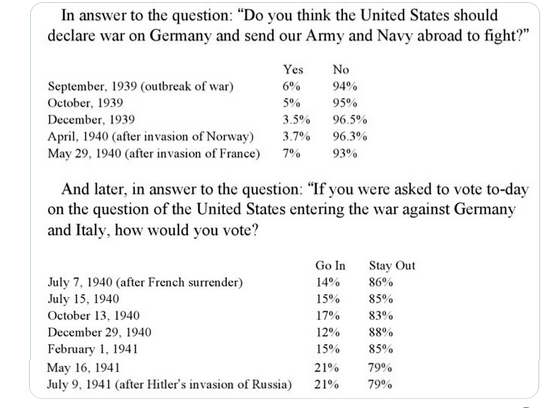 Another set of figures, from Gallup, are a bit better. These old survey results lead to the following notes:
- What would the world be like today if Japan had not attacked Pearl Harbor, and Hitler had not preemptively declared war on the U.S.? The attack might be one of the best examples I know of how a terrible event can lead to an objectively beneficial outcome: moral luck exemplified.
- Karine Jean-Pierre, who speaks for the White House, said last week that “when you are not with where a majority of Americans are, then, you know, that is extreme.”
- You know: polls.
1. I did not know this, and I’m now sorry I do. But not especially surprised: a Pew survey from 2019 revealed that the “U.S. has world’s highest rate of children living in single-parent households.” I see no reason for the data to have improved in three years, do you? And, of course, the reason this terrible condition exists is for the reason discussed frequently here: an elimination of crucial ethical norms because the society decided that it was more important not to shame or stigmatize irresponsible and damaging conduct than to minimize it. The consequences flowing from this failure in maintaining ethical standards is wide-ranging, disastrous, and too extensive to analyze here. Continue reading








Extradimensional Cephalopod might break an Ethics Alarms record today with three COTDs—I’m not sure yet: stay tuned. This one the earliest of the three, includes his cogent analysis of ranked choice voting systems, which I am on record as hating. As I have learned more about the Democrats donating to the nuttier Trump-endorsed Republicans in state primary contests, my hatred is even more entrenched. The more opportunities a system creates to game it, the less trustworthy it is. In my view, ranked choice voting asks the voter to try to game the system. Count me out.
Here is EC’s Comment of the Day on the Alaska special election item in “Labor Day Weekend Ethics Warm-Up, 9/2/2022: Which Are The Pod People And Which Are The Fascists?”
***
At first I took issue with your characterization of the Alaska election, on the basis that ranked choice voting would have removed the spoiler effect. However, I realized that’s not quite true.
Under first-past-the-post voting, if 60% of voters preferred the Republican party but were evenly split across two Republican candidates, then the Democratic candidate would have won with a 40% plurality.
In the same scenario but with ranked choice voting, one of the Republicans would have been eliminated and their votes would have gone to the other Republican candidate, who would have won. In that situation a Republican wins, just like in the FPTP scenario, but also the Republican voters get to vote on which Republican wins without risking their party losing. That is, if they all have a Republican as their second choice.
Continue reading →