Independence Day With Ethics Alarms 3…Ethics Fireworks (and Duds)!

1. Gaslighting! Seth Abramson is an American professor, attorney, author, and political columnist whom I have been mercifully unaware of previously. In response to last night’s inspiring speech by the President (inspiring unless you’re in favor of gutting U.S. culture and rights), he tweeted,
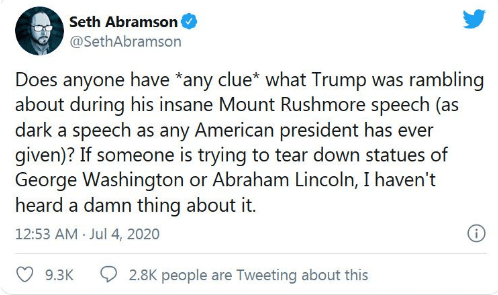
Someone please explain to Seth that if you don’t pay better attention than that to what’s going on, you are ethically obligated to shut the hell up.

2. I have to mention this because it’s embarrasses Harvard. Claira Janover, who graduated in May from the once-respectable university with a degree in government and psychology, saw a  short clip she posted on Tik Tok where she threatened to stab anyone who had  “the nerve, the sheer entitled caucasity to say ‘all lives matter'” go viral.

“I’ma stab you,” the Connecticut native says on the clip, zooming in close on her face. “I’ma stab you, and while you’re struggling and bleeding out, I’ma show you my paper cut and say, ‘My cut matters too,’” she added.

Oh, I get it! She’s making an analogy between someone saying “All Lives Matter” as a retort to “Black Lives Matter,” saying killing non-black people isn’t an issue because black people being killed is to white people being killed  like a stabbing is to a paper cut! Or something like that. It’s not a very good analogy. No, it wasn’t a “a true threat,” either. It was just an ugly and obnoxious video that signaled that she is irresponsible and intolerant of other points of view. This impugned the judgment of her new employers, the international accounting and consulting firm Deloitte, and they canned her. Of course they did. She should have known that would happen.

I would have fired her just for saying “Ima stab you.” Corporations don’t tend to pay huge fees to people who say, “Ima” anything.

Rather than being accountable, Janover has decided to play the victim, claiming Trump supporters are at fault for her fate, and attacking her ex-employer.

“I’m sorry, Deloitte, that you can’t see, ” she said, “that you were cowardice [sic] enough to fight somebody who’s going to make an indelible change in the world and is going to have an impact.” If she keeps this up, she may successfully ensure that nobody hires her, and though she will no doubt claim otherwise, it will have nothing to do with racism.

Good job, Harvard! Continue reading →
Independence Day With Ethics Alarms 2… Observations Upon Re-Watching “Gettysburg”

I began the Fourth of July this year by watching the last 90 minutes of “Gettysburg,” Ted Turner’s epic 1993 film.  My wife and I had begun watching on July 3, the date of Pickett’s Charge and the final day of the 1863 Civil War battle, but the more than four-and-a-half hour running time took me to Independence Day.

This was the extended version, the Director’s Cut, which adds 17 minutes of deleted  scenes to the version shown in movie theaters, itself one of the longest movies ever offered to the American public. We had last watched the un-extended film from beginning to end on a VHS tape almost 30 years ago.

Observations:

  • “Gettysburg” is an ethics movie, and a great one. I don’t know why this didn’t come through to me the first time I watched it. Primarily it celebrates the Seven Enabling Virtues discussed in yesterday’s post, but the film teaches us a lot about leadership, integrity, compassion, duty, loyalty, and conflicts of interest.

If the film isn’t routinely shown in schools, and I’m sure it isn’t, that is a lost opportunity. A whole course of study could be based on the film alone, and it would be more educational than most history courses.

  • Some of the added minutes extend the Pickett’s Charge re-enactment, and the length of the sequence adds to its horror and wonder. How could anyone enthusiastically follow orders to attempt such a deadly march into enemy artillery and rifle fire, while lined up like tin rabbits at a shooting gallery, in an open field, even having to climb over fences?

The film makes it clear, and this is accurate, that it was the men’s trust and admiration, almost worship, of Robert E. Lee that made such insane valor possible. At Gettysburg, Lee abused that trust. He was warned that the plan was madness, and he was so certain of his own invulnerability that he persisted.

  • The film made me realize that it is likely that Lee’s famous “It was all my fault!’ refrain to his returning shattered troops signified his realization that  his vanity and pride had been the direct cause for the Pickett’s Charge fiasco, and indeed the entire engagement. After the fiasco, the film shows Lee as a shattered man. General Longstreet, who repeatedly advises Lee to go around the Union entrenchment and take up a position on high ground between Pennsylvania and Washington, reminds Lee that even after the failed Confederate assault on Little Round Top on July 2, it is not too late for his plan to work. Lee replies that such a maneuver would be tantamount to a retreat, saying that he had never left the field of battle with the enemy  in control, and is not about to start.

If General Lee was capable of listening to what he was really saying, he would have realized that he was using a personal motive to justify a decision that could not be justified rationally. Continue reading →

Independence Day With Ethics Alarms 1… Ethics Quote Of The Month: President Donald Trump

“It is time for our politicians to summon the bravery and determination of our American ancestors. It is time. It is time to plant our flag and to protect the greatest of this nation for citizens of every race in every city in every part of this glorious land. For the sake of our honor, for the sake of our children, for the sake of our union, we must protect and preserve our history, our heritage, and our great heroes. Here tonight before the eyes of our forefathers, Americans declare again, as we did 244 years ago, that we will not be tyrannized, we will not be demeaned, and we will not be intimidated by bad, evil people. It will not happen.”

President Donald J Trump, speaking at Mt. Rushmore last night, and aggressively defending the United States of America, its Founders, its history and culture.

Bravo.

Last night’s speech, a ringing assertion of American greatness and a defiant condemnation of those who would topple it, despite the inevitable Trump flourishes of exaggeration, hyperbole, and deliberate provocation, was exactly what was needed, called for, and had to be said. It was inspiring, or should have been: I wonder about anyone who could read the transcript and not be stirred. I would ask, “What happened to you?” We also now know why it was appropriate to give that speech by Mt. Rushmore. The President extolled and defended our heroes, and devoted a section of the speech to each of the Presidents on the mountain, including, as CNN said last night to its damnation, “two slaveholders.”

There are about ten passages in the speech that I could have highlighted. I picked that one because it reminded me of this speech by a fictional President in a movie I detest, “Independence Day.” I would not be surprised to learn the speechwriter had that model in mind:

“President Whitmore” is talking about space aliens trying to destroys us. The mobs of America-haters who are attacking our core values and culture remind me of the aliens in “Invasion of the Body-Snatchers,” taking over the minds and bodies of one rational citizens, and terrorizing those who won’t submit to their “conversion.” Continue reading →

In Revealing Contrast To The Patriots Who Built This Nation 244 Years Ago, Consider John Kerry

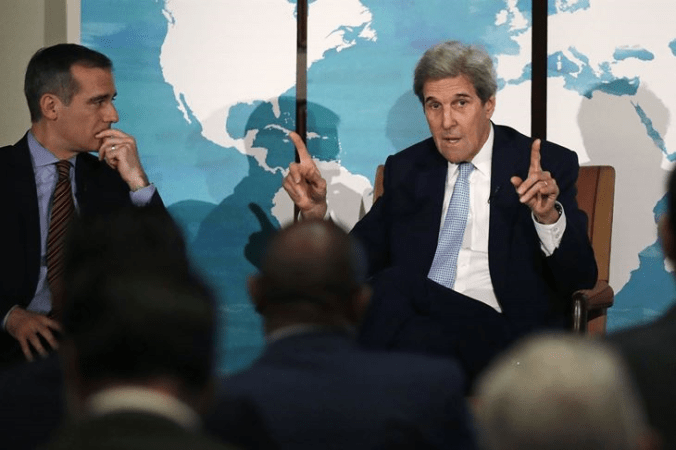
Speaking to the Copenhagen Democracy Summit this week on a panel via cybercast, John Kerry, former U.S Senator and Secretary of State, and unsuccessful candidate for President in 2004,  told his audience that a victory by President Trump could provoke a revolution in the United States, as he claimed that Republicans have a history of denying voting rights to Democratic voters. Kerry implied that  voter suppression contributed to his defeat in 2004 as well as former Vice President Al Gore’s loss in 2000, and he repeated Stacey Abrams’ completely unsupported claim that this was the reason for her defeat in Georgia’s 2018 gubernatorial race.

“If people don’t have adequate access to the ballot, I mean that’s the stuff on which revolutions are built,” Kerry said.  “If you begin to deny people the capacity of your democracy to work, even the Founding Fathers wrote in the Declaration of Independence, the Constitution, we have an inherent right to challenge that. And I’m worried that increasingly, people are disaffected. We’re not meeting the standard that we ought to be meeting, so I’m deeply concerned about protecting the vote.”

Kerry’s remarks, as so many of Kerry’s statements have been throughout his career, were reprehensible. The mystery, as always when Kerry is involved, is whether they were made with evil intent, or just as a bi-product of his severely limited intellect. John Kerry is not an intelligent man. Continue reading →

Ethics Hero: Fox Sports 1’s Marcellus Wiley

Well, here’s one ex-NFL player who doesn’t have brain damage.

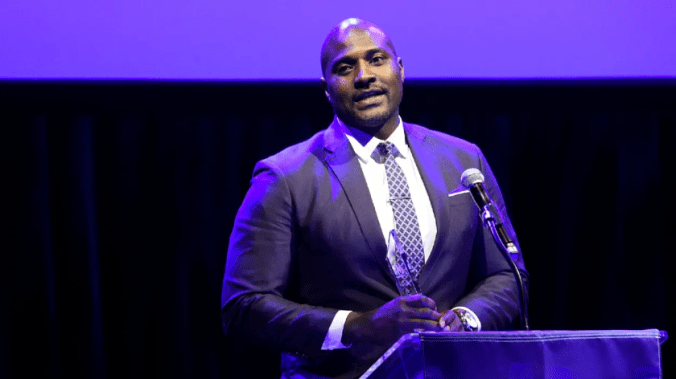
Marcellus Wiley is a sports commentator for Fox Sports. On his show “Speak for Yourself,” Wiley made the rational and ethical argument against pandering to Black Lives Matter. Like me, and unlike virtually every virtue-signaling corporation and groveling politician, Wiley, a Columbia grad, actually read the group’s mission statement.

What a concept! All of your friends and Facebook followers, all of the Democrats and artists, all of the academics and university administrators, all of those who are publicly pledging fealty to an organization they know little about because its name is a catchy slogan (though a subversive one, like “It’s okay to be white”) ought to be held accountable when the fog clears. I want to hear Joe Biden explain how he supports the goals of Black Lives Matter as the group states them. “Oh, not that,” he’ll say. “Oh, of course not that one either.” If you support an organization, you support its mission, all of it. You are accountable for what the organization does if the power you help it acquire is used to accomplish what the group said it intended to accomplish. Continue reading →

Third Of July Ethics Concert, 2020, Part 2: The Less Grand And Not Historic, One Hopes

For historical and quirky reasons, “The Egg” is my favorite song from “1776.” The number takes place on July 3, as the Continental Congress debates Jefferson’s handiwork, and Tom, Ben Franklin and John Adams sit outside, hesitant to witness  the rhetorical carnage they know is coming. I played the role of Adams in several musical reviews, a part I would have loved to have tackled on-stage in a full production, but I am about 7 inches too tall.

Some productions cut this number, which is both bad history and bad theater. (The number to cut is “Cool, Cool, Considerate Men,” a cheap shot at conservatives, and a lousy song.)

1. And I will say, “None of your business, officer!” A new Virginia law, the Community Policing Act that took effect this week, requires police officers to ask individuals pulled over during traffic stops for their race, ethnicity, and gender. I very much doubt that the law will withstand a legal challenge. The change is part of the Governor Ralph “Call me Michael Jackson” Northam regime of enacting every oppressive progressive agenda item he can get away with. This one is aimed at eliminating “bias-based profiling,” and requires officers to record the driver’s race, ethnicity, age, and sex while conducting traffic stops.

Like so many other misguided approaches to fixing “systemic racism,” this one attempts to protect the rights of African-Americans by infringing on the rights of everyone else. If I am pressed to answer the question by an officer, I will answer that I identify as Asian and female. I urge my fellow Virginians to do likewise.

2. Wuhan virus ethics train wreck update: Continue reading →

Third Of July Ethics Concert, 2020, Part 1: Pickett’s Charge, Custer’s First Stand, And More

Charge!

The anthemic music is the finale to the 1993 film Gettysburg, which has one of my all-time favorite scores, by Randy Edelman. I have worn out three CDs, and this particular selection, “Reunion and Finale,” almost lost me my drivers license once when I was playing it loudly in my car and blew past the speed limit by 25 mph or so.

I will be interested to see if any channel shows Ted Turner’s epic this weekend. I’m sure it is now regarded as politically incorrect because the film does not portray the Southern generals and soldiers as vicious racists, and the balance that the film was praised for when it was released is now regarded as “pro-Confederacy propaganda.” That is a fatuous take on the film, which is about human beings, not politics, and arguably the most historically accurate historical drama ever made, based on what may be the best historical novel ever written, “The Killer Angels,” by Michael Shaara, just a wonderful book. Read it. You can thank me later.

Unlike July 2, one of the most significant dates in U.S. history with multiple major events, July 3 stands out for one momentous event. Even in the sequence of events leading to American independence, July 3 was relatively boring:  it was devoted to the debate over Jefferson’s Declaration, resulting in more than eighty additions and redactions.

July 3  was the final day of the pivotal Battle of Gettysburg in 1863, reaching its bloody climax in General Robert E. Lee’s desperate  gamble on a massed assault on the Union center. In history it has come to be known as Pickett’s Charge, after the leader of the Division that was slaughtered during it.

At about 2:00 pm this day in 1863, near the Pennsylvania town of Gettysburg,  Lee launched his audacious stratagem to pull victory from the jaws of defeat in the pivotal battle of the American Civil War.  The Napoleonic assault on the entrenched Union position on Cemetery Ridge, with a “copse of trees” at its center, was the only such attack in the entire war, a march into artillery and rifle fire across an open field and over fence. When my father, the old soldier, saw the battlefield  for the first time in his eighties, he became visibly upset because, he said, he could visualize the killing field.

The battle lasted less than an hour. Union forces suffered 1,500 casualties,, while at least 1,123 Confederates were killed on the battlefield, 4,019 were wounded, and nearly 4000 Rebel soldiers were captured. Pickett’s Charge would go down in history as one of the worst military blunders of all time. Continue reading →

The Court Ruling I’ve Been Waiting For Since 2011

In a June 30 decision, B.L v. Mahanoy Area School District, the 3rd U.S. Circuit Court of Appeals  ruled that a Pennsylvania  high school violated a cheerleader’s First Amendment rights when it kicked the young woman off the squad for a message she had posted on SnapChat. A distruct court judge had ruled last year for the ex-cheerleader, whose  post pictured the teen and her friend holding up their middle fingers accompanied by the eloquent sentiment , “fuck school fuck softball fuck cheer fuck everything.” She was  upset because she had only made the junior varsity cheerleading squad, rather than the varsity team.

The ACLU of Pennsylvania argued the case for the girl, so at least sometimes the organization  still puts its partisan politics aside to do its traditional job of looking out for the First Amendment. The group called the ruling a “landmark decision,” finally barring schools from policing students’ off-campus speech using the claim that it might disrupt school activities.

The Supreme Court decision on campus speech, Tinker v. Des Moines Independent Community School District, did not apply to off-campus speech. Tinker held that student speech could be regulated by schools only if it would substantially disrupt school operations or interfere with the rights of others. That case involved a school disciplining students when they wore black armbands to class as a protest against the Vietnam War.

The 3rd Circuit majority ruled .“We hold today that Tinker does not apply to off-campus speech—that is, speech that is outside school-owned, -operated or -supervised channels and that is not reasonably interpreted as bearing the school’s imprimatur,”

Because the teen’s speech was outside the school context, Tinker did not apply. The cheerleader’s speech “lies beyond the school’s regulatory authority,” the court said.

The ACLU’s  press release stated that the decision was important “because it recognizes that students who are outside of school enjoy full free speech rights, not the diluted rights they have inside the schoolhouse.”

Bingo.

Finally. Continue reading →

Morning Ethics Warm-Up, 7/2/2020, Part 2: It’s “Know Your American History Day”!, The Usual Ethics Mess

The theme from “Rocky” topped the charts on July 2, 1977. Remember that Apollo Creed won the fight, so maybe “Rocky” won’t be banned as racist.

1. Stop making me defend Alyssa Milano! Not that I don’t enjoy watching the obnoxiously woke being hoisted by their own petards, but the has-been actress turned Twitter scold is being accused of appearing in blackface because of this:

Alyssa is irate, tweeting at the “gotcha!” critics, “Hey, assholes! The picture is me parodying Jersey Shore and Snookie’s (cq) tan. Snookie’s tan (she is a sweetheart by the way) is worthy of parodying as is Trump’s ‘tan.'”

“Snookie,” in case you have a life and never watched “Jersey Shore,” is Italian, not black.

Milano’s defense is solid, except that her woke allies seem to regard dark make-up as blackface when it suits their needs. Wasn’t the dark make-up that prompted the Washington Post to get a D.C. woman fired for her 2018 Halloween Party costume satirizing Megyn Kelly? What are the rules here?

2. What will it take for CNN to finally admit that Chris Cuomo is an idiot and an embarrassment to the network, his profession, and homo sapiens, and fire him? In the latest episode of “I Love Fredo,” the CNN anchor accused St. Louis attorney Mark McCloskey, who used his guns to confront a mob of George Floyd protesters who had broken through an iron gate to access his private property, the “face of white resistance”  to the Black Lives Matter movement. McCloskey responded,

First of all, that’s a completely ridiculous statement. I am not the face of anything opposing the Black Lives Matters movement. I was a person scared for my life, who was protecting my wife, my home, my hearth, my livelihood. I was a victim of a mob that came through the gate. I didn’t care what color they were. I didn’t care what their motivation was. I was frightened. I was assaulted and I was in imminent fear that they would run me over, kill me, burn my house.

Why wouldn’t he think that, based on what we have seen in the last couple of week?

Then Cuomo argued—he’s also a lawyer you know—that  the McCloskeys committed wrongdoing by “pointing a loaded weapon at a group of people who were walking past. They did not go up your steps. They didn’t go to your house. They didn’t touch you, they didn’t try to enter your home or do anything to your kids, but you say you were assaulted.” But it was a mob. A mob advancing on one’s home is inherently a threat.

Prof. Turley has an extensive analysis of that issue here. In one of his equivocating moods, Turley concludes, to the extent I can decypher his overly careful discussion,  that a conviction on the facts of the case would be a long-shot at best. Continue reading →

Morning Ethics Warm-Up, 7/2/2020, Part I: It’s “Know Your American History Day”! [Corrected!]

Good Morning, America!

The Ethics Alarms countdown to the Fourth—you know, that racist holiday celebrating white supremacy?—begins today, one of the truly epic dates in our history. Of course, those who find history upsetting because it makes them feel”unsafe” don’t know any of this stuff, making them pretty much useless citizens with their ability to understand current events stuck at an infantile level.

  • On July 2,  1776, The Second Continental Congress, assembled in Philadelphia, formally adopted Virginia delegate Richard Henry Lee’s resolution for independence from Great Britain. The vote was unanimous, with only New York abstaining. Of course,  Richard Henry Lee was Robert E. Lee’uncle and a slave-holder, so we really shouldn’t remember him or his significance to our nation’s independence.

Never mind.

  • On July 2, 1839, enslaved Africans on the Cuban schooner Amistad mutinied, killing two crew members and seizing control of the ship, which had been transporting them to be slaves on a sugar plantation. This set in motion a series of events that ended with  the U.S. Supreme Court ruling, with only one dissent, that the Africans had been illegally enslaved and had  exercised a natural right to fight for their freedom.  Massachusetts Congressman  John Quincy Adams,  the sixth president of the United States from 1825 to 1829 who, like his father, was a passionate foe of slavery, served on the Africans’ defense team. With  financial assistance of abolitionists , the Amistad Africans were returned to their homes in West Africa.

They never teach this story in schools, but your kids can read about it here. Continue reading →