Morning Ethics Warm-Up: 6/16/17

1. It looks like Bill Cosby is going to be acquitted, and probably rightly so, though probably for the wrong reason: bias. The jury is deadlocked, and I’d bet my head that one or more hold-outs just can’t accept the fact that that nice Cliff Huxtable would do those horrible things unless the victim consented somehow. Cheat on his wife. maybe. But not that.

Celebrity defendants whose public images are benign begin criminal trials with automatic unreasonable doubt built-in; this is part of the reason O.J. and Robert Blake (“Baretta”) avoided murder convictions. Celebrities with less sterling reputations are not so fortunate: had Bill Cosby been the one who shot a woman he barely knew at his home under strange circumstances, he would have probably been acquitted. Unfortunately for Phil Spector, the pop record producer had a well-established reputation for being nuts. The reasons Cosby can be acquitted for just reasons is that the victim is on record calling and chatting with him dozens of times after she was drugged and sexually assaulted, and because only one of the 50 or so Cosby victims was allowed to testify to show a pattern of behavior. The standard of  proven  guilt beyond a reasonable doubt is intentionally difficult to meet. There is no doubt whatsoever in my mind that Cosby is guilty, and his eventual acquittal won’t change my certainty. Nonetheless, those attacking the verdict and the jurors will be wrong, just as they were with O.J. and Casey Anthony.

2. One more thing regarding Cosby: yesterday I heard a CNN anchor who was about to interview another Cosby victim describe the woman as someone who has accused Bill Cosby of “inappropriate conduct.” The host caught herself, sort of, by adding, after a pause, “to say the least.” The woman claimed she had been raped. Even the anchor couldn’t bring herself to attach to dear, funny, sweet Cos such a heinous crime, so she engaged in craven equivocation. “Inappropriate conduct”?  Belching at the dinner table is inappropriate conduct. Drugging trusting young women and raping them is entirely different.

This is CNN.

 I regard a broadcast news journalist stating that Bill Cosby has been accused of “inappropriate conduct” misleading, incompetent, and fake news. Continue reading

Comment of the Day: “Morning Ethics Warm-Up: 6/14/17”

Some of Ethics Alarms’ most adept and provocative commenters have not authored official Comments of the Day. This is mostly due to the randomness of the selection process, as well as the fact that masters of the long-form have an inherent advantage over those who are more succinct.

I failed to get the Best of Ethics 2016 posted this year, but one of its items is always Commenter of the Year. That honor was going to go to Chris, who not only has been one of the most prolific commenters here since he first dropped by, but also one of the most resilient, forming the bedrock foundation of the Ethics Alarms liberal contingent, which still needs some recruits to balance the teams. Chris’s recognition in the Comment of the Day category does not accurately reflect his value here.

Here is his Comment of the Day on the post, “Morning Ethics Round-Up: 6/14/17, taking off from one of my numbered observations therein. I’ll be back briefly at the end.

Jack: “2. It is astounding to me that so many Democrats deny that there is a liberal (progressive, really) climate of hate.”

This is because when most liberals use the term “hate,” we are referring to prejudice, bigotry, and other forms of unjustified hatred. The term has become closely associated with people who favor oppression: “Hate groups.” “Hate crimes.” “Hate speech.”

But of course, when we liberals hate someone, it’s because they deserve it.

I am going to be completely honest: I hate the current president. I think he’s a terrible person. I think he is doing damage to our country. And, of course, I think he is hateful of others for illegitimate reasons: xenophobia, misogyny, religious hatred…these are all forms of hatred that we universally condemn. But how to go about fighting this type of hatred without succumbing to hatred ourselves?

Hatred is a natural human emotion. We all hate someone. Your Christian grandmother who says “I love all sinners” probably hates one of the other Christian grandmothers at church who says the exact same thing, because that other woman is a judgmental gossip. Hating someone isn’t unethical…but how we process that hatred can be. Continue reading

Morning Ethics Warm-Up: 6/15/17 [UPDATED]

1. Topic for a longer post when I can think hard about it: five officials in Michigan, including the head of the state’s health department, were charged with involuntary manslaughter yesterday in connection with the Flint water fiasco. The use of criminal sanctions based on gross incompetence by public servants is such a slippery slope that I instinctively recoil from it. Unless an official can be shown to have deliberately harmed people, trying officials for crimes when the real “crime” is that they were  stupid, negligent, incompetent or lazy has the whiff of scapegoating about it, will discourage more citizens from entering government service, and is so likely to become a political weapon—especially these days–that abuse of process is almost inevitable. The Flint catastrophe involved culpability at three levels of government, all the way to the EPA. These five officials are criminals, and the rest are—what? Acceptably incompetent?

2. The polarization in the news media and society is such that I find myself hesitating to use material that appears on an openly conservative website,  papers like the Washington Times or New York Post, or Fox News. This, despite the fact that I use the New York Times and the Washington Post more than any other sources, despite the undeniable evidence that their coverage is often partisan and biased. In the current environment where the Left and its allies appear to be circling the wagons, I encounter articles like the one by Megan Fox discussed in the next item and wonder why similar  analysis isn’t  appearing in the Times, the Post, or Vox? It is obviously valid and fair. But it is also critical of the left-biased news media, and so far, that entity is refusing to acknowledge how much harm its abandonment of objectivity is inflicting on the nation. So the analysis appears on a right-biased site, giving half the country an excuse to ignore it, and those who read my related post an excuse to dismiss it, and Ethics Alarms.

Good system. Continue reading

Okay, We Know The Shooter Was A Member Of “The Resistance”…Now What?

You can now see the shooter’s anti-Trump, pro-Bernie Facebook page, since he has been identified. It’s filling up with so many hate messages so quickly that the thing crashed my browser. In the realm of brazen virtue signaling, writing hateful messages to dead people on their Facebook pages ranks high.

James T. Hodgkinson III, 66 (above), whom the Post formally calls “the suspect” (he was shot while firing at the Republican Congress members who were at their baseball practice) appears to have fit one of the three categories of potential shooters I unfairly, impulsively thought would be responsible for the attack.  He was a member of “the resistance,” the “Not my President” group including many prominent public figures, celebrities, pundits, the Democratic Part leadership, distinguished professional and educators, millions of students  and Hillary Clinton ,who have vowed to undermine, block and remove President Trump by any means necessary, using fear, inflammatory language, rumors, Big Lies, trumped up accusations, absurd legal theories and unprecedented insults and ridicule to poison public opinion.

Hodgkinson could have been a random madman, but he wasn’t.  What does this mean? What conduct does it suggest on the part of the public, the nation and its leaders?

1.  One can credibly argue that it is unfair to connect this incident to the non-stop hate focused on President Trump, and by extension his party, since November 8. One could also credibly argue that man-made pollution hasn’t been proven to influence climate change.

All I know is that I have, as Ethics Alarms documented the extraordinary push to “otherize” this President since the election and the disgraceful efforts to undo the will of the people as expressed at the ballot box, repeatedly warned that this was dangerously divisive, destructive to society and our democracy, and that if it didn’t stop, violence was all but inevitable. (I have been far from the only one to issue this warning, both here and elsewhere.) I concluded that if “the resistance” continued demonizing President Trump, and by extension his supporters, this kind of thing would happen. It happened. It happened shortly after the violent imagery surrounding the President had escalated in recent weeks. Maybe it is a coincidence. I doubt it.

I expect progressives of integrity to cease their denials and address the issue honestly, as they have largely failed to do so far. Continue reading

Morning Ethics Warm-Up: 6/14/17

1.  I am wrestling myself to the ground to avoid making any assumptions about the shooting this morning (about three miles from my home in Alexandria, Virginia) of two Republican Congressmen and an aide while the GOP baseball team was practicing for tomorrow’s annual Congressional baseball game for charity. When Rep. Gabby Giffords was shot (and a judge killed, among others) in Tucson, Arizona, the news media, pundits and Democrats leaped to blame Sarah Palin and Rush Limbaugh for so-called “eliminationist rhetoric,” defined in Palin’s case as using cross-hairs on an electoral map to indicate which Democrats could be defeated in 2012—you know, as in “he’s in my cross-hairs.” This was a transparent effort to stifle political speech. In 1995, when a Federal building in Oklahoma City was blown up in a domestic terrorist attack, “violent anti-government” rhetoric from the Right was also blamed, though there was no evidence that Timothy McVeigh would not have done exactly the same thing if political discourse had been all John Lennon and rainbows.

The Giffords explanation was cynical and contrived; the Oklahoma City response a bit less so, but in neither of those cases were violent imagery and hateful language (no party officials and member of Congress used “fuck” back then, late night TV hosts were largely apolitical and couldn’t call Presidents “cockholsters” without being fired, the “resistance” in 1995 consisted of fringe militia groups, not recent unsuccessful Presidential candidates with a large following, and nobody was giving standing ovations to Central Park theatrical productions showing a doppleganger of the President of the United States being assassinated. In other words, if Rush Limbaugh had held up a prop bloody head of Barack Obama prior to Giffords’ shooting, I would not have derided the critics who argued that irresponsible partisan rhetoric was at least part of the cause. But he didn’t. Nobody did. Nobody would have thought of doing so. Then.

So when my wife told me, the second I woke up, about the shooting this morning, my immediate thought was, “I wonder who the shooter is, an illegal immigrant, a Muslim, or a member of “the resistance?”  This was unfair, and I knew it. The shooter might have been, as it was in Tucson, a wacko. It might have been moral luck that it was the Republican baseball team that was attacked and not the Democrats, just as it was moral luck that nobody was killed. Continue reading

Observations On That Disturbing Trump Cabinet Meeting

Yesterday’s weird, televised segment of the Cabinet meeting was troubling in many ways. If you missed it, and I am envious if you did because it will haunt my nightmares for a long time, here is what happened:

Trump began by giving a positive assessment of his first 143 days and said,”Never has there been a President….with few exceptions…who’s passed more legislation, who’s done more things than I have.” Bad start. Trump, in fact, has signed very few bills. “Never—with few exceptions”—is classic Trump-speak, aka gibberish. This is also the kind of statement Trump’s Furies call “lies.” This was not a lie. In some convoluted way, the President thinks its sort of true. THAT’S the problem, not that he’s lying.

This was just the appetizer, though. The full course was the Cabinet officials, one by one, around the table, taking turns praising their boss.  This could not have been spontaneous. It reminded me of “King Lear”s” opening when the old, fading monarch requires each of his three daughters to tell him how much they love him as the price for getting a piece of his kingdom.

The charade began with Vice President Pence, who called it the “greatest privilege of my life” to serve in the Trump administration. Then Attorney General Jeff Sessions said it was an “honor” to serve Trump, and the rest of Trump’s Cabinet more or less aped what Pence or Sessions had said. Maybe they had all been given talking points. As a final inducement to projectile vomiting, Lackey-in-Chief Reince Priebus gave us a suck-up for the ages:

“On behalf of the entire senior staff around you, Mr. President, we thank you for the opportunity and the blessing that you’ve given us to serve your agenda and the American people And we’re continuing to work very hard every day to accomplish those goals.”

And may I fellate you here, sir, or later?

Disgusted and depressed observations:

1. This is exactly the kind of self-destructive fiasco  a top Chief of Staff who has a proven record running successful government operations on the state or national level could and would prevent. Instead, Trump has a Chief of Staff who actively made it worse. In February, Ethics Alarms featured my post calling for the appointment of such a figure as “the single most ethical thing President Trump could do.” That was four months ago, and this is more desperately needed now than ever.

2. Since this horrible display did happen, we now can say with certainty that none of the President’s inner circle has the influence, guts or common sense to stop him when he yields to his worst instincts.

3. We can also conclude that not a single member of the President’s Cabinet possesses  sufficient integrity, courage, principle or self respect to be trusted by the American public. These are billionaires and generals, and not one said to Trump, “I’m sorry, Mr. President, but this will make you look weak and me look like an ass-kissing yes-man. I won’t do it, nor will I remain in a Cabinet stocked with lapdog sycophants who would debase themselves and their high offices by doing it.  Do you discard this idiotic charade, or do I resign now?”

Shame on them, every one. Continue reading

Morning Ethics Warm-Up: 6/13/17

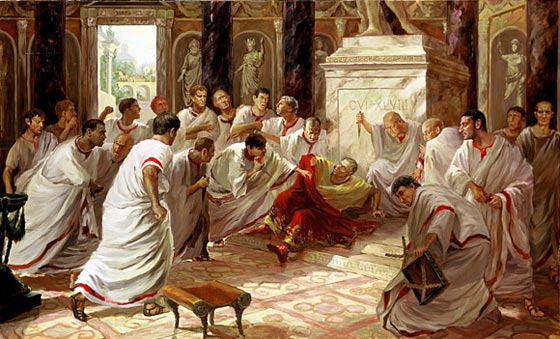
1.  The controversy over the Central Park “Julius Caesar” casting Donald Trump–his stage clone, really—as Caesar continues to be ignorantly argued. What’s worse, Fox News constantly calling the Shakespearean classic an “assassination play” (it’s not, not even close), or people who really would love to see Trump assassinated arguing that there’s a double standard because some professional productions of  “Julius Caesar” in recent years cast a black actor as the targeted emperor? Does anyone for a second believe that if a high-profile theatrical production depicted a character as clearly intended to symbolize Obama as the New York City production styles its Caesar as Trump being assassinated in a scene like the one below, there would not have been equivalent, indeed greater outrage?

The most cited production with a black, modern business-suited Caesar had an actor with a shaved head playing the role, clearly signalling that this was NOT Barack Obama. This, however, is “Donald Trump”:

My question is: Does the audience cheer? I bet they do, and I bet that’s exactly what the director wanted. I support the production, and reject efforts to pressure donors into pulling support. Theater is often political, and outrageous, and should be. But the play’s defenders who cite versions that evoked a black leader as equivalent are arguing that people are more upset at a faux Trump assassination than they would have been if “Obama” were slaughtered in Central Park, and that is absurd.

2. Another looming boycott is the effort to punish NBC’s Megyn Kelly for interviewing InfoWars’ Alex Jones, the professional conspiracy theorist and right-wing liar. Because he famously suggested that the Sandy Hook massacre was a hoax—an instant IQ test for anyone deciding to ever pay attention to this jerk again—Sandy Hook parents and their allies are condemning NBC and Kelly for “giving him a platform,” and have succeeded in getting one sponsor, JP Morgan, to drop its ads. How long before both ends of the political spectrum start routinely pushing boycotts of any journalists who “give a platform” to someone their “side” has pronounced as evil?  The Sandy Hook victims’ families continue to abuse the sympathy their tragedy evoked by using it to attack core rights using appeals to emotion and little else. Some quotes from the Washington Post story: Continue reading

Ethics Observations On The “Shakespeare in the Park” Trump As “Julius Caesar” Production

In  New York City, Public Theater’s free Shakespeare in the Park festival this summer begins with  a version of “Julius Caesar“, in which Caesar is played by an actor made up and costumed to look like the current President of the United States, and Calpurnia (Caesar’s wife) is portrayed as a runway model with a Slavic accent. Some of the costumes include Anonymous masks and the infamous pussy hats. When Caesar/Trump is assassinated in the Senate, the murderers are women and minorities.

Oooo! Subtle!

The production has been in previews since May 23, and opens tonight at the Delacorte Theater in Central Park. Criticism of the concept,  theater and its financial supporters has been roiling all week, and many have compared the play to  Kathy Griffin’s severed Trump head stunt.  Fox News reported that it “appears to depict President Trump being brutally stabbed to death by women and minorities.” Well, yes, that’s right. Now some prominent corporate sponsors have publicly withdrawn their financial support, including Delta and Bank of America.

Delta’s statement:

“No matter what your political stance may be, the graphic staging of ‘Julius Caesar’ at this summer’s free Shakespeare in the Park does not reflect Delta Air Lines’ values,” Delta said in a statement on Sunday night. Their artistic and creative direction crossed the line on the standards of good taste. We have notified them of our decision to end our sponsorship as the official airline of the Public Theater effective immediately.”

Bank of America:

“The Public Theater chose to present ‘Julius Caesar’ in a way that was intended to provoke and offend. Had this intention been made known to us, we would have decided not to sponsor it. We are withdrawing our funding for this production.”

Other sponsors, such as Time Warner and the New York Times, have stood fast. Said the Times:

”As an institution that believes in free speech for the arts as well as the media, we support the right of the Public Theater to stage the production as they chose.”

Ethics Observations:

[Do remember that I am a professional stage director, previously the artistic director of a professional theater for 20 years, and that I dealt with donors, individual, corporate, non-profit and government, all that time.] Continue reading

Reconsidering “Lincoln,” Lincoln…And Trump

I’ve been reading a lot about Abraham Lincoln of late. A book by William Hanchett called “The Lincoln Murder Conspiracies” reminded me that while President Jackson is the closest historical match for the populist, outsider aspect of Donald Trump’s rise, the startlingly close match for the antipathy and hatred Trump has faced from the moment of his election eerily traces the experience of Abraham Lincoln.

Like Trump a minority President, Abe won only 39.8% of the popular vote but was still comfortably elected by the Electoral College. As with Trump, his opposition refused to give him a chance to govern or unify the nation, although in his case, the Democrats divided the country literally, seceding from the union before Lincoln took the oath of office. Today’s Democrats are without that option (thanks to Lincoln!), but are doing everything else in their power to undermine the elected leader. (And California, the most Democratic state, is saber-rattling about seceding.) Also like Trump, Lincoln did not concede that his lack of a popular vote majority in any way robbed him of a mandate to govern.

From the moment the election results were known, many Democrats proclaimed the election of Lincoln itself to be an act of aggression, a “declaration of war.” Many in Lincoln’s own party—even his own Attorney General—accused him, with some justification, of engaging unconstitutional measures. The Governor of New York evoked the Revolutionary War generation, saying that they would not stand for such incursions on their rights. Constitutional expert George Ticknor Curtis of Massachusetts predicted that the Lincoln Presidency would “be an end to this experiment in self-government.”

Meanwhile, pundits and critics heaped personal abuse on Lincoln, calling him grotesque, a barbarian, ” gorilla.” Diarist George Templeton Strong, whose words are so often quoted by Ken Burns in his documentary about the Civil War, called him a “yahoo.” It was said that fashionable New Yorkers would be ashamed to be seen in the presence of someone as boorish and uncultured as Lincoln;  it was rumored that he rejected handkerchiefs and “blew his nose through his thumb and forefingers, frontier-style.” As late as 1864, a New York editor wrote,

“[The President] is an uneducated boor. He  is brutal in all his habits and in all his ways. He is filthy. He is obscene. He is vicious.”

Somehow, despite this cruel barrage of ad hominem rhetoric, arguably more successful then that it would be now since the public has more knowledge of the President and can make their own observations, Lincoln persevered to meet the greatest challenges any President ever faced.

While still pondering some of the parallels with today’s relentless attacks on our current President, I watched again the 2012 Stephen Spielberg-directed film “Lincoln,” which was almost unanimously praised when it was released, and which I enjoyed a great deal when I first saw it. This time, however, “Lincoln” revealed itself as an ethics corrupter. Continue reading

The Comey Testimony, Part II

[Part I is here]

Now let’s look at some direct quotes from James Comey’s testimony: 

1. “Even though I was appointed to a ten-year term, which congress created in order to underscore the importance of the FBI being outside of politics and independent, I understood that I could be fired by a president for any reason or for no reason at all. And on May 9th, when I learned I had been fired for that reason, I immediately came home as a private citizen. But then the explanations, the shifting explanations, confused me and increasingly concerned me. They confused me because the president that I had had multiple conversations about my job, both before and after he took office, and he had repeatedly told me I was doing a great job and he hoped I would stay. And I had repeatedly assured him that I did intend to stay and serve out the remaining six years of my term. He told me repeatedly that he had talked to lots of people about me. Including our current attorney general. And had learned I was doing a great job. And that I was extremely well-liked by the FBI work force. So it confused me when I saw on television the president saying that he actually fired me because of the Russia investigation. And learned, again, from the media that he was telling privately other parties that my firing had relieved great pressure on the Russian investigation. I was also confused by the initial explanation that was offered publicly, that I was fired because of the decisions I had made during the election year. That didn’t make sense to me for a whole bunch of reasons, including the time and all the water that had gone under the bridge since those hard decisions had to be made. That didn’t make any sense to me. And although the law required no reason at all to fire an FBI director, the administration then chose to defame me and more importantly the FBI by saying that the organization was in disarray. That it was poorly led. That the workforce had lost confidence In its leader. Those were lies, plain and simple. And I am so sorry that the FBI workforce had to hear them and I’m so sorry the American people were told them. I worked every day at the FBI to help make that great organization better. As a help, because I did nothing alone at the FBI. There are no indispensable people at the FBI. The organization’s great strength is that its value and abilities run deep and wide. The FBI will be fine without me. The FBI’s mission will be relentlessly pursued by its people and that mission is to protect the American people and uphold the constitution of the United States. I will deeply miss being part of that mission, but this organization and its mission will go on long beyond me and long beyond any particular administration. I have a message before I close for the — for my former colleagues of the FBI. First I want the American people to know this truth. The FBI is honest. The FBI is strong. And the FBI is and always will be independent. And now to my former colleagues, If I may, I am so sorry I didn’t get the chance to say good bye to you properly. It was the honor of my life to serve beside you, to be part of the FBI family and I will miss it for the rest of my life. Thank you for standing watch, thank you for doing so much good for this country. Do that good as long as ever you can. And senators, I look forward to your questions.”

Observations: This entire statement is unworthy of the emphasis that has been placed on it by the wildly spinning news media, The key piece of information to frame the entire episode is  “I understood that I could be fired by a president for any reason or for no reason at all.” Comey also presumably understood that a sub-fact within that understanding is that he could be told some of the reasons he was fired, no reasons, or the reasons the President felt like talking about. He was told he was doing a great job and then fired? Welcome to the work force. Telling an employee that he is doing a great job when he isn’t may be good management, usually isn’t, but is still well within the range of management discretion, and certainly not illegal.

Comey said that he also concerned that the President was saying that firing “had relieved great pressure on the Russian investigation.” As we learn later, the President was not being targeted in that investigation, and we know that he regards it as a politically motivated effort to distract and derail his administration and its agenda. There was nothing sinister about the President’s desire that the investigation go away as quickly as possible. I would argue that he has an obligation to do whatever he can to speed it along. If he didn’t trust Comey’s judgment—and who would?—seeing his exit as a plus is reasonable. Naturally, Comey wouldn’t see it that way.

It is amazing to me that a fired employee saying that his superior’s assessment that his organization was in disarray, that he was a poor leader and that his staff had “lost confidence In its leader” is given any weight at all. What fired employee doesn’t think his firing is unjust and the criticism of him is unfair? Comey calls it a lie: how does he know what Trump had been told or heard? How does Comey know what his agents say behind his back?

Your opinion that someone’s negative opinion about you is wrong and based on erroneous information does not make that opinion a lie. As a lawyer, Comey should know that, and should not have thrown the word “lie” around to be misunderstood by people who don’t know what a lie is—that is, most of the public. Continue reading