Morning Ethics Warm-Up, 11/29/2017: Featuring Vital Questions Such As: Will Women Now Try To Look Unattractive? Should A Hospital Employ A Nurse Who Hates White People? Is That Man Trying To Rape A Manniquin With An Ice Dildo?

Good Morning!

1  Documented insanity. The New York Times has been on an extended binge of highlighting the suffering of deported illegal residents. I could probably post several more episodes of the Ethics Alarms “Good Illegal Immigrant ” series every week. The intellectual dishonesty of almost all of these Times stories, like the pro-illegal immigrant movement itself, is impressive. Essentially, they all can be reduced to, “Isn’t it terrible that these lawbreakers have to endure the consequences of their own actions?”

Complementing these stories are periodic opinion pieces like “ICE’s Courthouse Arrests Undercut Democracy,”‘ by César Cuauhtémoc García Hernández, an associate professor of law at the University of Denver. He writes a pro-illegal immigration blog, identifiable in motive by its habitual use of the cover word “migrant” to mean “illegal immigrants” and the deliberately misleading word “Immigration” to mean “illegal immigration.” Hernández’s op-ed’s argument follows as the night follows day:

“In El Paso, ICE arrested a woman moments after she requested a court’s help keeping away an abusive partner. Fear and uncertainty caused by this type of courthouse arrest are already keeping people away from the halls of justice. In Denver, the city prosecutor gave up on four domestic violence cases because the victims said they were too afraid of ICE to appear in court. In a nationwide survey conducted in April by the nonprofit Tahirih Justice Center, four out of 10 social service providers working with immigrant survivors of abuse said they had clients who had abandoned legal claims because of fear of what will happen if they call the police or go to court.”

Wait: why were these people afraid of ICE? By immigrant survivors, doesn’t Hernandez mean illegal immigrant survivors? If he does, why doesn’t he say so? His favorite terms are “unauthorized” immigrants, and here and there “undocumented” immigrants, poor things. Whatever happened to their documents?

It’s not a threat to democracy if illegal immigrants are afraid to come to court. They should be afraid to come to court. They should be afraid to take advantage of any aspect of  our government or American society. Underlying the professor’s claimed concern for democratic institutions is his contempt for the rule of law. He wants to blur the distinction between illegal and legal immigration to the vanishing point. He quotes the California chief justice as she writes that “the vast majority” of “undocumented immigrants” “pose no risk to public safety.” Is that the desired standard for law enforcement now? As long as a known law-breaker poses no risk to public safety, he or she should be immune from arrest when they turn up in court?

The Times is apparently committed to bombarding its readers with this unconscionable position in perpetuity: our monstrous government has decided to enforce its immigration laws, and the very fabric of our democracy is threatened as a result.

2. CNN Tales.   On a related note, this morning I saw a slick TV ad on CNN supporting “Dreamer” legislation. The terms “illegal,” and even the cover words “undocumented” or “unauthorized” were never used, as various Presidents were shown extolling “immigrants.” “Dreamers” were described as “immigrants” who came here as children.

An ethical broadcast news organization should not accept money to run ads that intentionally misinform its viewers.

But THIS is CNN!…and so is this:  A CNN spokesperson told Politico…
Continue reading

A New Rationalization For A Slow Sunday: #57A The Utilitarian Cheat, or “If It Saves Just One Life”

On another thread, a reader attacked the Rationalization List <GASP!>,, the beating heart of Ethics Alarms, arguing that many of what are labelled rationalizations are valid justifications and cited as such on this very site. A vile canard! Of course many rationalizations can also be valid arguments for or against conduct. Take #59. The Ironic Rationalization, or “It’s The Right Thing To Do.” We do the right things because they are right, but we also have calculated why they are right, which means dealing with and rebutting the counter-arguments that might suggest those decisions are not right.  However, #59 addresses the frequent use of the “It’s the right thing to do” as a argument-ender, employing it as evidence when it really has to be a conclusion based on other evidence and analysis.

The latest addition to the Ethics Alarms Rationalization List does not have this problem. It is almost always a cheap rhetorical device, slyly edging what needs to be a clear-eyed, rational analysis of proposed conduct into the confounding realm of emotion. #57 A, The Utilitarian Cheat or “If its saves just one life” is a sub-rationalization under #57, 57. The Universal Trump, or “Think of the children!”  (It could easily be the other way around.)

#57 A. The Utilitarian Cheat or “If it saves just one life”

Invoking Rationalization #57A is as good a test as there is for identifying an untrustworthy demagogue. The claim that something is worth enacting, eliminating, establishing or doing is ethically and morally validates “if it saves juts one life” is aimed directly at the mushy minds of sentimentalists  and the dangerously compassionate. If the argument is made in good faith, the speaker is an incompetent dolt; usually it is the desperate last resort of a someone who has found that their real arguments are inadequate or unpersuasive.

The insidious trick inherent in the device is that we agree that human life is precious, and that we can not and will not place a dollar sign on a human being. The next step, however, in which a single life, or even many, is deemed justification for any expense or other draconian societal trade-offs, is impractical and irrational. It would save many lives if automobiles were built like tanks and could never exceed five miles an hour. Locking up ever angry husband that threatened the life of an estranged spouse with a menacing phone call would save many lives. So would forcing women to carry their babies to term, eliminating the right to have an abortion. Torture used without restrictions probably would save one life or more. Prohibition was sold using #57A.

All of these policy conundrums and many others are too complex by far to use simple-minded absolutism as their ethical guideline, and about 30 seconds of logical clarity will usually make that clear.  Those who employ The Utilitarian Cheat, however, don’t want clarity. It is an appeal to embrace acts that can do wide-ranging harm to society, civilization, human aspirations and liberty, because un-named lives can be saved. Though it is opposite of the exploitation of human life for other goals that Kantian ethics forbids, it is equally invalid.

___________________________

Graphic: gunssavelives.net

Ethics Quiz: Italy’s New Strategy To Fight The Mafia

corleone-family

Anyone who has seen “The Godfather” I or II has a sense of the mafia culture in Italy. That wasn’t fiction; indeed, it was probably understated, and is strong as ever. Now legislators are experimenting with a radical new approach to fighting organized crime in the country, a deep-rooted pathology that has persisted for centuries.The strategy is draconian: separating children from their mob families and moving them to a different part of Italy to end a generational cycle of crime. Families are the heart of organized crime: the “Godfather” films’ portrayal was absolutely accurate on that score.

Italian magistrate Roberto Di Bella began taking children away from their criminal families after seeing children as young as 11 or 12 serving as lookouts during murders, participating in drug deals and mob strategy sessions, and learning how to shoot an assault rifle. “Sons follow their fathers,” he told New York Times reporter Gaia Piani Giani. “The state can’t allow that children are educated to be criminals.”

Di Bella began taking children away from parents convicted of mob ties five years ago,  separating about 40 boys and girls, ages 12 to 16, from their families. Sometimes the children’s mothers accompany them to the new locales. The rest of the embryonic mafiosi  go into foster care.Di Bella says that none of the children he has taken away from their families have committed a crime since, and impressed with his results,  Italy recently passed statutes that legalize the strategy as a way to destroy crime families.

Of course the program is controversial.  Di Bella, however, believes that it is a utilitarian necessity. He told the Times that mafia fathers have written to him to thank him for for giving their children a chance at a normal life, their children have told him they feel liberated, and mothers ask if he will do it for their children.

Your Ethics Alarms Italian Ethics Quiz of the Day:

Is the policy of removing children from organized crime families ethical?

Continue reading

Comment Of The Day: “CVS Line Ethics”

golden-2

Texaggo4’s Comment of the Day  enriched the surprisingly lively discussion about  the ethical conundrum of how many single-item purchasers a CVS customer in line should let go before him to checkout if he had, as I did last week, a full cart.

 His discussion of applying The Golden Rule to the situation took off from my comment referring to his earlier assertion that it wasn’t strictly a question settled by Reciprocity. The numbered statements on Tex’s post are from me. Here is Tex’s COTD on the post, “CVS Line Ethics”—I added another brief comment he offered in the same thread at the end, as it is germane:

1.“I don’t recall Jesus, Zoroaster, Buddha and the rest ever noting the CVS exception.”

I don’t recall ever noting an exception either…since this isn’t necessarily Golden Rule territory. In this scenario, application of the Golden Rule would arise as the exception.

“2. The GR has nothing to do with an obligation. It is never an obligation. It is based on altruism.”

It is very much about obligation– and obligation isn’t a dirty word. The real question here is where do you draw the line on whose needs outweigh the others, and if they really do or not. Golden Rule would compel you to allow someone to cut if their cutting *actually* decreases *actual* harm. The Golden Rule doesn’t compel you to allow someone to cut *just because* it increases an already-present level of contentment in their lives. It may strongly suggest such conduct in so much as it doesn’t needlessly impose on you, but it no means compels it, hence this isn’t necessarily a Golden Rule scenario.

You see, “so whatever you wish that others would do to you, do also to them, for this is the Law and the Prophets” is a painfully open ended, and as such-much criticized maxim, when taken out of context. So, the Golden Rule IS the Law. Looking at the phrase elsewhere one would glean that ALL the Law, and therefore the Golden Rule, depends on two basic commands:

“You shall love the Lord your God with all your heart and with all your soul and with all your mind”
“You shall love your neighbor as yourself”

Continue reading

Self-Driving Car Ethics: Who Do They Decide To Kill? You?

av-choice

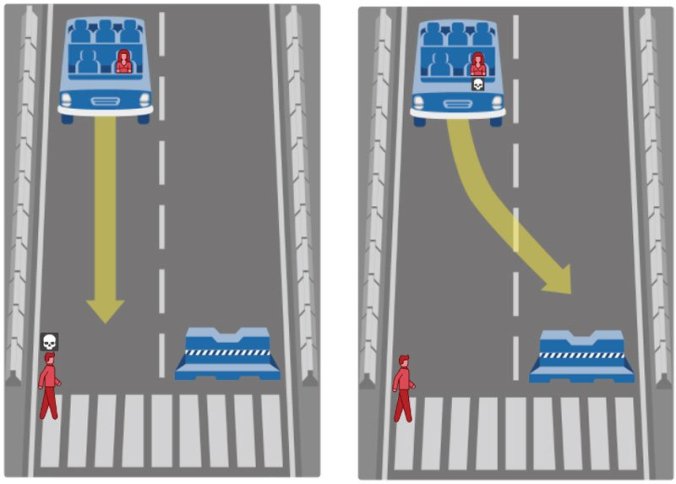
CBS’s “Bull,” a drama about a jury consultant (played by “NCIS” alum Michael Weatherly) is an ethics mess…but then, so is the former jury consultant Weatherly’s  character is loosely  based on: “Dr.” Phil McGraw. The show does find some interesting ethics issues, however. A couple of weeks ago the story involved the programming in an experimental self-driving car. The issue: is it ethical for such a car to be programmed to kill its passenger if it has to make a life or death choice?

The ethical conflict involved is the so-called “trolley problem,” which is, as the name suggests, over a hundred years old. British philosopher Philippa Foot developed it into series of hypotheticals in 1967. In 1985, American philosopher Judith Jarvis Thomson scrutinized and expanded on Foot’s ideas in The Yale Law Journal. Here is one of Thompson’s scenarios:

“Suppose you are the driver of a trolley. The trolley rounds a bend, and there come into view ahead five track workmen, who have been repairing the track. The track goes through a bit of a valley at that point, and the sides are steep, so you must stop the trolley if you are to avoid running the five men down. You step on the brakes, but alas they don’t work. Now you suddenly see a spur of track leading off to the right. You can turn the trolley onto it, and thus save the five men on the straight track ahead. Unfortunately,…there is one track workman on that spur of track. He can no more get off the track in time than the five can, so you will kill him if you turn the trolley onto him.”

The problem: Now what, and why?

A. Throw the switch in order to maximize well-being (five people surviving is greater than one).
B. Throw the switch because you are a virtuous person, and saving five lives is the type of charitable and compassionate act a virtuous person performs.
C. Do not throw the switch because that would be a form of killing, and killing is inherently wrong.
D. Do not throw the switch because you are a Christian, and the Ten Commandments teach that killing is against the will of God.
E. Do not throw the switch because you feel aiding in a person’s death would be culturally inappropriate and illegal. Continue reading

Ethics Hypothetical: Rules, Compassion, Integrity, Fairness, And A Looming Race Card

clock2

[The hypothetical is inspired by two recent events I witnessed in the past week.]

Preface: The state requires new bar admittees to take a one-day course covering the basics of practicing law in the jurisdiction—how the courts work, special procedural rules, unique aspects of local practice, horror stories, the works. They must complete the course or they can’t be certified, and the court-ordered series of lectures and presentations is held only once a month.

A company runs the mandatory curriculum under contract to the state, and is required to confirm in writing to the courts that its requirement have been fulfilled. One key requirement is that every attendee must be present for every minute of the presentations, except for brief emergencies, like using the rest rooms. The course administrators carefully monitor attendance. The published description of the course directs that once the course begins, theoretically at 9 am sharp, no late-comers will be admitted.

As you might imagine, missing the session can be quite a hardship, as participants often live and work in other jurisdictions.

The Event: It is 9:08 am on the day of the program, and the introductory video that begins the orientation is almost finished. It consists of interviews with members of the bar about the benefits of practicing in the state, the importance of ethical practice, etc: to say it is not substantive is an understatement. Literally nothing that is said and shown in the video is anything but boilerplate.

A young man, sweating profusely, bursts in the door, looking unhappy and desperate. “I’m sorry I’m sorry!” he babbles. He says that he had to drive up from a neighboring state and had an accident. “Can I still get in?” he pleads.

The male staffer responsible for the session chats briefly with an associate. The program was late starting, and this late arrival will miss nothing if he goes in now. “All right,” the honcho says as the young man heaves a sigh of relief. “I shouldn’t do this, but you haven’t missed anything.” As he goes into the auditorium, one can here the opening remarks of the first speaker, a judge. It is now 9:12 am, and another young man bursts through the door on a dead run. “My crazy cabbie’s been driving me all over the city for an hour!” he shouts. “I flew in last night from Arizona! Please, please, don’t make me do this again…I barely was able to afford this trip.” The administrator is wondering if he had seen the previous guy go into the auditorium. He’s heard this judge’s spiel many times: all that has been missed, to be honest, are a few (lame) jokes. “All right, all right, get in there quick!” he tells the new supplicant. “I’ll finish your paperwork during the break!” The kid looks like he’s going to cry, he’s so relieved.

I’m there, watching this (I’m on the program) and say to the administrator, “I bet this happens every time.” He says, “It does. I know that nobody misses anything that isn’t in the printed materials until 9:15, so it’s a hard stop after that.”

And another late arrival bursts through the door. It’s a bit after 9:14. The staffer has just told me that the final final deadline is 9:15, and it’s not that yet. This poor guy is bleeding through his pants,  has a big bruise on his face, and is saying something about a bicycle accident. By the time he gets himself settled—he is told that there is no time to clean up—it’s past 9:16. He starts toward the auditorium door as the other staffer says, “OK, that’s IT,” and starts to take the registration materials and lists away….just a very stressed young African-American woman enters, in plenty of time to see the bicycle rider, who is white, enter the auditorium. I can hear the judge through the open door. He’s still telling jokes, longer this time than usual.

Issues and Observations

1. The young woman was not admitted, and told that she had to come back another month. She too was from out of state. She also had a legitimate-sounding excuse.

  • Was that fair to her?
  • Should it have mattered that the program had not yet reached a serious stage?
  • She was told that 15 minutes was the absolute, unwaivable deadline. That was true, but it was not the deadline the company was contracted and pledged to enforce. That deadline was 9:00 am.

2. Should the explanations used by the latecomers play any part in the decision to allow them in? Why? Continue reading

“Code Black” Glosses Over A Medical Ethics Imperative

Code Black

In TV’s medical drama “Code Black‘s” episode “Diagnosis of Exclusion,” we were plunged, as is too often the case in such shows, into a freak situation that might not occur in any U.S. hospital for a century, but that somehow happens on TV routinely.

A lunatic stalker named Gordon (Jesse Bradford) tried to rape doctor Malaya Pineda (Melanie Chandra) in the hospital garage, after stabbing a hospital administrator, perhaps fatally. Dr. Pineda fought back, the stalker stabbed her in the stomach, and then mild-mannered Dr. Angus Leighton (Harry Ford) arrived in time to pull the stalker off of his wounded friend and save her life. In the struggle that ensued, crazy Gordon was stabbed in the neck with his own knife.

This was presented in flashback, in the form of an official inquiry where Dr. Leighton explained that he told the stalker not to pull out his knife, but he did anyway, causing uncontrollable bleeding. “Maybe I could have done more but, I was out of my mind,” Angus explains. Leighton says he tried to stop the bleeding as he screamed for help. By the time the paramedics got the murderous patient into the ER, he was beyond saving.

Ahhh, but that’s not exactly what happened, we learn! First we saw Angus’s older brother, also a doctor, tell him that he did the right thing, that Gordon tried to kill two women that day and would have gone on to kill more if Angus hadn’t acted as he did.

Wait, what? Continue reading

“I think abortion is evil, but it is a necessary evil.” Discuss.

Foetus-435110

This blog doesn’t discuss evil very often because it is not a term appropriately associated with ethics. Evil is a concept related to morality. In an ethics discussion, I would take evil to mean something extremely, irredeemably unethical by any ethical analysis or system. The statement “I think abortion is evil, but it is a necessary evil” appeared parenthetically in a comment by Beth, a frequent commenter on Ethics Alarms who is a mother and a lawyer, regarding the Planned Parenthood videos. Though the news media appears to have successfully distorted that story by focusing only on whether the videos were evidence of illegal “trafficking in body parts” by Planned Parenthood, that was not the reason I posted the essays, and it is not the reason those videos are significant in the ongoing debate over abortion rights. Two high ranking individuals in the organizations casually discussed the crushing and crunching of the heads and torsos of living and helpless individuals with the sensitivity I would associate with stepping on a roach. If this doesn’t disturb you, it should. If it does disturb you, as it did Beth, what does that mean?

Abortion is one of the most important and difficult ethics issues in the culture, indeed in world culture. It involves millions of lives and millions of deaths, law, bioethics, religion, social policy, science, human rights and feminism, as well as society’s ultimate respect for life itself. I have written about the ethics of the abortion debate frequently (you can find most of the relevant posts here), but to summarize the Ethics Alarms views on the topic:

1. Abortion is an ethics conflict, meaning that there are ethical principles in opposition to each other, requiring society to set priorities.

2. The absolutist position on the anti-abortion side is that abortion involves the taking of innocent human life, which begins from conception, and is thus unethical in all cases. It is a strong position if one accepts the underlying assumption.

3. However, no absolute position is really absolute. Every ethics absolute has an exception, or several: there must be some circumstances when abortion is necessary and right. (This is not true of moral absolutes, since moral absolutes are self defining. If the power dictating a moral precept says it is absolute, it is so.)

4. The absolutist position on the abortion side of the argument holds that a woman’s right to have complete dominion over her body, reproductive activity and health justifies abortion in all cases. This is not a strong position, and in fact is one that cannot be honestly argued or sustained. It supports abortion on demand for any purpose or preference, entirely at the mother’s discretion.

5. To make that argument, extreme pro-abortion advocates have had to deny the humanity and human rights of unborn children, even to the point of arguing that they are not individuals at all, but mere “parasites,” or “tumors.” The removal of a second life from the equation that is at the core of the abortion problem makes the abortion decision easy and guilt-free; it also settles the debate by pretending the central issue doesn’t exist. That issue is that there is another life involved, not just the mother’s.

6. The debate over the ethics of abortion has been handicapped by the tactic of both sides to pretend a legitimate interest championed by the other doesn’t exist. A woman’s ability to control her own life, career and what happens to her body is an important societal issue, yet the term “pro-life” ignores it entirely. It is not the only important interest involved in the abortion decision, however, as the term “pro-choice” suggests.

7. Neither absolute position, whatever its theoretical virtues, is practical from a policy perspective. Desperate women who are pregnant will seek abortions, people will help then (or exploit them, or kill them), and public policy cannot pretend otherwise. Society will not tolerate punishing women for aborting their unborn children, whether they deserve to be punished or not. Yet allowing mothers to have unborn children killed on a whim leads to the callous, ugly, dangerous attitude toward innocent life on display in the Planned Parenthood videos. Callousness toward any human life, history has shown us, is a slippery slope with the potential of doing terrible harm to the culture.

8. Roe v. Wade was a premature Supreme Court decision and a badly reasoned one. Until and unless it is overturned, abortion is a right. That does not mean, and never meant, that abortion necessarily is right.

9. Because absolutism fails here, abortion is a problem that demands utilitarian analysis–balancing of interests and values, in the best interests of society, long and short-term, and everyone in it, according to the facts as we understand them.

10. Balancing requires an honest acknowledgement that there is something to balance. The “pro-choice” and “pro-life” dichotomy doesn’t acknowledge that in their most extreme incarnations, and since abortion is currently a right, the pro-choice lobby detects no reason to yield to logic, science and reality. Continue reading

Ethics Quote Of The Week: The Washington Post

“The court’s legal analysis in Arizona State Legislature v. Arizona Independent Redistricting Commission was something of a reach. But the ruling’s practical implications are unequivocally positive.”

—–The Washington Post in an editorial praising the Supreme Court’s approval of Arizon’s unconstitutional solution to the persistent problem of gerrymandering abuse.

"IGNORE WHEN INCONVENIENT" Really?

“IGNORE WHEN INCONVENIENT” Really?

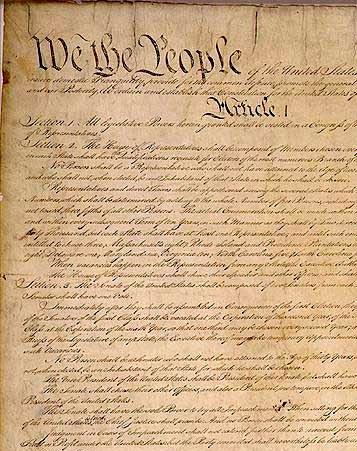
The Post’s quote means nothing more nor less than “the ends justify the means.” “Something of a reach” is a shameless equivocation: John Roberts’ dissent to the 5-4 majority’s “legal analysis” —there really is none—resembles Mike Tyson slapping around Honey Boo-Boo. The decision’s argument approving the Arizona end-around the Constitution’s Elections Clause that reads, “The Times, Places and Manner of holding Elections for Senators and Representatives, shall be prescribed in each State by the Legislature thereof” can be fairly summarized as “this will work, so the Constitution be damned.” It’s not a “reach.” It’s  obvious defiance of what the document says.

It that so bad? It depends on what you think is more important, integrity or solving a problem. All of the big Supreme Court decisions in the past week have essentially raised this ethics conflict, and it is clear that the liberals on the Court is on the side of solving problems—at least as they see them— even when it means compromising what the Constitution says and what the Founders intended who drafted it, with the libertarian Justice Kennedy, who tends to lean away from laws constraining citizens anyway, often joining the  colleagues to his left. This issue is as stark an example as there can be,

Gerrymandering is unethical and anti-democratic. It was not foreseen by the authors of the Constitution, who can’t be expected to have predicted every devious political maneuver their successors would come up with to pollute their ideals. Unfortunately, the Constitution doesn’t provide a way for the public to stop the practice, other than electing less corrupt legislators, and legislators use gerrymandering to make that exceedingly difficult. A tweak of the wording in the Constitution could carve out an exception, but the Founders also made amending the Constitution in any way at all an almost impossible chore, including amending it to allow easier amending.

What’s a country to do? Well, sometimes the ends really do justify the means: that’s what utilitarianism means. If the Court can kill or limit gerrymandering by, as John Roberts felicitously put it in his dissent, gerrymandering the Constitution, it might be a good choice on balance. It benefits democracy. The conservatives argue, however, and legitimately so, that such a decision also creates a dangerous, even sinister precedent despite its good intentions (none of the Justices seem to think that gerrymandering is anything but unhealthy for democracy). What other laws that violate the plain words of the Constitution will the Court approve because its “practical implications are unequivocally positive,” to the cheers of partisans?  How many times can the Court do this before the Constitution is a dead letter, and any executive–or despot— can claim that government action, regardless of what Constitutional guarantees oppose it, is to be rubber stamped because it solves a real problem? Continue reading

Carolyn Hax And The Unanswerable Ethics Dilemma

secrets

My favorite advice columnist, innate ethicist Carolyn Hax, courageously and wisely addressed an ethics problem that is the equivalent of squaring the circle or finding the end of pi. The question posed by a commenter:

My mother says she will not tell me who my father is and will take the secret to the grave with her. Is there ever any good reason for not telling someone who their father is?

This is not merely a difficult question but also a portal question leading us to a myriad of specific ethics dilemmas. Hax offers a few, some of which aren’t very good:

  • If she doesn’t know for sure herself.

Well, of course: also if she can’t communicate due to her mouth being sewn shut, her arms amputated, she never learned Morse Code and it lousy at charades.]

  • If he committed crimes so heinous that she fears they would change the way you see yourself.
  • If he was and is still married to her sister, cousin, best friend.

Or if the mother is the father…?

  • If revealing his name would reveal something embarrassing about her or her past choices or the circumstances of your birth.

Nope. Embarrassment about the truth is not a valid reason for withholding it from someone who has a legitimate and justified reason to know it.

  • If she promised him she would take the secret of his identity to her grave.

Too bad: that’s never a good reason. A commitment to the dead does not, can not and must not have priority over obligations to the living. That’s an unethical promise; the daughter cannot be ethically made to suffer for it.

If he’s a sperm donor and she thinks there’s something wrong with admitting that.

  • The mother thinking it’s a good reason isn’t the same as it being a good reason. Come on, Carolyn.

My favorite is if the father is Satan, and the mother wants her daughter to have as normal and happy a life as possible until the inevitable day when Dad calls on her to assume her destiny as the DARK EMPRESS OF THE DAMNED! Continue reading