Abortion, “The Fly” and the Ethics Incompleteness Theorem

"AWWW! He looks just like his father!"

“AWWW! He looks just like his father!”

The most interesting aspect of ethics is at the margins, those situations where absolutists are challenged to hold to their principles because of unforseen variations that no general analysis could anticipate. The absolute ban on torture as unethical becomes shaky under the “hidden nuclear bomb” scenario.  Capital punishment opponents find that their compassion evaporates when asked whether Hitler or bin Laden deserved execution.

This is the Ethics Incompleteness problem, which I last wrote about at length in March of 2014:

“The human language is not sufficiently precise to define a rule that will achieve its desired effects, that is work, in every instance. There are always anomalies around the periphery of every normative system, no matter how sound or well articulated. If one responds to an anomaly by trying to amend the rule or system to accommodate it, the integrity of the rule or system is disturbed, and perhaps ruined. Yet if one stubbornly applies the rule or system without amendment to the anomaly anyway, one may reach an absurd conclusion or an unjust result. The Ethics Incompleteness Principle suggests that when a system or rule doesn’t seem to work well when applied to an unexpected or unusual situation, the wise response is to temporarily abandon the system or rule and return to basic principles to find the solution. No system or rule is going to work equally well with every possible scenario, which is why committing to a single system is folly, and why it is important to keep basic ethical values in mind in case a pre-determined formula for determining what is right breaks down.”

I was watching the Jeff Goldblum remake of “The Fly” (written and directed by David Cronenberg) last night, and rather than being properly horrified by Geena Davis’s nightmare of giving birth to a yard long fly larva, I found myself wondering how anti-abortion absolutists would handle her unusual dilemma. The film follows the tragedy of scientist Seth Brundle (Goldblum ) who has developed a means of teleportation. The process involves a computer breaking down a body, then transmitting the atoms electronically to a receiving “pod,” and reassembling them there. Unfortunately, when Seth tests the device on himself, an unnoticed fly gets into the sending pod, and the result is a version of Brundle that has fly DNA mixed in. (In the memorably campy Vincent Price original, what arrived in the receiving pod was a man with a giant fly head and a fly with a tiny human head.) Gradually Brundle mutates in form and mind into a monstrous hybrid, but before he knows what has happened to him, he impregnates girl friend Davis. Soon she realizes that something with insect DNA is gestating inside of her, though all tests show a healthy human embryo. Not surprisingly, she wants an abortion.

Would those who argue that abortion is murder maintain that she shouldn’t be able to have one, or that aborting the fetus is wrong? Let’s make the problem harder: let’s say she only learns that she has a fly-baby in the third trimester, when our laws wil not permit abortions unless the mother’s life is in peril. Some questions: Continue reading

Unethical Quote of the Week: Dick Cheney

Hello, I'll be your torturer today. Now, if you are innocent, please understand, on balance this works.

Hello, my name is Skug, and I’ll be your torturer today. Now, if you are innocent, please understand, on balance this works.

“I’m more concerned with bad guys who got out and released than I am with a few that, in fact, were innocent.”

—Former V.P. Dick Cheney, giving his reactions on “Meet the Press” regarding the Senate’s critique of the Bush Administration and the CIA’s interrogation methods.

I try to be fair to Dick Cheney, whose character has been distorted beyond all recognition by his partisan foes. Sunday, however, he was apparently attempting to validate all the most terrible things anyone has said about him, as well as providing future students of ethics real life examples of ethical fallacies.

The one quoted above is the pip: so much for the jurisprudential principle that It is better that ten guilty persons escape, than that one innocent suffer.”   Chuck Todd reminded Cheney that 25% of those detained were apparently innocent. The Cheney variation: “It is OK if some innocent persons are unjustly punished as long as the bad guys get what they deserve.”

It is hard to pick the most unethical assertion, however; there are so many horrible statements to choose from. Such as: Continue reading

Ethics Hero: Sen. John McCain

waterboard1

While other Republicans are attacking the Senate report on torture as a political hit piece by Democrats—which, in part, it is, but that doesn’t diminish its significance—the one Senator who has experienced torture is supporting the report’s conclusions and criticism, saying…

I know from personal experience that the abuse of prisoners will produce more bad than good. Most of all, I know the use of torture compromises that which most distinguished us from our enemies.”

Exactly.

My position on this topic is unchanged from what I wrote in 2006, which you can read here.

“Would You Rather”: An Ethics-Horror-Health Care-Dinner Party In Hell Movie You May Have Missed

“Would You Rather” is an odd 2012 film that sets up a film-long set of unlikely ethical dilemmas for its characters to solve. Desperate to save her dying brother with expensive medical treatment she can’t afford, the heroine (played by Brittany Snow) finds herself at a dinner party with seven other desperate strangers, hosted by a wacko family of millionaires who will help one of them after the others have been “eliminated” during the course of the evening. As what is described as a game progresses, each contestant is put through escalating rounds of risk, pain and torture in which they must make various Sophie’s Choices, such as…

  • Would you rather administer a painful shock to yourself with high-voltage electricity, or the person next to you? What if that person has been weakened by a previous shock? What if she is in a wheelchair?

Ethics Quiz: The Case Of The Reasonable Gun Nut

A voice of moderation in the gun control debate?

A voice of moderation in the gun control debate?

“Guns and Ammo Magazine,” a stalwart of gun rights advocacy,  fired contributing editor Dick Metcalf after he penned, and the magazine published, an editorial advocating moderate gun control.

In his opinion piece titled “Let’s Talk Limits,” Metcalf wrote in part,

“Way too many gun owners still seem to believe that any regulation of the right to keep and bear arms is an infringement. The fact is, all constitutional rights are regulated, always have been, and need to be….All U.S. citizens have a right to keep and bear arms, but I do not believe that they have a right to use them irresponsibly.”

The Horror. You would have thought he had come out for legalized cannibalism. Readers attacked the editor and the magazine on social media, and threatened to cancel subscriptions. “Guns and Ammo” editor Jim Bequette posted an apology to readers on the magazine’s website, saying he should never have run the column:

“In publishing Metcalf’s column, I was untrue to that tradition, and for that I apologize. His views do not represent mine — nor, most important, ‘Guns & Ammo’’s. It is very clear to me that they don’t reflect the views of our readership either. I made a mistake by publishing the column,” he continued. “I thought it would generate a healthy exchange of ideas on gun rights. I miscalculated, pure and simple. I was wrong, and I ask your forgiveness.”

Bequette not only announced that “Guns & Ammo” had fired the author, but also that he was leaving as well.

Your Ethics Alarms Ethics Quiz for today is…

Was “Guns and Ammo” unfair to fire Dick Metcalf for writing a moderate and thoughtful opinion piece advocating some gun controls? Continue reading

Question: Why Is Supporting The Use Of Children As Soldiers Better Than Using Torture In Interrogations?

child-soldier5

The Child Soldiers Prevention Act of 2008 requires the United States to withhold any form of aid from nations that use children in their armies, a clear human rights violation.  President Obama  waived the provision in 2010, as Samantha Power, then the National Security Council senior director for multilateral affairs and human rights, assured the media and the nation  that “the waivers would not become a recurring event.” By the terms of the law, the President has to notify Congress that he is waiving it within 45 days of making the decision. Monday afternoon, with Congress on the eve of a government shutdown and knowing that any such announcement would be largely ignored by the public and the press, the White House press announced yet another waiver of the law The new Child Soldiers Prevention Act waiver applies fully to Chad, South Sudan and Yemen. Congo and Somalia received partial waivers.

Here’s the text of the Presidential determination, signed by Mr. Obama: Continue reading

Let Me Explain It To You, Ruth: It Is All About Trust

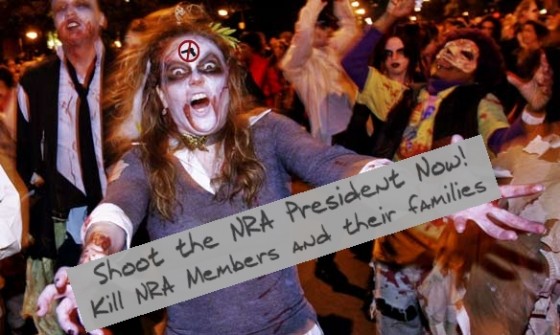
zombies-anti-gun-560x335

Washington Post editorial writer Ruth Marcus gave us a jaw-droppingly arrogant and willfully obtuse lament yesterday. She is in despair. Why would such a sensible, unthreatening gun control measure as the Manchin-Toomey background check amendment fail to pass the Senate? Poor Ruth just can’t understand it. The Senators voting against the bill were so “impervious to logic.” It just didn’t make sense!

What is ruefully amusing and telling about Marcus’s “how dare anyone disagree with us?” rant is that her essay answers its own question.  It is stuffed full of the elements that completely justify Senators or anyone who respects gun-ownership, the Second Amendment and guns opposing any proposals at all that come out of the post-Sandy Hook exploitation campaign by Marcus and her political compadres. It all comes down to trust, Ruth, and you are one of those who is untrustworthy on the topic of guns. Your column proves it, just as President Obama’s petulant outburst of contempt against gun rights absolutists proves his untrustworthiness. Continue reading

A Party Of Portmans, Of Cynics, Of Losers, Or No Party At All

GOP-ButtonThe just released GOP post mortem on the 2012 election is either wishy-washy, cynical, ambiguous or confused, depending on your level of charity. Personally, I would call it useless, as any internal assessment is likely to be when an organization knows that it will be dissected by unfriendly critics and used against them by outright enemies. It is also depressing.

In its essence, the report is about “messaging,” a.k.a marketing, a.k.a. “making people like what you’re peddling by not really letting them know the truth about it.” Undeniably, the Democrats have been better at this in recent years, as passing Obamacare without ever explaining what was in it either to the public or the legislators voting for it, running in 2008 as the tonic for all of George W. Bush’s supposed assaults on human and Constitutional rights and then pretty much adopting all of them and a couple more, like drone strikes, and perhaps most of all, making “transparency” a centerpiece of the 2008 campaign and then delivering a governing style that is anything but. “Messaging” to political parties means “lying” to the so-called “low information voter,” and no doubt about it, the Democrats were better at lying—not necessarily more prolific at it, now, but better—than Republicans in 2012

They must be so proud.

Thus the post mortem lurches between vague appeals to messaging and disturbing assertions that principle and integrity are just too darn risky in 2013 America. For example, the report notes that Republicans were tarred as the party of the rich–hardly a new label, based on those 1920’s political cartoons I have on file, but apparently more Americans don’t like rich people, and would rather be poor people who take the rich people’s money, or something…the report isn’t quite clear on why being rich in America is now somehow a bad thing. The report, therefore, seems to suggest a range of alternatives: Continue reading

“The Walking Dead” Ethics: The Toughest Leadership Dilemma Of All

“Michonne, you’re gone..these are words that Rick choke upon, my Michonne…

“Michonne, you’re gone..these are words that Rick should choke upon, my Michonne…

In the absence of “Homeland,” currently waiting for Claire Danes to get back in shape after becoming a mom, AMC’s “The Walking Dead” is the best ethics show on TV. Apocalypse ethics is instructive and fascinating, because it addresses ethical problems as they were originally considered, before laws, before enforcement methods, and before organized morality. The objective is survival and continuation of the tribe and the species, without abandoning all semblance of humanity.

Yesterday’s episode built to an ethical dilemma of major consequence; naturally, some reviewers thought this was boring. Rick, the former sheriff leading the (mostly) good guys through the zombie-filled wilderness that was once the United States, is trying to protect the group’s refuge, an abandoned prison, from the imminent attack of a larger, better-armed commune run by a deranged psycho who calls himself “the Governor.” A former member of Rick’s group who now consorts (cough!) with the Governor (and who has been rightly condemned as an idiot for doing so, since she either knows or should know that he has the basic instincts of Vlad the Impaler), attempts a mediation to avoid bloodshed, and Rick and the Governor meet to parley. Continue reading

Comment of the Day: Ethics Bob Asks: “Did Torture Lead Us To Bin Laden”? My Answer: “So What If It Did? It Was Still Wrong.”

How did we end up discussing torture on Christmas Eve?

Sorry about that.

timebombHere is a stimulating comment by Zoebrain in the “Zero Dark Thirty” torture thread. I’m especially fond of it, because as theoretical and probably impossible as her resolution would be in practice, it neatly addresses the central problem conflict in the “torture is an absolute wrong but you might have to use it to save the world” scenarios, like the familiar “ticking bomb” hypothetical.  In her analysis. one violates the absolute rule, but accepts a proportional penalty for doing so.

I advocate a similar approach in legal ethics in situations where a lawyer decides as a matter of personal conscience that he or she must violate core legal ethics values, like keeping the confidences of a client, in furtherance of a higher objective not recognized be the Rules of Professional Conduct, such as keeping a serial killer from going free.

Here is Zoebrain’s Comment of the Day on the post, Ethics Bob Asks: “Did Torture Lead Us To Bin Laden”? My Answer: “So What If It Did? It Was Still Wrong.” Continue reading