Mid-Day Ethics Reflections, 6/24/2020: Bombshells Bursting In Air!

Always appropriate, any day, any time…and besides, they tore down the author’s statue. This is his memorial…

1. As for monuments…the Governor of South Dakota,  Kristi Noem, responding to suggestions that Mount Rushmore would soon be on the George Floyd mob’s hit list, said curtly, “Not on my watch.”

It is not so fanciful a notion, since three of the four Presidents on the mountain have had statues toppled, and the fourth, Lincoln, now has his own statue under fire.  The Freedmen’s Memorial Monument to Abraham Lincoln in Boston’s Lincoln Park is targeted by an online petition as is its original, the statue that stands in Washington D.C.’s Lincoln Park. The fact that the statue was commissioned and paid for by freed African-Americans appears to have no importance to the statue-topplers whatsoever.

After all, Facts Don’t Matter.

2. If there is a shark. she will jump it. House Speaker Nancy Pelosi asserted in an interview Tuesday that Republicans are “trying to get away with murder, actually — the murder of George Floyd.” We must remember this when it is determined that the police involved in Floyd’s death can’t get a fair trial because the second highest ranking elected official in the country declared Floyd to be a murder victim before a trial.

A Democratic-run city (for over a half-a century) with a Democratic mayor and and overwhelmingly Democratic City Council (without a single Republican), in a state with a Democratic Governor, oversaw a police department that has been criticized for its conduct long before Floyd’s death, did nothing to remedy the problem, and now faces the consequences.

By what possible distortion of facts and logic can it be argued that Republicans are “trying to get away with murder”?

Once again, another question must be raised: how could CBS News Radio correspondent Steve Futterman, hearing Pelosi’s accusation, not point this out and still presume to be called a journalist? Continue reading

Saturday Ethics Warm-Up, 5/16/2020: The Experts Edition

Hey!

Why aren’t you at the beach?

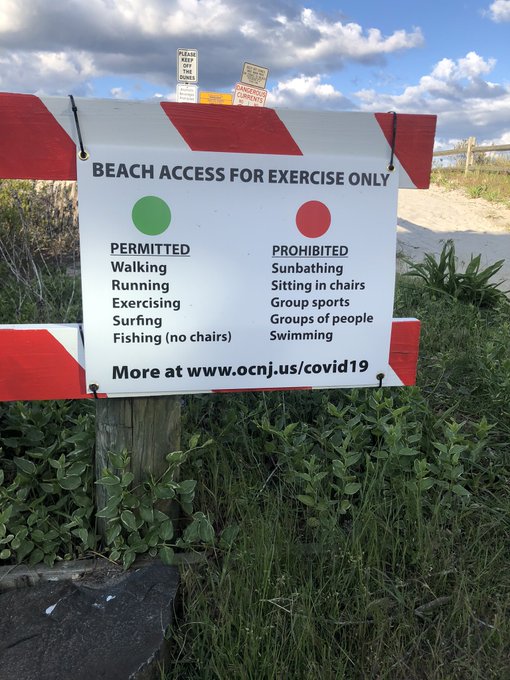
1. One reason: it’s stupid at the beach. Here’s a sign on a beach at Ocean City New Jersey:

Explain that, please. Are you OK as long as you stay on the surfboard, but not permitted to swim if you fall off? Why is a solo sunbather breaching the rules? Sitting in chairs is dangerous, but standing around is not? These kinds of arbitrary restrictions can’t be justified, and will inevitably lead to public distrust and defiance…and ought to.

Here is the obligatory clip from “Bananas” (with Greek subtitles, for some reason):

2. Here’s the “expert” who is imposing dubious restrictions in LA County: Los Angeles County Director of Public Health Dr. Barbara Ferrer, who first told the county’s board of Supervisors that the county’s “Safer at Home” order would  be extended for three more months when it expired yesterday, then extended it with no end date. The reason her opinion should be worshiped without question is…well, I don’t know what.  As I keep trying to explain to my Deranged Facebook friends, you only allow doctors to dictate policy if the only thing the public has to worry about is health, since that’s all doctors care about: if we are reduced to living on roots and berries and living in caves, well, if everyone is healthy, that’s a win from from a doctor’s perspective.

Dr. Ferrer, however, isn’t even a medical doctor. She’s not an expert in virology or epidemiology. She has a Ph.D in  social welfare, making her a Doctor of Wokeness, and also has the degrees Master of Arts in Public Health,  Master of Arts in Education, and Bachelor of Arts in Community Studies.  Based on these credentials, she is paid a half-million dollars a year to tell citizens how they will be allowed to live their lives “for the greater good.” Continue reading

Wuhan Virus Ethics Updates, Part 1

1. Why keep calling it the Wuhan virus? Because the largely successful news media and political correctness assault on the completely legitimate (and non-racist) label continues to bolster Chinese Communist propaganda and blame-shifting, and because the effort emerged as yet another use of Big Lie #4: “Trump Is A Racist/White Supremacist.”

As for me personally, I will keep using the term because I resent being told that what cannot possibly be racist is racist, especially when my capitulation enables similar political correctness bullying. See the Third Niggardly Principle.

2. Because it’s so darn difficult to maintain social distancing while playing tennis... About  200 yards from my home in Alexandria, Virginia, the public tennis courts have their nets removed by another proto-fascist. Yesterday, I saw two people playing on one of the courts using a self-rigged net.  Good for them.

3. The problem is, you can’t force bank employees to come to work. Our bank, a large national chain, has all of its offices closed in this area, Banking is certainly an essential  service, but the fact is that you can’t do banking completely remotely, though the bank is pretending you can. Its website asks for a social security number at the same time as scammers are sending out fake emails that lead you to an authentic-looking clone of the bank’s site so they can steal your personal data. Try to call to clarify or address any problem, and you get a message about how wait times are longer than usual. I’ll say they are: to try to get a fraudulent $4000 charge to our account cancelled, I had to wait for an hour and 40 minutes, then be transferred to wait another 35 minutes, then be cut off when a transfer failed.

Meanwhile, the bank’s on-hold music is played at an unbearable volume, and is an endless loop of some hellish arrangement of a melody that would have been rejected for a theme park ride. I am certain that the recording is designed to make you hang up, or, in the alternative, go crazy and run into the street naked.  It is exactly like the deliberately uncomfortable seats and garish color schemes fast food outlets use to ensure you vacate the premises the second you finish eating. I swear that there cannot be a single person on the globe who would find this music anything but torture. The genre is “loud, abrasive, repetitious semi-music,” and there is no market for that. It makes hip-hop seem like Chopin.

Banks are essential, and rather than stopping stores from selling “non-essential” items, the government ought to require really essential services to have open outlets to serve depositors and bank customers experiencing their own emergencies. If a 7-11 clerk can come to work, so can a bank employee. Banks have my property within their control, and in exchange for the privilege, they are obligated to respond when I need service related to that money. Continue reading

When Ethics Alarms Don’t Ring Because You Never Were Taught About Nazi Germany

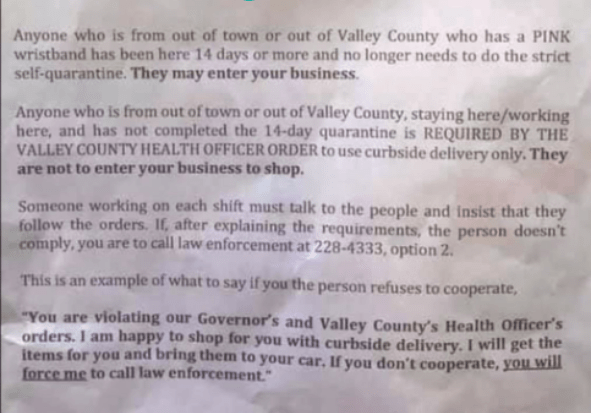
In Montana, the Valley County Health Department sent out a flier to businesses decreeing that all essential workers from outside the county must wear pink armbands or bracelets signifying their quarantine status in order to shop in the county. Anyone not wearing a pink armband, the flyer said, would be reported to police.

If that graphic is too blurry for you, it reads in part,

Anyone who is from out of town or out of Valley County who has a PINK wristband has been here 14 days or more and no longer needs to do the strict self-quarantine. They may enter your business. Anyone who is from out of town or out of Valley County, staying here/working here, and has not completed the 14 day quarantine is REQUIRED BY THE VALLEY COUNTY HEALTH OFFICER ORDER to use curbside delivery only. They are not to enter your business to shop.

Boy, that reminds me of something. What is it? It’s right on the tip of my tongue…something to do with..is it the Holocaust? Could that be it? No, it can’t be. No health department would be that stupid, would it? Especially when mayors and governors around the country are being accused of having a “Who’s the best dictator?” competition? Would it? Really?

Here’s the Nazi badge code, in case you can’t read German: Continue reading

No, The President Isn’t A Dictator, But Given The Opportunity, These Elected Officials Might Be

There are many ironies and contradictions in the various government reactions to the Wuhan virus, some quite yummy, like the municipalities that had banned plastic bags that are now forced to ban the re-usable kind, and demand the use of the plastic once again. Some day, when this is all over, we can sit around and laugh about it all.

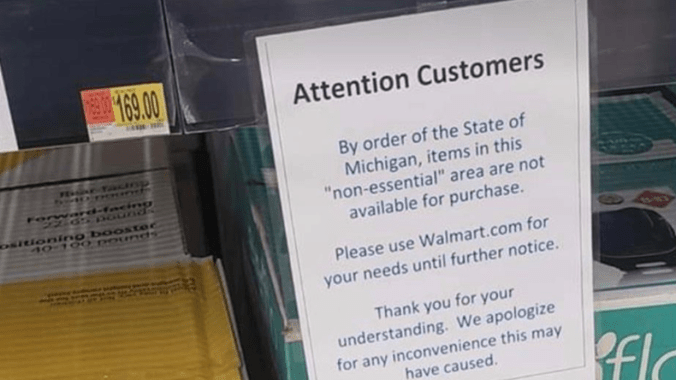
This development, however, is not funny: a frightening number of governors, mayors and police officers have demonstrated how much of our democracy is currently entrusted to nascent totalitarians. I know, I know: to protect the public in a unique crisis, extraordinary measures must be taken, and because so many in our democracy don’t really possess the intelligence and sense of social responsibility that the Founders, in their idealistic fervor, decided to pretend they had (much less the common sense of the average meerkat), sometimes those measures must be accompanied by the force of law. However, because it is a democracy and one that begins with wariness of governments infringing on personal liberties, and will end with our governments being supported when they decided those liberties can be ignored on a whim and a hunch, the recent gusto with which elected officials and their police forces have felt justified in crushing those liberties are warnings that responsible citizens must not let go unpunished. I wrote about one example here, regarding Vermont’s governor’s move to stop the big box stores from selling items Maple Syrup big Brother considers “non-essential.” There are more.

Ethics Alarms already covered the father taken away in handcuffs for playing T-ball on on otherwise empty field with his wife and 6-year-old child, but the Philadephia police pulling  people off  buses for not wearing masks, or the aspiring fascist officer  who tried to  chase down single jogger on an empty beach initially escaped my attention. There are so many examples, you see. Continue reading

Distance Learning Ethics: A Student Shows A Gun From His Home, And The School Freaks Out

“Look, Mom! Billy has a cool crossbow!”

In the first weeks of compelled distance learning in many school districts, schools encountered many issued that should have been anticipated but were not.

One student at Montgomery County, Maryland’s Albert Einstein High School horrified officials—I haven’t been able to determine what the students thought–by showing a gun. The gun was legally purchased’ the gun wasn’t loaded. No threats were made. Nonetheless , the school seemed to think that it had authority and leave to take action.

Montgomery County Public Schools Spokesperson Gboyinde Onijala told local news media that the school system is not going to tolerate anything online they wouldn’t allow in the classroom.

“For any student of ours who thinks, ‘Oh because it’s online learning, there aren’t disciplinary actions they can take,’ and they actually have that wrong. And as we spelled out very clearly to our message to the community this morning,” said Onijala. Indeed, now the school system says it will be taking disciplinary action, though Montgomery County Police announced that they did not charge the 17-year-old  who displayed the weapon.

Gee, that’s comforting. Thanks, Big Brother! Exactly what would the police charge the student with? I don’t think the school has any basis to discipline the student either, and if I was the student’s parent, I would not accept any punishment at all from that source, or the police, of course. The option of punishments would be mine, because the offense occurred on my turf, the offense being  handling my gun. Continue reading

Sunday Morning Alarms, 4/5/2020: After The First Two Items, You Won’t Want To Read Any More And Will Just Go Back To Bed…

….like I did…

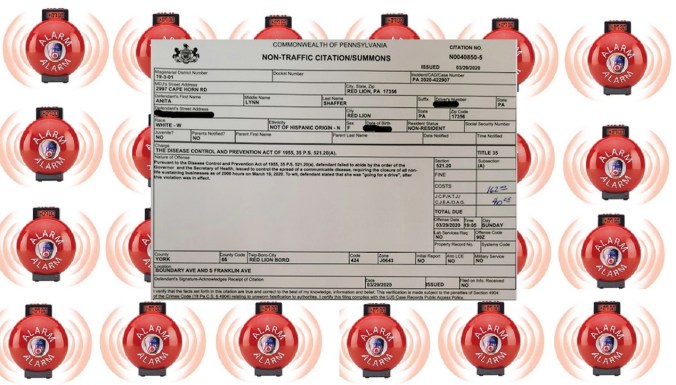
1. KABOOM! Pennsylvanian Anita Shaffer, 19, decided to flee her York County home  a week ago for a mental health drive.  On her way back home, two Pennsylvania State Police officers stopped her about her car’s faulty tail-light. While talking with the officers,  Shaffer told them that she was just “going for a drive.” In response, they wrote her a ticket for more than $202.25 for violating the Pennsylvania Governor Tom Wolf’s stay-at-home order.

That’s the citation above. It says Shaffer “failed to abide by the order of the governor and secretary of health issued to control the spread of a communicable disease, requiring the closure of all non-life-sustaining businesses as of 20:00 hours on March 19, 2020. To wit, defendant states that she was ‘going for a drive’ after this violation was in effect,”

State police spokesman Ryan Tarkowski explained the ticket, saying, “Troopers have been encouraged to use contacts with the public as opportunities to reinforce the necessity to abide by stay-at-home orders.”

And how, exactly, does ticketing an individual who is engaged in conduct that cannot possibly infect anyone  accomplish  that?

Well, Tarkowski blathered,  being a soulless bureaucrat incapable of admitting that THE STATE is full of it in this case, “Troopers maintain discretion to warn or issue citations and the decision is specific to the facts and circumstances of a particular encounter.”

Fine. These facts do not justify a ticket by any stretch of the imagination. The officers’ discretion shows they are not qualified to wield the power they have. Indeed, the citation magnifies the extreme arbitrariness of such orders, and their danger when those charged with enforcing them have the judgment of Gestapo officers.

I’m surprised the cops didn’t slap her around a little, shoot her in the kneecap or even rape her, you know, to show the defiant prole who’s boss and not to ever, ever defy Big Brother.

Tarkowski also said Shaffer’s citation is the only one issued for violating the stay-at-home order. It’s good that the police picked a representative one to symbolize the Pennsyvania message to it’s citizens, which is apparently, “You will do as you are told, underlings.”

Well, not to be crude, but screw that.

Shaffer told reporters  she was within her rights to operate her car, and plans on challenging the citation.  Good. And again I ask, where is our vaunted American Civil Liberty Union on this issue? For three years, we have been hearing false cries of outrage about how the President is an autocrat just waiting to crush our civil rights, and now, when the civil rights of citizens are being ignored by tin pot governors all over the country, the ACLU just shrugs and sighs in its bunker, “It’s for the greater good.”

Oh..there was nothing wrong with her tail light. Continue reading

Vermont Crosses The Line: When Government Is Cavalier About Restricting Our Liberty, It’s Time To Push Back

Right wing pundit Sarah Hoyt has been at the forefront of those arguing that it would be better and safer to accept the risk  of more deaths from the Wuhan virus than to allow state governments to behave like police states. So far, I have thought she was wrong and unduly paranoid, but Vermont’s latest action has me agreeing with her response, which was, “I’M SORRY. ARE THE PEOPLE OF VERMONT ALL OUT OF MIDDLE FINGERS?”

From the Burlington Free-Press (Bernie Sanders was once mayor of Burlington. That’s just something to keep in the back of your mind, as this episode suggests the slow but deadly spread of the Totalitarian Left Virus, which may eventually need to be called “the Burlington Virus”):

Large Vermont retailers such as Target, Walmart and Costco are now required to limit the sales of non-essential items in order to mitigate the spread of COVID-19. The directive was announced by the Agency of Commerce and Community Development on Tuesday. The agency hopes it will reduce the overall number of people going into stores to purchase items such as clothing, electronics and toys during the state’s “Stay Home, Stay Safe” executive order.

“Large ‘big box’ retailers generate significant shopping traffic by virtue of their size and the variety of goods offered in a single location,” said Lindsay Kurrle, secretary of the Agency of Commerce and Community Development in a news release.  “This volume of shopping traffic significantly increases the risk of further spread of this dangerous virus to Vermonters and the viability of Vermont’s health care system.”

Retailers are being asked to promote online ordering, delivery and curbside pickup to customers….

The order is here. Continue reading

Written Statement of Prof. Jonathan Turley: “The Impeachment Inquiry Into President Donald J. Trump: The Constitutional Basis For Presidential Impeachment” [PART V]

Note the date…

In his final section before concluding, Professor Turley covers other theories being floated as justification for impeachment, and finds them startlingly weak and contrived.

The Hill has Turley’s lament regarding the  the Alliance of Unethical Conduct’s attacks on his thorough and objective dismantling of their coup efforts. (The AUC—that’s the Ethics Alarm shorthand for the Democratic Party-“resistance”-mainstream media alliance to remove Trump from office by any means possible, not Turley’s.)  He writes,

Despite 52 pages of my detailed testimony, more than twice the length of all the other witnesses combined, on the cases and history of impeachment, [Washington Post columnist Dana Milbank] described it as being “primarily emotional and political.” Milbank claimed that I contradicted my testimony in a 2013 hearing when I presented “exactly the opposite case against President Obama” by saying “it would be ‘very dangerous’ to the balance of powers not to hold Obama accountable for assuming powers ‘very similar’ to the ‘right of the king’ to essentially stand above the law.”

But I was not speaking of an impeachment then. It was a discussion of the separation of powers and the need for Congress to fight against unilateral executive actions, the very issue that Democrats raise against Trump. I did not call for Obama to be impeached….

In my testimony Wednesday, I stated repeatedly [as I stated in my testimony during the Clinton impeachment] that a president can be impeached for noncriminal acts…. My objection is not that you cannot impeach Trump for abuse of power but that this record is comparably thin compared to past impeachments…. … Democrats have argued that they do not actually have to prove the elements of crimes…. In the Clinton impeachment, the crime was clearly established and widely recognized…. [W]e are lowering impeachment standards to fit a paucity of evidence and an abundance of anger…. 

Writes Ann Althouse in a post yesterday, “it seems to me that the real impeachable offense has always been that Donald Trump got himself elected.”

I wish Prof. Turley had dealt with that, the real justification, in their minds, for the House’s impeachment push.

Back to the professor:

C.  Extortion.

 As noted earlier, extortion and bribery cases share a common law lineage. Under laws like the Hobbs Act, prosecutors can allege different forms of extortion. The classic form of extortion is coercive extortion to secure property “by violence, force, or fear.”85 Even if one were to claim the loss of military aid could instill fear in a country, that is obviously not a case of coercive extortion as that crime has previously been defined.

Instead, it would presumably be alleged as extortion “under color of official right.” Clearly, both forms of extortion have a coercive element, but the suggestion is that Trump was “trying to extort” the Ukrainians by withholding aid until they agreed to open investigations. The problem is that this allegation is no closer to the actual crime of extortion than it is to its close cousin bribery. The Hobbs Act defines extortion as “the obtaining of property from another, with his consent, induced by wrongful use of actual or threatened force, violence, or fear or under color of official right.”87

As shown in cases like United States v. Silver, extortion is subject to the same limiting definition as bribery and resulted in a similar overturning of convictions. Another obvious threshold problem is defining an investigation into alleged corruption as “property.” Blackstone described a broad definition of extortion in early English law as “an abuse of public, justice which consists in an officer’s unlawfully taking, by colour of his office, from any man, any money or thing of value, that is not due him, or more than is due, or before it is due.”89 The use of anything “of value” today would be instantly rejected. Extortion cases involve tangible property, not possible political advantage.90 In this case, Trump asked for cooperation with the Justice Department in its investigation into the origins of the FBI investigation on the 2016 election. As noted before, that would make a poor basis for any criminal or impeachment theory. The Biden investigation may have tangible political benefits, but it is not a form of property. Indeed, Trump did not know when such an investigation would be completed or what it might find. Thus, the request was for an investigation that might not even benefit Trump.

The theory advanced for impeachment bears a close similarity to one of the extortion theories in United States v. Blagojevich where the Seventh Circuit overturned an extortion conviction based on the Governor of Illinois, Rod Blagojevich, pressuring then Sen. Barack Obama to make him a cabinet member or help arrange for a high- paying job in exchange for Blagojevich appointing a friend of Obama’s to a vacant Senate seat. The prosecutors argued such a favor was property for the purposes of extortion. The court dismissed the notion, stating “The President-elect did not have aproperty interest in any Cabinet job, so an attempt to get him to appoint a particular person to the Cabinet is not an attempt to secure ‘property’ from the President (or the citizenry at large).” In the recent hearings, witnesses spoke of the desire for “deliverables” sought with the aid. Whatever those “deliverables” may have been, they were not property as defined for the purposes of extortion any more than the “logrolling” rejected in Blagojevich.

There is one other aspect of the Blagojevich opinion worth noting. As I discussed earlier, the fact that the military aid was required to be obligated by the end of September weakens the allegation of bribery. Witnesses called before the House Intelligence Committee testified that delays were common, but that aid had to be released by September 30th. It was released on September 11th. The ability to deny the aid, or to even withhold it past September 30th is questionable and could have been challenged in court. The status of the funds also undermines the expansive claims on what constitutes an “official right” or “property”:

“The indictment charged Blagojevich with the ‘color of official right’ version of extortion, but none of the evidence suggests that Blagojevich claimed to have an ‘official right’ to a job in the Cabinet. He did have an ‘official right’ to appoint a new Senator, but unless a position in the Cabinet is ‘property’ from the President’s perspective, then seeking it does not amount to extortion. Yet a political office belongs to the people, not to the incumbent (or to someone hankering after the position). Cleveland v. United States, 531 U.S. 12 (2000), holds that state and municipal licenses, and similar documents, are not ‘property’ in the hands of a  public  agency. That’s equally true of public positions. The President-elect did not have a property interest in any Cabinet job, so an attempt to get him to appoint a particular person to the Cabinet is not an attempt to secure ‘property’ from the President (or the citizenry at large).”

A request for an investigation in another country or the release of money already authorized for Ukraine are even more far afield from the property concepts addressed by the Seventh Circuit.

The obvious flaws in the extortion theory were also made plain by the Supreme Court in Sekhar v. United States, where the defendant sent emails threatening to reveal embarrassing personal information to the New York State Comptroller’s general counsel in order to secure the investment of pension funds with the defendant. In an argument analogous to the current claims, the prosecutors suggested political or administrative support was a form of intangible property. As in McDonnell, the Court was unanimous in rejecting the “absurd” definition of property. The Court was highly dismissive of such convenient linguistic arguments and noted that “shifting and imprecise characterization of

the alleged property at issue betrays the weakness of its case.”94 It concluded that “[a]dopting the Government’s theory here would not only make nonsense of words; it would collapse the longstanding distinction between extortion and coercion and ignore Congress’s choice to penalize one but not the other. That we cannot do.”95 Nor should Congress. Much like such expansive interpretations would be “absurd” for citizens in criminal cases, it would be equally absurd in impeachment cases.

To define a request of this kind as extortion would again convert much of politics into a criminal enterprise. Indeed, much of politics is the leveraging of aid or subsidies or grants for votes and support. In Blagojevich, the court dismissed such “logrolling” as the basis for extortion since it is “a common exercise.” If anything of political value is now the subject of the Hobbs Act, the challenge in Washington would not be defining what extortion is, but what it is not.

D.  Campaign Finance Violation

Some individuals have claimed that the request for investigations also constitutes a felony violation of the election finance laws. Given the clear language of that law and the controlling case law, there are no good-faith grounds for such an argument. To put it simply, this dog won’t hunt as either a criminal or impeachment matter. U.S.C. section 30121 of Title 52 states: “It shall be unlawful for a foreign national, directly or indirectly, to make a contribution or donation of money or other thing of value, or to make an express or implied promise to make a contribution or donation, in connection with a federal, state, or local election.”

On first blush, federal election laws would seem to offer more flexibility to the House since the Federal Election Commission has adopted a broad interpretation of what can constitute a “thing of value” as a contribution. The Commission states “’Anything of value’ includes all ‘in-kind contributions,’ defined as ‘the provision of any goods or services without charge or at a charge that is less than the usual and normal charge for such goods or services.’” However, the Justice Department already reviewed the call and correctly concluded it was not a federal election violation. This determination was made by the prosecutors who make the decisions on whether to bring such cases. The Justice Department concluded that the call did not involve a request for a “thing of value” under the federal law. Congress would be alleging a crime that has been declared not to be a crime by career prosecutors. Such a decision would highlight the danger of claiming criminal acts, while insisting that impeachment does not require actual crimes. The “close enough for impeachment” argument will only undermine the legitimacy of the impeachment process, particularly if dependent on an election fraud allegation that itself is based on a demonstrably slipshod theory. Continue reading

Laws Aren’t Enough: Compassion, Prudence, Proportion And The Golden Rule Must Also Be In The Equation

Here is a cautionary tale out of Great Britain,  whose ethics comprehension appears to have gone into a tailspin.

In Manchester, England about a year ago, Jamie Griffiths , then a 19-year-old male student, reached out and  touched a 17-year-old female classmate’s arm while they were both walking along a city street during the day. Jamie explained to police, which the young woman contacted because of the incident, that he had just wanted to get her attention, introduce himself, and maybe “make a friend.”

Instead, the woman claims, the spontaneous encounter quickly spiraled out of control. As she told the court, according to The Manchester Evening News,

“I was just set on getting home and [reviewing] for my mock exams, but as I was coming over the bridge I saw him facing a hedge and I thought it was really weird. He wasn’t doing anything. He was just facing the hedge, staring at it. As I walked towards him, I was watching him and he suddenly swung round so he was facing me. I remember it happening fast. As soon as he moved, I moved, and I said: ‘stop’ and he touched me on my arm. I sort of jolted out of the way and I went into the road to avoid him and he very quickly walked away…I forgot about it for a while because I had my exams. I just thought it was weird behavior.” She went to the police and reported the episode. Then there was a second. This time, the 17-year-old was was walking to school when Griffiths walked in front of her and touched her side, staying in contact, she said, for about three seconds. “He smirked at me, he didn’t stop, he just touched me and walked off and I broke down crying in the street—it was quite traumatic.”

She and her mother filed a crime report. The student was traumatized by the encounters, she says. “Every time I started working I would cry because I would think of it. I felt very unsafe, even in my own home.”

A magistrate convicted Jamie Griffiths of two charges of sexual assault, accepting the young woman’s assessment that there was “no doubt” that had she not moved away from him that first time he touched her arm, he would have gone on to touch her breast. “The complainant’s evidence was very clear, logical and without embellishment,” the magistrate told the defendant. “We can think of no motivation for you to touch the victim other than sexual. Had she not taken evasive action the assault was likely to have been even more serious.” Continue reading